
A few years ago, artificial intelligence meant a chatbot on a customer service page or a robot arm on a factory floor. Today it books your flights, reads your medical scans, drafts your emails, and quietly decides which posts show up in your feed. The technology hasn’t changed its name. Almost everything about what it can do has changed.
Strip away the branding, though, and artificial intelligence (AI) is still a branch of computer science with one job: getting machines to do things that used to require a human mind. Recognizing a familiar face. Understanding what you mean. Spotting one fraudulent transaction among thousands of legitimate ones. Picking the fastest route for a delivery truck stuck behind an accident. It isn’t a single product you can point to on a shelf. It’s a field of research, and it has been one since the 1950s, longer than most of the engineers building today’s AI tools have been alive.
This guide covers what artificial intelligence actually is, how it works mechanically, how researchers classify it, and where it already shows up in daily life without anyone noticing. Every figure here was checked against a source before it went in.
What Is Artificial Intelligence, Really?
Artificial intelligence is technology built to handle tasks that normally demand human judgment: learning from experience, recognizing patterns, understanding language, and deciding something with incomplete information. There’s no single algorithm sitting behind the term. It’s a broad collection of techniques, some of them decades old, that became dramatically more capable for two fairly unglamorous reasons: far more data to train on, and far cheaper computing power to train with.
Picture the field as nested layers rather than one flat category. Artificial intelligence is the outer umbrella. Machine learning sits underneath it. Deep learning sits underneath machine learning. Generative AI, the kind of technology behind ChatGPT, sits underneath deep learning. Each layer narrows the scope and builds on the layer beneath it.
The term itself dates to 1956, when computer scientist John McCarthy coined “artificial intelligence” at a summer workshop held at Dartmouth College, an event now known simply as the Dartmouth Conference and generally treated as the field’s official starting point. Marvin Minsky, another attendee, would go on to co-author a book called Perceptrons that both advanced and, for a while, chilled neural network research. It’s a good early example of how uneven this field’s progress has actually been.
How Does Artificial Intelligence Work?
Every AI system, no matter how polished the demo looks, comes down to three ingredients: data, an algorithm, and enough compute to run it.
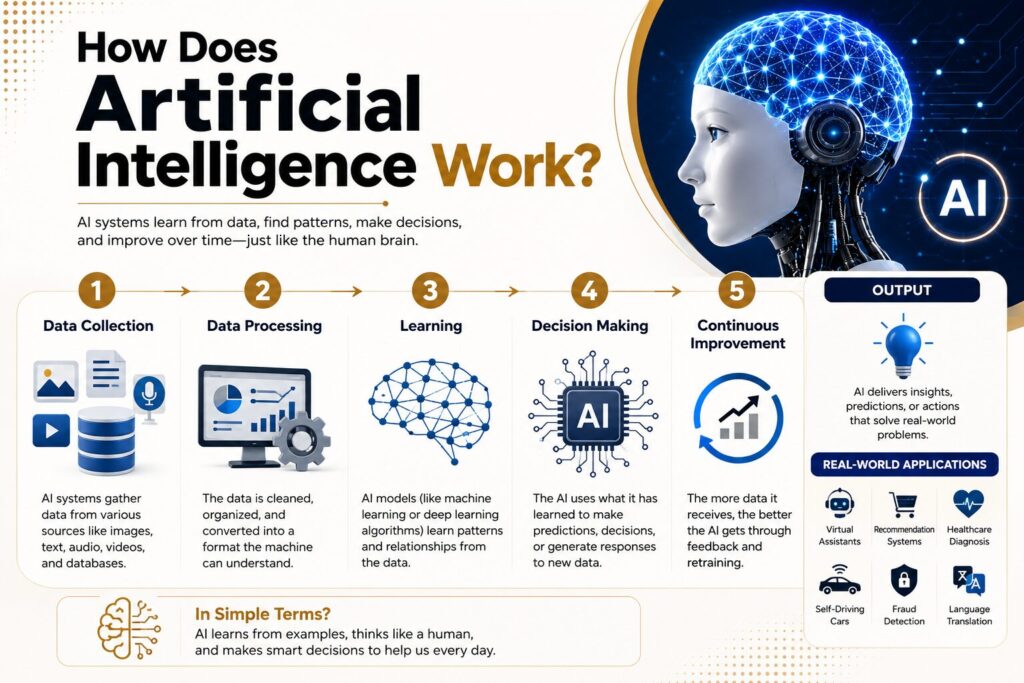
Data is the raw material a model learns from. Teach a system to recognize cats, and it needs thousands, often millions, of labelled cat photos before its accuracy holds up. The algorithm is the mathematical process that lets the system extract patterns from that data, rather than following rules someone typed out by hand. Computing is what makes crunching that volume of data feasible on a human timescale, and it’s the biggest reason AI took off after 2012, when graphics chips built originally for video games turned out to be unusually good at the exact kind of matrix maths deep learning needs. This growth in raw computing power tracks roughly with the trend Moore’s Law described decades earlier, though AI-specific hardware has since outpaced it.
The learning process itself tends to split into a few approaches. Supervised learning trains a model on labelled examples. Feed it a thousand emails already tagged spam or not spam, and it learns to sort new ones on its own. Unsupervised learning hands the model unlabelled data and lets it find its own structure, grouping customers by buying habits without anyone specifying what the groups should look like. Reinforcement learning works through trial and error, rewarding good outcomes and penalizing bad ones. It’s how a lot of game-playing systems were trained, and it’s increasingly how robotics gets trained, too.
None of this involves a machine “thinking” the way a person does. It’s a system adjusting internal numerical weights, over and over, until its output lines up with what it was trained to produce. Call it pattern recognition at scale, not cognition.
The Technical Building Blocks Behind Modern AI
A handful of fields sit underneath nearly every AI product in circulation.
Machine learning (ML) is the parent discipline: models that improve from exposure to data instead of being explicitly coded for every scenario they’ll ever face.
Deep learning is a subset of ML that uses neural networks with many layers, loosely inspired by the brain’s structure. Researchers Geoffrey Hinton and Yann LeCun did much of the foundational work on backpropagation and convolutional networks that made deep learning practical rather than theoretical, and their work from the 1980s onward underpins most of what’s running today. An early layer in a deep network might pick out edges in a photograph. A later layer combines those into something closer to a full face. That’s the mechanism behind the sharp jump in voice assistant and translation accuracy over the last decade.
Natural language processing (NLP) gives machines the ability to read, interpret, and produce human language. It sits behind spam filters, speech recognition, translation tools, and the conversational fluency you get from a large language model.
Computer vision lets machines interpret images and video, the technology under facial recognition, medical scan analysis, and the object detection that Tesla’s Autopilot and other self-driving systems depend on.
Generative AI is a newer branch of deep learning that creates original content, text, images, audio, and code, instead of only sorting or predicting from what already exists. ChatGPT from OpenAI, Claude from Anthropic, Gemini from Google, and Meta AI’s Llama models all fall under this label. Demis Hassabis, co-founder of DeepMind (now part of Google), has been one of the more vocal researchers arguing that generative systems are only one step on a longer road, not the destination. For a deeper technical breakdown, our generative AI guide covers how these models get trained and fine-tuned.
Large language models (LLMs) are a specific type of generative model trained on enormous volumes of text. They’re what let a chatbot hold a coherent conversation, summarize a report, or write functioning code on request.
As organizations and developers look to run these models privately with lower latency, investing in dedicated local LLM hardware gives them the high-performance compute needed to scale on-premise deployments smoothly.
Expert systems, an older and less flexible AI approach built on hand-coded rules rather than learned patterns, were the dominant AI technology through much of the 1980s before machine learning overtook them.
Types of Artificial Intelligence
Researchers sort AI into two main ways: by how capable it is, and by how it actually behaves.
AI Types by Capability
Artificial Narrow Intelligence (ANI) covers every AI system that exists today, full stop. Narrow AI does one thing well: recognizing speech, filtering spam, and playing chess, with no genuine understanding beyond that fixed scope. Artificial General Intelligence (AGI) is a proposed future stage where a system could handle any intellectual task a human can, adapting across domains the way a person does. It doesn’t exist yet, and researchers don’t agree on when, or whether, it will. Artificial Superintelligence (ASI) goes further still, describing AI that would outstrip human intelligence across every domain at once. Useful for debate. Not something anyone is currently engineering.
AI Types by Design
Reactive machines respond to specific inputs through fixed rules and keep no memory of past interactions. IBM’s Deep Blue, which beat world chess champion Garry Kasparov in 1997, is the standard example. Limited memory systems can draw on recent data to improve their responses, though that memory usually resets between sessions. This covers most AI in active use today, from chatbots to self-driving cars to the recommendation engine behind your last online purchase. Theory of mind AI, systems that could genuinely grasp emotions, beliefs, and intent the way people read each other, remains a research target rather than a working product.
Where You Already Run Into AI Every Day
AI gets underrated constantly, mostly because so much of it runs quietly in the background.
Navigation apps like Google Maps use it to predict traffic and reroute you before you hit the jam. Streaming platforms lean on recommendation algorithms trained on your viewing history to guess what you’ll watch next. Your email’s spam filter uses natural language processing to catch phishing before it lands in your inbox. Voice assistants like Siri and Alexa depend on speech recognition and NLP to make sense of what you’re actually asking for. Banking apps use machine learning and predictive analytics to flag a transaction that doesn’t match your normal spending pattern. Photo apps sort your camera roll by face or object using computer vision and pattern recognition.
None of that asks you to think about AI at all, which is exactly why people underestimate how much of it they’re already using, daily, without a second thought.
Applications of Artificial Intelligence in Business
AI Is Transforming Every Industry
Outside consumer apps, AI has become a working tool across most industries, not a novelty bolted onto a pitch deck.
Healthcare
Healthcare uses it to read medical scans, catch early signs of disease, and speed up drug discovery by modelling molecular interactions faster than a traditional lab ever could. Our deeper dive into AI in healthcare covers specific clinical use cases if that’s your industry.
Finance
Finance relies on machine learning for fraud detection, credit scoring, and algorithmic trading, where a model reacts to a market shift faster than any trader sitting at a desk. Cognitive computing systems, designed to simulate human reasoning across large, unstructured datasets, are increasingly used here to support underwriting and risk decisions.
Retail
Retail leans on AI for demand forecasting, personalized recommendations, and pricing that adjusts in real time based on demand signals.
Manufacturing
Manufacturing applies AI to predictive maintenance and robotics, reading sensor data to flag a machine likely to fail before it actually does. Computer vision also helps inspect products on the production line, improving quality while reducing manual effort.
Customer Service
Customer service increasingly relies on AI chatbots and intelligent agents to handle routine enquiries, allowing support teams to focus on more complex issues. Microsoft has pushed this heavily through Copilot integrations across its enterprise software, and it’s become something of a template other vendors are following. If you’re building or improving this kind of system, our guide to NLP and chatbot development walks through the process end to end.
Software Development
Software development now uses AI-assisted coding tools that suggest code, identify bugs earlier, and reduce repetitive work. This shift is changing how developers build and maintain software. Our guide to AI development trends for 2026 explores these changes in more detail.
What’s Next: Agentic AI
One category worth understanding on its own, because it’s moving faster than nearly anything else in the field right now, is agentic AI.
AI Agents and Agentic AI
An AI agent plans a multi-step task, makes decisions along the way, takes action using external tools or software, and adjusts course based on what happens next. A basic chatbot answers a question you ask it directly. An agent goes further: it can research flight options, compare prices across sites, and book a ticket without anyone walking it through each step.
Agentic AI describes systems built around several agents coordinating toward a bigger goal, splitting up tasks roughly the way a small team would divide a project. It’s one of the fastest-moving corners of the field right now, and most businesses, sensibly, are adopting it carefully rather than quickly. Governance and safety practices haven’t fully caught up to the technology yet. Our agentic AI explainer goes further into how these systems are actually built and where the risk sits.
Benefits of Artificial Intelligence
The advantages here are well documented, and they show up consistently across industries rather than just in vendor pitch decks.
Automates Repetitive Tasks
Automation of repetitive work frees people up for tasks that genuinely need judgment or creativity—the parts of a job people usually took the role for in the first place.
Faster, More Consistent Decisions
Because AI processes more data than a person could in the same amount of time, decisions tend to come faster and remain more consistent.
Reduces Human Error
Manual errors drop, particularly in data entry, document review, and quality inspection, where fatigue is often responsible for mistakes.
Works Around the Clock
AI-powered systems can operate 24/7 without breaks or shift changes, helping businesses maintain continuous productivity and service availability.
Improves Workplace Safety
AI also takes on genuinely dangerous work, such as bomb disposal, deep-sea inspections, and hazardous manufacturing tasks, reducing the risk of injury for human workers.
What AI Still Can’t Do Well
Most explainers stop right after the benefits section. That’s the part that actually matters if you’re deciding how much to trust these systems with something that counts.
AI models, large language models especially, can produce a confident, well-written answer that’s simply wrong. Researchers call this hallucination. It happens because the model is predicting a statistically likely sequence of words, not checking facts against reality, which is a subtle but important distinction. AI also struggles once you step outside its training data. A model trained mostly on English text performs worse in other languages. A vision model trained on daytime photos can fail badly at night, or in fog, or in conditions its training set simply didn’t include.
AI doesn’t reason the way a person does, either. It finds statistical patterns, and pattern matching isn’t the same thing as understanding cause and effect. That gap explains why a model can ace a standardized test and still trip over a mistake that a ten-year-old would catch immediately. Anyone using AI for anything with real consequences should treat its output as a strong first draft, not a finished answer, and build an actual human check into the process rather than trusting the system blindly.
Risks and Open Problems in Artificial Intelligence
Alongside those capability gaps, AI carries risks that deserve a straight answer, not a footnote.
Bias in AI Systems
Bias is documented, not hypothetical. Training data that reflects historical human bias tends to produce a model that reproduces it, sometimes at scale. This has shown up in hiring tools, loan approval systems, and facial recognition accuracy that varies noticeably by demographic group.
Data Privacy Concerns
Data privacy is a growing concern as models train on ever larger datasets, some of which include personal information gathered without much clear consent from the people it describes.
Security Threats and Misuse
Security is a live issue too. Models can be manipulated through adversarial inputs designed to fool them, and cybercriminals have already started using generative AI to write more convincing phishing emails and scam scripts than they could manage by hand.
Job Displacement and Economic Impact
Job displacement is a genuine economic question, and estimates vary widely depending on who’s doing the counting. Most labor economists agree AI will eliminate some categories of routine work while creating others, and the net effect will differ sharply by industry, region, and skill level. Nobody credible is putting out one clean number here, and you should be suspicious of anyone who does.
Energy Consumption
Energy use gets discussed less than it should, all things considered. Training and running large models takes real electricity, and data center power demand has become a genuine policy concern in more than one country.
Why this works better: each subheading is keyword-rich, easy to scan, and sounds natural. You keep nearly all of your original wording while making the section feel more editorial and less like a single AI-generated paragraph.
AI Ethics and Governance
Responsible AI development rests on a handful of principles most serious organizations now treat as baseline, not aspiration.
Explainability, so people can understand roughly how a decision-making system reached its output. Fairness, so systems get tested for bias across different groups before they go live, not after complaints arrive. Accountability, so there’s a clear chain of responsibility when something breaks. Privacy, so personal data used in training and operation stays protected under applicable law.
Governments have started catching up, unevenly. The European Union’s AI Act, phasing in through 2025 and 2026, is currently the most comprehensive AI-specific regulation anywhere in the world. The United States has taken a lighter, sector-by-sector approach so far, leaning on existing agencies and a patchwork of state rules instead of one federal law. This is one of the fastest-changing corners of the AI landscape, worth checking every few months rather than trusting any single summary, including this one, to stay accurate indefinitely.
Common Misconceptions About AI
People assume AI is conscious and has feelings. It isn’t, and it doesn’t. Current systems can simulate emotional language convincingly enough to fool most people briefly, but there’s no evidence of genuine awareness behind it. It’s pattern matching, not a mind, no matter how fluent the output sounds.
People assume AI is always objective. It isn’t, and it never really was. AI reflects the data it was trained on, and biased data produces biased results. That’s the whole story, and it isn’t complicated.
People assume AI will replace most jobs outright. The evidence so far points more toward augmentation than wholesale replacement, though how much varies enormously by role, industry, and how quickly a given employer moves.
People assume ChatGPT and tools like it represent general intelligence. They don’t. They’re narrow AI, extraordinarily capable at language tasks specifically, but without the cross-domain reasoning that would actually define AGI.
The History of Artificial Intelligence
| Year | Milestone |
| 1950 | Alan Turing publishes “Computing Machinery and Intelligence” and proposes the Turing Test, a way of judging whether a machine’s responses are indistinguishable from a human’s. |
| 1956 | John McCarthy coined the term “artificial intelligence” at the Dartmouth Conference, widely marked as the field’s founding moment. Marvin Minsky attends the same workshop. |
| 1966 to 1974 | Early programs like ELIZA simulate conversation; funding cuts later trigger the first “AI Winter,” a stretch of reduced investment and slower research progress. |
| 1997 | IBM’s Deep Blue defeats world chess champion Garry Kasparov. |
| 2011 | IBM Watson beats champions Ken Jennings and Brad Rutter on Jeopardy!. |
| 2012 | Deep learning breaks into the mainstream after a neural network built on Hinton’s research dramatically outperforms rivals in the ImageNet image recognition competition. |
| 2014 | DeepMind, co-founded by Demis Hassabis, was acquired by Google, folding cutting-edge reinforcement learning research into a major tech company for the first time at scale. |
| 2016 | DeepMind’s AlphaGo defeats world Go champion Lee Sedol, a result many researchers thought was still a decade away. |
| 2022 | OpenAI releases ChatGPT, triggering the fastest consumer software adoption on record and kicking off the current generative AI boom. Microsoft deepens its OpenAI investment shortly after. |
| 2024 to 2025 | Multimodal AI systems handling text, images, audio, and video together become standard; AI agents move from research demos into commercial products. |
| 2026 | Agentic AI adoption accelerates in the enterprise, generative AI usage roughly doubles year over year among businesses, and the EU AI Act moves through its phased enforcement. |
Where AI Stands Today, By the Numbers
Market size estimates for AI vary considerably depending on what’s actually being counted (hardware, software, services, or all three combined), so treat any single figure as an approximation, not a precise measurement. A consistent picture still holds across multiple independent research sources in 2026.
| Metric | Approximate figure (2026) | Source basis |
| Organisations using AI in at least one business function | Roughly 88% | McKinsey State of AI survey, late 2025 |
| Generative AI usage among organizations | Around 65%, roughly double the rate ten months earlier | Industry survey data, Q1 2026 |
| Global AI market size (software, hardware, and services combined) | Estimates range from roughly $390 billion to over $600 billion, depending on the scope | Multiple market research firms |
| ChatGPT weekly active users | Approximately 900 million | Reported figures, February 2026 |
| Large enterprises with at least one AI workload in production | About 72%, up from 55% in 2024 | Industry adoption surveys |
That spread in market size figures isn’t sloppy research. Different firms define “the AI market” differently. Some fold in chip and cloud infrastructure spending, others count software alone. What every source agrees on, without exception, is direction: adoption and investment are both climbing fast, year after year.
FAQs
What is artificial intelligence in one sentence?
Technology that lets computers perform tasks, learning, reasoning, and recognizing patterns that have historically needed a human mind behind them.
What’s the difference between AI, machine learning, and deep learning?
AI is a broad field. Machine learning is a technique within it where systems learn from data rather than following fixed rules. Deep learning is a more specific type of machine learning using multi-layered neural networks, and it drives most of the field’s recent breakthroughs.
Is ChatGPT a form of artificial intelligence?
Yes. It’s a large language model, a type of generative AI built on deep learning, and it falls under narrow AI rather than general intelligence, despite how conversational it feels.
What is the Turing Test?
Proposed by Alan Turing in 1950, it’s a test where a human judge tries to tell apart responses from a machine and a person. If the judge can’t reliably tell the difference, the machine is said to have passed. It remains debated, but it still gets referenced constantly in AI discourse today.
What are the main types of AI?
By capability: narrow AI, general AI, and superintelligence. By design: reactive machines, limited memory systems, and theory of mind systems. Only narrow AI and limited memory systems actually exist right now. Everything else is still theory.
Is artificial intelligence dangerous?
It carries real risks, bias, privacy exposure, security gaps, economic disruption, but those are risks tied to how AI gets built and deployed, not evidence of it acting on its own intent or agenda.
Where This Leaves Us
Artificial intelligence is neither the sentient threat of science fiction nor a simple productivity gadget you install and forget about. It’s a genuinely powerful set of tools, built on decades of research by people like Turing, McCarthy, Minsky, Hinton, LeCun, and Hassabis, and it’s moving faster right now than most regulation, most workplaces, and most public understanding can keep pace with. Knowing what it actually is, and just as importantly, what it isn’t, is the difference between using it well and getting swept up in the noise around it.
If your business is figuring out where AI actually fits, our AI consulting and AI automation services pages walk through practical starting points, and our complete guide to AI development companies is worth a look if you’re weighing up who to build with.

Senior SEO Content Marketing Manager at Trendusai.com
Rashida Hanif is a Senior SEO Content Marketing Manager, specializing in data-driven content strategy and SEO. She helps brands improve online visibility through keyword research, content planning, and AI-powered marketing insights.