Something significant shifted in artificial intelligence at the close of 2025, and most people missed it. The conversation moved from “what can AI generate?” to “what can AI do, decide, and execute on its own?” That question now has an institutional answer. The Agentic AI Foundation (AAIF), launched in December 2025 under the Linux Foundation, is the organized response from the world’s most powerful technology companies to a simple but urgent problem: autonomous AI agents need open, shared infrastructure to grow responsibly.
This is not another incremental product release. It is a structural moment in the history of artificial intelligence — comparable to when Linux brought open governance to operating systems, or when Kubernetes standardized the way software runs in the cloud. The agentic AI foundation news coming out of 2026 signals that the industry is no longer experimenting with AI agents in isolation. It is building the roads on which those agents will travel permanently.
Here are the 7 key updates every developer, enterprise leader, and informed observer needs to understand.
1. The Agentic AI Foundation Launches Under the Linux Foundation
On December 9, 2025, the Linux Foundation announced the formation of the Agentic AI Foundation (AAIF) — a neutral, open-source consortium co-founded by Anthropic, OpenAI, and Block, the company behind Square and Cash App. Supporting members at the platinum tier include Amazon Web Services, Google, Microsoft, Bloomberg, and Cloudflare.
The AAIF’s mission is direct: to ensure that agentic AI develops transparently and without fragmentation into incompatible proprietary systems.
Why the Linux Foundation specifically? Because it has done this before. Linux itself proved that critical technology infrastructure is more stable and more trusted when no single company controls it. Kubernetes proved it for cloud infrastructure. The AAIF is making the same argument for AI agents, and the founding members are conceding something significant in service of that goal: they are giving up exclusive control of their own tools so the ecosystem can benefit collectively.
Jim Zemlin, Executive Director of the Linux Foundation, stated that within one year, the foundation’s inaugural projects had already become essential tools for developers building this new class of agentic technologies. The governance model AAIF provides, transparent, community-driven, and stable, is precisely what production-grade infrastructure demands.
Within four months of its launch, AAIF grew to over 170 member organizations. For context, the Cloud Native Computing Foundation (CNCF), which now governs Kubernetes and is considered one of the most successful open-source foundations in history, had fewer members at the same stage of its existence. For businesses looking to act on these open standards rather than observe them, the starting point is building on vendor-neutral protocols from the beginning — which is precisely where custom AI development services become strategically valuable.
2. Anthropic’s Model Context Protocol Becomes the Universal Standard
The most consequential technical development in the agentic AI stack in 2026 is not a model — it is a protocol. Anthropic’s Model Context Protocol (MCP), originally released in November 2024 and donated to the AAIF in December 2025, has become the de facto standard for connecting artificial intelligence systems to external tools, data sources, and applications.
What is MCP, in plain terms? Before MCP, every AI model needed its own custom connector to talk to every external tool. An engineer wanting Claude to query a database had to build one integration. Wanting GPT-4 to do the same required a separate one. Gemini required a third. This is known as the N×M problem — N models multiplied by M tools equals an unmanageable volume of redundant connectors. MCP solves this by defining one shared language. A tool exposes itself once, and any MCP-capable AI model can communicate with it.
MCP co-creator David Soria Parra, speaking at the MCP Dev Summit North America in April 2026, summarized adoption with a number that captures the scale: more than 110 million SDK downloads every single month. OpenAI’s Agent SDK now pulls MCP in as a dependency. So does LangChain. AWS, Google Cloud, and Microsoft Azure all support it natively. And the list of AI tools for developers built on top of MCP is expanding rapidly across the industry.
In January 2026, the MCP Apps extension was released, expanding developer capability and opening new categories of integration. The 2026 MCP roadmap includes scalable remote deployment, support for long-running agent tasks, and stronger enterprise readiness, including observability pipelines and full compatibility with existing enterprise authentication systems.
It is worth noting one honest limitation: MCP’s adoption of the OAuth specification for authentication, while sensible in principle, relies on relatively niche parts of the standard. Full compatibility across diverse enterprise environments still requires careful implementation. This is an active area of development under AAIF governance, and the roadmap addresses it directly.
3. OpenAI’s AGENTS.MD Convention Adopted by 60,000+ Open-Source Projects
Released in August 2025 and contributed to the AAIF as a founding project, OpenAI’s AGENTS.md is a lightweight, plain-text convention for giving AI coding agents consistent, project-specific guidance. Think of it as a README file written specifically for AI agents rather than human developers — a structured way to tell an agent what a project does, how it is organized, what constraints exist, and what it should never touch.
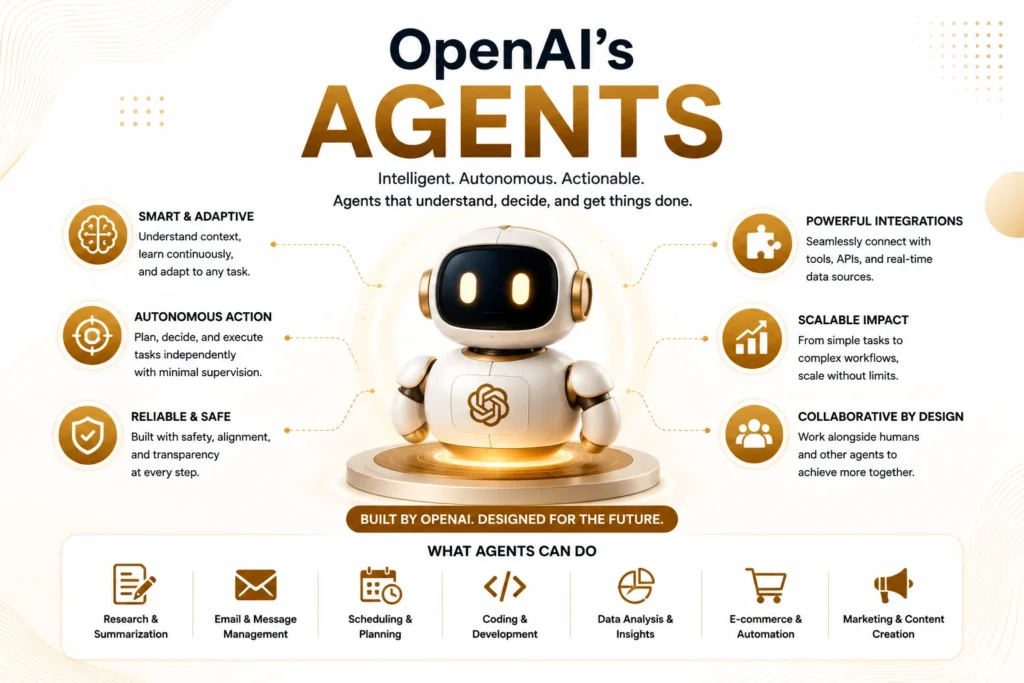
The adoption trajectory is striking. Since its release, AGENTS.md has been integrated into more than 60,000 open-source projects and agent frameworks. The list of tools supporting it includes Cursor, GitHub Copilot, Gemini CLI, Devin, Jules, VS Code, Codex, Amp, and Factory — a broad cross-section of the developer tooling market.
Why does this matter for enterprises? Consistent agent behavior across complex codebases has historically been one of the most difficult problems in agentic deployment. Different agents, running in different environments, interpreting the same project differently — that produces unpredictable results. AGENTS.md establishes a shared contract between a project and the agent operating within it, enabling more reliable, auditable, and repeatable behavior at scale.
The convention’s simplicity is a feature, not a limitation. It requires no special tooling to implement, no runtime dependency, and no licensing consideration. A developer adds an AGENTS.md file to a repository, and any supporting agent framework reads it automatically.
4. Block’s Goose Agent Framework Moves to Production and Joins AAIF
Block donated its open-source AI agent framework, Goose, to the AAIF in April 2026, formalizing its role alongside MCP and AGENTS.md as a founding project of the foundation. Goose is a local-first, open-source framework that combines large language models, extensible tools, and MCP-based integration into a structured runtime environment for agentic workflows.
Where many AI agent frameworks are hosted services that process data through third-party infrastructure, Goose runs locally on the user’s machine or on private infrastructure. For regulated industries, including healthcare, finance, and legal services, this distinction is not a preference. It is a compliance requirement. For these sectors, practical AI automation and agent deployment become possible without routing sensitive data through third-party infrastructure.
Block’s strategic reasoning for open-sourcing Goose reflects a broader pattern across the AAIF: companies giving up proprietary control to gain network effects. When an open-source framework improves through community contribution, every organization using it benefits simultaneously. Block gains engineering credibility, community-driven improvements, and a stronger foundation for building differentiated products on top of a shared infrastructure layer.
The Goose GitHub repository has moved to the AAIF organization at github.com/aaif-goose, with dedicated documentation now hosted at goose-docs.ai. The 2026 roadmap for Goose focuses on production stability, enterprise integrations, and deeper interoperability with MCP remote servers.
5. Enterprise Adoption Accelerates Beyond Analyst Projections
The numbers from 2026 confirm what the AAIF’s formation anticipated: autonomous AI agents are no longer a research project or a pilot program. They are production infrastructure.
Gartner, one of the most conservative and credible voices in enterprise technology research, forecasts that 40% of enterprise applications will include task-specific AI agents by the end of 2026 — compared to fewer than 5% in 2025. That is an eightfold increase in a single year. Gartner further projects that agentic AI could drive 30% of all enterprise application software revenue by 2035, surpassing $450 billion.
The broader market data reinforces this. The global agentic AI market grew from $7.6 billion in 2025 to a projected $10.8 billion in 2026, outpacing early cloud adoption rates. IDC projects that 40% of roles in Global 2000 companies will involve direct engagement with AI agents by the end of this year. Enterprise deployments are returning an average of 171% ROI, according to Deloitte’s 2026 State of AI in the Enterprise report — a figure that significantly exceeds the returns from traditional automation. This is exactly the philosophy behind what a trusted AI development company should offer when building enterprise agent solutions for clients.
The following table captures the key adoption and market metrics from verified analyst sources:
| Metric | Figure | Source |
| Enterprise apps with AI agents by the end of 2026 | 40% | Gartner (Aug 2025) |
| Enterprise apps with AI agents in 2025 | <5% | Gartner |
| Global agentic AI market size, 2026 | ~$10.8B | Svitla/IDC composite |
| Global agentic AI market size, 2025 | $7.6B | Svitla/IDC composite |
| Average ROI on enterprise agent deployment | 171% | Deloitte 2026 |
| MCP SDK monthly downloads | 110M+ | AAIF / Soria Parra keynote |
| MCP public servers registered | 9,400+ | Digital Applied (Apr 2026) |
| AGENTS.md adoption (open-source projects) | 60,000+ | OpenAI |
| AAIF member organizations | 170+ | AAIF (Apr 2026) |
| Projected agentic AI enterprise software revenue by 2035 | $450B+ | Gartner |
One figure deserves additional scrutiny: while 79% of enterprises report having adopted AI agents in some form, only 11% are running them in production according to first-party survey data. That 68-percentage-point gap is the defining challenge of 2026. It reflects the real difficulty of integrating autonomous systems into legacy workflows, data environments, and governance structures — challenges the AAIF’s open standards are specifically designed to address.
6. A Global Events Program Builds the Agentic AI Community Across 10 Cities
On April 2, 2026, the AAIF announced its expanded global events program for 2026, the most geographically ambitious developer conference series the agentic AI ecosystem has produced to date.
The schedule includes MCP Dev Summits in New York, Shanghai, Tokyo, Toronto, and Nairobi, designed to give developers hands-on exposure to MCP, Goose, and AGENTS.md in a focused, community environment. These regional summits feed into two flagship events: AGNTCon + MCPCon Europe in Amsterdam on September 17–18, 2026, and AGNTCon + MCPCon North America in San Jose, California, on October 22–23, 2026.
Mazin Gilbert, Executive Director of AAIF, described the program’s intent: the 2026 events reflect growing global demand for vendor-neutral infrastructure that enables AI agents to operate reliably and securely across tools, data, and platforms. Each event is designed to move standards from specification documents into working systems that run at production scale.
The inclusion of Nairobi on this list is not incidental. It signals that agentic AI governance is not a story confined to Silicon Valley or European capitals. The developers and organizations shaping this infrastructure exist across multiple continents, and the AAIF is structuring its community to reflect that geography.
The AAIF Technical Steering Committee has also approved a formal three-stage project lifecycle — Growth, Impact, and Emeritus — opening the door for external projects beyond the three founding contributions to join the foundation. This creates a governed pathway for the broader open-source agentic AI ecosystem to standardize under AAIF governance.
7. Regulation Arrives: EU AI Act Enforcement, A2A Protocol, and the Security Imperative
The compliance deadline that every enterprise deploying AI agents should have circled on its calendar is August 2, 2026. That is the full applicability date of the EU AI Act (Regulation 2024/1689), which imposes a risk-based regulatory framework on AI systems deployed in the European Union, with particular provisions for systems that autonomously plan and execute tasks.
For high-risk deployments, which include AI agents operating in healthcare, financial services, critical infrastructure, and recruitment, the Act mandates ongoing risk management processes, human oversight with structured intervention points, traceability of decisions, and transparency in system outputs. Organizations that cannot demonstrate these capabilities face substantial penalties.
The governance challenge is specific. Agentic AI systems that operate across multiple tools, services, and data sources generate compliance obligations at each integration point. An agent booking a flight, executing a trade, or prioritizing a patient queue is not just an AI system — it is, under certain conditions, a regulated actor. The EU AI Act creates accountability for the behavior that happens between the prompt and the tool call, and most enterprises are not yet equipped to demonstrate that accountability at audit. The organizations best positioned for this deadline are those that have already made AI governance and enterprise transformation a structural priority — not a compliance checkbox added at the end.
Alongside regulatory pressure, two additional developments are reshaping the agentic AI protocol landscape.
Agent-to-Agent Protocol (A2A) v1.0 and Google’s Universal Commerce Protocol have joined the AAIF ecosystem alongside the three founding projects. A2A formalizes how AI agents communicate with each other in multi-agent systems, a critical gap that MCP, which governs agent-to-tool communication, does not address. Together, MCP and A2A begin to define a complete communication layer for agentic systems.
Security has emerged as the most underaddressed dimension of agentic deployment. Autonomous agents that can access tools, invoke APIs, and manipulate data represent a new category of attack surface. Prompt injection, where malicious content embedded in external data instructs an agent to take unauthorized actions, is one of the most serious and least solved vulnerabilities in agentic systems today. Oracle’s Deep Data Security, announced at its AI World Tour in March 2026, addresses this at the database layer by enforcing user-specific access controls that prevent agents from being manipulated into unauthorized data access.
For any organization deploying autonomous AI agents, security governance is no longer an optional layer added after deployment. It is a foundational design requirement.
What This Means for Developers, Enterprises, and the Broader Industry
The seven updates above are not isolated announcements. They are components of a single, coherent structural development: the agentic AI ecosystem is acquiring the institutional infrastructure that durable technology categories require.
Open standards governed by neutral foundations, not proprietary platforms controlled by individual vendors, are the conditions under which critical infrastructure achieves long-term stability, interoperability, and trust. The AAIF is building that foundation for AI agents, and the pace of adoption across MCP, AGENTS.md, and the broader membership suggests the industry recognizes what is at stake.
For developers, the practical implication is that building on MCP-compatible tools and adopting AGENTS.md conventions now positions projects for long-term ecosystem compatibility rather than proprietary lock-in.
For enterprise technology leaders, the Gartner and IDC figures make the strategic calculus clear. The 40% of enterprises that integrate task-specific AI agents by the end of 2026 will not be operating the same applications as the 60% that do not. The productivity, workflow, and cost-structure gap between those two groups will widen over time.
For policymakers and compliance teams, the EU AI Act’s August deadline is a forcing function. The organizations that treat it as a compliance checkbox will struggle. Those that treat it as an architectural requirement, building traceability, human oversight, and governance into their agentic systems from the start, will be better positioned for every regulatory development that follows.
Key Takeaways
The Agentic AI Foundation represents a maturity inflection for the entire field of autonomous AI. In 2024, the question was whether AI agents could work. In 2025, it was where to deploy them. In 2026, the question is how to govern them, and the AAIF is providing the infrastructure through which that governance becomes possible.
The seven updates above are not separate stories. They are chapters in the same narrative: AI agents are becoming infrastructure, and 2026 is the year that infrastructure begins to be governed like infrastructure should be.

Senior SEO Content Marketing Manager at Trendusai.com
Rashida Hanif is a Senior SEO Content Marketing Manager at Trendusai.com, specializing in data-driven content strategy and SEO. She helps brands improve online visibility through keyword research, content planning, and AI-powered marketing insights.