
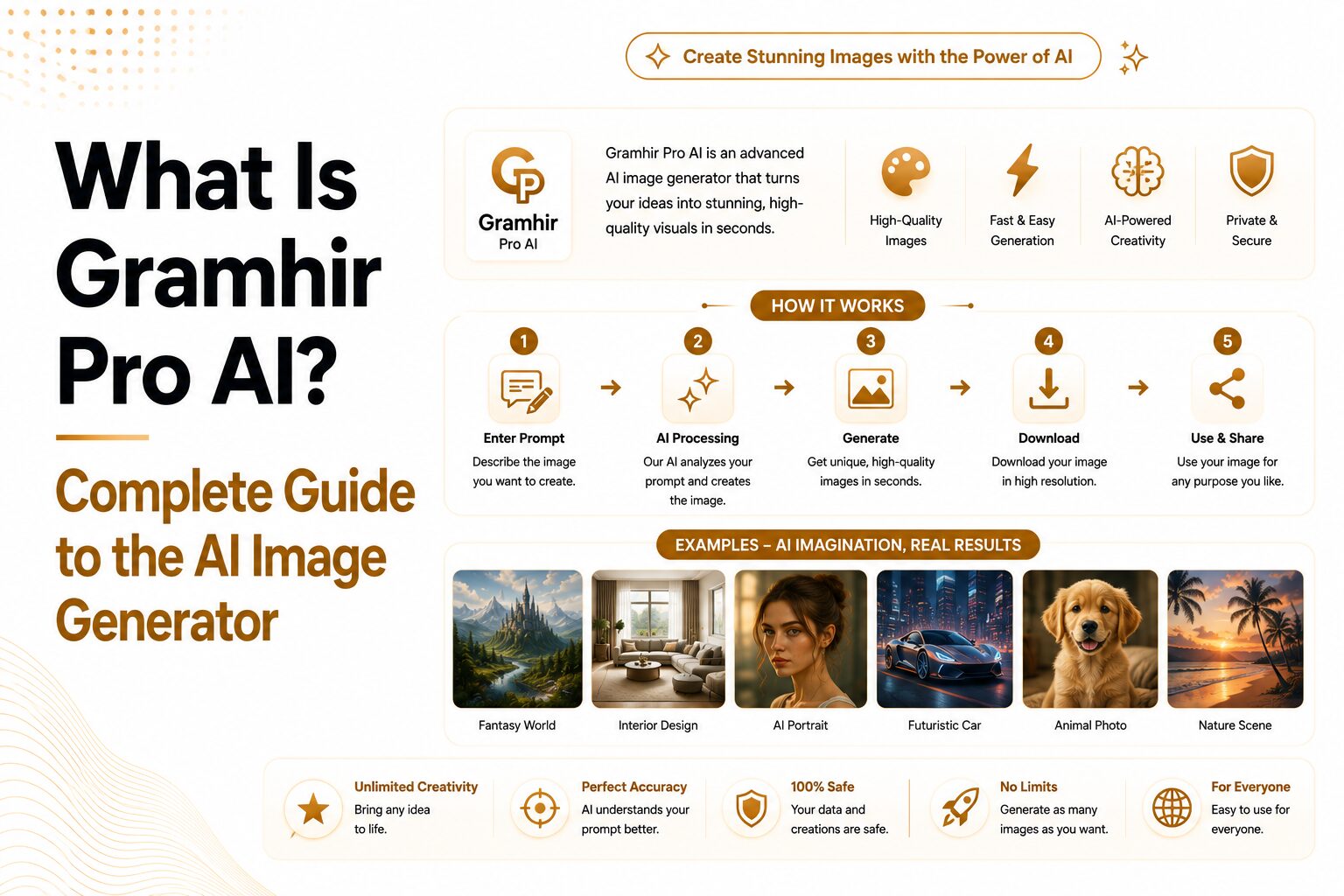
There are already plenty of articles explaining what Gramhir Pro AI is, and most of them cover the same basic features. Rather than repeating the product description, I spent a week using the tool with different prompts to see how it performs in everyday use. The goal was simple: find out where it works well, where it struggles, and whether it’s worth using.
Gramhir Pro AI is a text to image AI generator. You type a description and it spits out a finished picture in seconds, right in your browser. That part’s true, no complaints there. What nobody seems to talk about is where the thing actually earns its price tag, and where it doesn’t.
So here’s the guide. What Gramhir Pro AI is, how it works under the hood, what it costs, and how it holds up against Midjourney and DALL-E 3. If you typed “what is Gramhir Pro AI image generator” into Google and landed here hoping for something more honest than a rewritten press release, you’re in the right spot.
What Is Gramhir Pro AI Image Generator
Put simply, it’s a browser based AI image generator with no download required. You type in a subject, a setting, maybe a mood, and it renders a picture that matches. No brushes, no layers, none of the Photoshop learning curve.
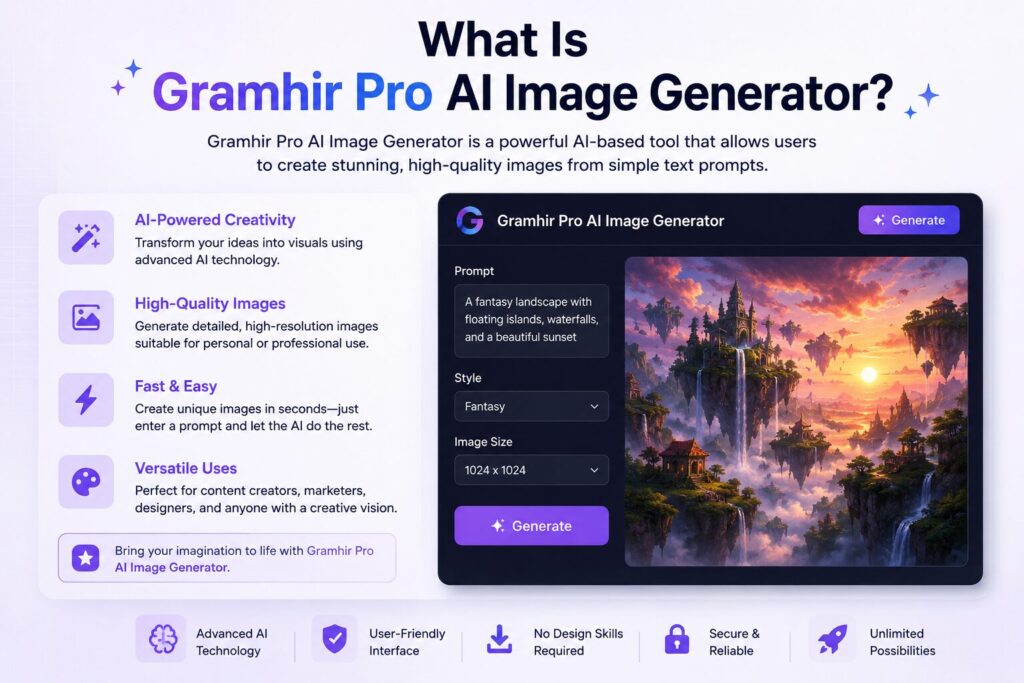
Who’s it for? People who need images all the time but don’t have a designer sitting around. Marketers cranking out and being creative. Bloggers are sick of using the same three stock photo sites everyone else uses. Small ecommerce sellers who need product mockups but can’t afford a photo studio. Gramhir.pro AI doesn’t assume you know anything going in. You’ll need to learn how to write a decent prompt, sure, but that’s an afternoon skill, not something you study for months.
Quick snapshot of the tool based on what I saw during testing:
| Detail | Gramhir Pro AI |
| Access | Browser only, nothing to install |
| Free plan | Yes, limited daily generations, watermark on exports |
| Paid plan | Around $15/month, unlimited generations, HD downloads |
| Typical generation time | 3 to 12 seconds |
| Underlying technology | Generative Adversarial Network (GAN) |
| Export formats | PNG, JPEG |
| API access | Not available right now |
| Strongest at | Product shots, marketing visuals, blog imagery |
| Weakest at | Embedded text, hands, fine anatomy |
How Gramhir Pro AI Actually Works
Most articles cover this in one throwaway paragraph. That’s a mistake, because the tech explains basically every strength and weakness you’ll run into. If you want the fundamentals spelled out in more depth, TrendUsAI has a broader primer on what generative AI actually is and how it’s used across industries, which is worth a read alongside this one.
The GAN Engine Behind It
Gramhir Pro AI runs on something called a Generative Adversarial Network, or GAN. It’s technically a Generative Adversarial Networks image tool, if you want the formal name. Here’s the easiest way to picture it: two AI systems locked in a loop, arguing with each other. One, the generator, makes an image. The other, the discriminator, tries to catch it out, to spot whether it looks fake. Every time the discriminator finds a flaw, the generator has to adjust. Every time the generator gets better, the discriminator has to get sharper to keep up. Back and forth, over and over, and whatever survives that fight is the image you end up seeing.
Compare that to the diffusion models running DALL-E 3 and Midjourney. Those build an image by slowly clearing noise out of a random pattern, step by step, with your prompt guiding it the whole way. Diffusion is usually slower, but it nails fine detail, especially text, way more reliably. GANs like the one behind Gramhir Pro AI trade some of that precision for raw speed. And you’ll feel that trade off constantly once you start generating.
How It Reads Your Prompt
The system doesn’t read your prompt the way you or I would. It breaks the sentence apart into concepts, subject, setting, lighting, style, and checks each piece against patterns it picked up during training. Only once it’s built that internal map does it start actually rendering pixels.The same pattern-matching logic shows up on the retrieval side too — if you’re curious how AI models “read” an image rather than generate one, our guide to reverse, visual, and AI-powered image search covers that in detail.
That’s why a one word prompt gives you something bland. Type “coffee shop” and the model has almost nothing to grab onto. Type “a quiet coffee shop interior, morning light through tall windows, steam rising off a cup on a wooden table” and suddenly it has real anchors to work with. The gap between those two results, in my own testing, was not subtle. Not even close.
How to Use Gramhir Pro AI to Create Images
Here’s what I actually did, step by step.
1. Sign up. Head to the site, drop in your email, make an account. Nothing to install.
2. Write the prompt. Subject, setting, lighting, style. Vague prompts get vague results, and that’s true of every AI art generator from text prompt, not just this one.
3. Pick a style and aspect ratio. There are presets, realistic photography, digital painting, anime, watercolor, 3D render, minimalist illustration. Set your dimensions based on where the image is going. Square for social, wide for a blog header.
4. Hit generate. Most of mine came back in 3 to 12 seconds, depending on how much I’d packed into the prompt. There’s a preview mode too, so you can compare a few takes before you actually spend a download.
5. Download it, or tweak it. Happy? Save as PNG or JPEG. Not quite right? Change a word or two and regenerate instead of starting completely over.
Quick example. My first shot at “a car on a coastal road” came back flat. Fine composition, but no mood at all. I rewrote it as “a vintage red convertible on a coastal road at sunset, warm golden light, photorealistic.” Same subject, totally different feel. Better light, more depth, actually usable this time. That one edit taught me more about how Gramhir Pro AI reads a prompt than the entire help section did.
Key Features of Gramhir.pro AI Image Generator
Short list, but everything on it earns its spot.
Style presets covering realistic photography, digital painting, anime, watercolor, 3D render, and minimalist illustration. Aspect ratio control so you’re not cropping after the fact. A preview mode that lets you test variations without burning a download credit. Batch generation for queuing several prompts at once, which teams producing content at volume will appreciate. And color palette tweaks that let you nudge the tone of a finished image without rewriting the whole thing.
None of this is unique to Gramhir Pro AI, to be fair. What actually stands out is how little friction there is getting to any of it. The settings sit right on the main screen instead of being buried three menus deep like some competitors.
Is Gramhir Pro AI Free or Paid
Both. It runs on the standard freemium model you’d expect from software in this space.
The free plan caps you at a certain number of generations per day, keeps you at standard resolution, and slaps a watermark across every export. Fine if you’re just poking around. Not enough if you’re publishing on any kind of schedule.
The paid tier runs about $15 a month. No watermark, HD downloads, no daily cap, and it comes with commercial usage rights, so you can actually use the output in client work or paid campaigns without worrying about it.
For reference, that’s cheaper than Adobe Firefly’s standard tiers and more expensive than budget options like NightCafe, which starts under $6 a month but gives you fewer presets to work with. Whether $15 is worth it really comes down to how much you’re generating. A freelancer making a handful of images a week can probably stay free forever. A team publishing daily will blow through that cap fast.
Gramhir Pro AI Review 2026, the Honest Version
Time to be blunt, because most reviews of this thing skip right past the rough edges.
What actually holds up: product photography and marketing visuals. This is where Gramhir Pro AI is genuinely good. The photorealistic and 3D render styles turn out clean, usable output for ecommerce listings and social ads. And it’s fast, most generations finish in under ten seconds, all cloud side, so your own laptop’s specs don’t matter one bit.
What doesn’t: text. Ask it for a sign, a label, anything with actual words on it, and you’ll usually get back garbled nonsense or misspelled letters. This isn’t some flaw unique to Gramhir.pro AI art either. It’s a widely documented limitation of GAN-based image models, which tend to lag behind diffusion-based tools when it comes to rendering readable, coherent text inside an image.
Hands are the other problem. Extra fingers, joints bent the wrong way. If your work involves realistic people, this isn’t some tiny cosmetic issue you can ignore, it’s a real limitation.
And there’s no API. If you wanted to hook Gramhir Pro AI into some automated pipeline, say, generating a thumbnail every time a new blog post goes live, you’re out of luck for now. Everything’s manual, browser based, one image at a time. Businesses that need that level of custom automation are usually better off having a purpose-built system made for them — TrendUsAI’s generative AI development services cover exactly that kind of pipeline work.
Best Use Cases for Gramhir.pro AI Photo Generator
Some jobs suit this tool a lot better than others.
Marketing and social content is probably the strongest fit. Teams posting daily or weekly can pump out on brand visuals without waiting in line for a designer. Running ten variations to A/B test a campaign takes minutes, not days. If you’re doing AI image creation for marketers at any real volume, this is where it shines.
Ecommerce product visuals are another good match. The photorealistic and 3D presets work well for lifestyle shots and mockups, especially in fashion, beauty, and home goods, where brands need volume without booking an actual photo shoot.
Integrating these custom visuals into a digital newsletter creator helps content teams compile AI graphics into responsive HTML layouts, complete with interactive multimedia elements and reader engagement analytics that traditional PDF attachments lack. Writers on a regular schedule can pull custom featured images instead of recycling the same stock photos everyone else uses, and that alone makes a site feel a lot more original.
Early concept work, sure. Designers stuck on direction can knock out a batch of quick variations to spark ideas, even if the final piece ends up built by hand later.
Where it falls apart: anything needing readable embedded text, close up portrait work, or an automated API driven pipeline.If you’re not sure whether an off-the-shelf tool like this is enough for your workflow or whether you need something custom-built, it’s worth talking it through — TrendUsAI’s AI consulting team can map out what actually fits your use case before you commit to a stack.
Gramhir Pro AI Alternatives for Image Generation
If it’s not quite the right fit, here’s how it compares to the three tools people usually put next to it.
| Tool | Technology | Text rendering | Approx. price | Best for |
| Gramhir Pro AI | GAN | Weak | $15/month | Product and marketing visuals |
| DALL-E 3 | Diffusion | Strong | $20/month (via ChatGPT Plus) | Text in image, business graphics |
| Midjourney | Diffusion | Moderate | $10+/month | Artistic and stylized work |
| Stable Diffusion | Diffusion, open source | Varies | Free (self hosted) | Full creative control |
Prompt Writing Tips for Gramhir.pro AI Art
A handful of habits made a real difference for me.
Name the light. Golden hour, overcast, neon lit, studio lighting, whatever it is, this one detail shifts the mood of an image more than almost anything else you could add.
State the style directly, even with a preset already picked. Typing “photorealistic, sharp detail” or “flat vector illustration” right into the prompt reinforces whatever preset you chose.
Describe the framing. Close up, centered, shot from a distance. Skip this and you’ll get inconsistent results between variations of what should be the same prompt.
Don’t cram the scene. A prompt juggling five different objects usually comes out cluttered and messy. Pick one clear subject and build detail around that.
Adjust, don’t restart. If a result’s close but not quite there, change a word or two and regenerate rather than rewriting from scratch. Small edits give you more predictable results.
FAQs
Is Gramhir Pro AI free or paid?
Both. The free plan comes with a daily cap and watermarked exports. Paid plan runs about $15 a month, drops the watermark, and adds commercial rights.
What is Gramhir Pro AI image generator, exactly?
A browser based AI image generator with no download required, built on GAN technology, that turns text prompts into finished visuals in seconds.
Can Gramhir Pro AI produce photorealistic images?
Yes, that’s actually where it performs best, particularly the photorealistic and 3D render presets for product and marketing work.
Why does Gramhir Pro AI struggle with text inside images?
Because GAN based systems treat text as a visual pattern instead of an actual sequence of characters. It’s a known weak spot across most image generators, not something unique to this platform.
Can I use Gramhir Pro AI images commercially?
Only on the paid plan. Free tier exports have a watermark and aren’t meant for commercial use. Worth double checking the platform’s current terms before publishing anything paid.
Does Gramhir Pro AI have an API?
Not yet. It’s built for manual, browser based use, not automated workflows.
What are the best Gramhir Pro AI alternatives?
DALL-E 3 if you need text heavy graphics, Midjourney for artistic work, Stable Diffusion if you want full control and don’t mind running it locally.
Do I need design experience to use it?
Not really. The main skill is prompt writing, describing subject, light, and style clearly. Most people get the hang of it within a handful of tries.
Can I share Gramhir Pro AI images directly to social media?
Yes. Download the image once it’s generated and post it to Instagram, LinkedIn, or Facebook just like any other image file.
Final Verdict
Gramhir Pro AI does one thing well. It turns a written idea into a usable image fast, at a price that beats most professional design alternatives. For marketers, ecommerce sellers, and bloggers who need visuals on a regular basis, it’s earned a spot in the rotation.
It’s not the right call if your work depends on readable text inside an image, precise human anatomy, or automated API integration, DALL-E 3 or a diffusion based tool will handle those better. But used within its actual strengths, Gramhir Pro AI is a genuinely useful tool. Not a replacement for everything else, but a solid one worth keeping around. For teams that outgrow what an off-the-shelf generator can do and need AI built around their own workflow, TrendUsAI is worth having on your radar for that next step.
Senior SEO Content Marketing Manager at Trendusai.com
Rashida Hanif is a Senior SEO Content Marketing Manager, specializing in data-driven content strategy and SEO. She helps brands improve online visibility through keyword research, content planning, and AI-powered marketing insights.