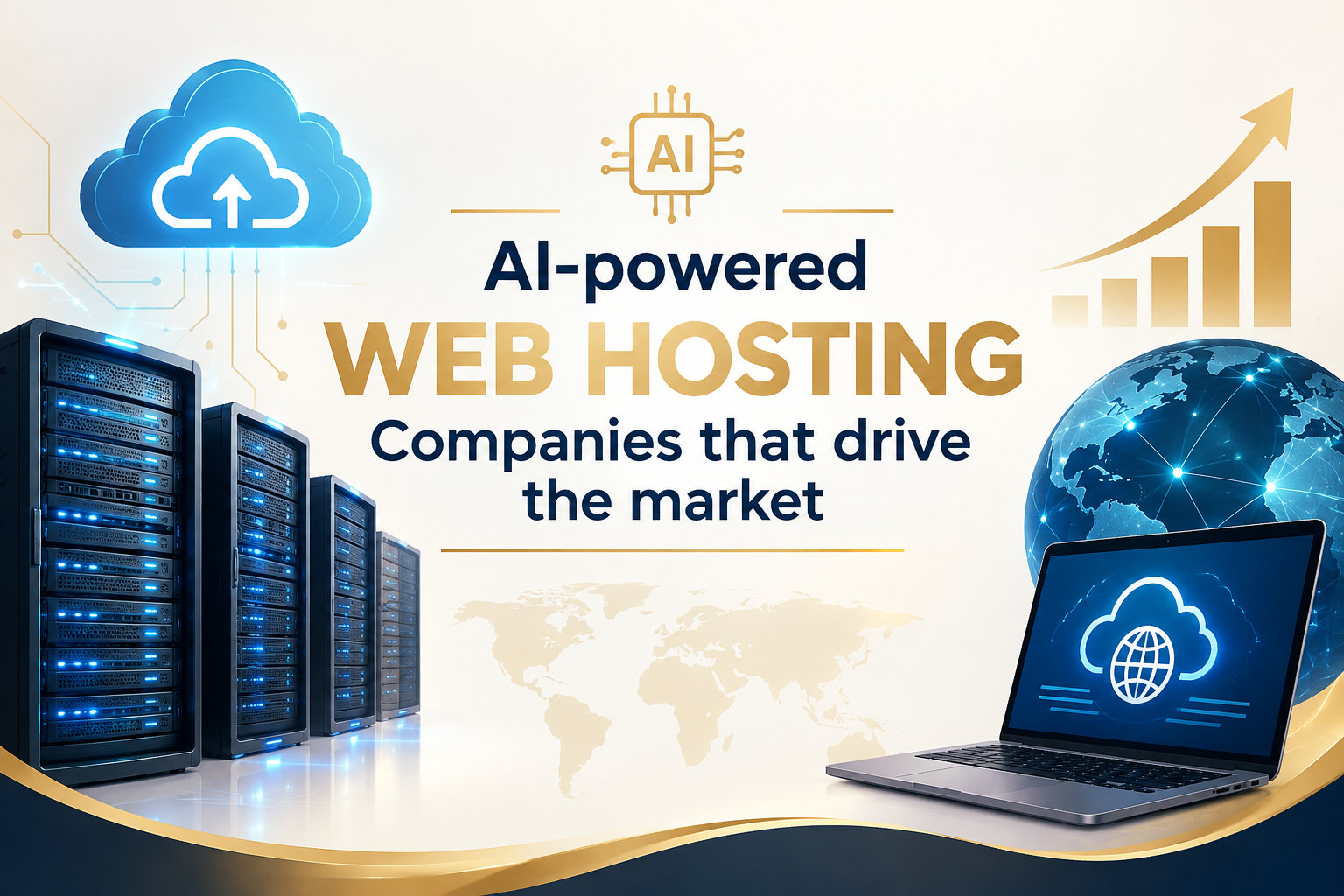
The web hosting industry is entering a new era. Artificial intelligence (AI) is changing how businesses build websites, manage servers, improve performance, and protect their online assets. What once required extensive technical knowledge can now be simplified through intelligent tools that automate routine tasks, recommend suitable hosting solutions, and help website owners launch projects faster.
As businesses increasingly depend on their online presence, hosting providers are evolving beyond traditional server infrastructure. AI-assisted website creation, automated maintenance, intelligent resource management, and proactive security are becoming important parts of the hosting experience.
Among the companies embracing this transformation are UltaHost and HostOnce, two providers combining hosting infrastructure with AI-powered tools to make website management more accessible.
1. UltaHost: Combining High-Performance Hosting with AI-powered Website Creation
UltaHost is a web hosting provider offering solutions for individuals, developers, entrepreneurs, and businesses that need reliable infrastructure for their online projects.
The company’s approach to AI focuses on simplifying website creation and management, particularly for WordPress users. Its AI-powered WordPress website builder helps users generate personalized websites quickly, reducing the time and technical effort traditionally required to launch a new project.
These capabilities help website owners streamline creative tasks while maintaining control over their websites.
Beyond website creation, UltaHost provides hosting infrastructure designed to support performance, scalability, and security. Its managed WordPress services include features such as threat monitoring, firewall filtering, vulnerability protection, and malware cleanup.
What makes UltaHost noteworthy?
- AI-assisted website building: Helps users create professional websites with less manual work.
- Managed hosting: Helps reduce the technical burden of maintaining a WordPress website.
- Security-focused infrastructure: Includes protective features designed to help detect and mitigate website threats.
- Scalable hosting options: Offers different hosting environments to accommodate projects with varying resource requirements.
By bringing AI tools into the website creation process, UltaHost demonstrates how hosting providers can offer more than server space. They can also help customers move from an initial idea to a functioning website with fewer technical obstacles.
2. HostOnce: Making Hosting and Server Management Smarter with AI
HostOnce is another hosting provider incorporating artificial intelligence into the customer experience. Its platform combines traditional hosting services with AI-powered tools intended to simplify website creation, hosting selection, and server management.
One of its key offerings is HovaAI, an AI assistant designed to make server management more accessible. According to HostOnce, the assistant supports natural-language interactions and capabilities related to maintenance, scaling, and recovery.
This approach addresses a common challenge in web hosting: managing infrastructure can become increasingly complicated as a website grows. AI-assisted tools can help users understand their options, perform routine tasks, and manage their hosting environment with less manual intervention.
HostOnce also offers HovexBuilder, an AI-powered website-building product that helps users create and launch websites. Its broader hosting portfolio includes shared hosting, WordPress hosting, VPS, VDS, and dedicated servers, allowing customers to choose infrastructure according to their needs.
The company also highlights NVMe storage, automated backups, security monitoring, and support services as part of its hosting offering.
What makes HostOnce noteworthy?
- AI-assisted server management: HovaAI is designed to help users manage infrastructure through plain-language requests.
- AI-powered website creation: HovexBuilder helps simplify the process of building and launching websites.
- Automation-focused approach: AI-assisted maintenance and scaling capabilities aim to reduce repetitive management tasks.
- Multiple hosting environments: Customers can choose between shared, virtual, and dedicated hosting options.
- Performance and security features: The platform highlights NVMe storage, backups, monitoring, and security protections.
HostOnce illustrates how AI can become part of the hosting management experience rather than simply an additional tool for generating website content. Its focus on AI-assisted infrastructure management may appeal to businesses and developers looking to simplify routine hosting operations.
3. Hostinger: AI Tools for Building and Managing Websites
Hostinger combines web hosting services with AI-powered tools designed to simplify website creation and management. Its AI Website Builder helps users generate websites from written descriptions, while additional tools support content creation, image generation, and website customization. Hostinger also offers AI-assisted features for WordPress users, making it easier for beginners and small businesses to establish an online presence without extensive technical knowledge. By integrating these capabilities into its hosting ecosystem, Hostinger makes AI accessible to users who want to launch websites quickly and manage them with less manual effort.
4. Wix: AI-powered Website Creation and Business Management
Wix brings artificial intelligence into website development through its AI website creation experience and integrated business tools. Users can describe their goals and generate a website tailored to their needs, then customize its layout, content, and functionality. Wix also provides AI-assisted tools for writing website copy, generating images, and supporting marketing activities. Although Wix is primarily an all-in-one website-building platform rather than a traditional standalone hosting provider, its integrated hosting infrastructure and AI capabilities make it a relevant player in the broader AI-powered website market. Its approach is particularly attractive to entrepreneurs and small businesses seeking a streamlined way to establish and manage an online presence.
5. Bluehost: AI-assisted WordPress Website Development
Bluehost combines WordPress hosting with AI-assisted website creation tools designed to help users build websites more efficiently. Its AI-powered website-building capabilities can help generate initial website layouts and content based on information about a user’s business or project. Customers can then refine their websites using WordPress and its extensive plugin ecosystem. By combining hosting infrastructure with tools that reduce the complexity of website development, Bluehost aims to make launching a professional website more accessible to beginners, entrepreneurs, and small businesses. Its WordPress-focused approach makes it a relevant option for users who want the flexibility of a widely used content management system alongside AI-assisted development.
How AI Is Changing the Web Hosting Industry
The growing adoption of AI in web hosting reflects a broader shift toward automation and simplified infrastructure management. Several areas are particularly important.
Intelligent resource management
Websites experience fluctuations in traffic, and hosting resources must be able to accommodate changing demand. AI-assisted systems can analyze operational data and help identify resource requirements, performance bottlenecks, and opportunities for optimization.
Where supported, automated scaling can help websites respond to traffic changes without requiring constant manual intervention.
Proactive security and threat detection
Security remains one of the most important responsibilities of a hosting provider. AI-assisted monitoring can help identify unusual patterns, suspicious activity, and potential threats.
However, AI should complement established security practices such as firewalls, software updates, access controls, backups, and incident response procedures rather than replace them.
Faster website creation
AI website builders are lowering the barriers to launching an online project. Instead of starting with a blank page, users can describe their business or website idea and use AI-generated layouts, text, and images as a starting point.
This can be especially useful for small businesses, freelancers, startups, and entrepreneurs who need to establish an online presence without building every component manually.
Simplified technical management
Hosting environments involve numerous tasks, from configuring applications to managing backups and troubleshooting server issues. AI assistants can make these activities more approachable by interpreting natural-language requests and helping users navigate technical processes.
The extent of automation varies by provider and product, so customers should verify which tasks an AI assistant can actually execute and which still require human approval.
Performance optimization
AI can support performance analysis by identifying slow components, unusual resource consumption, or configuration problems. Combined with efficient infrastructure, caching, and content delivery networks, these insights can help improve the user experience.
Actual website speed still depends on multiple factors, including application design, server resources, database performance, and visitor location.
4. What Businesses Should Look for in an AI-powered Hosting Provider
AI features alone are not enough to determine whether a hosting provider is the right choice. Businesses should evaluate the complete hosting environment before making a decision.
Important considerations include:
- Performance: Look at storage technology, server resources, network quality, and independent speed measurements.
- Reliability: Review the provider’s uptime commitments and service-level agreement.
- Security: Check backup policies, malware protection, access controls, and recovery procedures.
- Automation: Determine whether AI tools merely provide recommendations or can perform tasks directly.
- Scalability: Make sure the hosting plan can accommodate future traffic and application requirements.
- Technical support: Confirm that qualified human support is available when automated assistance is insufficient.
- Pricing transparency: Review renewal rates, resource limits, migration conditions, and the cost of optional AI products.
The most effective solution is not necessarily the one with the largest number of AI features. It is the one that combines useful automation with dependable infrastructure, transparent pricing, and appropriate technical support.
Conclusion
AI is reshaping the web hosting market by making website creation easier, infrastructure management more accessible, and routine operations increasingly automated.
UltaHost stands out for integrating AI-powered website creation and WordPress customization tools with managed hosting and security features. HostOnce brings AI into both website building and server management through products such as HovexBuilder and HovaAI.
Both companies illustrate the direction in which the industry is moving: from hosting providers that primarily supply server resources toward platforms that help customers build, manage, and maintain their online businesses more efficiently.
As AI technology continues to evolve, the companies best positioned to compete will be those that turn automation into measurable customer benefits while maintaining the reliability, security, and performance that every successful website requires.

Senior SEO Content Marketing Manager at Trendusai.com
Rashida Hanif is a Senior SEO Content Marketing Manager, specializing in data-driven content strategy and SEO. She helps brands improve online visibility through keyword research, content planning, and AI-powered marketing insights.