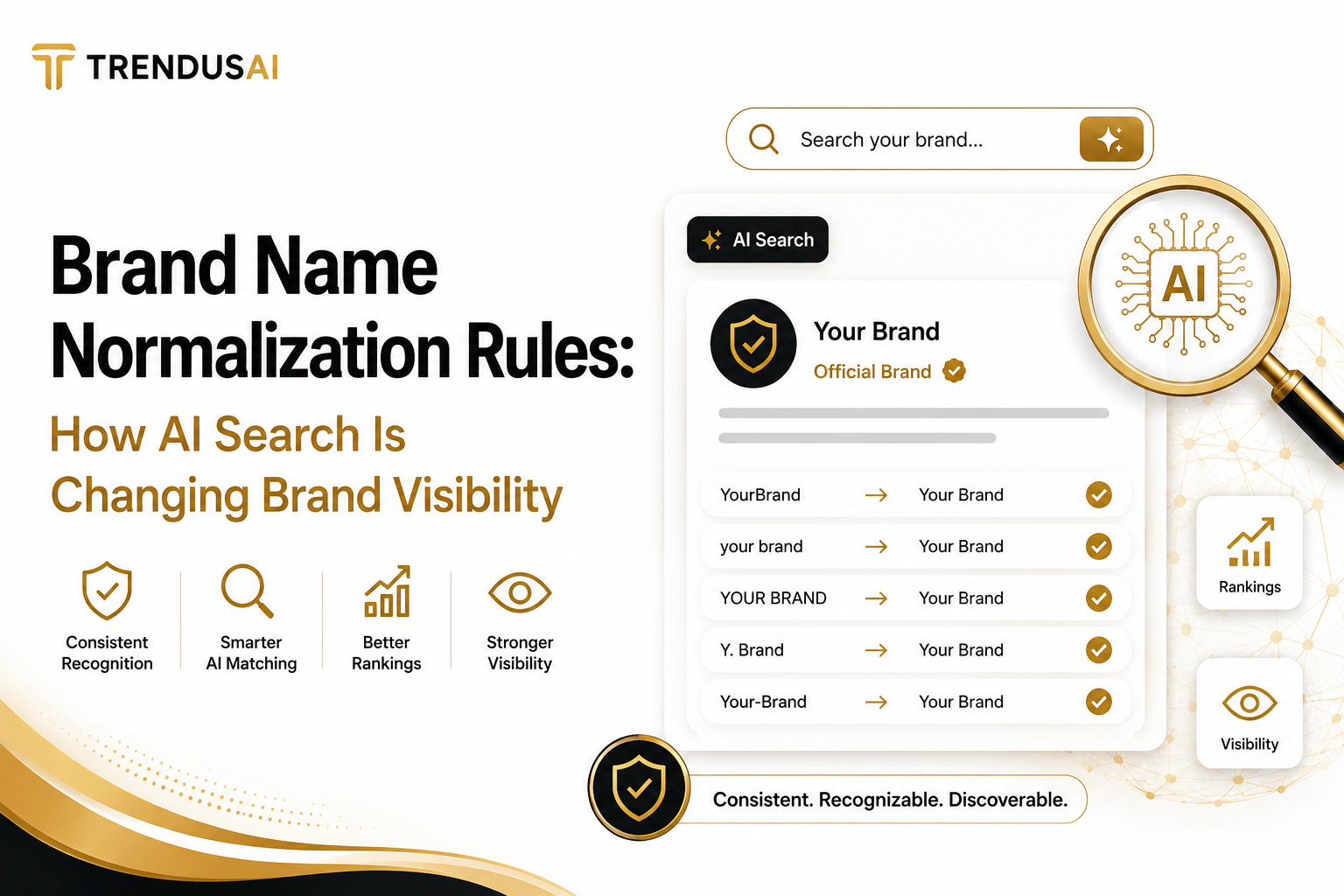
Search a company name in ChatGPT, Perplexity, or Google AI Overviews, and you might get a mixed answer. One version of your name gets cited. Another gets ignored. A third gets mixed up with a competitor. The same problem shows up inside a CRM, where one client can end up saved as three separate accounts. This happens because both AI search engines and CRM systems read brand names as data points, not just words. If your brand appears as “Ad Pulse” on your website, “AdPulse” on LinkedIn, and “Ad-Pulse” in a press release, a system sees three different entities instead of one. Brand name normalization rules fix this problem at the root, whether the goal is clean CRM records or better AI search visibility. This guide covers the exact rules and workflow used to fix inconsistent brand names before they cost you visibility or revenue.
What Are Brand Name Normalization Rules?
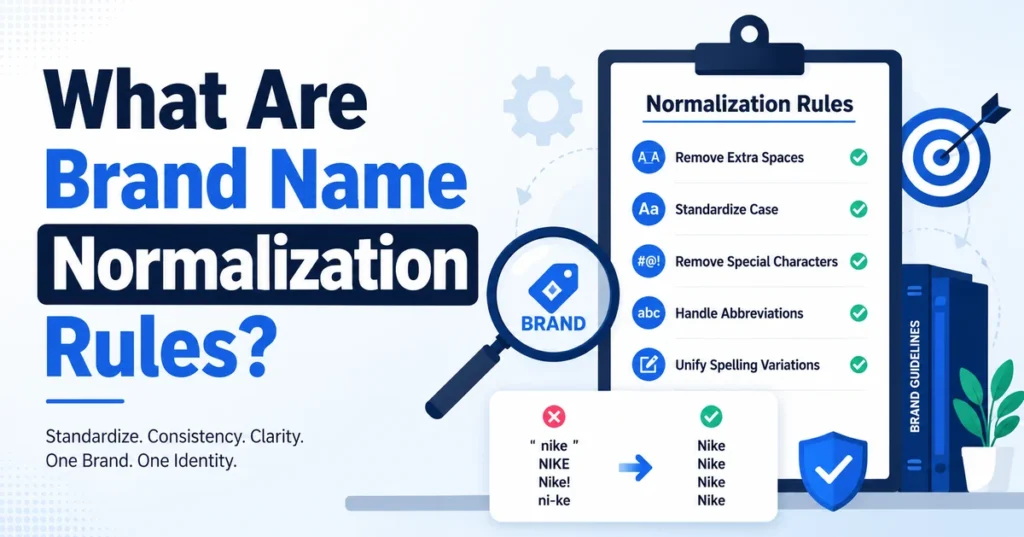
Brand name normalization rules are the standards a business sets to keep one name format across every platform, document, and data source. The goal is simple. Pick one canonical brand name and apply it everywhere, instead of letting each department, vendor, or listing site write it differently. This is also called company name normalization or brand name standardization, depending on which team is doing the work.
A canonical brand name is the official, agreed-upon version of a company’s name. Every other version, like abbreviations, legal suffixes, or old spellings, gets mapped back to this one form through an alias mapping table.
Take a small example. A company might appear online as “Ad Pulse,” “AdPulse,” and “Ad-Pulse.” These look similar to a human reader, but a database or search algorithm may treat them as three separate brands unless normalization rules tell it otherwise. Businesses that manage this at scale usually keep a master brand registry, a single reference table that stores the canonical name plus every known alias:
| Raw Name | Canonical Name | Record Type | Domain | Region |
| Ad Pulse | Ad Pulse | Brand | example.com | Global |
| AdPulse | Ad Pulse | Alias | example.com | Global |
| Ad-Pulse | Ad Pulse | Alias | example.com | Global |
A structure like this is what a CRM team uses to clear out duplicate company records during a data cleanup project, and it is also what feeds clean brand data into AI search tools later on. Brand name normalization rules solve this exact gap between how humans read names and how machines process them.
How AI Search Understands Brand Entities
Traditional keyword search matched exact words on a page. AI search works differently. It reads brands as entities, meaning it tries to identify the real-world company behind the name, not just the text string. This is how AI search reads brand names in practice, and it explains why brand names can appear differently across different AI tools.
This works through entity recognition and entity matching. AI models scan the web, pull mentions of a brand, and try to link them to one underlying record. When this works well, a search engine understands that “Google,” “Google LLC,” and “Alphabet’s Google” all point to the same entity.
Here is the part most guides skip. AI systems connect these entities using several signals, and structured data is one of the strongest. A brand often has a node in the Knowledge Graph, a Wikidata ID, and sameAs schema links on its own website that point to its official social profiles and directories. Text mentions, backlinks, and business listings add further context on top of that. When these signals are missing or inconsistent, AI search can struggle to merge the brand’s mentions into one record. This is where multiple brand variations cause real problems. Instead of one strong entity, the AI sees several weak, disconnected mentions, and confidence in any single answer can drop.
Why Brand Consistency Matters for AI Search
Clean, consistent brand names affect more than search rankings. They shape how visible and accurate a company looks across every AI-powered surface.
Knowledge Graph visibility. Consistent name data across the web supports entity disambiguation, which can help a brand build a stronger Knowledge Graph presence. It is not a guarantee of a Knowledge Panel, but scattered name variations make the process harder.
AI-generated citations. Tools like ChatGPT, Perplexity, and Gemini rely on associating information with the correct entity before citing it. Consistent naming makes that association easier. A brand with scattered name variations is harder to cite with confidence.
Voice search and featured snippets. Voice assistants read out brand names directly. A wrong or outdated variation sounds unprofessional and can send the customer to the wrong company.
Entity authority. Search engines build trust in a brand over time. Trust signals scatter across multiple name versions instead of building up under one strong entity.
Clean brand data also feeds directly into accurate AI-generated answers. If the underlying data is inconsistent, the AI’s summary of your company will carry that same inconsistency.
What Happens When Your Brand Name Is Inconsistent
Inconsistent brand names create four common failure points in AI search.
First, the AI may ignore your brand entirely because it cannot confirm which name variation is correct. Second, it may merge your brand with a different company that has a similar name. Third, it may cite an outdated name variation that no longer matches your current branding. Fourth, authority and credit meant for your company can get attributed to the wrong entity altogether.
Picture two companies: “Nova Finance” and “Nova Finance Group,” operating in the same industry with different services. If one company’s older press releases still use “Nova Finance Group” while its current site says “Nova Finance,” an AI search tool may combine both into a single confused entity. A customer asking about pricing or reviews could get information meant for the wrong business. This is not a small SEO issue. It is a trust and revenue issue.
7 Essential Brand Name Normalization Rules
These rules form the base of most brand data cleanup projects, whether the goal is CRM accuracy or AI search visibility.
- Remove unnecessary legal suffixes. Drop “Inc.,” “LLC,” “Corp.,” and similar tags from the display name unless a legal document specifically requires them.
- Standardize capitalization. Choose one capitalization style for the brand name and apply it consistently, instead of letting “MICROSOFT,” “microsoft,” and “Microsoft” exist side by side.
- Normalize punctuation and special characters. Decide how hyphens, ampersands, and periods should appear, and remove inconsistent variations.
- Standardize abbreviations. Pick either the full name or the short form as the standard, and map the other version back to it.
- Connect parent and subsidiary brands. Link subsidiary names to their parent company record so the relationship is clear in your data.
- Handle geographic or regional variations. Some brands use different names in different countries. Map these to one master record while keeping the regional name available.
- Preserve official brand spelling. Some brands break capitalization rules on purpose, like eBay, adidas, and iPhone. Normalization rules should protect these exceptions, not overwrite them.
A rule worth adding as an eighth item: check trademark and legal accuracy before stripping symbols. Removing every ™ or ® mark during cleanup can create compliance or PR problems, so confirm with legal or brand teams before applying blanket changes.
Common Brand Name Normalization Mistakes
Even teams that understand the rules make repeatable mistakes when they apply them.
- Inconsistent capitalization across platforms. A brand name written correctly on the website but wrong on a directory listing still causes entity confusion.
- Different brand names across domains. Multi-brand companies sometimes use different names on different domains without linking them together.
- Mismatched social media handles. A handle that does not match the official brand name weakens the entity signal.
- Inconsistent PR and media mentions. Old press coverage using a retired name variation stays live and keeps confusing AI crawlers.
- Overaggressive matching. Merging two different companies because their names look similar creates a new, worse problem than the one you started with.
- Ignoring subsidiaries and international variations. Skipping this step leaves gaps in the entity graph that AI search cannot fill on its own.
- Treating normalization as a one-time cleanup. New brand mentions, partnerships, and rebrands appear constantly. Without ongoing monitoring, drift returns within months.
How AI Can Automate Brand Name Normalization
Manual cleanup does not scale past a few hundred records. Once messy brand data spreads across a CRM, a website, and a dozen directories, AI-powered entity matching handles the volume that most CRM and brand databases actually carry.
The process usually combines a few techniques. Natural language processing detects name variations by understanding word patterns, not just exact matches. Machine learning models flag likely duplicate brand or company records based on shared attributes like domain, address, or industry, a step often called deduplication. Fuzzy matching compares how close two strings are, even when spelling or spacing differs, which is especially useful for CRM matching where the same client gets entered slightly differently by different sales reps.
Fuzzy matching threshold settings matter here. Most tools score similarity as a percentage and compare it against a minimum character length before treating two names as a match. A threshold set too low creates false matches between unrelated companies. A threshold set too high misses real variations that should be merged. Getting this balance right takes some testing against your own data before rolling it out fully.
Because automated matching is never perfect, AI confidence scoring flags uncertain matches for human review instead of applying them automatically. This keeps the speed of automation without the risk of merging two different brands into one record by mistake, and it is the same review step CRM teams use before finalizing a merge between duplicate company records.
Brand Name Normalization for CRM and Data Governance
AI search is only one half of why brand name normalization rules matter. The other half lives inside the CRM, where duplicate company records cause real operational problems long before an AI system ever gets involved.
When a sales rep types “Nestle” and another types “Nestlé S.A.,” the CRM often treats them as two accounts instead of one. This breaks lead routing, since new leads can attach to the wrong record. It skews reporting, because revenue and pipeline numbers split across duplicates. It also creates sales attribution problems, since two reps might unknowingly work the same account under different names.
Company name normalization inside a CRM usually focuses on:
- Merging duplicate company and brand records during data imports
- Mapping parent and subsidiary relationships for account matching
- Keeping customer records consistent across sales, support, and billing systems
- Applying one alias table so every known name variation routes to the same account
This is where brand data governance comes in. Data governance means assigning clear ownership and rules for how brand and company names get entered, checked, and corrected over time. Without it, even a clean CRM import drifts back into duplicate records within a few months, since new reps and new data sources keep introducing fresh spelling variations. Tools built for this kind of CRM data cleanup, such as HubSpot Operations Hub, Insycle, Openprise, RingLead, and DemandTools, apply many of the same fuzzy matching and deduplication rules described above, just aimed at sales and marketing data instead of public web mentions.
Brand Name Normalization for AI Search and GEO
Generative engine optimization, or GEO, depends on the same clean data that traditional SEO needs, applied to more platforms.
Start by keeping consistent brand information across every website and subdomain your company controls. Then check how your brand appears in mentions across other platforms, not just your own properties. Structured data matters here too. Organization schema markup and sameAs links tell search engines which external profiles belong to your brand, which directly improves the accuracy of AI-generated brand descriptions.
A practical checklist for where to fix brand data:
- Google Business Profile
- Wikipedia and Wikidata
- Crunchbase
- LinkedIn company page
- G2 and Capterra listings
- Relevant industry directories
Fixing the name on your own site alone will not solve AI search visibility. AI models learn from the wider web, and different systems draw on different sources, so leaving gaps on any of these platforms makes it harder for your brand entity to come through consistently.
Real World Examples of Brand Normalization
| Raw Name | Normalized Name |
| Microsoft Corporation | Microsoft |
| Microsoft Corp. | Microsoft |
| MICROSOFT | Microsoft |
| Google LLC | |
| Google Limited |
Multi-brand portfolios add another layer of complexity. A parent company managing several sub-brands, similar to how Meta manages Facebook and Instagram, needs normalization rules that map each sub-brand to its own canonical name while still recording the parent relationship in the master brand registry. Without this link made explicit in the data, AI search and CRM systems have less to work with when trying to connect a sub-brand back to its parent company’s authority.
How to Build an AI-Powered Brand Normalization Workflow
A repeatable workflow keeps brand data clean long after the first cleanup project ends.
- Collect brand and company data from every source, including CRM, website, and third-party listings.
- Clean the raw data by removing duplicate fields and formatting errors.
- Identify variations using fuzzy matching and NLP tools.
- Match entities and group variations under one canonical record.
- Apply canonical names across all connected systems.
- Verify uncertain matches through human review before finalizing.
- Store the original name alongside the normalized name; never delete the source data.
- Continuously monitor new data at the point of entry, not after it has already spread.
- Monitor external AI mentions after normalization using listening tools such as Google Alerts, Mention, Brand24, Profound, or Otterly.ai to confirm AI search engines are citing the brand correctly.
That final step closes the loop between internal data cleanup and actual AI search results. Without it, a team has no way to know if the normalization work actually changed how AI engines describe the brand.
AI vs Traditional Brand Name Normalization
Four methods handle brand normalization today, each suited to a different data size and complexity.
- Manual rules work for small datasets, under a few hundred records, where a person can review each entry directly.
- Regex-based normalization handles predictable patterns, like removing “Inc.” or standardizing punctuation, across mid-sized datasets.
- Fuzzy matching catches spelling differences and typos that regex rules miss, useful once datasets pass a few thousand records.
- AI- and NLP-based normalization scales to large, messy datasets with many sources, and adapts to new variations without constant manual rule updates.
As a simple decision guide, match the method to your data volume. Small, clean datasets rarely need more than manual rules. Large datasets pulled from multiple platforms, especially ones feeding AI search visibility, need NLP-based matching backed by human review for edge cases.
Best Practices for AI-Ready Brand Data
- Maintain one canonical brand database, sometimes called a master brand registry, that every team references.
- Keep original names stored alongside normalized versions for audit purposes.
- Use consistent canonical entity IDs across systems instead of relying on name matching alone.
- Add domains and other identifiers to strengthen entity matching accuracy.
- Review low-confidence matches manually before they enter production data.
- Normalize data at ingestion, not after it has already spread across systems.
- Treat this as part of ongoing brand data governance, with clear rules for how new company records get checked and merged, not a one-time CRM data cleanup project.
- Assign one internal owner for brand entity accuracy, ideally a cross-functional role covering SEO, data or RevOps, and PR, so the responsibility does not fall between teams.
Frequently Asked Questions
What is brand name normalization?
Brand name normalization is the process of standardizing every version of a company’s name into one consistent, canonical form across all platforms and data sources. Businesses apply brand name normalization rules to decide exactly how that standard form gets chosen and enforced.
Why is brand normalization important for AI Search?
AI search engines read brand names as entities. Inconsistent names create confusion, weaken entity authority, and can lead to inaccurate or missing AI-generated answers about your company.
Can AI automatically normalize company names?
Yes, AI tools use NLP and fuzzy matching to detect name variations and group them under one canonical record, though uncertain matches still need human review.
What is a canonical brand name?
A canonical brand name is the official, agreed-upon version of a company’s name that all other name variations are mapped back to.
How does brand normalization improve SEO?
Consistent brand names strengthen entity signals, which help search engines connect mentions, backlinks, and citations to the correct company profile.
Is brand normalization important for GEO?
Yes. Generative engine optimization depends on AI systems correctly identifying your brand across the web, which requires the same consistent naming that normalization rules provide.
How do you prevent AI from confusing similar brands?
Apply brand entity matching rules that combine unique entity identifiers, structured data like schema markup and sameAs links, and clear parent-subsidiary mapping to separate your brand from similarly named companies.
How do I know if AI search engines are citing my brand correctly?
Check AI-generated answers directly by asking tools like ChatGPT or Perplexity about your brand, and use monitoring tools to track how your brand name appears across AI search results over time.
Conclusion
Brand name normalization rules connect two things that used to sit in separate departments: CRM data quality and AI search visibility. A clean master brand registry keeps duplicate company records out of the CRM, and the same clean data gives AI systems the entity signals they need to recognize, cite, and trust a company correctly. Skipping this work does not just create messy spreadsheets. It creates real gaps in how sales teams track accounts and how customers find the right brand through AI search. This is not a project with an end date. New mentions, new platforms, and new variations appear constantly, which means brand name normalization has to run as an ongoing part of brand data governance, not a one-time fix.

Senior SEO Content Marketing Manager at Trendusai.com
Rashida Hanif is a Senior SEO Content Marketing Manager, specializing in data-driven content strategy and SEO. She helps brands improve online visibility through keyword research, content planning, and AI-powered marketing insights.