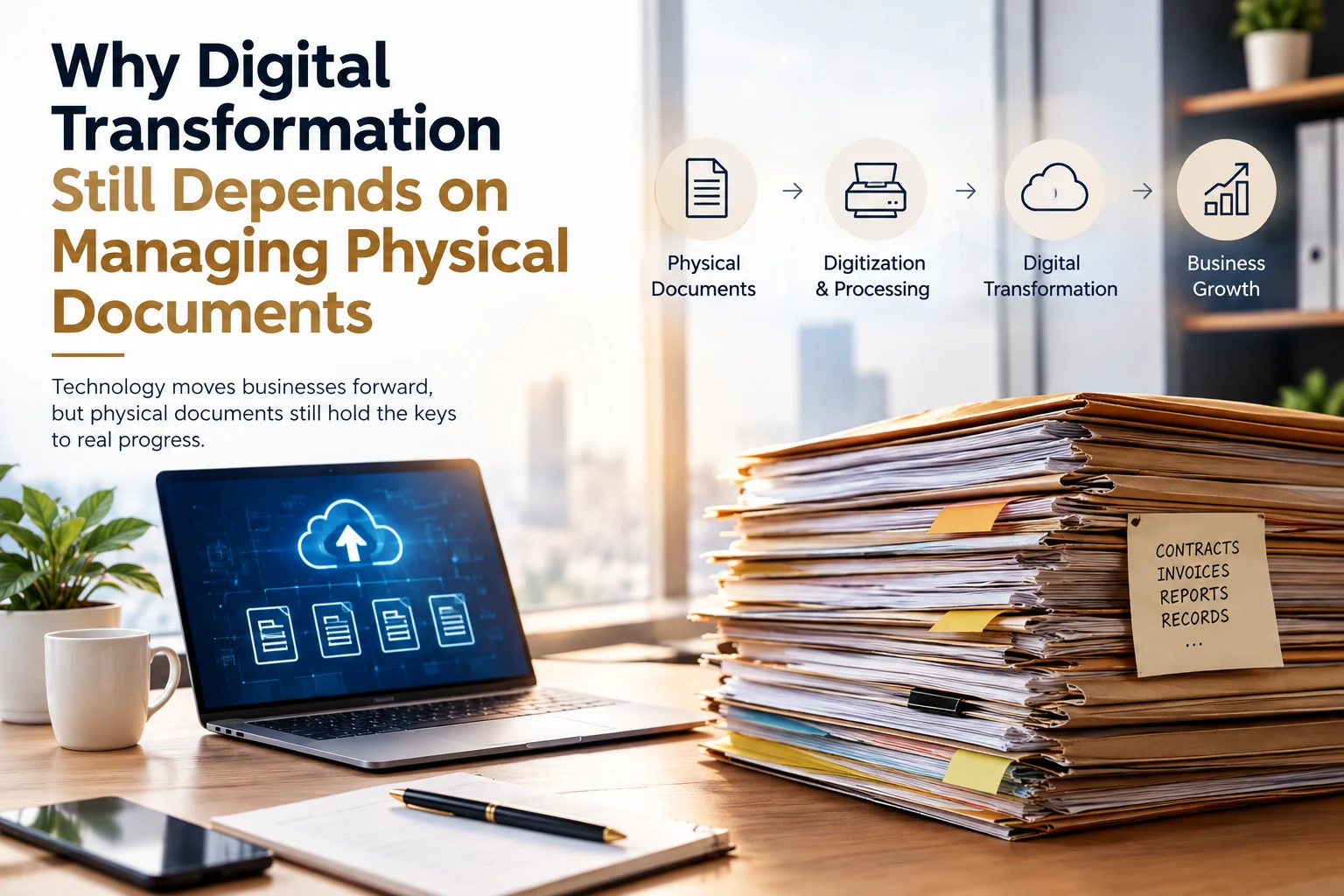
Digital transformation has become a priority for businesses looking to improve efficiency, reduce operational costs, and make better use of information. Cloud computing, artificial intelligence, and automated workflows have changed how organizations manage everyday operations. However, one important part of business infrastructure often receives less attention: physical documents.
Despite widespread investment in digital technology, many organizations continue to rely on paper records for legal, financial, administrative, and regulatory purposes. Contracts, employee files, historical records, and other important documents cannot always be discarded simply because a digital system has been introduced.
Successful digital transformation requires businesses to manage both physical and electronic information. Without a coordinated approach, organizations risk creating fragmented systems that make information harder to access, protect, and maintain.
Digital Transformation Does Not Automatically Eliminate Paper
Businesses are investing heavily in technologies intended to modernize their operations. According to IDC, global spending on digital transformation software is projected to reach $640 billion by 2029. This investment reflects the growing importance of connected systems, automation, and data-driven decision-making.
However, introducing new technology does not immediately eliminate decades of accumulated paperwork. Organizations operating in healthcare, finance, manufacturing, and professional services frequently maintain physical records alongside digital platforms.
Several factors explain why paper remains relevant:
- Regulatory requirements: Certain documents must be preserved for specified periods, and applicable rules may impose additional requirements on their format or authenticity.
- Historical information: Older business records may contain valuable information that has never been digitized.
- Operational continuity: Some organizations still receive original contracts, forms, and correspondence in physical formats.
- Legal documentation: Original signatures and supporting records may need to remain available for verification or legal proceedings.
- Technology limitations: Digitizing every existing document can require substantial time, resources, and quality-control procedures.
These considerations demonstrate why physical document management remains important even as digital adoption increases.
Physical Records Are Part of Information Management
An effective information management strategy considers the entire lifecycle of a document, from its creation and active use to its eventual archiving or authorized destruction.
For businesses maintaining extensive paper archives, organization and accessibility are particularly important. Poorly managed records can create unnecessary administrative work, increase retrieval times, and expose sensitive information to unauthorized access.
This is where document storage services can support a broader information management strategy. Organizations with large collections of archived paperwork can use dedicated storage facilities to preserve records that must remain available but are no longer needed for daily operations. Combined with indexing, retrieval procedures, and retention schedules, this approach allows businesses to maintain physical information without overcrowding their workplaces.
Effective physical document management generally involves:
- Classification: Organizing records according to department, document type, sensitivity, or retention requirements.
- Access controls: Restricting confidential information to authorized personnel.
- Inventory tracking: Maintaining accurate records of document locations and storage history.
- Retention management: Establishing policies for how long different categories of information must be preserved.
- Secure disposal: Destroying records when their retention periods expire, and no legal hold or other obligation requires preservation.
These practices help organizations maintain accountability across both physical and digital information systems.
The Relationship Between Document Management and Data Security
While digital transformation can lead to an increase in cybersecurity, information security is not limited to computer systems. Confidential information stored in physical documents may be identical to that found in databases, as it can include customer, accounting, and personnel data.
It is possible for a company to have high-tech cybersecurity systems in place while at the same time having its confidential documents lying around in drawers without locks.
Physical information security should therefore be addressed through documented procedures, controlled access, employee training, and appropriate storage conditions. Environmental considerations are also relevant. According to the U.S. Environmental Protection Agency, approximately 67.4 million tons of paper and paperboard entered the U.S. municipal solid waste stream in 2018, representing 23.1% of total waste generated that year.
Although these figures cover more than business documents, they illustrate the importance of responsible paper management. Clear retention policies, selective digitization, and appropriate recycling or secure destruction procedures can help organizations avoid retaining unnecessary materials indefinitely.
How Businesses Can Integrate Physical and Digital Records
Managing physical documents effectively does not require organizations to abandon their digital transformation goals. Instead, both systems should operate within a coordinated information governance framework.
Businesses can follow a structured process:
- Conduct a records assessment. Identify existing physical documents, determine their business value, and establish which records require continued preservation.
- Develop retention schedules. Define how long different records must be maintained based on legal obligations, operational needs, and internal policies.
- Prioritize digitization. Focus on frequently accessed documents and records that would benefit most from digital retrieval, collaboration, or automated processing.
- Establish secure storage procedures. Maintain appropriate conditions, accurate inventories, and controlled access for physical records that must be retained.
- Connect physical and digital inventories. Use consistent classification systems and identifiers so employees can determine where records are located, regardless of their format.
- Review policies regularly. Reassess storage needs, retention requirements, security practices, and opportunities for further digitization as business operations change.
This approach helps organizations avoid unnecessary duplication while ensuring that important information remains accessible.
Building a More Complete Digital Transformation Strategy
But the digital revolution should improve the process of managing corporate data through technology, not by substituting paper with technology. Firms ignoring physical documentation will be creating new technologies while facing inefficiencies from old ones.
A more complete strategy recognizes that physical and digital information often coexist for legitimate business reasons. By establishing consistent retention policies, secure storage practices, and coordinated retrieval processes, companies can improve efficiency without compromising information integrity.
In conclusion, modernization can only be achieved if the flow of information in an organization is understood. Companies that can control paper-based files as well as digital files stand in a good position to foster compliance and confidentiality within the organization.

Senior SEO Content Marketing Manager at Trendusai.com
Rashida Hanif is a Senior SEO Content Marketing Manager, specializing in data-driven content strategy and SEO. She helps brands improve online visibility through keyword research, content planning, and AI-powered marketing insights.