
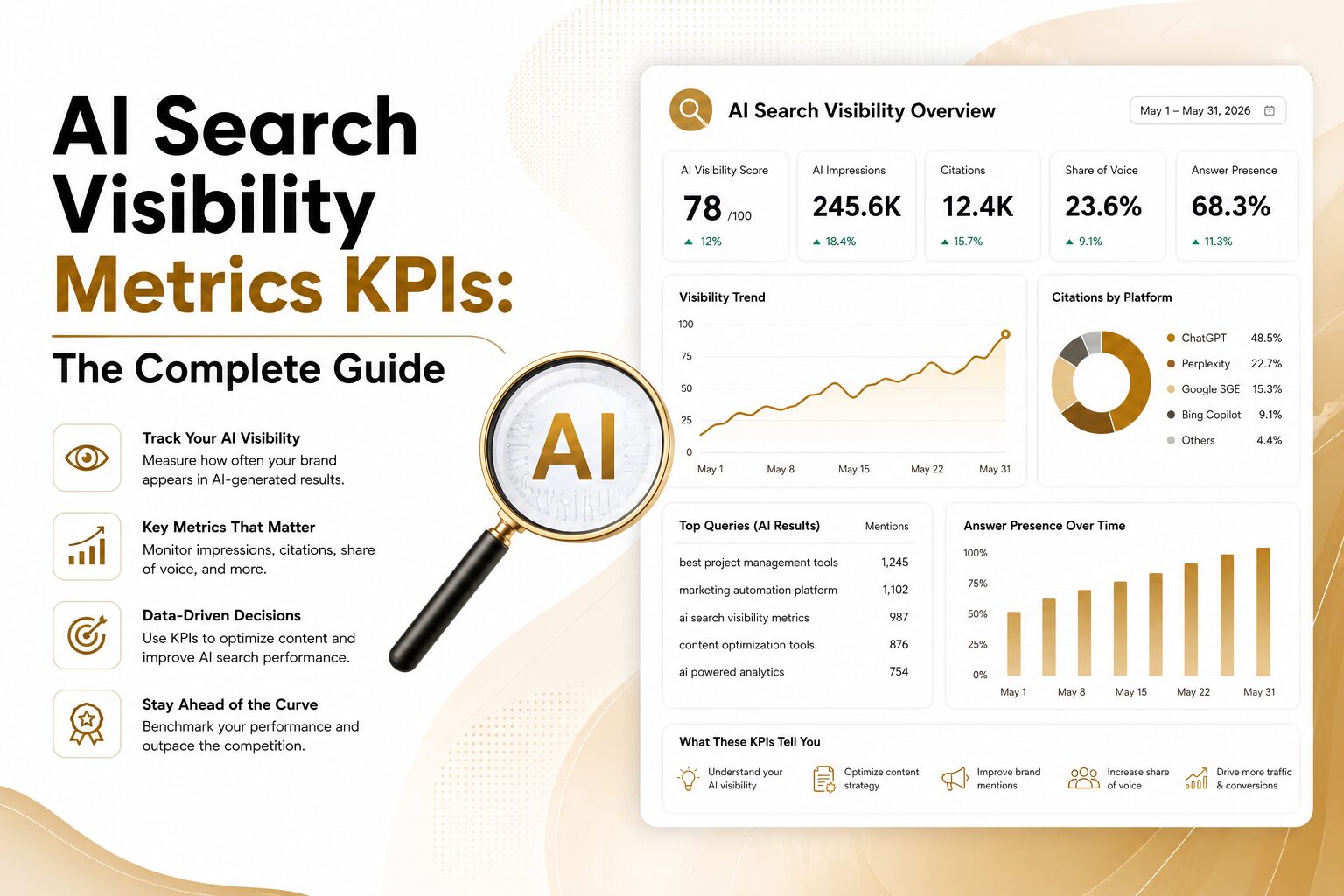
AI Search Visibility Metrics KPIs measure something rankings never had to measure: whether your brand gets mentioned inside an AI-generated answer at all. For two decades, rankings, impressions, and click-through rate told the whole story. AI search runs on a different logic. When someone asks ChatGPT, Gemini, or Perplexity a buying question, your brand either shows up in that answer or it doesn’t, and increasingly, the person asking never clicks through to a website to find out more.
That’s the shift this guide covers. You’ll get eight core AI Search Visibility Metrics KPIs, how each one is calculated, how AI visibility differs from traditional SEO in practice, and a five-step way to start measuring it this month.
Why Traditional SEO Metrics Fall Short
Rankings and organic traffic measure what happens after someone clicks a blue link. AI answers increasingly resolve the question before that click happens. A user can read a full comparison of your product inside an AI Overview or a ChatGPT response and never visit your site, so your session count stays flat while your actual exposure grows underneath it.
Search Console and GA4 weren’t built to isolate this. Google doesn’t cleanly separate AI Overview impressions from standard organic ones, and referrer headers from tools like ChatGPT or Perplexity often get stripped. That sends a chunk of your AI-driven visits straight into the “direct traffic” bucket, where they sit unrecognized rather than showing up as their own channel. The gap is real. It’s structural, and the AI-powered keyword optimization approaches built for traditional ranking factors were never designed to close it.
Clicks are no longer the unit you optimize for. Citations are becoming the new one. That doesn’t make rankings, sessions, or conversions irrelevant — it just means they answer half the question now, and this is where AI Search Visibility Metrics KPIs pick up the other half.
The Core AI Search Visibility Metrics KPIs
A metric without a calculation behind it is a talking point, not a KPI. Each of these eight AI Search Visibility Metrics KPIs comes with a formula or a clear way to measure it.
1. Visibility Rate / Brand Mention Rate Formula: (queries where your brand is mentioned ÷ total queries tested) × 100
Run a fixed set of buyer prompts across ChatGPT, Gemini, Perplexity, and Copilot, then count how many return your brand by name. Most B2B brands land in the low single digits the first time they measure this. A modest starting number here doesn’t mean the program is broken — it’s the honest baseline most people are working from.
2. Citation Frequency & Citation Quality: Citation frequency counts how often your domain or content actually gets sourced inside an AI answer, separate from a name-check. LLMs typically cite only two to seven sources per response, so this shortlist is genuinely competitive to earn a spot on. Quality matters just as much as volume: check whether the AI is pulling from your strongest, most current pages, or from an outdated blog post and a third-party directory you don’t control.
3. Share of AI Voice Formula: (your brand’s mentions ÷ total mentions across all brands in the same prompt set) × 100
Run the identical prompt list against two or three direct competitors and log every brand that gets named. Fifteen mentions can look fine on its own, until you learn a competitor pulled fifty on the same questions. Share of voice is what turns a raw count into a real competitive read, and it’s one of the AI Search Visibility Metrics KPIs that tends to surprise people most.
4. Sentiment / Accuracy Score: Sentiment tracks whether AI describes your brand positively, neutrally, or critically. Accuracy tracks something more urgent: whether the pricing, features, or positioning the AI states about you are correct. A citation that misstates your price does more damage than no citation at all, so this pair deserves a manual read rather than a quick percentage.
5. Source Prominence Score: Citations don’t carry equal weight. A mention placed first in an answer, with a full sentence of context around it, does more work than a name dropped at the end of a list. Score prominence by placement, snippet length, and mention count within a single response — it’s a weighting layer on top of raw citation frequency.
6. AI Referral Traffic is the closest thing to bottom-of-funnel proof among the AI Search Visibility Metrics KPIs. In GA4, build a segment for sessions where source contains chat.openai.com, perplexity.ai, gemini.google.com, or claude.ai. Expect undercounting — stripped referrer headers mean a real share of AI-driven visits will land in direct traffic instead, so treat this number as a floor rather than a ceiling.
7. Prompt Coverage Formula: (prompts where you appear ÷ total prompts in your tracked set) × 100
Visibility rate tells you how you’re doing on average. Prompt coverage tells you where the blind spots actually sit: awareness-stage questions, comparison questions, and decision-stage questions deserve separate scoring, because strong coverage on one stage can hide a total absence on another. This is the same logic behind local search visibility work: a brand can look strong on a headline number while missing entirely from the specific questions that drive a decision.
8. Hallucination / Misattribution Rate Formula: (fabricated or misattributed claims ÷ total claims audited) × 100
This one tracks invented statements about your brand, or content credited to a competitor when it should be yours. It’s the metric most teams skip, and the one with the highest cost to brand integrity when it’s ignored. Catching it early triggers a correction before a wrong claim spreads across more answers.
AI Search Visibility Metrics KPIs vs. Traditional SEO
| Dimension | Traditional SEO | AI Search Visibility Metrics KPIs |
| Primary goal | Rank a webpage in search results | Get cited or mentioned inside AI-generated answers |
| Success metric | Position 1 ranking, organic clicks | Visibility rate, citation frequency, share of AI voice |
| Key signal | Backlinks, keyword relevance, page authority | Entity consistency, source prominence, cross-platform corroboration |
| Attribution | GA4 sessions, CTR, conversions | Prompt-based tracking, AI referral traffic, branded search lift |
How to Measure AI Search Visibility Metrics KPIs
Three practical paths exist, and most teams end up running a mix of the first two.
Manual prompt testing. Open ChatGPT, Perplexity, Gemini, and Copilot side by side. Run the same fixed prompt list once a month. Log whether your brand appeared, whether it was cited with a link, and which competitors turned up alongside you. This costs nothing but time, and it’s the right place to start before committing budget to a platform.
GA4 and Search Console. Build a GA4 segment for AI-referral sources, and filter Search Console’s performance report to branded queries. Neither tool was built for this, so treat both as directional. A rising branded-search trend that tracks alongside a rising citation count is meaningful evidence, even without a clean single-click attribution path.
Dedicated AI-visibility platforms. Tools such as Semrush’s AI Visibility Toolkit, Gryffin, Hatter, and newer entrants like Profound or Otterly automate prompt sampling across platforms and smooth out the week-to-week noise you get from manual spot-checks. They earn their cost once you have budget to actually act on what the data shows about your AI Search Visibility Metrics KPIs. For a broader view of where this tooling category is headed, see AI tools dominating search trends.
5-Step Implementation Playbook
- Baseline audit. Run your prompt set across every major AI platform once, before changing anything, so you have a real starting point rather than a guess.
- Define your prompt set. Map 25 to 100 real buyer questions across awareness, comparison, and decision stages. Five or six questions about your own product name won’t give you an honest read on your AI Search Visibility Metrics KPIs.
- Track core KPIs monthly. Visibility rate, citation frequency, share of AI voice, and sentiment/accuracy are the four to run every cycle at minimum. Add prompt coverage and hallucination rate quarterly.
- Report to leadership in outcome language. “We appear in 34% of prompts” lands flat. “AI tools now recommend us in roughly a third of comparison questions in our category” lands. Pair that with any movement in branded search volume — that combination is what builds a budget case.
- Monitor and iterate. Re-run your full prompt set after major model updates and after any significant content push. AI citation patterns can shift 40 to 60% month over month on the same prompt, so a single bad month is noise. Three consecutive flat or declining months is the signal worth acting on.
Common Mistakes to Avoid
Chasing a single vanity number. A visibility score with no tie to branded search, pipeline, or revenue is a chart nobody outside your team will trust for long.
Counting mentions without reading them. One negative or inaccurate mention can outweigh five positive ones. A spreadsheet full of counts gives you volume without telling you whether that volume is actually helping you.
Skipping competitor benchmarking. Your citation count means little on its own. Run the identical prompt set against two or three named competitors every cycle, or you’re only seeing half the picture.
Treating one AI platform as the whole picture. ChatGPT gets the attention because it’s the biggest, but buyers doing real research lean on Perplexity too, and Gemini rides inside Google itself. Track a single platform,m and you’re likely missing a real share of your actual visibility.
The Bottom Line
Clicks used to be the whole story. Now they’re half of it. The brands adapting fastest treat AI Search Visibility Metrics KPIs as a portfolio — visibility rate, citation frequency, share of voice, accuracy, and referral traffic read together, rather than one dashboard number chased on its own. Start with a baseline audit this month. Track the eight AI Search Visibility Metrics KPIs above on a monthly cadence, and report them to leadership in terms of branded search lift and pipeline. That’s the difference between a metric leadership glances at once and a program that earns a real budget line.
FAQs
What is a good AI search visibility rate?
There’s no universal benchmark — it depends heavily on category and competition density. As a rough starting point, aim for inclusion in 30–40% of your highest-priority, decision-stage prompts once your content and authority signals mature. Most brands start well below that.
How is citation frequency different from brand mention rate?
Brand mention rate counts how often your name appears anywhere in an answer. Citation frequency is narrower — it counts how often your actual content or domain gets used as a source. A brand can be mentioned without being cited, and the reverse happens too.
Can I track AI referral traffic in GA4?
Partially. You can build a segment for known AI-platform sources like chat.openai.com or perplexity.ai, but referrer headers get stripped often enough that a meaningful share of AI-driven visits lands in direct traffic instead. Treat the GA4 number as a floor.
How often should AI Search Visibility Metrics KPIs be measured? Monthly is the standard cadence for the core ones — visibility rate and citation frequency especially. Weekly checks make sense for high-priority prompts during an active campaign, and a full audit is worth repeating after any major model update.
What’s the difference between AEO and GEO?
Answer engine optimization and generative engine optimization get used interchangeably in most current industry writing, both describing the work of optimizing content for inclusion in AI-generated answers. Some practitioners split them further — GEO for the technical and structural side (schema, extractability), AEO for the answer-format side (direct, question-first content).
Do I need a paid tool to start tracking this?
No. A spreadsheet, a fixed prompt list, and an hour a month running that list manually across ChatGPT, Perplexity, Gemini, and Copilot will get you a working baseline on your AI Search Visibility Metrics KPIs. Paid platforms earn their cost once you have budget to act on what the data shows.

Senior SEO Content Marketing Manager at Trendusai.com
Rashida Hanif is a Senior SEO Content Marketing Manager, specializing in data-driven content strategy and SEO. She helps brands improve online visibility through keyword research, content planning, and AI-powered marketing insights.