
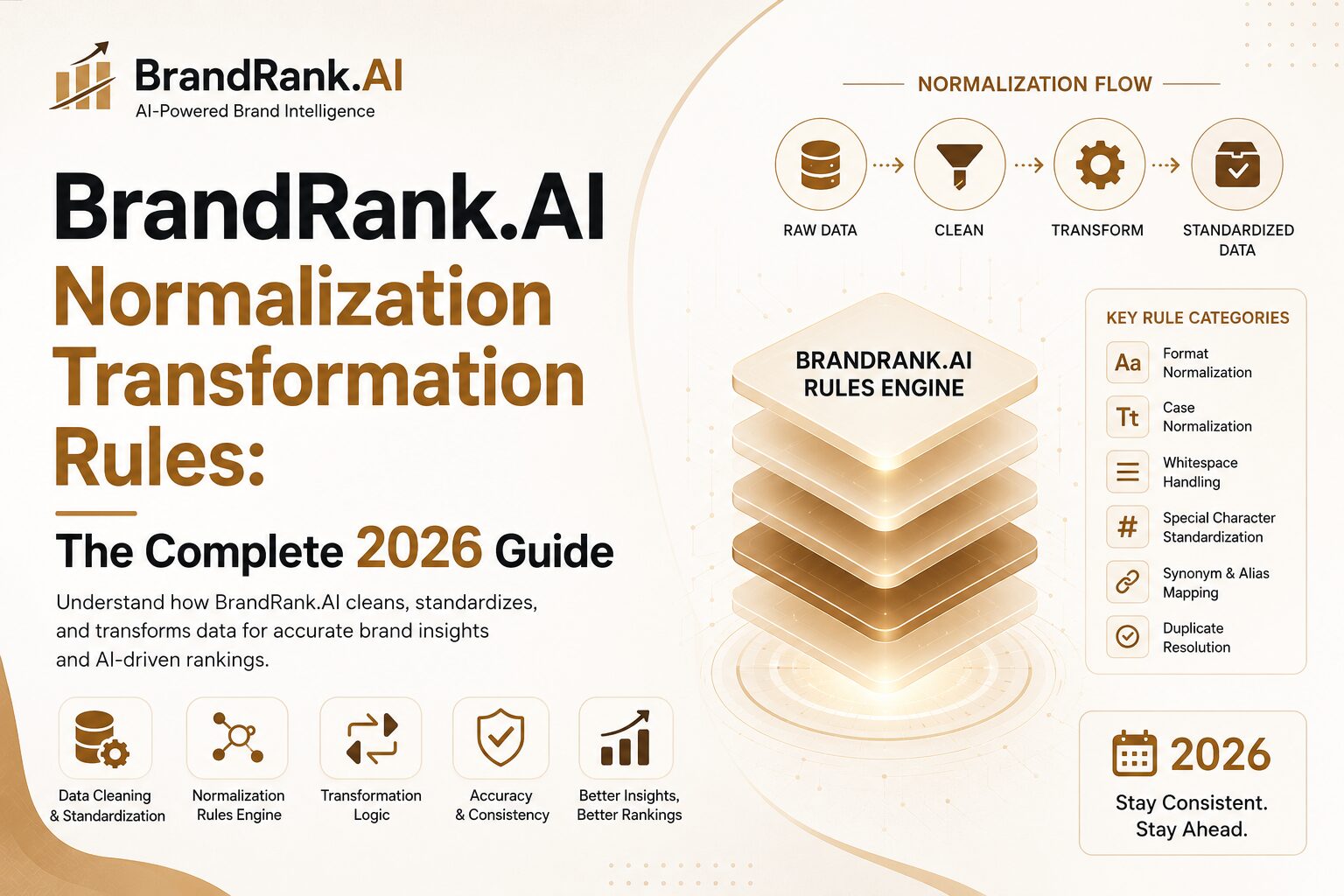
Your brand name looks one way on your website and another way on a directory listing. An AI tool gets asked about your product and either skips you or names you wrong. That’s not a ranking problem. It’s a data problem, and it’s exactly the gap BrandRank.AI normalization transformation rules are meant to close.
AI search tools don’t read pages the way search engines used to. They build a picture of your brand from scattered mentions across the web, and that picture only holds together if the underlying data matches. This guide breaks down what BrandRank.AI normalization transformation rules actually mean, also known in shorthand as brandrank.ai normalization rules, why brand data consistency affects how often AI models cite you, and how brand name normalization rules get applied in practical steps.
What Is BrandRank.AI?
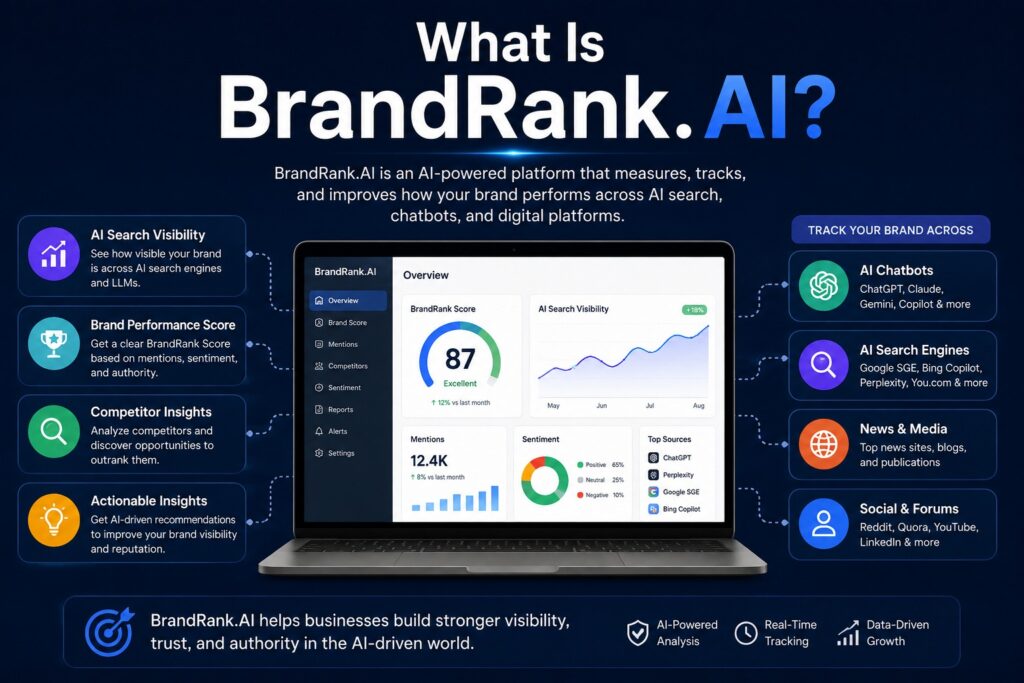
BrandRank.AI is an AI visibility platform that tracks how visible a brand is inside AI-generated answers. It measures three things: AI Search Visibility, Content Readiness, and Brand Vulnerability, sometimes labeled a Risk Score.
AI Search Visibility shows how often and how accurately a brand comes up in tools like ChatGPT, Google Gemini, Perplexity, Meta AI, Claude, and Copilot. Content Readiness scores whether existing content gives a model enough clear, fact-dense content to cite. Brand Vulnerability flags where inconsistent data could cause a model to misidentify a brand or repeat an outdated fact. The platform’s tagline, “Prompting Your Brand Truth,” sums up the goal: one accurate record an AI model can trust. Access comes in three tiers: Scout for basic monitoring, Strategist for deeper diagnostics, and Orchestrator for teams running full normalization work across many properties, including directories like Google Business Profile, Crunchbase, and LinkedIn.
What Are BrandRank.AI Normalization Transformation Rules?
One thing worth saying upfront: BrandRank.AI normalization transformation rules aren’t an officially published technical standard. The phrase is an industry shorthand that’s grown around the platform’s process, and it gets described a little differently depending on who’s writing about it. What follows is the practical version.
Normalization means taking every version of a brand’s data and mapping it back to one canonical form, or official version. If a business shows up online as “BrandRank AI,” “Brand Rank,” and “brandrank.ai,” normalization settles on one standardized format and treats the rest as aliases through entity resolution. Transformation rules are the actual instructions that carry this out, things like replacing an old name with the correct one, running URL standardization through 301 redirects, or stripping a suite number from an address field. They’re called transformation rules because they don’t just flag a problem through entity recognition. They rewrite the record.
How Normalization and Transformation Work Together
Normalization sets the target, the correct version of a name or address. Transformation rules are what get scattered, inconsistent data to that target, following basic data-processing principles. One defines the destination. The other does the entity-resolution work of getting there.
Why Brand Data Consistency Matters for AI Visibility: Being Findable vs. Being Cited
AI models assign something close to an entity confidence score to every brand they come across, built from probabilistic models that weigh how many independent sources agree on the same facts. This is what people mean by cross-platform corroboration, and those corroboration signals decide whether a brand gets cited by name or left out of an answer entirely.
There’s a real difference between being findable and being cited. A brand can show up in a regular search result without ever being trusted enough for an AI model to reference directly in a generated answer. Citation depends on source attribution and entity linkage across sources. If your founding year, product name, or address doesn’t match from one listing to the next, you get confusing fragments instead of one clear entity signal, and a model has no clean citation source to work with. It either repeats whatever version shows up with the highest citation frequency and citation prominence, or it skips the brand. This structural advantage, or lack of it, is the core reason BrandRank.AI normalization transformation rules exist in the first place.
A Simple Example of Brand Normalization
Picture a product called “Wireless Earbuds Pro” on your own site, “Wireless Earbuds Pro” on Amazon, and “WEB Pro Wireless” on a retailer’s page. A person reading all three knows it’s one product. A model scanning structured data at scale can read brand identity fragmentation into it, treating three separate items as three separate entities.
Normalization picks one name and applies it everywhere the product appears, so every mention reinforces the same entity instead of splitting it apart through brand identity splintering. This is a small example, but it’s exactly the kind of digital footprint mismatch BrandRank.AI normalization transformation rules are built to catch.
Data Normalization Beyond Brands
Brand normalization borrows from a discipline that’s been around for decades. SEO teams normalize URLs. CRM systems, meaning customer relationship management platforms, normalize contact records so “John Smith” and “J. Smith” don’t turn into two customers. Business intelligence tools normalize job titles, a process sometimes called job title normalization, before running reporting and analytics. Healthcare systems normalize patient records across providers, and e-commerce platforms normalize product titles across marketplaces using category standardization.
BrandRank.AI applies that same logic to how AI systems perceive a brand, turning scattered mentions into machine-friendly data. The mechanics aren’t new. The target audience, AI models instead of humans or databases, is what’s changed.
How BrandRank.AI Normalization Transformation Rules Work
The process runs in five steps.
Collect data. Pull brand mentions, listings, and structured fields from your site, directories, and third-party listings, including Wikipedia, Wikidata, and the Google Knowledge Panel.
Detecting inconsistencies. Compare records against each other and flag mismatched names, addresses, categories, or product titles that create entity signals a model can’t reconcile.
Apply transformation rules. Rewrite flagged records into the canonical version, correcting higher trust sources first based on source-priority logic.
Validate the results. Confirm the fix displays correctly and nothing else broke, like a schema field pointing at an old URL.
Store clean data. Keep the canonical version in one central record so future updates start from something accurate instead of drifting again, which limits data drift over time.
Types of Transformation Rules
Transformation rules generally split into a few categories: text standardization for spelling and capitalization, duplicate removal for duplicate directory listings, format standardization for dates and phone numbers, entity mapping to link aliases back to one record, and metadata standardization for title tags and schema fields. Location normalization and URL standardization, often paired with 301 redirects, round out the list.
The 8 Core Categories of BrandRank.AI Normalization
- Brand name normalization. One canonical name, everywhere.
- Product and service name normalization. Matching titles across your site and every marketplace.
- Category and taxonomy normalization. Using the same industry language AI models already associate with your business type.
- Location and address normalization. Identical name, address, and phone number, known as NAP data, across every listing.
- Structured data and schema markup alignment. Organization schema, LocalBusiness schema, and Product and Organization schema that match what’s visible on the page, tied together with a working sameAs property.
- Citation and review platform normalization, also called citation and duplicate cleanup. Cleaning up mentions on Reddit, Quora, Yelp, Google Business Profile, Crunchbase, and LinkedIn.
- Historical brand variation management. Making sure an old name from a rebrand, or rebrand residue, doesn’t keep surfacing.
- Cross-language and regional variation normalization. Keeping identity consistent across translated or regional listings.
Together, these eight categories, reinforced by knowledge graph entries in sources like Wikidata and the Google Knowledge Graph, make up most of what people mean when they talk about BrandRank.AI normalization transformation rules in practice.
Normalization vs. Transformation vs. Traditional SEO
| Approach | Main Focus | Who It’s For |
| Traditional SEO | Ranking pages in search results | Search engine crawlers |
| Normalization | Making brand data consistent | AI models and directories |
| Transformation | Executing the fix across sources | Teams and automated pipelines |
SEO hasn’t gone away. It’s just not the whole picture anymore, and AI models pull from entity resolution and structured data as much as they pull from page rank.
Database Normalization: Normal Forms Explained
The word “normalization” has a formal, older meaning in database design worth knowing, since it’s the root of this whole concept.
First Normal Form, or 1NF, requires each field to hold a single value, with no repeating groups in one column. Second Normal Form, or 2NF, removes partial dependencies, so every non-key field depends on the whole primary key, not just part of it. Third Normal Form, or 3NF, removes transitive dependencies, meaning non-key fields depend only on the key. Boyce Codd Normal Form, or BCNF, is a stricter version of 3NF for cases where multiple candidate keys overlap.
Some systems intentionally break these rules on purpose, storing repeated data to speed up reporting. That trade-off makes sense for internal databases where database integrity and update anomalies are the main concern. It doesn’t work for brand data meant to be read by outside AI models, where consistency matters more than query speed.
Statistical Normalization: Scaling Numerical Data
In data science, normalization also means rescaling numbers so they can be compared fairly. Min-Max normalization rescales values into a fixed range, usually zero to one. Z-score normalization rescales based on distance from the average, measured in standard deviations. Decimal scaling, robust scaling, log transformation, and unit vector normalization cover other cases, like data with outliers or skewed distributions.
How BrandRank.AI Normalization Differs from Database Normalization
Database normalization keeps a system efficient and free of update anomalies. BrandRank.AI normalization keeps brand facts consistent enough for an outside model to trust and cite. One protects internal database integrity. The other protects entity confidence in the eyes of a model reading from the outside, using the same AI training data patterns a model was built on. Same word, same general logic, different audience.
How BrandRank.AI Measures the Effect of Normalization
The platform tracks four things after normalization work goes live. The AI Search Visibility Score shows how often and how accurately AI tools mention the brand. The Content Readiness Score rates how citable existing content is based on structure and factual claim density. The Brand Vulnerability or Risk Score, sometimes described as brand risk scoring, flags where inconsistent data could still cause misrepresentation. Competitive Benchmarking compares a brand’s visibility against direct competitors in the same category.
AEO vs. SEO, and Where GEO Fits
| Term | What It Optimizes For | |
| SEO | Ranking in search engine results pages | |
| AEO (Answer Engine Optimization) | Being the source an AI model pulls an answer from | |
| GEO (Generative Engine Optimization) | Being named inside a generated AI response |
AEO and GEO overlap heavily, and people use the terms almost interchangeably. Both rely on the same base requirement: clean, consistent, well-structured brand data a model can confidently attribute to you. Getting there usually means setting up an internal governance process, complete with trust levels for different sources and an escalation path for disputed data, closer to AI governance than classic marketing. This is where BrandRank.AI normalization transformation rules do most of their work, and where some people start describing the whole space as the Answer Economy.
Practical Tips for Implementation
Pick one canonical brand name and write it down before touching anything else. Build an exceptions list first, since some directories need slightly different formatting on purpose. Audit your top touch points before trying to fix two hundred listings at once. Never overwrite raw data without archiving the original.
Sequence your rules deliberately, correcting your highest trust sources before smaller directories copy the error further. Treat sources differently based on trust levels, since a Wikipedia entry doesn’t carry the same weight as an obscure directory. Add a real @sameAs property in your Organization schema pointing to verified profiles. Match your category language to how AI models already describe your industry, watching your historical content volume for anything that no longer fits.
Fix address formatting across every listing at once, not one at a time. Don’t let an old brand name linger after a rebrand, since that’s how brand identity splintering starts. Normalize on an ongoing basis instead of once a year, to keep data drift low. Validate every change before it goes live. Give models concrete, checkable statements to cite, not vague marketing language. Monitor and validate results instead of assuming a fix worked.
A Simple Way to Apply These Rules
Start with an audit. Create a canonical brand record. Fix your own pages first, then move to your top authority third-party listings. Add precise schema markup. Test real customer queries against AI tools to see what comes back. Repeat the audit every quarter, since new listings and mentions keep appearing.
BrandRank.AI Implementation Playbook
Conduct a brand entity audit, listing every place your brand appears and noting mismatches. Define a canonical brand data set that becomes your single source of truth. Implement and verify schema markup so it matches what’s visibly written on the page. Audit and correct third-party listings, prioritizing the ones with the most authority. Align content strategy with how AI models actually cite brands, favoring specific claims over vague ones. Build a small PR and citation strategy so outside sources back up your canonical data through stronger corroboration signals. Monitor, measure, and repeat the process, since this isn’t a one-time fix.
Where Content Creation Fits In
Clean data gives a model something accurate to cite. Content gives it something worth citing. A page written with fact-dense content and clear, checkable statements gives a model a specific citation source to pull from. A content library audit usually turns up pages that read fine to a person but carry almost no factual claim density, and read as flat in sentiment besides. Vague, promotional copy gives a model nothing usable in an AI-generated answer, no matter how clean the schema underneath it is.
Assign a Human Owner
Normalization needs a human owner, not just a tool. Content and SEO teams handle on-page consistency and schema. Technical and web teams handle structured data and site-level fixes. Brand and PR teams handle how the company gets represented on third-party listings and in the press. Without someone owning it, and without a clear escalation path when sources disagree, inconsistencies creep back in as new pages and listings get created.
Common Normalization Failures That Hurt AI Visibility
An incomplete rebrand is the most common one, where rebrand residue, an old name that keeps surfacing, was never fully cleaned from directories. Product name fragmentation happens when the same item gets listed under several titles. Vague content gives a model nothing specific to reference. Ignoring platforms like Reddit and Quora leaves out sources AI models weigh heavily. And with no clear owner of AI visibility inside a company, small errors sit unnoticed until they show up in an actual answer.
Mistakes to Avoid
Merging unrelated businesses into one entity without checking that location, domain, and product actually match. Treating every online mention as if it were a citation, when much of it is just noise with no real citation probability behind it. Writing schema markup that claims facts not actually visible on the page. Fixing the website while ignoring review platforms that carry just as much weight. Expecting results overnight, when normalization usually takes sustained effort.
How to Tell If It’s Working
Watch whether AI tools start naming your brand consistently across repeated queries, a sign of rising citation probability. Spot-check whether your name, address, and category data match across touchpoints, including third-party listings and duplicate listings you may have missed the first time. Track whether new inconsistencies slow down over time instead of piling up, and whether entity linkage across your listings keeps getting stronger.
Conclusion
Brand normalization is turning into one of the more overlooked parts of digital strategy, and part of a wider shift some people call the Answer Economy. Broader brand measurement research, from groups like the ANA and firms such as Burke Inc., has studied similar consistency problems for years, just not with AI citation in mind. As more people ask AI tools for answers instead of typing a search query, brands with clean, consistent data are the ones that get named. BrandRank.AI normalization transformation rules describe a real process for getting there, even if the label itself is shorthand rather than an official standard. Define your canonical facts, fix your highest impact sources first, put a human owner in charge of it, and monitor and validate the work regularly instead of assuming it’s done.
Frequently Asked Questions
What are BrandRank.AI normalization transformation rules?
They’re the process used to make a brand’s name, address, category, and product data consistent across the web so that AI models can recognize and cite the brand correctly.
Is BrandRank.ai normalization transformation rules an official product name?
No. It’s a working, industry term. BrandRank.AI is a real platform, but this exact phrase isn’t a formally published technical standard.
How do BrandRank.AI normalization transformation rules improve AI search visibility?
By cutting down conflicting data across sources, which raises entity confidence and increases citation probability for a given brand.
What is AI search visibility?
It’s how often, and how accurately, a brand appears when people ask AI tools questions related to its industry or products.
How is AI search optimization different from traditional SEO?
Traditional SEO ranks a page in search results. AI search optimization decides whether a model trusts your data enough to name you inside a generated answer.
Does this replace SEO?
No. It works alongside SEO. Consistent brand data supports both traditional rankings and AI citations at the same time.
Can BrandRank.AI normalization transformation rules improve SEO?
Indirectly, yes. Clean NAP data, aligned schema markup, and fewer duplicate listings tend to help traditional rankings too, even though the main goal is AI citation.
Can BrandRank.AI normalization transformation rules be automated?
Parts of it can, like detecting inconsistencies and applying text standardization. Judgment calls, like which source to trust, still need a person.
Is BrandRank.AI designed for marketers or data engineers?
Both, in different ways. Marketers use it to manage brand entity data and citation strategy. Technical teams use it for schema markup, entity mapping, and site-level structured data.
How quickly do normalization improvements show up?
There’s no fixed timeline, since it depends on how many sources need correcting and how often AI models refresh their view of a brand. Sustained, ongoing normalization tends to show results faster than a one-time cleanup.
Do Reddit and Quora mentions improve AI citation?
They can, since AI models weigh community platforms alongside official sources when building entity confidence. Ignoring them is one of the common normalization failures listed above.
What is the role of the sameAs property in schema markup?
It links your Organization schema to verified external profiles, like Wikidata or a Google Knowledge Panel entry, which helps a model corroborate your identity across sources.
Which brands benefit most from BrandRank.AI normalization?
Brands with a history of rebrands, multiple product lines, or a lot of third-party listings tend to see the clearest benefit, since they have the most to clean up.
Do small brands need this, or only enterprises?
Smaller brands usually have fewer listings to fix, which makes the process faster, not less necessary.
What’s the single highest impact fix to start with?
Pick one canonical brand name and correct your highest authority listings first, since those get copied and cited the most.
Can a tool fully automate normalization, or does it still need a human?
Tools can flag and apply many fixes at scale. A human owner still needs to set the canonical standard, review exceptions, and decide which sources to trust most.

Senior SEO Content Marketing Manager at Trendusai.com
Rashida Hanif is a Senior SEO Content Marketing Manager, specializing in data-driven content strategy and SEO. She helps brands improve online visibility through keyword research, content planning, and AI-powered marketing insights.