Phone lines ring all day. Callers sit on hold while agents answer the same 10 questions, and after hours the calls go to voicemail. AI voice agents can pick up those calls, respond in a human tone, and hand harder calls to a person. Buying one is the hard part. The pricing page shows one number, and the real bill has four or five. This guide compares 10 AI voice agents for customer service and lays out a plan for testing one. Prices are checked in September and October 2026. Confirm with each vendor before you sign.
Why AI Voice Agents Matter for Customer Support in 2027
AI voice agents for customer support answer calls. They find out what the caller needs and finish simple tasks. Teams use them as AI customer service agents for the repeat calls that fill a queue.
The Growing Role of AI in Customer Service
Gartner predicts that agentic AI will resolve 80% of common customer service issues without a human by 2029, with a 30% cut in operating costs. Those are forecasts. A 2026 roundup from Lorikeet reports that only 14% of issues resolve through self-service today. Plan for steady gains and measure each step.
Why Businesses Are Moving Beyond Traditional IVR Systems
Old phone menus ask callers to press 1, then 2, then 3, and a caller with an odd request has nowhere to go. Conversational AI voice agents let people speak in full sentences. Natural language understanding finds the request, and automated call routing sends the caller to the right place.
How AI Voice Agents Help Manage High Call Volumes
A person takes one call at a time. A voice agent can take many at once. Retell, for example, lists 20 free concurrent calls on pay-as-you-go, with more at extra cost. Busy hours become a budget question instead of a hiring problem.
The Benefits of 24/7 Automated Customer Support
The benefits of AI voice agents start with coverage. Calls at 2 a.m. get answered, callers get automated phone support for simple tasks, and your team starts the day with post-call summaries instead of a voicemail pile.
Where AI Voice Agents Still Need Human Support
The limitations of AI voice agents are real. Angry callers, billing disputes, and rare cases need a person. The same Lorikeet roundup says 64% of customers wish companies would stop using AI in support, so give every caller an easy path to a human.
What Are AI Voice Agents and How Do They Work?
What Is an AI Voice Agent?
What are AI voice agents? Software that talks with callers by phone. They listen, decide, speak, and act inside your tools. Vendors also call them AI phone agents, voice bots for customer service, or an AI voice assistant for customer support.
How AI Voice Agents Understand and Respond to Customers
How AI voice agents work is a loop. The caller speaks. Speech-to-text turns the audio into words. A language model works out customer intent and writes a reply. Text-to-speech says the reply aloud. Voice activity detection spots when the caller stops talking, which keeps multi-turn conversations steady.
The Role of Speech Recognition, LLMs, and Text-to-Speech Technology
Automatic speech recognition (ASR) sets speech recognition accuracy. Large language models (LLMs) shape the answer. Text-to-speech (TTS) sets how human-like the voice sounds. Natural language processing (NLP) ties the steps together. Real-time voice processing keeps delays short, which matters for low-latency voice responses.
How AI Voice Agents Connect With CRMs and Helpdesk Systems
Function calling lets an agent act inside your tools. It can look up an order, update a ticket, or book a slot. That is how AI voice agents integrate with CRM systems and helpdesks through API integrations. CRM integration brings customer data retrieval. Helpdesk integration adds ticket updates and other real-time system actions. SIP trunking or WebRTC links the agent to your telephony infrastructure.
AI Voice Agents vs. Traditional IVR vs. Human Agents
Treat AI voice agents vs. human agents as a split of work. Agents handle routine calls, and people handle judgment calls. AI voice agents vs. traditional IVR comes down to speech versus keypad menus.
| Feature | Traditional IVR | AI voice agents | Human agents |
| How callers speak | Keypad or set phrases | Natural speech | Natural speech |
| Hours | 24/7 | 24/7 | Shifts |
| Unusual requests | Weak | Varies by setup | Strong |
| Empathy and judgment | None | Limited | Strong |
| Cost model | License fee | Usage or per resolution | Wages and training |
AI Voice Agents vs. AI Chatbots
Chatbots type. Voice agents speak, so they must handle accents, background noise, and interruptions. Many vendors sell both, which supports omnichannel customer support. Chatbase, Zendesk, and ElevenLabs all pair voice with chat.
What to Look for in a Future-Ready AI Voice Agent
The features of AI voice agents differ more than sales pages suggest.
Natural-Sounding Voices and Real-Time Conversations
Skip the demos and listen to real calls. Look for human-like voice conversations that survive interruptions. Real-time conversational AI should let a caller cut in without losing the thread.
Low Latency and Accurate Responses
Long pauses make callers talk over the agent. Retell describes its response time as sub-second, but speed shifts with the model and carrier you pick. Test low-latency voice responses on your own phone numbers.
Multilingual Support and Accent Recognition
List your caller languages first, then test accents, since multilingual customer service automation depends on speech recognition and voices in each language. Retell lists 30+ languages and Cognigy lists 100+. Both are vendor claims.
CRM, Helpdesk, and Telephony Integrations
Ask for named connectors. Check Salesforce, Zendesk, Genesys Cloud CX, Five9, and Talkdesk if you use them. Confirm SIP trunking support if you keep your own carrier.
Real-Time Human Handoff and Call Transfers
Live agent transfer should pass the transcript and caller details to the person. Retell describes warm transfer with full context. Test human handoff on a hard call.
Knowledge Base Access and Context-Aware Responses
Knowledge-grounded responses cut wrong answers, so the agent should read from your approved knowledge base. Context-aware responses also need caller history from your CRM.
Security, Privacy, and Compliance Controls
Ask for SOC 2 reports, HIPAA terms, data retention settings, and identity verification options. AI voice agent security also covers call recordings and staff access. Some vendors charge extra. One pricing review lists Vapi’s HIPAA option at $2,000 a month.
Scalability, Reliability, and Customization
Check concurrency limits, uptime terms, and how fast you can change voice agent workflows. Production-ready voice agents need version history and a way to roll back a bad update.
Analytics, Call Transcripts, and Performance Reporting
You need call transcription, post-call summaries, and conversation analytics. AI agent performance analytics should show resolution, transfers, and failures by call type.
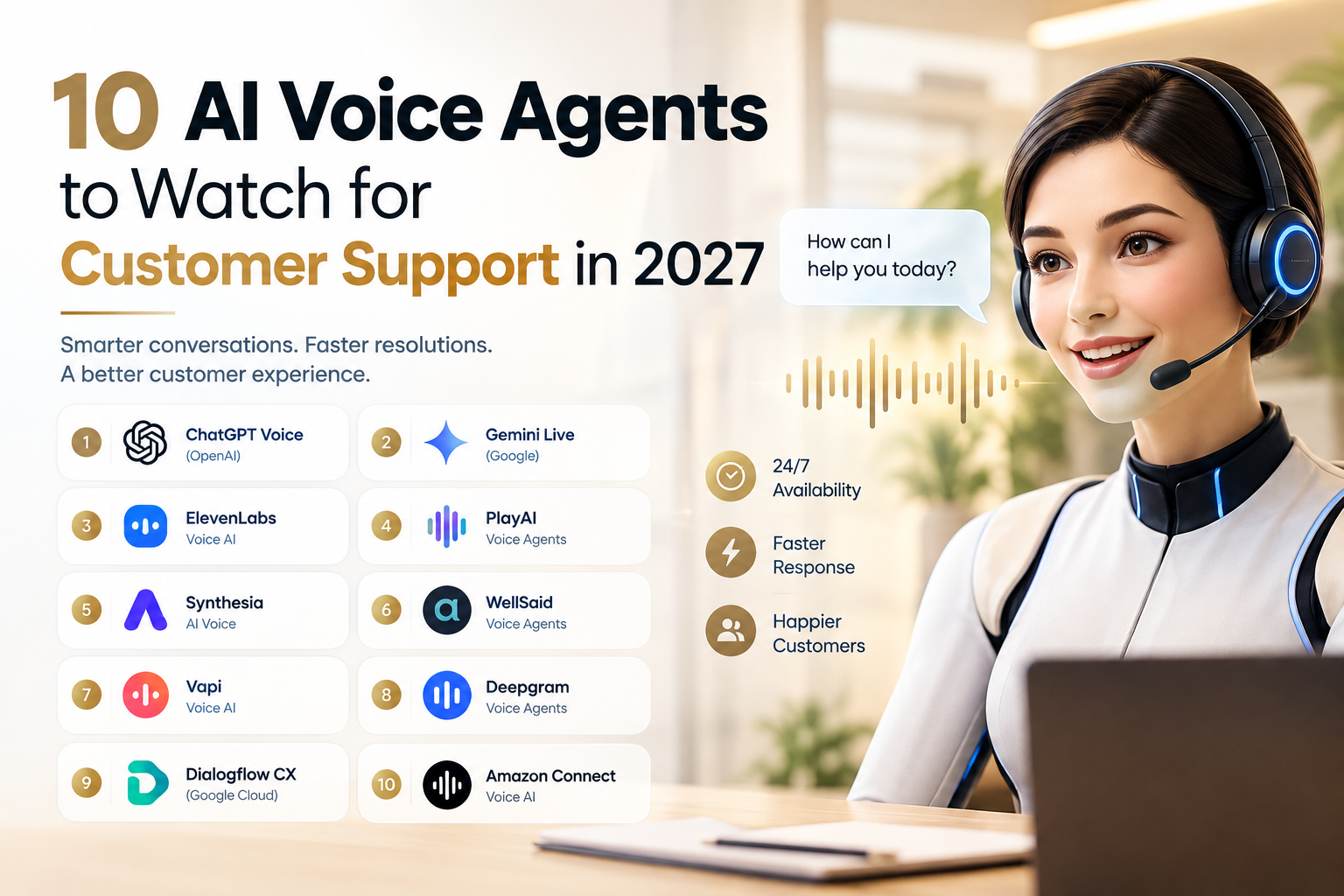
10 AI Voice Agents to Watch for Customer Support in 2027
Pricing and features come from vendor pages and 2026 reviews checked in September and October 2026. Vendors change plans often, so treat every number as a starting point.
1. Retell AI: For Real-Time AI Phone Conversations
Retell AI is a developer-friendly platform for AI phone agents. It manages turn-taking, interruptions, voicemail detection, and warm transfer. You pick the LLM, voice, and carrier. Retell lists SOC 2 Type II, HIPAA, and GDPR compliance and connects to your own carrier through SIP trunking.
Retell lists pay-as-you-go pricing with no platform fee. The final rate adds voice infrastructure, the LLM, and telephony. Extras such as AI quality assurance cost more, and enterprise pricing is custom. Retell has no native CRM, so you connect your own.
Pros: clear per-minute pricing, warm transfer, call analysis, and simulation testing. Cons: modular billing makes budgets harder to predict. Best for: startups and midsize teams with a developer.
2. PolyAI: For Enterprise Customer Service
PolyAI builds voice assistants for enterprise contact centers. One review lists native connections with Genesys, NICE, Avaya, Cisco, and Amazon Connect. Callers speak in their own words, and the agent can pass the call to a person when needed. PolyAI says its per-minute pricing includes maintenance and support.
PolyAI doesn’t publish rates. Third-party guides estimate six-figure annual contracts, and one review reports 4 to 6 weeks to implement. Expect a sales process.
Pros: natural voice, managed service, contact center integrations. Cons: no public pricing and a slower start. Best for: large contact centers with steady call volume.
3. ElevenLabs ElevenAgents: For Natural-Sounding Voice Experiences
ElevenAgents builds on ElevenLabs voice technology. You can create agents for voice, chat, and email, and choose among several LLMs. ElevenLabs publishes its plans, which a 2026 review lists from $6 to $990 a month. Minutes past your plan cost $0.08 each, and text messages cost $0.003. Silent stretches bill at 5% of the usual minute rate.
The LLM and your phone carrier cost extra. ElevenLabs lists SDKs for Python, JavaScript, React, and Swift, plus a WebSocket API.
Pros: published pricing, strong voice focus, multichannel agents. Cons: carrier and model costs sit outside the plan. Best for: teams that want a polished voice and can handle some setup.
4. Vapi: For Developers Building Custom Voice Agents
Vapi is built for developers. You choose the speech-to-text, LLM, text-to-speech, and telephony providers, and Vapi runs the call flow. It charges a $0.05 per minute hosting fee, and providers bill at their own rates on top. If you bring your own provider keys, you pay those vendors directly.
Pros: control over every part of the stack. Cons: needs engineers, and costs are spread across vendors. Best for: developers and product teams building custom voice agent workflows.
5. Synthflow: For No-Code Voice Automation
Synthflow lets teams build voice agents with visual workflows and little code. Two 2026 guides say the old monthly plans are gone, leaving pay-as-you-go and enterprise contracts. One guide lists enterprise contracts from $30,000 a year and typical all-in costs of $0.13 to $0.24 per minute.
Some guides list a voice engine rate near $0.09 per minute, with the LLM and telephony added on, and optional features cost more. Confirm your CRM is on the integration list before you commit.
Pros: quick to build, white-label options for agencies. Cons: pricing changes often, and the enterprise floor is high for small teams. Best for: teams without engineers and agencies at midsize volume.
6. Chatbase: For AI-Powered Customer Support
Chatbase started as a no-code tool for support agents trained on your own content. A 2026 review says voice agents launched in April 2026. One pricing guide says voice and telephony open at the Standard tier.
Message credits drive costs, and one reply can use several credits. Extra AI agents cost more. Chatbase lists connections to Stripe, Zendesk, Shopify, HubSpot, Slack, and WhatsApp. Training on your knowledge base suits order questions and policy answers.
Pros: easy setup, voice and chat in one place. Cons: voice is newer, and credit math takes effort. Best for: small and midsize ecommerce and SaaS support teams.
7. NiCE Cognigy: For Complex Contact Center Operations
Cognigy.AI is an enterprise platform for voice and chat AI agents, now part of NiCE. It includes Voice Gateway for phone connections, Knowledge AI, and Agent Copilot for human agents. The AWS Marketplace listing cites 100+ languages, 30+ channels, and 100+ prebuilt integrations. Cognigy says it was named a Leader in the 2026 Forrester Wave for conversational AI platforms for customer service.
Pricing is custom and varies by channels, LLM workload, and add-ons. One review lists SaaS, private cloud, and on-premises options. Plan for governance work, testing, and a longer setup than self-serve tools.
Pros: scale, governance, human and AI teamwork. Cons: setup effort and no public pricing. Best for: large, complex contact centers in regulated fields.
8. Parloa: For Enterprise AI Customer Conversations
Parloa sells an AI Agent Management Platform. Teams design, test, deploy, and monitor agents from one place, with a focus on voice. A software directory lists ISO, SOC 2, PCI DSS, HIPAA, and DORA compliance. Another listing says Parloa can sit on top of Genesys, Avaya, or Five9 setups.
Parloa doesn’t publish prices and sells through sales. Per one listing, it runs in the cloud with no self-hosted option. Hotels use it for reservation and loyalty calls, and insurers and utilities use it for high-volume inbound calls.
Pros: lifecycle tools, agent orchestration, and simulation before launch. Cons: no public pricing and cloud-only. Best for: midmarket and enterprise teams with large inbound volume.
9. Salesforce Agentforce Voice: For Salesforce-Based Support Teams
Agentforce Voice runs inside Salesforce, so agents use your CRM data on every call. Salesforce lists Flex Credits at $500 per 100,000 credits. A standard action uses 20 credits, or $0.10. A voice action uses 30 credits, or $0.15. An older flat $2 per conversation model still applies to some customers.
Salesforce Voice for human agents is priced per user: $50 with your own telephony, or $75 with 750 Amazon Connect minutes. You need Salesforce licenses and setup time. Per one licensing guide, Flex Credits and conversation pricing can’t run in the same org.
Pros: native customer data, one vendor for CRM and voice. Cons: action-based billing is hard to forecast. Best for: teams already deep in Salesforce.
10. Zendesk Voice AI: For Customer Support Workflows
According to pricing guides, Zendesk added AI agents to every Suite and Support plan in May 2026. Suite Team costs $55 per agent each month, and Suite Professional costs $115, billed annually. Plans include 5 to 15 automated resolutions per agent each month, depending on tier.
One guide says voice AI agents became generally available in September 2026. It lists charges for resolutions, telephony minutes, an AI agent connection fee, and call recording. Calls can escalate to a person with a transcript and summary. The same guide reports $1.50 to $2.00 per resolution after the allowance. Zendesk’s pricing page may show different figures, so check it.
Pros: works with Zendesk tickets, summaries, and escalation. Cons: layered costs. Best for: teams already on Zendesk.
Quick Comparison of the 10 AI Voice Agents
This AI voice agents comparison matches tools to team types. Pick the row that fits yours.
Best AI Voice Agent for Small Businesses
Chatbase and Synthflow suit small teams that want to build without code. Retell fits if one developer can help. Check each price page, since small plans change often.
Best AI Voice Agent for Enterprise Contact Centers
PolyAI, NiCE Cognigy, and Parloa target large teams. All three use custom pricing, so budget for a sales process and a pilot.
Best AI Voice Agent for Developers
Vapi lets you pick every provider in the stack. Retell and ElevenLabs also offer APIs and flexible model choices.
Best AI Voice Agent for Multilingual Support
Cognigy lists 100+ languages and Retell lists 30+. Test your own languages and accents before you choose.
Best AI Voice Agent for CRM Integration
Agentforce Voice fits Salesforce shops. Zendesk Voice AI fits Zendesk shops. Others connect through API integrations and function calling.
Best AI Voice Agent for No-Code Automation
Synthflow and Chatbase let non-developers build agents. Parloa and Cognigy offer low-code tools with more setup.
| Platform | Best use case | Deployment options | Voice and language capabilities | Integration support | Pricing model | Main limitation |
| Retell AI | Real-time phone agents | Cloud, SIP trunk | 30+ languages (vendor claim) | CRMs, Twilio, Vonage, Telnyx | Per minute, modular | Budget is harder to predict |
| PolyAI | Enterprise contact centers | Cloud | Natural voice, confirm languages | Genesys, NICE, Avaya, Cisco, Amazon Connect | Custom, per minute | No public pricing |
| ElevenLabs ElevenAgents | Voice quality, multichannel | Cloud | Multilingual, confirm list | SDKs, WebSocket API | Plan plus $0.08 per extra minute | Carrier and LLM billed extra |
| Vapi | Custom builds | Cloud API | Depends on chosen providers | API, function calling | $0.05 per minute plus providers | Needs engineers |
| Synthflow | No-code automation | Cloud | Multilingual, confirm list | CRM and business tools | Per minute, enterprise contract | Pricing changes, high enterprise floor |
| Chatbase | Support with chat and voice | Cloud | Depends on chosen model | Stripe, Zendesk, Shopify, HubSpot, Slack, WhatsApp | Monthly plan with credits | Voice is newer |
| NiCE Cognigy | Complex contact centers | SaaS, private cloud, on-premises | 100+ languages (vendor claim) | 100+ prebuilt integrations | Custom | Setup effort |
| Parloa | Enterprise voice conversations | Cloud only | Multilingual, confirm list | Genesys, Avaya, Five9 | Custom | No public pricing |
| Salesforce Agentforce Voice | Salesforce teams | Salesforce cloud | Voice actions, confirm languages | Salesforce CRM data | Flex Credits or per user | Needs Salesforce |
| Zendesk Voice AI | Zendesk teams | Cloud | Confirm voice AI languages | Zendesk tickets | Per agent plus per resolution | Layered costs |
Where the table says confirm, I found no reliable public list. Ask the vendor.
Best AI Voice Agents by Industry
Each field has its own call types and rules. Match platform strengths to yours, from AI voice agents for businesses of ten people to those of ten thousand.
AI Voice Agents for Ecommerce Customer Support
Most ecommerce calls ask where an order is. Automated order status calls and return requests suit voice agents. Chatbase lists a Shopify app, and Zendesk and Salesforce fit teams that already run orders there.
AI Voice Agents for SaaS and Technology Companies
An AI agent for technical support needs a clean knowledge base and ticket access. Developer platforms like Vapi and Retell let you build custom flows. Zendesk Voice AI suits SaaS teams already on Zendesk.
AI Voice Agents for Healthcare Appointment Support
AI-powered appointment scheduling is a common use case. Ask for a signed HIPAA business associate agreement before any patient data moves. Retell lists HIPAA support, and Vapi lists a paid HIPAA option.
AI Voice Agents for Banking and Financial Services
Banks need identity verification, audit trails, and strict controls. Parloa lists PCI DSS and DORA compliance. PolyAI and NICE Cognigy target enterprise contact centers. Keep people in the loop for disputes and fraud.
AI Voice Agents for Travel and Hospitality
Hotels and airlines get bursts of calls about bookings and changes. Parloa lists reservation management and loyalty questions in hotel contact centers. Multilingual support matters for guests.
AI Voice Agents for Retail and Order Management
Retail calls cover stock checks, store hours, and delivery changes. Voice agents with real-time system actions can update orders. Set limits on refunds the agent can approve alone.
AI Voice Agents for Small Businesses and Local Services
Small shops need an AI receptionist for businesses that answers, books, and takes messages. Many owners look for the best AI phone answering service. Compare per-minute and flat plans against your real call minutes.
Real-World Customer Support Tasks AI Voice Agents Can Handle
Start with tasks that have clear answers, the usual entry point for AI voice automation.
Answering Frequently Asked Customer Questions
Store hours, return rules, and plan limits are easy wins. Knowledge-grounded responses keep answers matched to your policy.
Checking Order Status and Delivery Updates
The agent reads an order number, checks your system, and gives the delivery update. That is a classic customer support phone automation task.
Booking, Rescheduling, and Confirming Appointments
Agents book, move, and confirm slots in your calendar. Reminder calls can confirm visits before they happen.
Handling Returns, Refund Requests, and Cancellations
The agent opens a return, checks the policy, and sends a label. Cap refund amounts and send larger cases to a person.
Routing Calls to the Right Department
Customer intent detection picks the right team. Intelligent call handling beats a menu of ten options.
Providing Basic Account and Billing Assistance
Balance checks, invoice copies, and payment dates are common asks. Use identity verification before sharing account details.
Supporting Customers Outside Business Hours
Evening and weekend callers get answers or a booked callback instead of voicemail.
Escalating Complex or Sensitive Issues to Human Agents
Sensitive or complex issues go to a person with a post-call summary and transcript, so the caller doesn’t repeat the story.
AI Voice Agent Trends Expected in 2027
These expectations rest on vendor moves in 2026 and are not guarantees. The future of AI voice agents depends on cost, trust, and rules.
More Natural and Low-Latency Voice Conversations
Vendors compete on response time and voice quality. Expect faster models and better turn-taking in real-time conversational AI.
AI Agents That Complete Tasks Instead of Just Answering Questions
Salesforce bills per action and Zendesk bills per resolution. Pricing now follows outcomes, which pushes agents to finish the work.
More Context-Aware and Personalized Customer Interactions
Agents with CRM data can greet callers by plan and open orders. Context-aware responses save callers from repeating details.
Multilingual Support Across Global Markets
Vendors list dozens of languages, but quality still differs by accent.
Better Integration Between Voice, Chat, Email, and Messaging
ElevenLabs, Chatbase, and Zendesk pair voice with other channels. Omnichannel customer support lets context follow the customer from a call to a chat.
Greater Focus on AI Governance and Customer Data Protection
The FCC ruled in February 2024 that AI-generated voices count as artificial under the TCPA, so calls need prior consent. Expect more rules and more audits.
More Detailed Conversation Analytics and Quality Monitoring
Retell sells AI quality assurance as a paid feature. Conversation quality monitoring and AI-powered call analytics are now products you can buy.
The Growing Role of Human-AI Collaboration
Cognigy’s Agent Copilot helps human agents during calls. Reports on Gartner’s forecast note that complex or emotional cases will still need people.
How AI Voice Agents May Change Customer Service in 2027
Faster Responses and Reduced Waiting Times
Callers reach an agent at once, and queues shrink for routine calls. Complex calls still wait for people.
More Consistent Support Across Customer Channels
One knowledge base can feed voice, chat, and email, so answers match. Customer service workflow automation keeps the steps the same on every channel.
Automating Repetitive Tasks While Retaining Human Expertise
Move repeat calls to AI-powered self-service. Keep your staff for cases that need judgment and care.
Improving Customer Experience Without Losing the Human Touch
Offer a clear option to reach a person. Let the agent say it is an AI at the start of the call.
Challenges Businesses Should Prepare For
The challenges of AI customer service automation include wrong answers, unclear costs, weak handoffs, and consent rules.
How Much Do AI Voice Agents Cost?
The cost of AI voice agents depends on three things: call minutes, tools, and setup. Pricing for AI voice agents ranges from a few cents a minute to custom contracts.
Per-Minute Pricing vs. Monthly Subscription Plans
Retell and Vapi charge per minute. Chatbase and ElevenLabs sell monthly plans with included usage. Zendesk charges per agent each month. Per-minute pricing suits uneven volume, and plans suit steady volume.
Usage-Based, Platform, and Enterprise Pricing
Usage-based AI voice agent pricing follows minutes, actions, or resolutions. Platform fees cover the tool itself, like Vapi’s $0.05 per minute. PolyAI, Parloa, and Cognigy use custom enterprise quotes.
Additional Costs for Telephony, Models, and Voice Generation
Reviews list telephony at about $0.015 per minute through Retell’s managed Twilio, plus a small monthly fee per number. LLM costs swing by model. ElevenLabs lists $0.0005 to $0.0446 per minute. Premium voices cost more.
Integration, Setup, and Ongoing Maintenance Costs
Budget for developer time, knowledge base cleanup, testing, and monthly updates. Enterprise projects add service fees. One review reports 4 to 6 weeks to implement PolyAI.
How to Estimate Cost Per Resolved Customer Call
Divide total monthly AI spend by the calls the agent fully resolved. Say you spend $750 on 5,000 minutes. With an assumed 4-minute average, that is 1,250 calls. If 60% resolve without a person, you have 750 resolved calls. The cost per resolved call is $1.00. Swap in your own numbers.
Ways to Control AI Voice Agent Costs
Use a cheaper model for simple calls. Keep prompts short. Bring your own carrier through SIP trunking. Cap call length and concurrency. Transfer early when the agent is stuck, since long failed calls cost money.
How to Calculate the ROI of an AI Voice Agent
AI voice agent ROI is savings minus cost, divided by cost.
Estimate Your Current Customer Support Costs
Add agent wages, tools, training, and phone costs. Divide the total by the calls handled each month.
Calculate the Number of Calls Suitable for Automation
Sort one month of calls by type. Count the ones with a clear answer and a clear action.
Compare AI Costs With Human Handling Costs
Compare cost per resolved call for both. Include failed AI calls that a person still finishes.
Measure Resolution Rate and Customer Satisfaction
Savings mean little if callers call back upset. Track resolution and satisfaction next to cost.
Identify When AI Automation Is Worth the Investment
Monthly savings equal automated resolved calls times the gap in cost per call, minus fixed fees. Assume 1,000 resolved calls, a $5.00 human cost, and a $1.00 AI cost. Savings are $4,000 before fixed fees. These figures are examples only.
How to Choose the Right AI Voice Agent for Your Business
Which AI voice agent is right for your business? Work through these seven checks.
Identify Your Most Common Customer Support Calls
List your top five call reasons. Pick tools that handle those first.
Define Your Automation Goals and Budget
Set a target such as shorter waits or fewer missed after-hours calls. Set a monthly spending cap.
Evaluate Voice Quality and Response Accuracy
Call the demo agent ten times with real questions. Score accuracy and tone.
Check CRM, Helpdesk, and Telephony Compatibility
Confirm your CRM, helpdesk, and carrier are supported. Ask for a live demo of one real action.
Review Security, Data Retention, and Compliance Needs
Ask how long recordings are kept. Get HIPAA, SOC 2, or PCI details in writing if they apply to you.
Test Human Handoff and Failure Recovery
Ask hard questions and cut the line mid-call. See what the caller hears when a tool fails.
Compare Vendors Using a Consistent Evaluation Checklist
Score every vendor on the same sheet: accuracy, latency, integrations, security, handoff, and total cost.
How to Implement an AI Voice Agent for Customer Support
AI voice agent implementation works best in small steps.
Step 1: Audit Existing Call Volumes and Support Requests
Pull call logs for 30 to 90 days. Note volume by hour, reason, and result.
Step 2: Choose the Right Platform and Deployment Model
Pick self-serve, managed service, or enterprise to match your team’s skills and budget.
Step 3: Prepare Your Knowledge Base and Call Scripts
Clean old articles. Write short answers and approved wording for sensitive topics.
Step 4: Connect Your CRM, Helpdesk, and Phone System
Set up API integrations and SIP trunking or WebRTC. Test one lookup and one update.
Step 5: Configure Permissions and Escalation Rules
Limit what the agent can change. Define when it transfers: anger, repeat failures, or a request for a person.
Step 6: Test Common Questions and Difficult Scenarios
Run scripted calls with accents, noise, and interruptions. Fix what breaks.
Step 7: Launch a Small Pilot Before Full Deployment
Route a small share of one call type to the agent. Keep a person on standby.
Step 8: Monitor Results and Improve Agent Performance
Review transcripts weekly. Fix wrong answers and update the knowledge base.
Implementation Challenges, Security, and Human Handoff
Preventing Incorrect or Misleading AI Responses
Ground answers in your knowledge base. Block topics the agent shouldn’t cover. Review failed calls every week.
Protecting Customer Information and Call Recordings
Limit access, set retention periods, and mask card numbers. Ask vendors how they store call transcription data.
Managing Consent and Applicable Recording Laws
Recording laws vary by state and country, and some require every party to agree. For outbound AI voice agents in the US, the FCC’s February 2024 ruling treats AI-generated voices as artificial under the TCPA, which requires prior express consent. Ask a lawyer before launch. This guide isn’t legal advice.
Setting Clear Rules for Human Escalation
Write the triggers down. Examples: the caller asks for a person, two failed answers in a row, or a mention of legal action or safety.
Handling Accents, Background Noise, and Unexpected Questions
Test with real recordings. Give the agent a polite fallback line, then transfer.
Maintaining Service During Technical Failures
Set a fallback route to a queue or voicemail. Ask about uptime terms and status pages.
Monitoring Quality and Keeping Knowledge Bases Updated
Assign an owner. Update the knowledge base whenever a policy changes.
Key Metrics to Measure AI Voice Agent Performance
How to measure AI voice agent performance starts with these seven numbers.
Task Completion and Resolution Rate
The share of calls the agent finishes with no person. Count a call as resolved only when the caller doesn’t call back.
Human Transfer and Escalation Rate
The share of calls passed to people. A rate that is too low can mean the agent traps callers.
Average Handling Time
Track minutes per call. Shorter isn’t always better, so compare by call type.
Customer Satisfaction Score
Ask a one-question survey after the call. Compare scores for AI calls and human calls.
Repeat Contact Rate
Count callers who phone again about the same issue within a set window, such as seven days.
Cost Per Resolved Call
Divide total AI spend by resolved calls. Track it by call type.
Response Latency and System Reliability
Track pause length and failed calls. Set alerts for spikes.
Common Mistakes to Avoid When Choosing AI Voice Agents
Choosing a Platform Based Only on Voice Quality
A pleasant voice can hide weak answers. Score accuracy and actions first.
Ignoring Integration and Usage Costs
The listed per-minute rate is often one part of the bill. Vapi’s $0.05 fee is one example.
Automating Every Call Without Prioritization
Start with your top call reasons. Add more after the first ones work.
Failing to Provide a Human Support Option
Callers get stuck without one. Always offer a person.
Overlooking Security and Privacy Requirements
Ask for security documents before the pilot.
Launching Without Proper Testing
Run scripted and live pilot calls first.
Measuring Call Containment Instead of Customer Resolution
Containment counts calls that ended without a person, including callers who gave up. Measure resolution and repeat contacts instead.
Final Verdict
Pick by fit. Small teams without engineers should test Chatbase or Synthflow. Teams with a developer should test Retell, Vapi, or ElevenAgents. Large contact centers should talk to PolyAI, NiCE Cognigy, and Parloa. Salesforce and Zendesk customers should start with Agentforce Voice and Zendesk Voice AI.
Prices, plans, and features change often. Synthflow, Zendesk, and Salesforce all changed their pricing in the past year or so. Confirm every number on the vendor’s own page before you sign.
Run a pilot with real calls. Pick one call type, set a resolution target, and review transcripts each week. Keep a human option open. Then compare cost per resolved call across your top two choices.
FAQs
What Is the Best AI Voice Agent for Customer Support in 2027?
No single tool fits everyone. Chatbase and Synthflow suit small teams, Retell and Vapi suit developers, and PolyAI, NiCE Cognigy, and Parloa suit large contact centers. Salesforce and Zendesk users should check their own vendor first.
Which AI Voice Agents Should Businesses Watch in 2027?
Start with the ten in this guide. Also watch Bland AI, Rasa, and the contact center platforms Genesys Cloud CX, Five9, and Talkdesk, which several voice vendors connect to.
How Much Does an AI Voice Agent Cost Per Month?
It depends on minutes. At Retell’s listed $0.07 to $0.31 per minute, 1,000 minutes cost $70 to $310 a month. Chatbase lists plans from $40 a month. Enterprise tools use custom quotes.
Can AI Voice Agents Replace Human Customer Support Agents?
Not fully. They can take routine calls, and people handle sensitive and complex ones. Gartner’s forecast of 80% resolution by 2029 covers common issues only.
Do AI Voice Agents Work 24/7?
Yes, the software runs at all hours. You still need monitoring and a plan for outages. Many teams send night calls to the agent and book a morning callback for hard cases.
Can AI Voice Agents Integrate With Salesforce and Zendesk?
Yes. Agentforce Voice runs inside Salesforce, and Zendesk Voice AI runs inside Zendesk. Other tools connect through API integrations, and Cognigy lists 100+ prebuilt integrations.
Are AI Voice Agents Suitable for Small Businesses?
Yes, if call volume justifies the cost. Pay-as-you-go tools and plans from about $40 a month make small tests possible. Compare the cost with a part-time receptionist or an answering service.
Can AI Voice Agents Support Multiple Languages?
Yes. Retell lists 30+ languages and Cognigy lists 100+. Quality varies by accent, so test with real callers.
How Do AI Voice Agents Handle Angry or Frustrated Customers?
Set rules to transfer on signs of frustration, such as repeated requests for a person. The agent should pass a summary so the caller doesn’t repeat the story.
Are AI Voice Agents Safe for Sensitive Customer Data?
They can be, when set up with care. Ask for SOC 2 reports, HIPAA terms where needed, retention controls, and identity verification. Mask card and health details in transcripts.
How Long Does It Take to Implement an AI Voice Agent?
A test agent on a self-serve tool can be built fast. A real pilot with testing usually takes a few weeks. Enterprise projects take longer, and one review reports 4 to 6 weeks for PolyAI.

Senior SEO Content Marketing Manager at Trendusai.com
Rashida Hanif is a Senior SEO Content Marketing Manager, specializing in data-driven content strategy and SEO. She helps brands improve online visibility through keyword research, content planning, and AI-powered marketing insights.