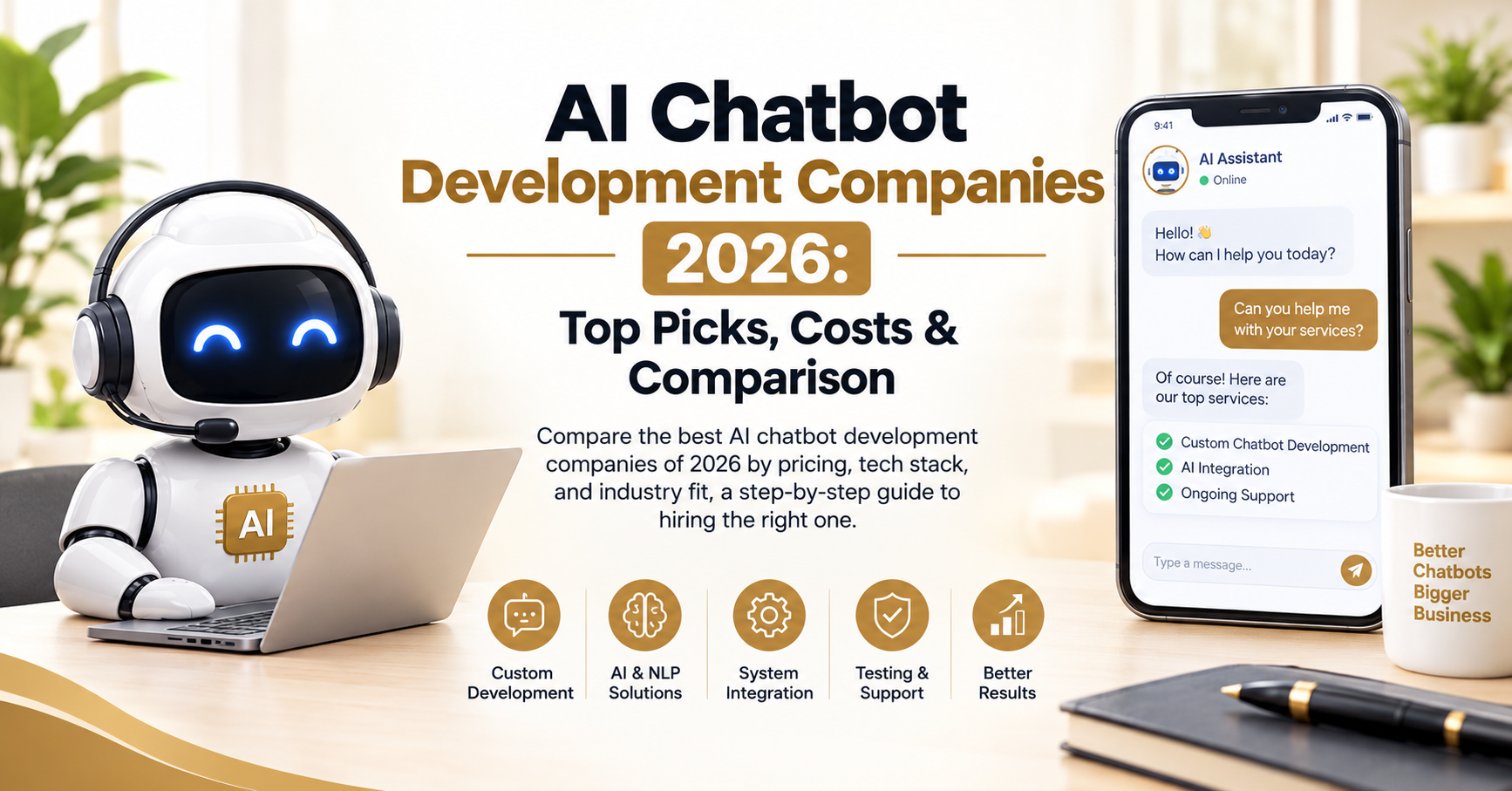
When searching for AI chatbot development services, you’ll come to know that most vendor pages say the same thing. Fast delivery, smart bots, happy clients. None of them tells you which of the many chatbot development services out there can actually build what your business needs.
The chatbot market has grown fast enough that the numbers are worth pausing on. It hit $11.8 billion in 2026, up 23.2% from $9.56 billion the year before, and Grand View Research expects it to reach $27.29 billion by 2030, a 23.3% compound annual growth rate. Generative AI chatbot development alone is already worth $12.98 billion this year and growing even faster, at 31.11% CAGR.
Companies keep adopting them because the math works: roughly $8 back for every $1 spent, plus support coverage that doesn’t need a night shift.
Who you hire decides whether you see that return or just the bill. This guide walks through what an AI chatbot development company actually does. It’ll help you understand who’s building real ones in 2026, what the work costs, and what to check before you sign anything.
Quick Summary
| Company | Founded | HQ | Starting Price | Best For |
| Master of Code Global | 2004 | Redwood City, CA, USA | $10,000–$25,000 | Mid-market to enterprise, design-led builds |
| Dev Technosys | 2010 | Jaipur, India | $10,000–$25,000 | Startups through enterprise, full builds |
| ScienceSoft | 1989 | McKinney, TX, USA | $5,000+ | Large enterprises, heavy compliance |
| Suffescom Solutions | ~2010 | India | Contact based | SMBs, industry-specific bots |
| WeSoftYou | 2016 | London, UK | Custom quote | Startups, multilingual bots |
What an AI Chatbot Development Company Actually Does
The label covers a lot of ground, but the work tends to fall into a few stages that most projects share, whether you’re hiring a chatbot development agency or a large conversational AI development company.
It starts with custom chatbot development; someone has to map out what the bot should handle, what it shouldn’t touch, and how the conversation flows before a line of code gets written. This is also where conversational UX design happens, the part that decides whether a bot feels natural or clunky. Then comes the model itself. Most bots built in 2026 sit on top of a large language model; GPT-, Claude-, or Gemini-based systems are the common picks, tuned on the company’s own data so it doesn’t answer like a generic assistant.
A chatbot with no CRM or ERP connection is just a chat window that looks busy. Real usefulness comes from chatbot integration with Salesforce, HubSpot, Zendesk, or whatever actually runs the business day to day, HubSpot LinkedIn integration can also help connect CRM data with LinkedIn activities, making it easier for sales and support teams to keep prospect information, conversations, and follow-up workflows organized. Channel integrations like the WhatsApp Business API and Facebook Messenger can then extend these capabilities to where customers already are After that comes testing, the unglamorous part where the team throws odd phrasing and edge cases at it before it meets a real customer. Once it’s live, it needs upkeep. Language shifts, products change, models get retrained, and chatbot analytics start telling you where people are dropping off. A bot that isn’t maintained starts drifting within months.
Types of Chatbots These Companies Build
Rule-based bots are the oldest kind, basically a decision tree with a chat interface. Tools like Chatfuel and ManyChat built a whole category around this approach for small business use cases. They work fine for narrow FAQs and fall apart the second someone phrases a question differently than expected.
Natural language processing chatbots do better here. Built on frameworks like Dialogflow or Rasa, they use intent recognition and entity extraction to catch variations in how people ask things, and some add sentiment analysis on top so the bot can tell when a customer is getting frustrated. They’re still boxed in by whatever patterns they were trained on, though.
Generative AI chatbots are a different animal entirely. Instead of picking from a script, they generate a response on the fly, which means they can handle open-ended questions and hold context across a longer conversation. This is the layer most conversational AI platforms are being rebuilt around right now.
Voice-enabled chatbots are having a moment too, mostly because they’re replacing the old IVR phone tree that everyone hates. And then there’s the newest category, agentic bots, which don’t just answer questions but do something: book a flight, process a refund, update a record, without a human stepping in between each step.
How Chatbot Development Got Here
It’s worth knowing the path, mostly because it explains why “chatbot” means something different now than it did ten years ago.
From the early 2000s through about 2015, bots ran on scripts. Fixed trees, fixed answers, useful for FAQs and not much else. Between 2015 and 2020, tools like Dialogflow and Rasa brought real NLP into the mix, so bots could recognize that “where’s my order” and “track my package” meant the same thing. Then GPT-4-class models landed between 2022 and 2025 and changed the baseline entirely; bots stopped matching keywords and started actually conversing.
By 2026, agentic behavior isn’t a bonus feature anymore; it’s closer to the expected standard. A bot that can only chat and can’t act is starting to look dated.
How to Pick the Right Chatbot Development Company
A few things are worth checking before anything else, whether you’re comparing an AI chatbot development company in the US or evaluating a chatbot app development company overseas.
Ask for real portfolio work in your industry, not a generic screenshot gallery. A team that’s shipped fintech bots understands compliance in a way a general dev shop probably doesn’t. Look at what they actually build on too, GPT based models, Rasa, Dialogflow CX, Botpress, and Kore.ai. XO all behave differently, and the right one depends on your budget and what you’re trying to automate.
Pricing structure matters more than people expect. Hourly, fixed price, and SaaS subscriptions each shift risk in a different direction; fixed price tends to suit a well-scoped project, and hourly makes more sense when the scope is still moving. If you need enterprise chatbot solutions in healthcare or finance, HIPAA or GDPR compliance isn’t a nice to have, get it confirmed in writing before you sign. And ask directly what happens after launch, since a bot that breaks on a Friday and stays broken until Monday is going to cost you customers. Get response time commitments written into the contract, not promised over email.
Companies Worth Looking At in 2026
Master of Code Global
Website: masterofcode.com | Founded: 2004 | HQ: Redwood City, CA, USA, with six additional global offices
Projects start around $10,000 to $25,000, roughly $50 to $99 an hour, with a team of 250+ people. Their tech stack covers generative AI integration, NLP, NLU, and sentiment analysis, built on Dialogflow and Rasa, and they hold official Microsoft and AWS partner status. Services include AI chatbot development, chatbot fine-tuning and optimization, voice assistants, and dedicated conversation design, serving retail and ecommerce, travel and hospitality, beauty, telecom, and finance clients. With 19+ years in the space, over 400 projects delivered, and solutions reportedly used by more than a billion users worldwide, every project comes with a dedicated conversation designer built in. Past clients include Tom Ford Beauty, T-Mobile, Luxury Escapes, Aveda Corporation, and Hilton. A solid fit for mid-market to enterprise brands that want a design-led, conversation-first build rather than a bare-bones script.
Dev Technosys
Website: devtechnosys.com | Founded: 2010 | HQ: Jaipur, India, plus offices in the USA, UK, UAE, and Canada
Projects start around $10,000 to $25,000, roughly $25 to $50 an hour, and the team runs 200 to 400+ people. Their stack leans on LLMs, NLP, RAG pipelines, Python, and both AWS and Azure. Services span custom chatbot architecture, voice assistants, multilingual chatbot support, and CRM integrated builds, across healthcare, fintech, retail, logistics, education, and real estate. They’re CMMI Level 3 and ISO 9001:2015 certified, with more than 2,000 delivered projects behind them, a reasonable pick for anyone from a startup to a larger enterprise wanting a full-cycle build without enterprise pricing.
ScienceSoft
Website: scnsoft.com | Founded: 1989 | HQ: McKinney, TX, USA, with offices in UAE, Latvia, Lithuania, and Poland
This one’s been around since 1989, which shows in the client list. Projects start at $5,000, hourly rates run $50 to $99, and the team sits at 500 to 999 people. The tech stack covers NLP and ML frameworks, Java, .NET, and both major cloud platforms. Work focuses on machine learning chatbots plus ecommerce and contact center automation, mostly for healthcare, insurance, investment, manufacturing, retail, and telecom clients. ISO 13485 certified, over 4,200 projects delivered. As a chatbot development company in the USA with three decades behind it, it fits large enterprises that can’t afford to get compliance wrong.
Suffescom Solutions
Website: suffescom.com | Founded: around 2010 | HQ: India, with global delivery
Pricing here is contact-based rather than published, sitting in the mid-range from what’s publicly known. Team size runs 100 to 250+, and the stack covers NLP, ML, custom AI models, and standard cloud integrations. They build AI chatbots, lead generation bots, and appointment scheduling tools for healthcare, retail, education, and finance clients. What sets them apart a bit is blockchain crossover work, useful if you’re in crypto or fintech and need that specific expertise. A good option for SMBs wanting something industry-specific rather than off-the-shelf.
WeSoftYou (WSU)
Website: wesoftyou.com | Founded: 2016 | HQ: London, UK
Pricing is custom-quoted but positioned as startup-friendly, and the team runs 50 to 100+ people. They work with GPT-based models, custom NLP, and CRM/ERP integrations, building customer support and sales chatbots, voice assistants, and AI-powered customer service automation for ecommerce, fintech, healthcare, and retail companies. Their multilingual focus is the standout here, worth a look if you’re expanding into new markets and need a bot that doesn’t lose context when switching languages.
A few other names come up often enough among the top chatbot vendors to be worth checking directly: BotsCrew, LeewayHertz, Kore.ai, Yellow.ai, Haptik, Netguru, Ada, and Kommunicate. Pricing and team size shift often in this space, so confirm current numbers with each company rather than trusting anything you read here as fixed.
Side by Side Comparison
Here’s how these leading chatbot development firms stack up when you put pricing, team size, and specialty side by side.
| Company | Starting Price | Team Size | Core Stack | Best For |
| Master of Code Global | $10,000–$25,000 | 250+ | Generative AI, NLP, NLU | Design-led, enterprise brands |
| Dev Technosys | $10,000–$25,000 | 200–400+ | LLMs, NLP, RAG, Python | Full builds, flexible budgets |
| ScienceSoft | $5,000+ | 500–999 | NLP, ML, Java, .NET | Compliance-heavy enterprises |
| Suffescom Solutions | Contact based | 100–250+ | NLP, ML, custom AI | SMBs, fintech and crypto |
| WeSoftYou | Custom quote | 50–100+ | GPT models, custom NLP | Startups, multilingual bots |
How Much Does Chatbot Development Cost in 2026
A basic bot, the kind that just answers FAQs on a fixed script, typically runs $5,000 to $10,000. Nothing fancy, but it does the job for narrow use cases.
Step up to something NLP-driven or lightly generative, with a handful of integrations, and you’re looking at $15,000 to $40,000. Where exactly you land in that range depends mostly on how much custom training the data needs. Enterprise-level bots, multilingual, multi-system, agentic- often clear $50,000, especially once you factor in ongoing fine-tuning and compliance work.
What actually pushes the number up isn’t the bot itself; it’s the integrations, the number of languages supported, how much fine-tuning the LLM needs, and how much post-launch maintenance you’re signing up for. A bot that answers questions costs a fraction of one that books appointments, checks inventory, and processes refunds on its own. Whatever you spend, weigh it against chatbot ROI over the first year, not just the upfront invoice.
Building In-House vs Hiring It Out
In-house gives you full control and keeps the data internal, which matters a lot for some companies. The catch is time. Hiring NLP engineers and ML specialists takes months in most markets, and the salaries aren’t small.
Outsourcing to a chatbot development agency gets you moving faster since the vendor already has the team and tooling ready. What you give up is day-to-day control, and you’re now tied to someone else’s roadmap and whatever turnover happens on their end.
Neither is universally right. In-house tends to make sense when chatbot capability is genuinely core to the product, and you’re building on it for years. For most businesses that just need a working bot without standing up an entire AI automation company internally, outsourcing is the more practical call.
Where This Actually Gets Used
Ecommerce and retail lean on chatbots for product recommendations, order tracking, and catching abandoned carts before the sale is lost. Healthcare and insurance use them for appointment scheduling, early symptom triage before a real consult, and claims status, all under tighter data rules than most industries deal with.
Banking and fintech tend to use bots for balance checks, fraud alerts, and loan guidance, usually with heavier identity verification layered in. Travel and hospitality lean toward booking changes and itinerary questions, often across several languages at once. Customer support and SaaS teams use customer support automation mostly for tier one ticket deflection and onboarding, catching issues before they ever become a ticket a human has to touch.
What’s Actually Changing in 2026
Agentic bots are becoming the norm rather than a nice extra, ones that complete tasks on their own instead of just answering questions. Voice AI keeps eating into the old IVR phone tree market, since customers would rather talk than press numbers.
Multilingual and regional bots are expected by default now if a business operates across markets, not something you request as an add-on. Omnichannel chatbot solutions matter more too; customers expect the same bot with the same memory of their conversation whether they’re on WhatsApp, the website, or Messenger. And retrieval-augmented generation, RAG, has become fairly standard generative AI development practice, letting bots pull from live documents and databases instead of relying only on what the model learned during training, which cuts down on wrong answers considerably.
Mistakes Worth Avoiding
Picking on price alone is probably the most common one. The cheapest quote usually skips testing, integrations, or post-launch support, and you end up paying for that gap later anyway, just with extra rework on top.
Ignoring what happens after launch is another. Bots need tuning once they’re live, and if the contract doesn’t cover that, you’re budgeting for it separately whether you planned to or not. Going in without clear KPIs is a third. Decide what success actually looks like- response accuracy, ticket deflection, conversion lift- before development starts, not after the bot’s already built and you’re trying to justify the spend. And skipping data privacy checks upfront, especially in healthcare or finance, tends to surface as a much bigger problem later, usually during an audit rather than before one.
FAQs
How long does chatbot development take?
A basic bot can go live in two to four weeks. Something medium complexity with several integrations usually takes six to twelve weeks. Enterprise-level agentic bots can take three to six months depending on how many systems they need to connect to.
How do I find the best chatbot development company for my business?
Check their portfolio in your industry specifically, confirm their tech stack fits what you need, ask about compliance certifications if you’re handling sensitive data, and read chatbot development company reviews on sites like Clutch or GoodFirms before you sign anything.
Is there a good chatbot development company for small business budgets, or do I need to search for one near me?
You don’t need a local chatbot development company near me anymore; most of the strongest vendors work fully remote. Suffescom and WeSoftYou both work well for smaller budgets, while Dev Technosys scales from small business projects up to enterprise ones.
Is in-house or outsourced development the better move?
Outsourcing gets you to market faster and costs less upfront for most companies. In-house only really makes sense if chatbot capability is central to your product long term.
What’s a realistic average cost, and how much does chatbot development cost overall?
Basic bots run $5,000 to $10,000. Medium complexity sits around $15,000 to $40,000. Enterprise agentic bots often go past $50,000.
Can a chatbot run on something like GPT-5 or Claude?
Yes, most companies building chatbots in 2026 are working with GPT- or Claude-based models, frequently paired with RAG so answers stay grounded in the company’s actual data instead of general training knowledge.
Where This Leaves You
The chatbot market isn’t slowing down, and neither is the number of vendors claiming to be the best chatbot development company for your project. Among the top chatbot development companies in 2026, the ones worth trusting are the ones with a real portfolio, clear pricing, and compliance credentials that actually match your industry. Master of Code Global, Dev Technosys, ScienceSoft, Suffescom Solutions, and WeSoftYou each fit a different budget and use case; none of them is the universal right answer. Confirm current pricing directly, ask for references in your specific sector, and get post-launch support terms into the contract before you sign anything.
If you’re ready to hire chatbot developers for your project, a free consultation is a reasonable next step to scope the work before committing to a vendor.

Senior SEO Content Marketing Manager at Trendusai.com
Rashida Hanif is a Senior SEO Content Marketing Manager, specializing in data-driven content strategy and SEO. She helps brands improve online visibility through keyword research, content planning, and AI-powered marketing insights.