
Most medical practices lose patients before a single ad even runs. A search happens, a doctor’s website loads slowly, and the patient hits back and picks someone else instead. Around 77% of patients use a search engine before they book an appointment, often long before they call the front desk. Doctors who run Google Ads without a real SEO for doctors plan usually pay more per lead than they should, and doctors who only chase organic rankings wait months for results they need now. This Google Ads for doctors SEO outline puts both sides together, step by step. A combination of this in a practice can build a patient acquisition strategy that works this year.
What Is a Google Ads for Doctors SEO Outline?
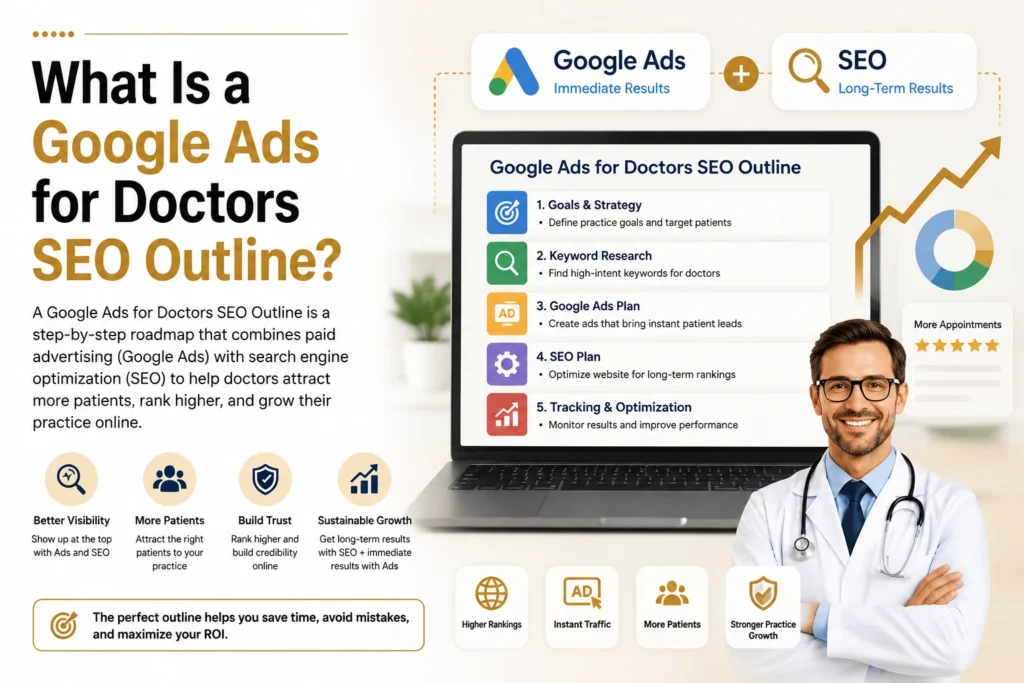
A Google Ads for doctors SEO outline is a written plan that connects paid search and organic search into one system for a medical practice. It maps which keywords to target, how to build ad groups, what a landing page needs to turn a click into a booking, and how local SEO for doctors supports paid campaigns instead of competing with them. Think of it as a blueprint, not one tactic. A solo dentist and a hospital wing need different scales, but the logic stays the same: match search intent to the right page, track what happens after the click, and spend money only where it brings booked patients.
If you’re wondering how to build a Google Ads for doctors SEO outline from scratch, start in this order: search intent, keyword groups, campaign structure, landing pages, and conversion tracking. Get those five pieces right, and most of the rest of this guide is fine-tuning.
Google Ads vs SEO for Doctors: Why You Need Both
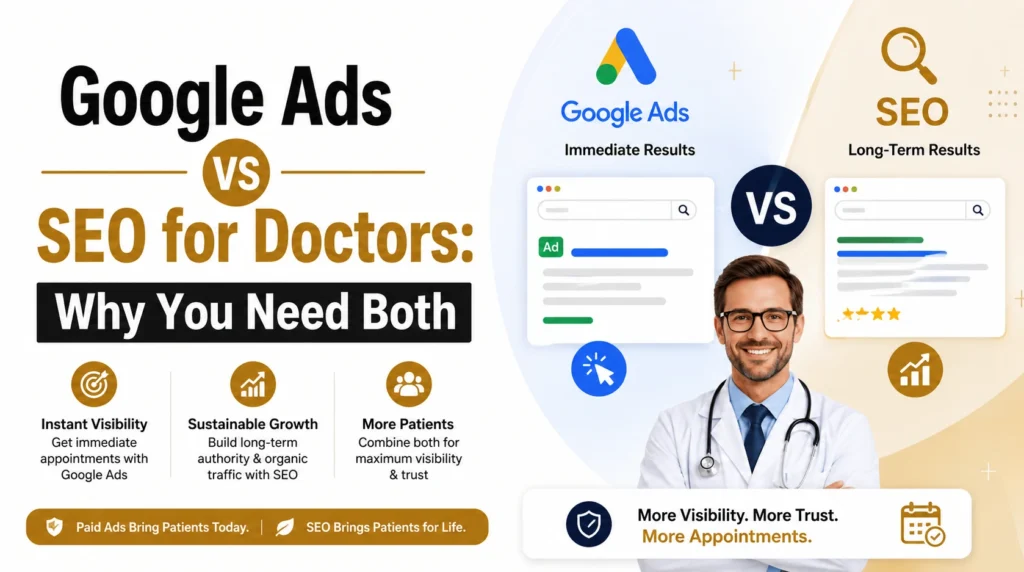
Google Ads for doctors get practices in front of patients within days. A new campaign can show up on page one for “cardiologist accepting new patients” the same afternoon it goes live. SEO for doctors takes longer, often three to six months before rankings settle, but traffic keeps coming once it ranks, without a per-click cost.
| Factor | Google Ads | SEO |
| Speed to results | Same day to about a week | Three to six months |
| Cost model | Pay per click, ongoing | Time and content investment |
| Best for | New practice, new location, seasonal demand | Long-term visibility and trust |
| Control | Full control over targeting and message | Shaped by algorithm and competition |
| Where it shows | Top of search, Google Maps ads | Organic results, Google Business Profile |
The 3 Category Keyword Framework
Every solid SEO strategy for doctors, and every ad account, sorts keywords into three groups.
Transactional keywords show clear booking intent, like “book appointment online,” “same day appointment,” or “urgent care open now.” These earn the strongest bids in Google Ads and the clearest calls to action on landing pages.
Location-modified keywords add a city or neighborhood, like “best doctor in Chicago” or “pediatrician near me.” Local SEO for doctors leans on this group heavily, and so does Google Business Profile optimization.
Specialty and condition-specific keywords match what the patient is actually dealing with, like “knee pain specialist” or “board certified cardiologist.” Patients often search the symptom before they search the doctor, so this group also feeds blog content and service pages for organic doctor SEO.
Negative keyword starter list: free, salary, jobs, training, internship, volunteer, home remedy, definition. These terms show research or career intent rather than booking intent, and blocking them keeps cost per click and cost per lead lower.
Choosing the best keywords for Google Ads doctors campaigns means picking terms from all three groups above, not just the obvious transactional ones. A mix of booking terms, location terms, and condition terms gives account coverage across the whole patient journey, from the first symptom search to the final click to book.
Campaign Structure That Doesn’t Waste Budget
A Google Ads account for a medical practice should split ad groups by specialty, service, or condition. Don’t lump everything into one group. A dermatology practice might run separate ad groups for acne treatment, skin cancer screening, and cosmetic dermatology, each with its own keywords and its own ad copy. Mixing them dilutes Quality Score and pushes up cost per click.
Match type matters just as much. Phrase match and exact match keep ads showing for searches close to what was actually typed, like “cardiologist accepting new patients.” Broad match often triggers ads for loosely related searches that waste money fast. In a HIPAA-sensitive field, sloppy targeting can also raise questions about how patient data gets tracked. Most healthcare SEO and PPC teams start new accounts on phrase and exact match, then test broad match once conversion data is stable in Google Analytics 4.
Ad extensions add more ways for a patient to act straight from the search result: call buttons, office location, appointment links, without an extra click. Some practices also add geo-fencing around their service area, so ads only show to patients close enough to actually visit.
Landing Pages That Convert Clicks Into Bookings
The page a patient lands on after clicking an ad decides whether that click becomes a booking. Message match comes first: if the ad promises “same day appointment,” the page headline should say the same thing, not a generic welcome message. Trust signals come next: board certifications, insurance accepted, real patient reviews, and a visible phone number above the fold.
Mobile speed matters more than most practices realize. Most searches happen on a phone, and a page that takes more than a few seconds to load loses patients before they see anything at all. This is landing page optimization at its simplest: cut what doesn’t help the patient decide, and keep what does.
Don’t send Google Ads traffic to a homepage. A homepage talks about the whole practice. A landing page talks about the one thing the patient searched for, a knee pain specialist or a same-day slot, and gives one clear next step: book an appointment online, call now, or check insurance.
Budget Planning by Practice Size
This Google Ads for doctors budget guide gives practices a framework for deciding how much to allocate, based on size, competition, and patient capacity, rather than a single number that won’t fit most accounts anyway.
Ad spend for a Google Ads for doctors and PPC for doctors plan depends on practice size, local competition, and how many services get promoted at once.
| Practice size | Typical budget scale | Main focus | Tracking priority |
| Solo practitioner | Smaller, tightly focused | One or two specialties | Calls and form fills |
| Multi-specialty group | Mid-range, split by service | Several ad groups by specialty | Cost per lead by service line |
| Hospital wing or large system | Largest, multi-campaign | Broad specialty coverage plus Performance Max | Cost per acquisition and long-term patient value |
Real cost per click shifts by specialty, city, and competition, so pull actual numbers from Google Keyword Planner for the local market rather than copying a figure from any single blog. Resources like WordStream, Think With Google, and LocaliQ publish general benchmark data that’s worth a look too, though local numbers will always move the real answer. What stays constant across every size is the metric that matters: return on ad spend, or ROAS, tells a fuller story than cost per click alone, since it ties spend to booked patients, not just clicks.
Conversion Tracking Setup
A campaign without tracking is a guess with a budget attached. Every Google Ads for doctors account needs call tracking, form tracking, and booking tracking, connected through Google Tag Manager and Google Analytics 4.
Call tracking needs a minimum duration rule. A ten-second hang-up isn’t a real lead, so most practices set a minimum length, often 30 to 60 seconds, before counting a call as a conversion. Tools like CallRail handle this automatically and record calls for quality checks later.
A short weekly audit keeps the account honest: check cost per lead (CPL) by ad group, check which landing pages convert best, check negative keywords for new junk traffic, and check Quality Score for any group that’s slipping. Most reports use cost per click (CPC), CPL, and cost per acquisition (CPA) side by side, so it helps to know the account is looking at all three, not just one.
Local SEO, Schema, and Google Business Profile
Local SEO for doctors starts with Google Business Profile optimization: accurate categories, a full service list, current hours, and real photos of the office instead of stock images. NAP consistency, meaning the name, address, and phone number match across every directory, including Healthgrades, is one of the stronger signals for showing up on Google Maps for a search like “doctor near me.”
Medical schema markup adds a layer patients don’t see, but search engines read directly. Physician schema, FAQ schema, and review schema help Google understand what a page offers and who it serves, which supports both rankings and how a listing looks in search results.
2026 Trend: Optimizing for AI Overviews and Voice Search
Search has changed. AI Overviews now answer many health questions directly at the top of the page, before a patient even scrolls to a list of links. Voice search adds another layer, since people ask a phone or smart speaker a full question, something like Who’s a good pediatrician near me that’s accepting new patients, instead of typing three keywords.
Showing up in both means answering real questions in plain language, with clear headings and a direct answer near the top of the page. This work sits close to what’s often called generative engine optimization, and it runs alongside traditional healthcare SEO rather than replacing it. This is also where voice search optimization matters most, since spoken questions tend to be longer and more specific than typed ones, and a page written to answer a full question out loud tends to answer the typed version too. E-E-A-T, meaning experience, expertise, authority, and trust, matters even more here, since author credentials and overall site trust weigh heavily in what gets pulled into an AI Overview.
The questions patients type into Gemini, ChatGPT, and other AI platforms look nothing like a Google search bar. Instead of typing “knee pain specialist,” a patient might ask something closer to why does my knee hurt when I bend it and which nearby clinic treats it without surgery. Instead of “pediatrician near me,” the question becomes something like which pediatrician near me is accepting new patients and takes walk-in visits on weekends. These platforms reward pages that already answer that full question in one place, with the symptom, the treatment, and the local option addressed together, rather than pages built around a short keyword alone. A practice offering SEO services for doctors in 2026 should be writing for this kind of question just as much as for the shorter searches on Google.
How Can I Appear in AI Searches?
A few practical steps help a practice get picked up as a source when AI platforms answer a patient’s question:
- Write pages that answer one full question completely, not a fragment of one.
- Keep author names, credentials, and board certifications visible on the page itself.
- Cover the local angle directly: city, service area, and whether the practice is accepting new patients.
- Back up claims with sources or explain them in plain terms instead of vague statements.
- Keep the page current, since outdated hours, insurance lists, or provider names hurt trust signals fast.
Common Mistakes That Waste Medical Ad Budgets
A handful of mistakes show up again and again in medical ad accounts.
- Broad match keywords running without enough negative keywords let in clicks that never convert.
- Ads pointing to the homepage instead of a matched landing page lose patients who came looking for one specific answer.
- Ignored Quality Score quietly raises cost per click month after month.
- Google Ads running around the clock for a practice that only answers calls during office hours wastes money spent on calls nobody picks up.
- Skipped remarketing means losing patients who visited once and got interrupted.
The 90 Day Execution Plan
Month 1: Setup and tracking. Build keyword lists across all three categories, structure ad groups by specialty, connect call tracking and Google Analytics 4, and get the Google Business Profile fully optimized.
Month 2: Optimize and test. Run the campaigns, watch cost per lead by ad group, test two or three landing page variations, and start building schema and content around the keywords showing the strongest organic potential.
Month 3: Scale winners. Shift budget toward the ad groups and services with the lowest cost per acquisition, rework or pause what’s underperforming, and expand the keyword list using terms that showed up in search query reports but weren’t targeted yet.
How to Choose the Right Agency
An SEO agency for doctors or a PPC agency for healthcare should answer a few direct questions without dodging. How do they structure ad groups for medical practices specifically? What’s their process for HIPAA-compliant tracking? Can they show real before-and-after numbers from another healthcare client, not a general case study borrowed from a different industry?
Red flags include agencies promising a fixed patient count before ever seeing the practice’s data, agencies that won’t explain their negative keyword approach, and agencies that treat a dermatologist and a general practitioner the same way. A trustworthy SEO company for doctors, and any team offering digital marketing for doctors more broadly, will understand both search and the rules medical marketing runs under, not just one or the other.
Conclusion
A Google Ads for doctors SEO outline works best when paid and organic search get treated as one system. Clear keyword categories, tight campaign structure, landing pages built for one goal, and tracking that goes past the click matter more than any single trick. Practices that follow a structured 90-day plan and check their numbers weekly tend to bring cost per lead down over time instead of guessing month to month. Keep it simple, keep it honest, and keep the focus on booked patients, not just clicks.
FAQs
How much should doctors spend on Google Ads?
Spend depends on specialty, location, and competition, so there’s no single right number for every practice. Decide based on how many new patients the practice can actually handle, then build the budget backward using local data from Google Keyword Planner.
How fast are results from SEO for doctors?
Organic SEO for doctors usually needs a few months before rankings settle. Google Ads brings visibility right away, which is why many practices run both together instead of picking just one.
Should a doctor start with Ads or SEO first?
No fixed order fits every practice. A new office or new location often needs Google Ads for doctors immediately for visibility. At the same time, SEO builds in the background so the practice isn’t stuck depending on ad spend forever.

Senior SEO Content Marketing Manager at Trendusai.com
Rashida Hanif is a Senior SEO Content Marketing Manager, specializing in data-driven content strategy and SEO. She helps brands improve online visibility through keyword research, content planning, and AI-powered marketing insights.