
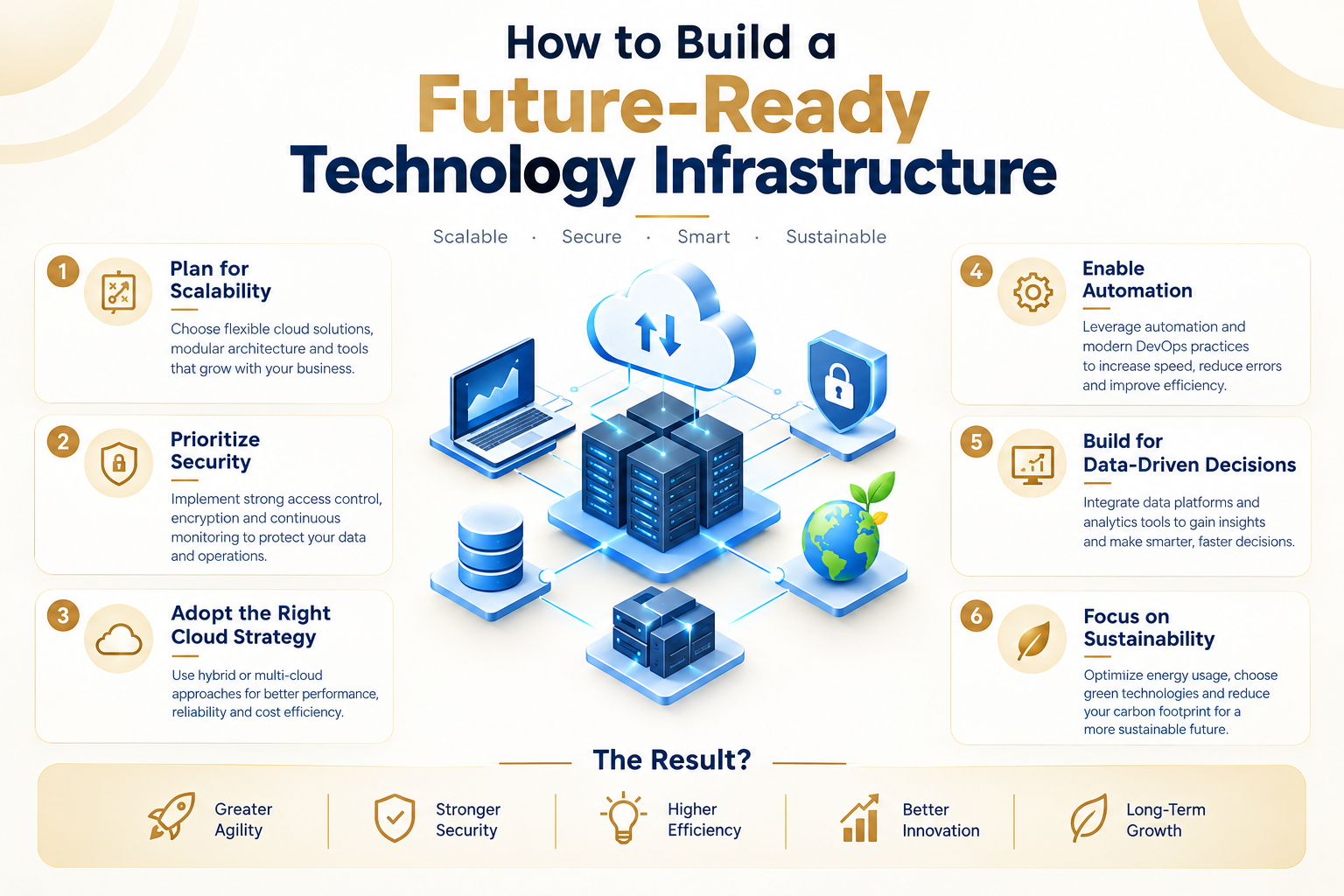
Every company has a moment when the technology it built for fifty people meets the demands of three hundred. Usually it arrives quietly: a report that takes eleven minutes to run, a tool nobody can integrate, a vendor who no longer returns calls. Nothing has broken outright, yet everything feels heavier than it should, and the team starts working around the systems instead of with them. That is the moment future-readiness stops being a slogan and starts being a budget line.
A future-ready infrastructure is not the newest one. It is the one that can absorb change without a rebuild: more users, new regions, a different operating model, an acquisition nobody saw coming. Absorbing change is a design property, and like most design properties it gets decided early, by people who were not thinking about it at the time.
The good news is that the choices which buy headroom are fairly boring, and they repeat across industries. Scalable systems, honest compatibility rules, hardware bought with a lifecycle in mind, and investment tied to objectives rather than enthusiasm. Four habits, applied steadily, outperform any single platform decision.
Scalable Systems Beat Clever Systems
Scalability has a reputation problem, because most teams hear it and start sketching microservices for an application serving four hundred users a day. Capacity you cannot use is just complexity with a monthly invoice. The useful version of scalability is narrower: can this component handle ten times its current load without a redesign, and can you tell before it fails. Answering that honestly usually points at monitoring and modularity long before it points at a new platform.
Hyperscalers learned this the expensive way, and much of their thinking is public; the Open Compute Project exists because one company’s growth outran its data centers and the fix turned out to be shared, open designs rather than proprietary gear. Smaller companies can borrow the same instinct without buying racks: favor components that others have scaled already, and treat anything bespoke as a liability you agreed to maintain.
Compatibility as a Long-Term Asset
Compatibility is what lets a system be replaced one piece at a time, which is how real infrastructure evolves. When tools talk through documented, widely implemented interfaces, the cost of swapping any one of them stays local. When they talk through a custom connector somebody wrote in a hurry, every change becomes a negotiation with the past.
Open standards do a lot of unglamorous work here. Protocols published by the IETF have outlasted most of the products built on them, and choosing technology that speaks those protocols is one of the cheapest hedges available. Internally, the same logic applies to structure; the practical tradeoffs are laid out well in this guide to software architecture patterns, and the recurring theme is that clear boundaries, not clever code, are what let a system change shape later. Document the boundaries you choose, since undocumented ones erode within a year.
Hardware and Procurement Choices That Age Well
Software gets most of the attention, and hardware quietly sets the ceiling. Devices, network gear, and whatever still runs in a closet somewhere determine which software your people can actually use, and how much friction they meet each morning. A fleet assembled from whatever was discounted that quarter becomes a support burden that no amount of cloud spending fixes.
Standardization helps, and so does buying on lifecycle rather than unit price: support windows, warranty terms, refresh cadence, and a plan for what happens to equipment at the end. This is where structured it hardware procurement pays for itself, because consistent specs and tracked assets turn a growth spurt into a repeat order instead of a scramble. Build a refresh schedule you can defend to finance, then hold to it, since deferred replacement is a loan with a very high interest rate paid in downtime and goodwill.
Aligning Technology Spend With Business Objectives
Infrastructure decisions drift when nobody states what the business intends to do next. A company planning to double headcount in one country needs different systems than one planning to open three small offices abroad, though both will be sold the same platforms. Ask what the plan is, in numbers, then test each investment against it. Anything that cannot be tied to a stated objective is probably a preference, and preferences belong in a backlog rather than a contract.
Governance matters as much as selection. Someone should own the standards, review exceptions, and retire tools nobody uses, because unmanaged sprawl is how a sensible architecture becomes an archaeological site. Keep the review light, quarterly at most, with a short written record of what changed and why. Teams that do this spend less on technology and get more out of it, which is an unglamorous outcome and the entire point.
Future-ready is a direction, not a finish line. No infrastructure survives contact with five years of business decisions unchanged, and none has to. What matters is whether each change costs a weekend or a quarter, and that ratio is set by the choices described above.
Start where the friction already is. The system people complain about is usually the one closest to its limit, and fixing it teaches you more about your own constraints than any roadmap exercise will. Then write down what you learned, so the next decision inherits it.
Growth rewards preparation that looks like restraint. Fewer platforms, clearer standards, hardware bought on purpose, and spending tied to a plan you can say out loud. Do that consistently and the infrastructure stops being the thing that holds the company back.

Senior SEO Content Marketing Manager at Trendusai.com
Rashida Hanif is a Senior SEO Content Marketing Manager, specializing in data-driven content strategy and SEO. She helps brands improve online visibility through keyword research, content planning, and AI-powered marketing insights.