Chief Technical Examiner is a title that sends people in circles. One search shows a government audit post, the next shows an exam board job, and a third shows an engineering sign-off role. You can’t tell which one fits your question, and job notices rarely explain. Now AI adds more confusion. Models write code, draft reports, and score work, and a person still has to check all of it. This guide separates the three meanings first. After that come daily duties, skills, qualifications, tools, risks, and the outlook past 2026. Read the part you need, or go straight through.
Quick Answer: A Chief Technical Examiner is a senior expert who reviews technical work against a standard and gives the final sign-off. The title shows up in government audits, engineering, patents, and exam boards. In the AI era, the job also covers checking AI systems for bias, evidence, and human oversight.
What Is a Chief Technical Examiner?
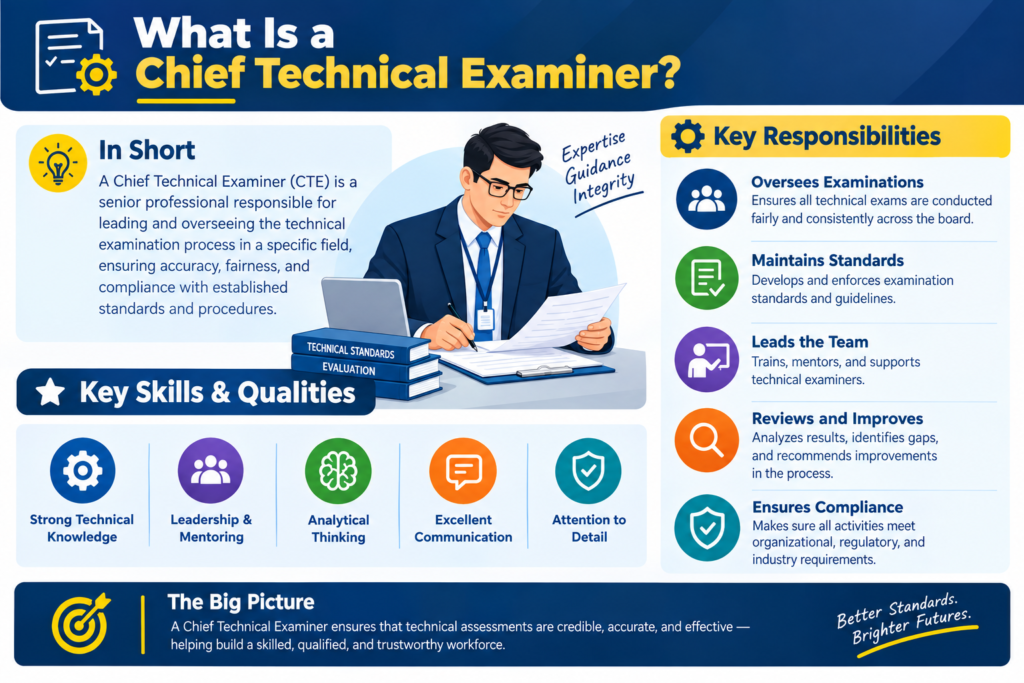
Who is the chief technical examiner in a given organisation? Simply put, the person who has the last word on technical quality. An examiner reads the evidence, compares it with a rule, and decides if the work passes. “Chief” means the person leads other examiners and owns the decision. No global definition exists, so each employer writes its own. That’s why the chief technical examiner shifts from one search result to the next.
Three uses come up the most. Find yours below.
Engineering and Product Validation
In engineering, the work is technical validation. The examiner checks designs, test results, and build records before a product ships. Engineering review, product quality control, and systems quality assurance all sit under this heading. The aim is technical integrity, meaning the product does what the paperwork says. Few companies use the exact title. You’ll more often see principal reviewers or technical assurance leads.
Patent and Regulatory Examination
Patent examination works differently. At offices like the USPTO, an examiner reads an application and tests each claim against earlier work. Primary examiners hold more sign-off power than junior ones. A regulatory technical examiner does a similar job for product rules, such as reviewing test data before a device reaches the market. Both people act as gatekeepers for the public.
Government Technical Audit in India
The Central Vigilance Commission (CVC) is India’s top body against corruption in central government work. It was set up in 1964. The Chief Technical Examiners’ Organisation is its technical wing, led by engineers. They carry out vigilance and construction audits on public works like roads and buildings, checking quality, cost and procedure. Here the Chief Technical Examiner (CTE) holds a civil service post, not a private title.
Education has its own version. Awarding bodies such as City & Guilds appoint a Chief Examiner to oversee papers, marking, and standardisation and awarding. The comparison section below covers the gap. This guide spends most of its time on the three technical meanings, with extra detail on AI and USA compliance.
What Does a Chief Technical Examiner Do?
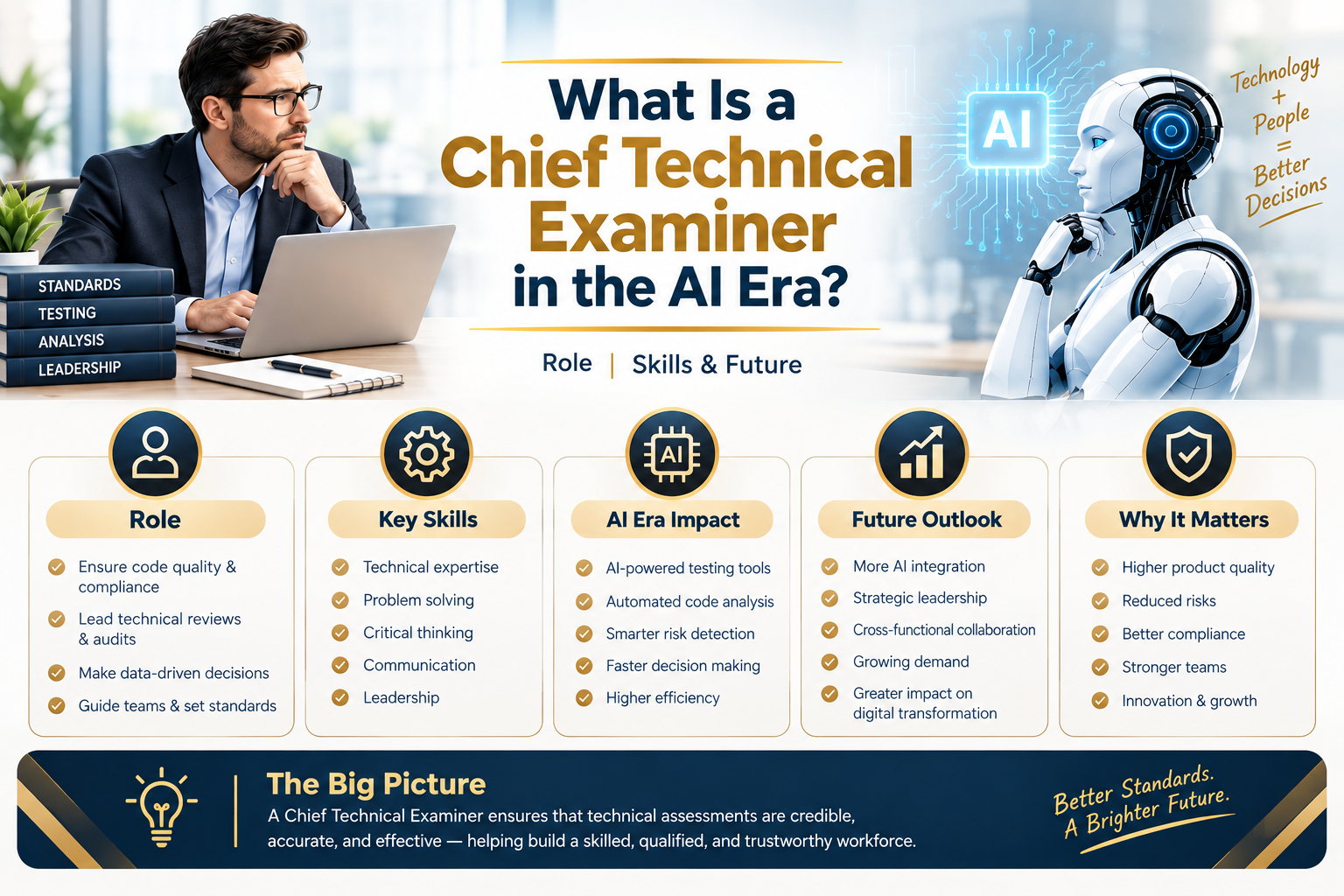
What does a chief technical examiner do in a normal week? Five things: technical review, compliance checks, quality sign-off, risk rating, and the final decision. Everything else supports those five. Details change by sector, but the pattern holds.
Chief Technical Examiner Job Description
A typical chief technical examiner job description goes like this. The person reviews technical files, sets pass marks, supervises a team, and writes up findings. They follow remediation actions until each issue is closed. They also keep an audit trail so an outside party can check the decision later. Deep subject knowledge matters, and so does sound judgment.
Chief Technical Examiner Roles and Responsibilities
The chief technical examiner role varies by employer. Still, the chief technical examiner responsibilities below turn up in most versions.
| Responsibility | What it involves |
| Technical review | Reads designs, data, code, or test records and looks for errors |
| Technical compliance | Checks work against standards, laws, and contract terms |
| Quality sign-off | Gives or withholds the technical sign-off |
| Risk classification | Rates each issue by the harm it could cause |
| Examiner supervision | Trains, checks and calibrates the review team |
| Audit readiness | Keeps records ready for outside inspection |
| Reporting | Writes findings and tracks remediation actions |
Regulatory compliance sits behind most rows, since standards come from law or contract. Quality assurance covers the rest. A good examiner links the two and explains results in plain language.
Where the Role Exists
Government audit and exam boards use the title most. Other sectors give the same job another name. The table shows where examiners work and what they check.
| Sector | What gets examined | Example bodies |
| Engineering | Designs, drawings, test and build records | Standards bodies, internal quality teams |
| Telecom | Equipment performance and safety against standards | FCC in the USA |
| Biotech | Trial data and manufacturing records | FDA in the USA |
| Patents | Applications and claims | USPTO, European Patent Office |
| Government audit | Public works, contracts and procedures | CVC in India |
| Education and certification | Exam papers, marking and grade standards | City & Guilds, Ofqual in England |
How AI Is Changing Technical Examination
How is AI used in technical audits? Teams use tools to read more evidence in less time, and people still make the decisions. Chief Technical Examiner AI work falls into four areas.
Automated Document and Code Review
Language models and code scanners read long files, flag missing clauses, and mark risky code. NLP tools can compare a contract with a checklist in minutes. A reviewer then goes through the flags and picks the ones that matter. A flag is a lead, never a finding. The examiner confirms each one against the source.
Anomaly Detection and Drift Detection
Anomaly detection marks values that break past patterns, like an odd sensor reading or a strange cost line. For machine learning models, drift detection tracks how far live data has moved from training data. Data drift means the inputs change. Concept drift means the link between inputs and outcomes changes. Both can cut accuracy over time, so post-deployment monitoring matters.
Explainability Reports and Model Evidence
Explainability reports show which inputs pushed a model toward an answer. SHAP and LIME are two common methods. Examiners also ask for model evidence: test results, data sources, known limits,s and who approved release. Many teams bundle these in a model card. Thin evidence means the sign-off waits.
Compliance Automation
Compliance automation tools match evidence to controls and keep activity logs. They save hours of copying and make audit readiness easier to maintain. They can’t decide if evidence is good enough. That call belongs to the examiner.
Will AI Replace the Chief Technical Examiner?
Will AI replace technical examiners? Nobody knows for sure, and job forecasts have been missed before. Looking at tasks gives a clearer picture. Reading and matching can be automated. Judgment and accountability are harder to hand over.
| Task | Where AI can help | What the human keeps |
| First pass review | Scans files and flags issues | Decides which flags are real |
| Pattern checks | Spots odd values in large data | Finds the cause and meaning |
| Report drafting | Produces a rough summary | Checks facts and signs the report |
| Standards mapping | Links evidence to controls | Judges if the evidence is enough |
| Final decision | Offers a score or suggestion | Owns the outcome and answers for it |
The law leans the same way. The EU AI Act asks for human oversight of high-risk systems, and software can’t be held to account. I expect that the job shifts toward checking AI output, with less time on raw files. That’s a forecast, not a fact.
Auditing AI Itself
A newer part of the work is the AI audit. Examiners now check AI systems the way they once checked bridges and circuits. An AI technical audit usually asks four things. What data trained the model? How does it perform? Who can override it? How is it watched after release? Related terms include algorithm audit, transparency and bias, and training data governance.
NIST AI Risk Management Framework (AI RMF)
NIST released the NIST AI Risk Management Framework (AI RMF 1.0) in January 2023. Use is voluntary. The framework sorts work into four functions: Govern, Map, Measure, and Manage. In July 2024, NIST added a Generative AI Profile, called NIST AI 600-1. US teams use these papers as an audit checklist and a shared vocabulary for responsible AI and AI governance.
EU AI Act
The EU AI Act is Regulation (EU) 2024/1689. It entered into force on 1 August 2024, and rules phase in over several years. Bans on certain practices apply from 2 February 2025. The Digital Omnibus, in force since 27 July 2026, moved the Annex III high-risk obligations from 2 August 2026 to 2 December 2027, and product-embedded systems to 2 August 2028. Dates have moved once already, so check the current timetable before you plan.
The Act uses risk classification with four tiers: unacceptable, high, limited and minimal. High-risk systems need risk management, training, data governance, logging, technical documentation, and human oversight. The logs become the audit trail. The most serious breaches can bring fines up to 35 million euros or 7% of worldwide yearly turnover, whichever is higher. US companies fall under the Act when their system’s output is used in the EU.
USA Compliance Angle
US teams face a patchwork. As of this writing, no single federal law covers every AI use, so duties come from agencies and states. Check for newer federal action. One clear case is New York City Local Law 144, which requires a yearly independent bias audit of automated hiring tools. ISO/IEC 42001, published in 2023, gives a certifiable standard for managing AI systems. Many US firms run it alongside the NIST framework.
Skills a Chief Technical Examiner Needs in 2026
Chief technical examiner skills fall into five groups. The table gives a practical example for each.
| Skill area | What it covers | Example in practice |
| Technical | Domain depth and knowledge of standards | Reads test data and spots a flawed method |
| AI literacy | How models are trained, tested, and fail | Asks for model evidence and reads explainability reports |
| Compliance | Laws, frameworks, and audit methods | Maps controls to NIST AI RMF or EU AI Act duties |
| Communication | Clear writing and plain speech | Explains a failed review to a non-expert |
| Leadership | Technical leadership and examiner supervision | Settles a dispute between two reviewers |
AI literacy doesn’t mean writing code every day. You just need enough knowledge to ask good questions. Say a vendor claims a model is fair. A skilled examiner asks how fairness was measured, on which groups, and with what data. That habit protects the sign-off.
Qualifications and Career Path
Chief technical examiner qualifications depend on the sector. Public posts follow rules set by the hiring department, so read each notice closely. Private roles usually list a degree, years of hands-on work, and an audit or quality credential.
Education and Certifications
Most paths start with a degree in engineering, science, or a close field. USPTO patent examiner posts, for example, ask for a technical degree. In the USA, some engineering work also needs a Professional Engineer license. Common credentials include ASQ Certified Quality Auditor, ISACA’s CISA, ISO/IEC 42001 lead auditor training,g and the IAPP’s AI Governance Professional (AIGP). Pick the one that fits your sector.
How to Become a Chief Technical Examiner
How to become a chief technical examiner? Here’s a practical route.
- Earn a degree in a technical field that fits your target sector.
- Work in design, testing, or quality assurance until you can spot weak evidence fast.
- Learn your sector’s standards and earn an audit or quality credential.
- Build AI literacy, including model testing, drift detection, and the NIST and EU frameworks.
- Move into reviewing other people’s work, then into examiner supervision.
Chief Technical Examiner Career Path: From Examiner to Chief
The chief technical examiner career path usually runs from checking work, to checking the checkers, to owning the decision.
| Stage | Main focus |
| Junior examiner or reviewer | Checks files against a clear checklist |
| Examiner | Reviews alone and writes findings |
| Senior examiner | Handles complex cases and mentors others |
| Lead or supervisory examiner | Supervises a team and calibrates standards |
| Chief Technical Examiner | Holds final sign-off and sets review policy |
Job seekers should search related titles too. Principal reviewer, technical assurance lead, and director of technical compliance often describe the same work.
AI Tools Used in Technical Examination
Tools change fast. The list below isn’t a ranking or an endorsement. It shows common categories with real examples, so you know what to look up.
| Category | Use | Example |
| Code analysis | Finds bugs and insecure patterns | SonarQube, Semgrep |
| Data validation | Tests data against set rules | Great Expectations |
| Drift monitoring | Tracks changes in live data and model output | Evidently, Arize |
| Explainability | Shows what drove a model’s output | SHAP, LIME |
| Bias testing | Compares results across groups | Fairlearn, AI Fairness 360 |
| Experiment tracking | Records models, data, and runs for the audit trail | MLflow |
Chief Technical Examiner vs Related Roles
Titles overlap, and people mix them up. Start with the pair that confuses readers most.
Chief Technical Examiner vs Chief Examiner
Chief Technical Examiner vs Chief Examiner comes down to what gets examined. A Chief Examiner works in education and certification. That person approves exam papers, oversees marking, and leads standardisation and awarding. A Chief Technical Examiner works on technical systems, work, or products. Both supervise examiners and own a final decision. Many results blur the two, so check the context of any job notice.
Comparison Table
| Role | Main focus | Final authority | Typical setting |
| Chief Technical Examiner | Technical validity and compliance | Yes, on technical sign-off | Government, engineering, patents |
| Chief Examiner | Exam standards and marking | Yes, on marks and standards | Awarding bodies, schools |
| Technical Reviewer | Detailed checks of single items | No, advises the decision maker | Product and research teams |
| Auditor | Independent check against criteria | No, gives an opinion or report | Finance, quality, security |
| Quality Manager | Running the quality system | Owns the system, not each review | Manufacturing, services |
Challenges and Risks
AI helps, and each gain brings a new risk. Four deserve attention.
Hallucination
Language models can state false facts in a confident voice. In 2023, a US federal court sanctioned lawyers in Mata v. Avianca after they filed a brief citing cases a chatbot had made up. A technical report can go wrong the same way. Check each AI claim against the original document.
Overreliance
People tend to trust automated output. Researchers call that automation bias. A reviewer who accepts every flag stops looking at the evidence. Spot checks and random sampling keep the habit in check. Read some files with no AI help at all.
Accountability
When AI assists a review, someone still owns the result. Record which tool was used, what it produced, and who checked it. Put that record in the audit trail. Without it, a challenged decision is hard to defend.
Data Privacy
Confidential designs, patient data, and personal records shouldn’t go into public tools. Read your employer’s policy and use approved environments. GDPR and HIPAA may apply, depending on the data. If you’re unsure, ask the privacy team before you upload anything.
Future Outlook: 2026 and Beyond
Five trends look likely. They’re forecasts, not facts.
- More rules for AI. Laws and standards keep asking for documented testing, which raises demand for examiners who understand AI.
- Continuous checks. Post-deployment monitoring may replace one-time reviews for many models.
- AI literacy as a baseline. Job notices will likely list it beside standard knowledge.
- Digital evidence. Logs, model cards, and automated test records will fill more of the file.
- Human sign-off stays. Tools will take on more reading, and a named person keeps the final decision.
Conclusion
A Chief Technical Examiner is the person who says a piece of technical work is sound and puts a name behind that claim. The title means different things in government audit, engineering, patents, and education, so check which one you’re reading about. AI speeds up reading, matching,g and monitoring. Judgment and accountability stay with people. If you want this career, build technical depth, learn the NIST AI RMF and the EU AI Act, and practise checking AI output against real evidence. Your next step: pick one sector from the table above and read three current job notices for it.
FAQs
What is a Chief Technical Examiner?
A Chief Technical Examiner is a senior expert who reviews technical work against standards and gives the final sign-off. The title appears in government audit, engineering, patents,s and exam settings. Duties vary, so read each job notice closely.
What does a Chief Technical Examiner do?
The person reviews evidence, checks compliance, rates risks, supervises other examiners,s and decides if work passes. They also keep records and track remediation actions. In AI settings, they check data, model evidence, and human oversight.
Will AI replace the Chief Technical Examiner?
Nobody knows for sure. AI can handle first-pass reading and pattern checks. Judgment, accountability, and legal responsibility stay with people, and the EU AI Act asks for human oversight of high-risk systems.
What skills are needed?
You need technical depth, AI literacy, compliance knowledge, clear writing, and leadership. The skills table above gives an example for each.
How is a Chief Technical Examiner different from a Chief Examiner?
A Chief Examiner leads exam marking and grade standards in education. A Chief Technical Examiner signs off on technical systems, works, or products. Both supervise examiners.
Is it a government role?
Sometimes. In India, the Chief Technical Examiner’s Organisation sits inside the CVC and is a government post. In engineering and other sectors, similar work often carries a private sector title.
How do I become a Chief Technical Examiner?
Earn a technical degree, gain hands-on experience in testing or quality assurance, and add an audit credential. Then build AI literacy and move into reviewing and supervising. Check the exact rules for any government post.
How is AI used in technical audits?
Teams use it for document and code review, anomaly detection, drift detection, and explainability reports. It also supports compliance automation. People confirm the results and make the final call.

Senior SEO Content Marketing Manager at Trendusai.com
Rashida Hanif is a Senior SEO Content Marketing Manager, specializing in data-driven content strategy and SEO. She helps brands improve online visibility through keyword research, content planning, and AI-powered marketing insights.