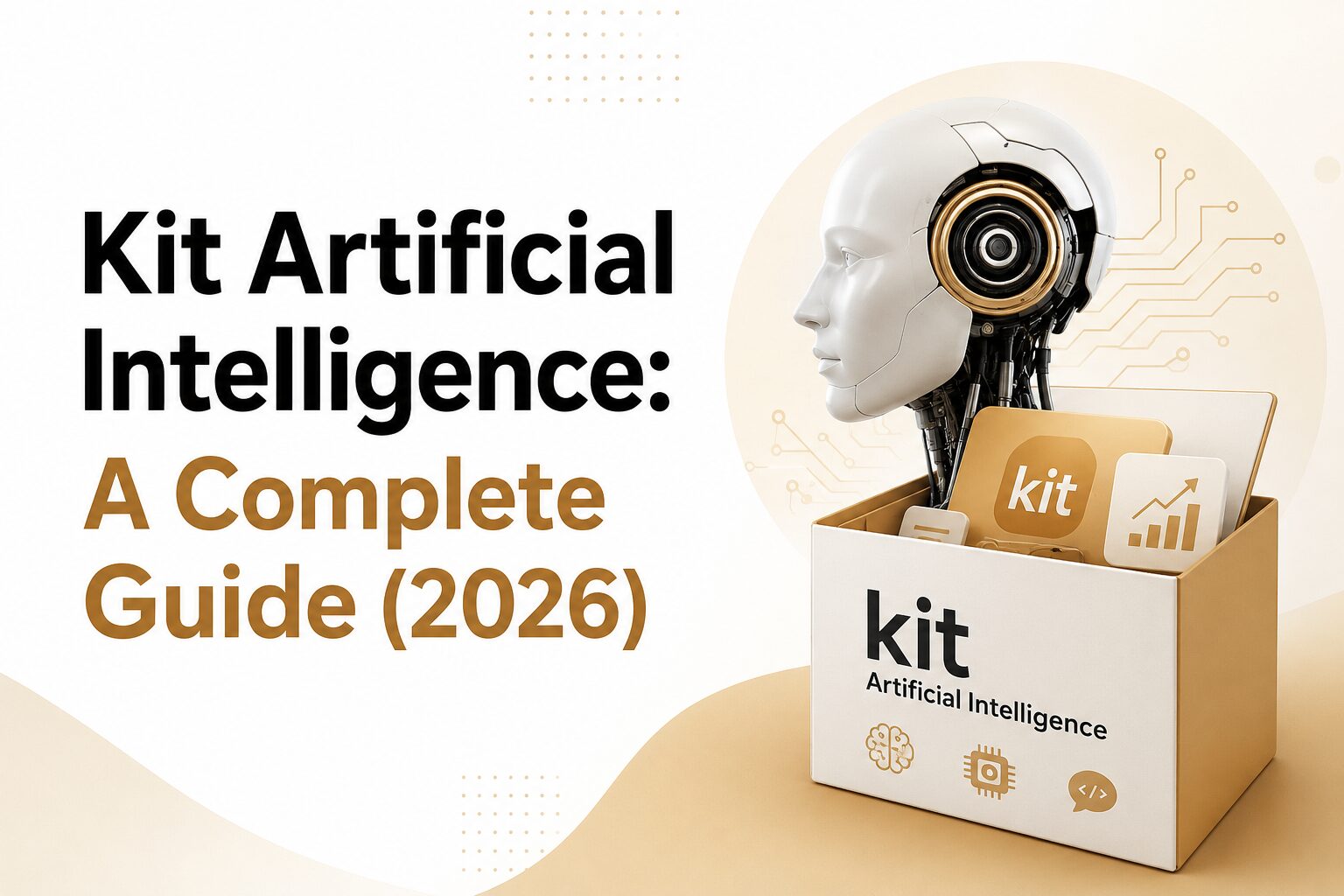
It’s a common misconception that building a working AI system requires a research lab, a large budget, or a team of AI experts. That is no longer the case. Advances in artificial intelligence have made practical AI development far more accessible. Today, a student can buy an AI kit, connect it to a Raspberry Pi, and run real-time object detection within hours.
An Artificial Intelligence kit combines hardware, software, and learning resources into a single package, making it easier to move from theory to hands-on projects. Whether you are a student, hobbyist, educator, or developer, these kits provide a practical way to learn AI while building real applications.
This guide explains what Kit Artificial Intelligence typically includes, highlights the best AI Kit options to consider in 2026, and explores how the market has evolved beyond what many older reviews still recommend.
What Is a Kit Artificial Intelligence System?
A Kit Artificial Intelligence system is a bundled package of hardware and software. It is built to let someone build and run AI applications without assembling every component from scratch. Most kits combine a processor or accelerator board, sensors such as a camera or microphone, and a set of guided tutorials that walk a user from setup to a finished project.
The point of this kind of platform is to remove the guesswork. Instead of sourcing chips, writing drivers, and debugging a toolchain from zero, you get a tested combination that’s known to work together. Common traits across most kits include:
- Pre-selected, AI-capable hardware
- Programming support, usually Python, sometimes Scratch or C++
- Structured setup guides or project manuals
- Room to expand into more advanced builds later
How the Kit Artificial Intelligence Market Has Changed
By 2026, Kit Artificial Intelligence products have split cleanly into three groups: educational robotics kits for hands-on learning, professional-grade development boards for production AI, and software-only cloud platforms that skip hardware entirely. Each serves a different buyer, and conflating them, which a lot of buying guides still do, leads people toward the wrong purchase.
Educational and Robotic Kit Artificial Intelligence Options
These kits teach by building. They dominate STEM classrooms and home labs because they turn abstract machine learning concepts into something with legs, a camera, or wheels.
Thames & Kosmos KAI: The Artificial Intelligence Robot
This kit walks a builder through assembling a six-legged robot. The robot can be trained to respond to gestures and sounds using a companion app and a phone camera. It ships with a 64-page illustrated manual and is aimed at beginners aged 10 and up. This Kit moves at a deliberate pace, but reviewers consistently rate it highly for how clearly it explains what’s actually happening under the hood.
Makeblock mBot 2
The mBot 2 pairs Scratch and Python programming with a CyberPi microcontroller, encoder motors, and a range of onboard sensors. With more than 60 expansion modules available, it scales from a first robot to a genuinely complex build, which is why it shows up so often in UK classroom AI programs.
SunFounder Raspberry Pi AI Robot Dog
A four-legged robot dog built around Raspberry Pi, with 12 servo motors and vision, hearing, and touch sensors. It runs on Python and can be paired with cloud LLMs for natural-language control, making it a popular pick for hobbyists who’ve outgrown a beginner kit but aren’t ready for a professional development board.
SunFounder PiCar-X 2.0
A self-driving car kit that demonstrates real autonomous-vehicle concepts rather than a toy simulation of them. It supports Python and Blockly, runs OpenCV and TensorFlow, and includes voice and video recognition — a genuinely useful hands-on introduction to how perception and decision-making work together in an actual moving system.
Elephant Robotics Desktop Arms
The myCobot and mechArm lines teach vision AI, hand-eye calibration, YOLOv5 object recognition, and ROS-based robotic control. These sit a level above hobby kits and are common in university labs and professional training programs, since they mirror how collaborative robots, cobots, actually get programmed on a factory floor.
Professional Kit Artificial Intelligence Development Boards
This is where the category stops being a toy and becomes real infrastructure. Performance is measured in TOPS (trillion operations per second) or TFLOPS, and pricing has moved sharply in 2026 — more on that below.
Raspberry Pi AI Kit (Hailo Accelerator)
The Raspberry Pi AI Kit pairs an M.2 HAT+ with a Hailo neural accelerator, available in two tiers: a 13 TOPS version built on the Hailo-8L chip, and a 26 TOPS version built on the full Hailo-8. It connects over the Pi 5’s PCIe interface and is natively supported by Raspberry Pi’s own camera software, so object detection, pose estimation, and image segmentation run without custom driver work. At roughly $70–130 depending on the tier and bundle, it remains the most accessible entry point into serious edge AI — the board most reviewers recommend as a first professional AI hardware kit.
NVIDIA Jetson Orin and Jetson AGX Thor
The Jetson line is where things got expensive, fast, and very recently. As of this week, NVIDIA raised prices across its entire Jetson lineup by as much as 101%. The Jetson Orin Nano Super Developer Kit — long marketed as the $249 affordable entry point — now costs $399. The Jetson AGX Orin Developer Kit jumped from $1,999 to $3,499, and the flagship Jetson AGX Thor Developer Kit rose from $3,499 to $5,499. All three developer kits are currently out of stock on NVIDIA’s US marketplace. If you’re comparing prices against an older article, assume the numbers are stale.
On raw capability, Jetson Orin NX modules deliver up to 157 TOPS, Jetson Orin Nano modules reach up to 67 TOPS, and the Jetson AGX Thor — built on NVIDIA’s Blackwell GPU architecture with 128GB of memory — delivers up to 2,070 FP4 TFLOPS, enough to run 70-billion-parameter language models on-device within a 130-watt power budget. That makes Thor a genuine option for edge deployments of large generative AI models, not just computer vision.
A Correction Worth Making: Google Coral Dev Board
Several buying guides still list the original Google Coral Dev Board — 4 TOPS, TensorFlow Lite-focused — as a current budget option. It isn’t. The 4GB Coral Dev Board and its System-on-Module were issued an official end-of-life notice and are discontinued. Google and Synaptics only recently unveiled a successor, a limited-edition “Coralboard” built around a 1 TOPS Torq NPU, shown at Google I/O 2026 — but as of this writing it’s distributed only to event attendees, with general pricing and availability still unannounced. If accurate, current-year information matters to your purchase, Coral isn’t a board you can simply order today.
TinyML and Microcontroller Kit Artificial Intelligence Boards
TinyML kits target ultra-low-power AI — the kind that runs for months on a coin battery inside a sensor.
- Arduino Nano BLE Sense Rev2 — widely treated as the TinyML reference board, combining motion, sound, and light sensors with TensorFlow Lite for Microcontrollers.
- Seeed Xiao ESP32S3 Sense — a compact, camera-equipped board with strong community support, a common first step into on-device vision AI.
- Arducam Pico4ML — built on the Raspberry Pi RP2040, purpose-built for embedded inference and real-time sensor processing.
Software-Only Kit AI Platforms
Not every AI kit involves hardware at all. Cloud-based options let you build and train without buying a single board.
- Azure AI Platform — prebuilt templates, bot frameworks, and document-mining tools like Form Recognizer.
- Google Cloud AI Hub — reusable machine learning models with PyTorch and Keras support for rapid deployment.
- Synthesia and HeyGen — AI video platforms that turn a script into a multilingual training or marketing video using a digital avatar, increasingly used by marketing and corporate learning teams as an AI content generation shortcut that skips a film crew entirely.
Kit Artificial Intelligence Performance at a Glance
| Hardware Kit | AI Performance | Current Price (2026) | Primary Use Case |
| Jetson AGX Thor | 2,070 TFLOPS (FP4) | $5,499 (dev kit) | Humanoid robotics, on-device large language models |
| Jetson Orin NX | Up to 157 TOPS | Module pricing varies by memory config | High-speed robotics, 3D mapping |
| Jetson Orin Nano Super | Up to 67 TOPS | $399 (dev kit) | Generative AI on small edge devices |
| Raspberry Pi AI Kit (Hailo-8) | 26 TOPS | ~$129 (module) | Vision AI, object detection |
| Raspberry Pi AI Kit (Hailo-8L) | 13 TOPS | ~$70 (module) | Budget-friendly edge AI |
| Coral Dev Board (original) | 4 TOPS | Discontinued | Legacy TensorFlow Lite projects |
| New Coral Board (Synaptics) | 1 TOPS | Not yet publicly priced | Ultra-low-power, ambient sensing |
Who Should Actually Use a Kit Artificial Intelligence Product
Matching the kit to the goal matters more than chasing the highest spec sheet:
- Students and educators get the most value from robotic and STEM kits — Thames & Kosmos KAI or the Makeblock mBot 2 — where the point is understanding, not raw throughput.
- Hobbyists and makers tend to land on Raspberry Pi-based boards, which balance capability, community support, and price without requiring an enterprise AI budget.
- Startups and small robotics teams benefit from Jetson Orin boards, which now function less like a hobby AI productivity tool and more like a genuine AI automation platform for prototyping products that will eventually ship.
- Enterprises and industrial teams deploying AI-driven insights at scale — smart manufacturing, retail security, industrial inspection — typically need Jetson AGX-class hardware or a fully managed AI software solution rather than a desktop kit.
- Synthesia or HeyGen better serves marketing and L&D teams looking for AI content generation without production overhead than any physical board at all.
How to Choose the Right Kit Artificial Intelligence Setup
Before buying, weigh:
- Whether the goal is learning or production deployment
- The AI performance you actually need, in TOPS or TFLOPS, not just what sounds impressive
- Power consumption limits, especially for battery-powered or always-on projects
- Programming language support — Python remains the default across nearly every kit
- Room to expand into more advanced projects without replacing the whole system
For most beginners, a robotics kit is the right starting point. For a business building toward a shipped product, a professional development board offers the long-term scalability a hobby kit can’t.
Practical, Business-Facing Use Cases
This hardware increasingly shows up in contexts that have nothing to do with hobbyist tinkering:
- Smart manufacturing: Desktop robotic arms and Jetson-powered edge devices automate assembly, sorting, quality control, and other production tasks using AI.
- Industrial inspection: Vision AI kits identify product defects in real time by processing camera data with on-device AI models.
- Retail and security: Edge AI boards analyze camera feeds locally, reducing latency, improving privacy, and minimizing reliance on cloud processing.
- Robotics research: Universities and research labs use Elephant Robotics arms and NVIDIA Jetson platforms to develop, test, and reproduce AI-driven robotics experiments.
- Collaborative robotics (cobots): AI-enabled cobots rely on sensors, cameras, and edge computing hardware to safely work alongside human operators in manufacturing and logistics environments.
Kit Artificial Intelligence vs. Large Language Model Assistants
A question that comes up constantly: can these kits run something like ChatGPT? The honest answer is nuanced. Boards like the SunFounder PiCar-X 2.0 and the Raspberry Pi AI Robot Dog support integration with cloud LLMs for voice interaction, and developers commonly wire in whichever model fits the project, OpenAI’s ChatGPT, Google Gemini, Anthropic’s Claude, or Microsoft Copilot, over an API connection. While a Kit AI Assistant focuses on hardware and edge intelligence, cloud AI assistants such as ChatGPT are designed primarily for conversation and content creation.
But the kit itself isn’t an AI assistant in the ChatGPT sense. It’s the sensing and inference layer; the LLM, when used, is a separate service bolted on for natural language processing. Jetson AGX Thor is the one board in this list powerful enough to actually run a large language model locally rather than calling one over the internet.
Final Thoughts
Kit Artificial Intelligence has matured well past its hobbyist origins. Educational robots still teach the fundamentals, but the professional side of the category, including Jetson boards, Hailo-accelerated Raspberry Pi kits, and enterprise-grade edge AI now underpins real manufacturing lines, inspection systems, and robotics products. The market also moves fast enough that year-old comparisons are already wrong on price and availability, as this week’s Jetson price increase and Coral’s discontinuation both show. Whoever you are; a student, hobbyist, or engineering lead, choosing the right Kit Artificial Intelligence platform in 2026 means checking current pricing and stock before you commit, not trusting a spec sheet that hasn’t been updated since launch.
Frequently Asked Questions
What is the best Kit Artificial Intelligence option for beginners?
Educational robot kits, such as the Thames & Kosmos KAI and Makeblock mBot 2 in particular are built for structured, guided learning and don’t assume prior coding experience.
Are Kit Artificial Intelligence boards suitable for professional or enterprise use?
Yes. Raspberry Pi AI Kit and NVIDIA Jetson boards are widely used in commercial and industrial AI deployments, though Jetson pricing has risen sharply in 2026, so budget accordingly.
Can a Kit Artificial Intelligence board run large language models?
Most rely on a cloud LLM API for natural language features. Jetson AGX Thor is the exception. Its 128GB of memory and Blackwell GPU let it run large models like Llama 3.3 70B directly on the device.
What happened to the Google Coral Dev Board?
The original 4 TOPS board is discontinued. A new, much lower-power Synaptics-built Coral board was shown at Google I/O 2026 but isn’t yet generally available.
Are software-only AI kits worth it?
Cloud platforms like Azure AI and Google Cloud AI Hub are excellent for fast deployment, but they skip the hands-on hardware learning that makes physical kits valuable for students.
How Does Kit Artificial Intelligence Work?
A Kit Artificial Intelligence system combines AI hardware, software, sensors, and preconfigured development tools into a single package. After setup, the hardware captures data from cameras, microphones, or other sensors, while built-in AI models process that data to perform tasks such as object detection, speech recognition, or image classification. More advanced kits can also connect to cloud services for machine learning and natural language processing.
What Are the Main Kit AI Features?
The exact features vary by product, but most Kit AI platforms include AI-ready hardware, Python programming support, computer vision capabilities, sensor integration, guided tutorials, expansion options, and compatibility with popular machine learning frameworks. Professional development boards often provide higher AI performance for demanding edge computing applications.
What Are the Benefits of Using Kit AI?
The biggest Kit AI benefits are faster learning, simplified setup, and reduced development time. Instead of sourcing individual components, users receive a complete platform that supports hands-on AI projects. Businesses can also use these systems to prototype AI-powered automation, intelligent automation, and edge AI solutions before deploying them at scale.
How Do You Use Kit AI?
Most users begin by assembling the hardware, installing the recommended Kit AI software, and following the included tutorials. Once configured, developers can build applications for computer vision, robotics, AI workflow automation, AI data analysis, or smart devices using supported programming languages such as Python.
Is Kit AI Suitable for Businesses?
Yes. Kit AI for businesses is increasingly used to develop proof-of-concept applications, automate inspection systems, build AI-powered decision making tools, and create edge AI solutions for manufacturing, logistics, healthcare, agriculture, and retail. Many organizations also use it as an AI business tool for testing ideas before investing in large-scale deployments.
Is Kit AI Useful for Marketers?
While hardware-based AI kits are designed primarily for robotics and edge computing, Kit AI for marketers usually refers to software-based AI platforms that support AI content generation, workflow automation, and team collaboration. These AI software for teams help automate repetitive tasks, improve productivity, and streamline marketing workflows.
Kit AI vs ChatGPT: What’s the Difference?
The biggest difference in the Kit AI vs ChatGPT comparison is their purpose. A Kit Artificial Intelligence platform provides the hardware and software needed to build AI-powered applications and robotics projects. ChatGPT is an AI assistant focused on generating text, answering questions, and supporting conversations. Developers often integrate ChatGPT or other large language models into AI kits through APIs, allowing the hardware to interact using natural language.
Is Kit AI Worth Using in 2026?
For students, educators, robotics developers, and businesses exploring edge AI, Kit AI remains one of the best AI productivity tools available in 2026. The right platform depends on your goals, budget, and required performance, but today’s AI automation platforms offer significantly more capability than earlier generations while supporting a wider range of AI workflow software and AI collaboration software.

Senior SEO Content Marketing Manager at Trendusai.com
Rashida Hanif is a Senior SEO Content Marketing Manager at Trendusai.com, specializing in data-driven content strategy and SEO. She helps brands improve online visibility through keyword research, content planning, and AI-powered marketing insights.