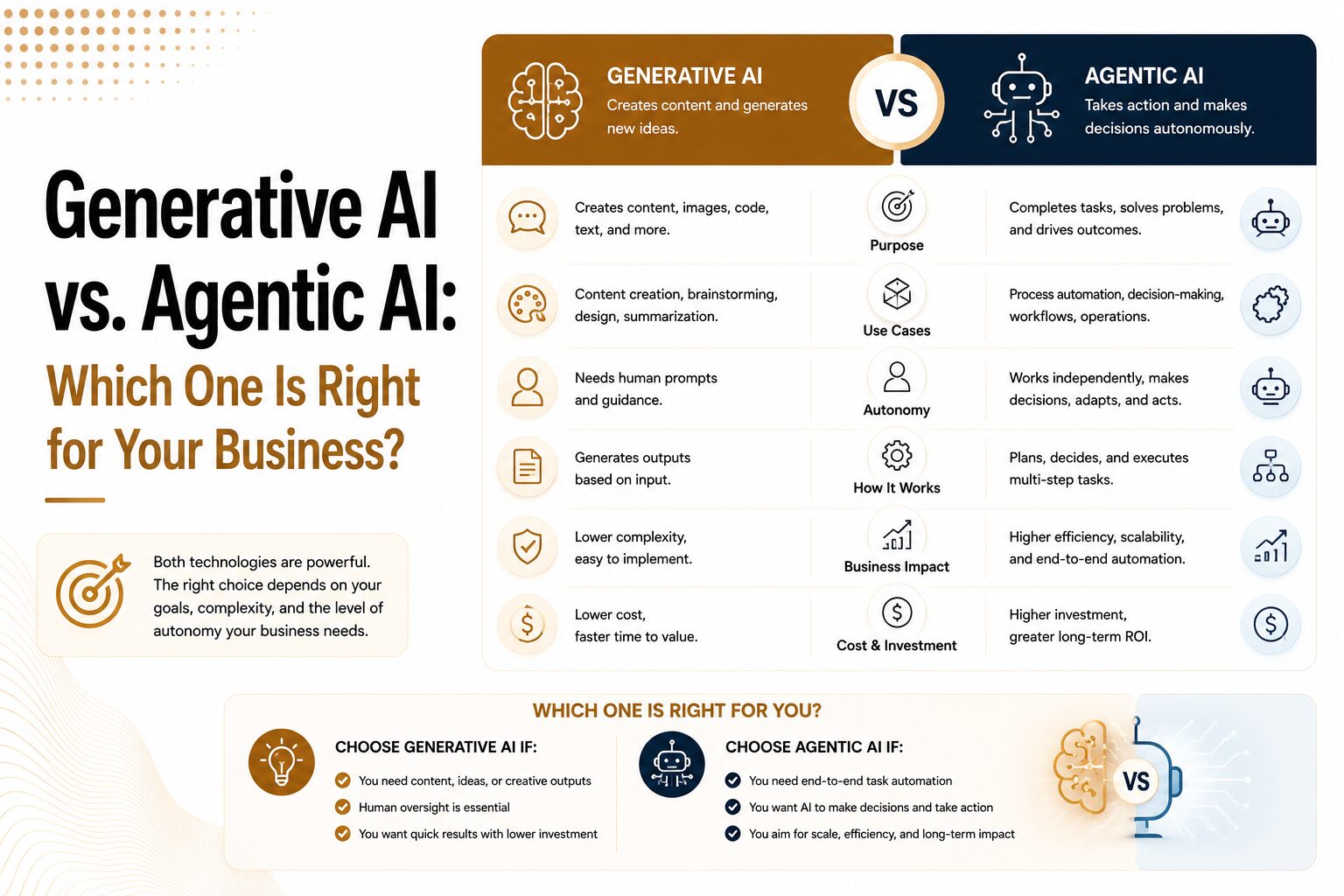
Almost every AI vendor this year is talking about either generative AI or agentic AI. The problem is that these terms are often used as if they mean the same thing. They don’t.
They describe different types of AI systems, with different capabilities, implementation costs, and levels of responsibility. Choosing the wrong one can be expensive. You might invest in an autonomous system when a simple generative model would have done the job, or settle for a content generator when your business really needs AI that can plan, make decisions, and complete tasks on its own.
The generative AI vs. agentic AI debate has become an important part of technology planning in 2026. Rather than relying on vague marketing claims or oversimplified definitions, it’s worth understanding what each approach is designed to do. This guide explains how generative and agentic AI differ, where each delivers the most value in a business setting. Moreover, you will learn what you can expect to spend, and how to decide which approach makes sense based on your company’s size, goals, and budget.
What Is Generative AI?
Generative AI is software powered by large language models (LLMs). These models are trained on massive collections of text, code, images, and audio, allowing them to recognize patterns in that data and generate new content that reflects what they have learned.
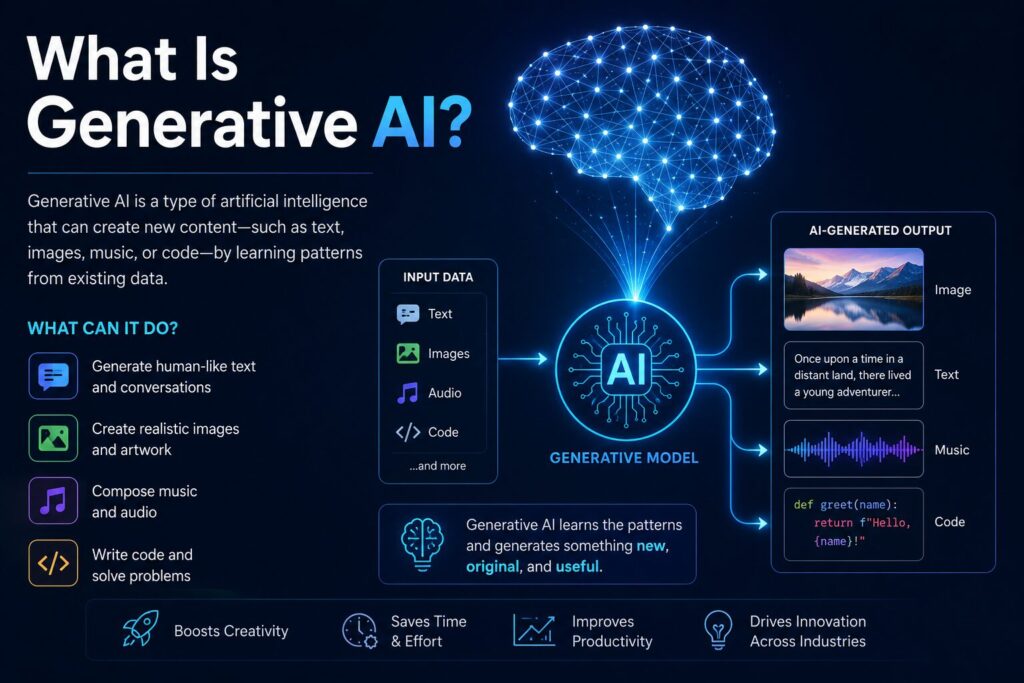
Today, some of the most widely used generative AI tools include ChatGPT from OpenAI, Claude from Anthropic, Gemini from Google DeepMind, and much of Microsoft’s Copilot product family, all of which are built on this underlying LLM technology.
The defining trait here is that it reacts. You give it a prompt, it produces a draft, and someone reviews the draft before it goes anywhere. It won’t check your calendar or update a database without being told to. It answers what you asked, then stops. That predictability is a big reason so many companies start their AI rollout here instead of somewhere flashier.
Under the hood, these models learn statistical relationships between words, pixels, or code tokens across billions of examples. Type a prompt, and the model isn’t pulling a fact out of a database somewhere; it’s calculating, piece by piece, what’s likely to come next given everything it absorbed during training. This explains why it can sound fluent and still get a specific fact wrong in the same paragraph. It predicts a pattern. It doesn’t retrieve a verified record. Any honest generative AI vs agentic AI comparison starts from that one distinction, because it’s the reason one gets treated as a drafting tool and the other gets treated as something that needs its own set of permissions.
Where Generative AI Adds Value for Business
Drafting emails, reports, proposals, and marketing copy is probably the most common use. Writing and debugging code isn’t far behind. Teams lean on it to summarize long documents, contracts, meeting transcripts, or to generate design concepts and image variations. A lot of first-line customer chat runs on it now. People also use it to pull research from several sources into one usable brief, and sales teams lean on it for outreach drafts and quick call prep.
If your generative AI development services need to stop at “produce a better draft, faster,” this is what you want. It’s the layer most companies get comfortable with first, since it carries the lowest operational risk of the two.
What Is Agentic AI?
Agentic AI goes further than content generation. Rather than just producing a response, it plans a sequence of steps, decides which tool to use at each one, takes the action, checks the result, and adjusts if something’s off. Plan, decide, act, monitor. The loop keeps running until the task’s done, or until it hits a rule that requires a human to step in.
Generative AI handles the conversation. Agentic AI handles the follow-through. A generative model can draft a customer reply. An agentic system can go read the account, verify the order, issue the refund per policy, update the record, and only escalate to a person when something falls outside its rules.
Tool access is what makes this possible. An agentic system connects to real software (a CRM, a payment processor, a ticketing system, a code repository) and gets handed a defined set of actions it’s allowed to take inside each one. The underlying LLM still does the reasoning, deciding which tool to call and in what order, but the whole system behaves less like a chatbot and more like a junior employee working through a checklist without asking permission at every line. One produces words. The other produces outcomes.
Where Agentic AI Adds Value for Business
The clearest wins show up in customer support: refunds, account changes, order tracking, all the stuff that once meant a human clicking through three separate systems just to close one ticket. Finance teams use it for reconciliations and regulatory filings. IT teams run it for ticket triage, patching, and monitoring. It’s turning up in procurement (requisition through purchase order), in human resources using an AI Agent for HR to handle leave requests and onboarding checklists, and in general orchestration across systems that once needed a person to manually hand work between them.
Frameworks like LangChain and AutoGen get used to build the multi-agent systems behind a lot of these workflows, and NVIDIA’s compute sits underneath most of the training and inference these systems need at scale.
Generative AI vs. Agentic AI: The Core Differences
Here’s the table that matters most when deciding where to put a budget.
| Factor | Generative AI | Agentic AI |
| Primary function | Creates content | Executes tasks and workflows |
| Autonomy | Responds to prompts | Plans and acts with limited supervision |
| Human involvement | Reviews and refines output | Steps mainly for exceptions |
| Memory | Typically limited to a session | Retains context across steps and time |
| Risk type | Informational (inaccurate or biased output) | Operational (incorrect actions on live systems) |
| Cost to implement | Low to moderate, often subscription-based | Higher needs integration, permissions, and monitoring |
| Time to value | Days to weeks | Weeks to months, depending on complexity |
| Best fit | Content, communication, ideation | Automation, orchestration, execution |
Notice the cost row. A generative AI subscription or API integration can be running within a week. An agentic deployment needs access provisioning, testing against real workflows, and a rollback plan before it ever touches live data, so the timeline and the budget both stretch out.
Who Is Building Generative AI and Agentic AI Tools
Know the landscape before you buy into it, since the generative AI vs agentic AI split often lives inside a single vendor’s product line rather than across two separate companies. On the model side, OpenAI, Anthropic, Google DeepMind, and Microsoft each ship both generative chat interfaces and agentic features layered onto the same underlying models. The split isn’t always a separate product. Sometimes it’s a mode, or a set of permissions switched on inside the same tool. NVIDIA sits underneath most of this as the hardware layer, supplying the compute that trains and runs these models at enterprise scale.
On the orchestration side, LangChain and AutoGen give development teams the scaffolding to chain tool calls, manage multi-agent systems, and coordinate handoffs between agents working different pieces of a task. Anyone shopping generative AI vs agentic AI vendors should ask which orchestration layer a product runs on, since that choice affects how easily the system gets audited, extended, or swapped out down the line. Knowing these names and where each one sits in the stack makes vendor conversations far more useful than treating “AI” as one lump category.
Generative AI vs Agentic AI for Enterprise AI Solutions
As more companies move past pilots, this generative AI vs agentic AI decision has turned into a core part of enterprise AI solutions planning, not a side conversation IT has on its own. AI for business used to mean a chatbot bolted onto a website somewhere. Now it means picking the right layer of autonomy for each function, then wiring AI decision-making into the approval chain a company already runs on.
Autonomous AI Agents and AI Decision-Making
Autonomous AI agents are the operational core of agentic AI. Give one a goal, a set of tools, and a boundary, and it starts making small AI decision-making calls on its own: which record to pull, which policy applies, which action comes next. Generative AI never makes that kind of call. It waits to be asked. That’s the clearest way to separate the two systems when a leadership team is trying to figure out where autonomy actually belongs and where it doesn’t.
AI Copilots, AI Orchestration, and Multi-Agent Systems
Most people’s first hands-on experience with any of this is an AI copilot: a chat window sitting inside an existing tool, drafting text or answering a question on request. That’s generative AI wearing a friendly interface. AI orchestration is a different layer entirely. It’s the coordination logic that lets several specialized agents, a data-pulling agent, a policy-checking agent, and an execution agent work together as one multi-agent system instead of a single model trying to do everything itself. Frameworks like LangChain and AutoGen exist specifically to manage that kind of coordination.
AI Workflow Automation and Human-in-the-Loop AI
AI workflow automation is where agentic AI tends to pay for itself. A task that used to move through four people and two systems now moves through one agent working off clear rules. None of this removes the need for oversight. Human-in-the-loop AI, meaning a person stays positioned to review, approve, or override specific steps, is what keeps AI workflow automation safe enough to run against live business data. The most reliable deployments treat human-in-the-loop AI as a permanent design feature, not a training-wheels phase you remove once the system proves itself.
Generative AI vs. Agentic AI Risk Profile
Weighing generative AI vs agentic AI purely on cost or capability misses the part that actually keeps executives up at night: risk. The gap between the two isn’t small, and it’s not just a matter of degree either. Generative AI mistakes are informational: a bad draft, a hallucinated statistic, an awkward email. Someone usually catches it before it does damage, because the output sits in a queue waiting for review.
Agentic AI mistakes are operational. An agent misreads a policy, issues a refund it shouldn’t have, and by the time anyone notices, that refund has already left the account. Update the wrong record, or fire off an action in a connected system, and the mistake is live. Not sitting in a draft folder waiting to be caught. Agentic deployments need permission scoping, audit trails, and a clear rollback plan before they go anywhere near production data, for exactly this reason.
Regulatory attention is rising alongside all of this. Healthcare, credit decisions, and recruitment are all seeing closer scrutiny of autonomous decision-making, and a business rolling out agentic AI should expect governance to work like a compliance requirement, not just good internal hygiene.
Budget owners tend to underweight this part of the comparison. A generative AI mistake costs time. An agentic AI mistake, left unchecked, can cost money, customer trust, or a regulatory finding. Oversight spending has to scale with however much autonomy is actually being handed over, and that’s easy to lose sight of when the productivity story looks so good on a slide.
How Businesses Are Using Generative AI and Agentic AI in 2026
The numbers back this up. Gartner projects that 40% of enterprise applications will include task-specific AI agents by the end of 2026, up from under 5% in 2025, which is a sharp jump in one year. Meanwhile, research aggregated by GoGloby shows roughly 88% of organizations already use generative AI in at least one business function, while fewer than 10% have scaled agentic AI to deliver measurable value anywhere in the business. Generative AI is mature and everywhere. Agentic AI is moving fast but still mostly stuck in pilot mode.
Think of a mid-size retailer drafting product descriptions and marketing emails with generative AI, while quietly running an agentic pilot on returns processing end-to-end. Or a regional bank summarizing loan files for underwriters with a generative tool, while testing an agentic system that reconciles transaction records overnight and flags anomalies for a compliance officer each morning. Neither company is choosing one over the other. They’re layering both, at whatever pace their governance team can keep up with. That’s what generative AI vs agentic AI actually looks like on the ground in 2026, less a debate and more a sequencing decision made function by function.
Which One Is Right for Your Business?
Framed as generative AI vs agentic AI, the right answer has less to do with which technology is more advanced and more to do with what kind of problem you’re actually solving.
Generative AI tends to fit when the goal is producing content, code, or communication faster. When a human will always review the output before it’s used. When you want something cheaper and quicker to stand up, with fast productivity gains. When the use case simply doesn’t require the AI to take real action on your systems.
Agentic AI fits better when the task spans multiple steps across different tools. When you need an outcome completed, not just drafted. When the workflow has clear rules that can define safe boundaries for autonomous action. When you’re actually ready to invest in oversight, permissions, and monitoring, not just say you are on a call with a vendor.
Plenty of businesses land somewhere in between and use both. Generative AI handles the communication, agentic AI executes the resulting workflow. One common setup: generative AI drafts a customer response, agentic AI checks the order, applies a refund under policy, updates the account, and escalates only the edge cases to a person.
So which is it, generative or agentic? Most businesses eventually figure out that was never really the question. It’s closer to which one first, and where.
A Practical Starting Point by Business Size
Generative AI vs agentic AI for businesses of any size usually comes down to sequencing more than anything else: which one first, not which one forever. Small businesses and startups usually do best starting with generative AI for content, customer communication, and coding support. Cheap, quick to set up, and it tends to show a return inside the first month or two.
Mid-sized businesses often get more out of layering AI-powered analytics into the CRM, ERP, or marketing tools they already run, before committing to a custom agentic build. It gives you a feel for where autonomy would actually help before spending on integration work. Our AI automation services team usually starts here with mid-market clients, mapping which manual processes are worth automating before recommending a full agentic rollout.
Larger or scaling businesses are usually where agentic AI pays off fastest, especially in customer service, sales workflows, and internal operations, where the higher setup cost gets absorbed through automation at scale. At this size, labor savings and speed gains tend to justify the governance overhead within a year.
One rule holds across every size: pick the lowest level of autonomy that actually solves the problem. A narrow, well-governed automation tends to beat a system handed broad autonomy with no clear guardrails. It’s also a lot easier to explain to an auditor down the road.
Governance Matters More With Agentic AI
Agentic AI takes real actions instead of producing suggestions for review, so it demands stronger oversight than generative AI ever will. Before deploying an agentic system, a business needs clear, written answers to a handful of questions. What permissions does this agent have, and are they the bare minimum required for its job? Can every action it takes be traced and audited after the fact? Is there a rollback process if it takes the wrong action? Where does a human need to stay in the loop, and where can the agent act on its own? And the one people tend to skip: what happens if the agent’s tool access gets compromised or misused by an outside party?
Voice-based fraud is a good illustration of why that last question matters. Our breakdown of how layered agentic AI defenses stop voice fraud and deepfakes shows how fast an autonomous system’s tool access can become the attack surface itself, rather than its decision-making being the weak point. Governance isn’t a checklist you tick off once before launch. It’s an ongoing job that has to keep scaling alongside whatever the agent is allowed to touch. None of this changes just because a company is small. Anyone weighing generative AI vs agentic AI in a regulated industry should expect the governance bar to be the same, regardless of headcount.
Frequently Asked Questions
Is agentic AI a replacement for generative AI?
No, and it rarely works that way in practice. Agentic AI usually relies on a generative model as its reasoning engine, then adds planning, tool use, and action on top. The two work together more than they compete.
Can a business use generative AI and agentic AI together?
Yes, and most companies already do in some form. A common pattern is for generative AI to draft communication while agentic AI carries out the task, with a human reviewing only the exceptions.
What is the biggest risk of agentic AI compared to generative AI?
It’s operational, not informational. A generative AI error usually shows up as a bad draft someone catches before it’s used. An agentic AI error can mean an action’s already been taken on a live system before anyone notices.
Do small businesses need agentic AI in 2026?
Not right away, necessarily. Most small businesses get more immediate value from generative AI for content and communication, and can add agentic automation later once a workflow is defined well enough to hand over safely.
How much does it cost to implement agentic AI vs generative AI?
Generative AI is typically cheaper to start, often just a subscription or a simple API integration. Agentic AI costs more upfront, since it needs system integration, permission scoping, and ongoing monitoring, though it tends to pay back more once it’s running at scale.
Which is better, generative AI or agentic AI?
Neither wins outright, since they’re built for different jobs. Generative AI is the better fit when the outcome is a piece of content. Agentic AI is the better fit when the outcome is a completed action. Comparing generative AI vs agentic AI on a single “better” scale usually means the real question got skipped.
What is the difference between generative AI and agentic AI?
Generative AI produces a draft and waits for a person to use it. Agentic AI plans, decides, and acts on real systems with limited supervision. That’s the difference in one sentence, and the rest of this guide just expands on it.
How does agentic AI improve business automation?
It extends automation past simple, single-step triggers. Traditional automation follows a fixed script every time. Agentic AI can handle a task where the next step depends on something it just learned, like which policy applies to a specific refund, without a person rewriting the rule for every new case.
What is the best AI solution for enterprise workflows?
There isn’t one universal answer here. The best enterprise AI solutions usually combine generative AI for communication-heavy work with agentic AI for workflows that need real execution, matched to however much governance a company can realistically support.
When should you use generative AI vs agentic AI?
Use generative AI when you are going to review the output anyway. Use agentic AI when the job only counts as done once an action has actually happened somewhere: a refund issued, ticket closed, record updated, without needing a person in the middle of every step.
What are generative AI and agentic AI use cases in 2026?
Generative AI use cases in 2026 lean heavily on content, code, and communication. Agentic AI use cases are concentrated in customer support, finance operations, IT, and procurement, anywhere a multi-step workflow can be defined clearly enough to hand over safely.
Final Thoughts
Generative AI and agentic AI aren’t competing technologies. They solve different problems. Generative AI speeds up how work gets created. Agentic AI changes how work gets carried out. The businesses getting the most value from AI in 2026 aren’t picking a side in the generative AI vs agentic AI debate. They’re using generative AI to move faster on content and communication, and agentic AI to automate the workflows that follow, with governance keeping both in check.
Start with the outcome you actually need. If the job ends when good content gets produced, generative AI is your answer. If the job only ends when an action gets completed, agentic AI is what gets you there. Not sure which stage your business is at? That’s worth a conversation before it’s worth a contract, and the team at TrendUsAI works through exactly that kind of assessment with clients before recommending a build.

Senior SEO Content Marketing Manager at Trendusai.com
Rashida Hanif is a Senior SEO Content Marketing Manager, specializing in data-driven content strategy and SEO. She helps brands improve online visibility through keyword research, content planning, and AI-powered marketing insights.