A client of mine spent close to two million dollars rolling out an AI system last year. Six months in, I asked a simple question during a review call: who signs off if this model makes a bad call on a customer? Silence. Three people started answering at once, then stopped, because none of them actually knew. That’s not a rare story. It’s the norm.
Boards approve the budget. Teams build the thing. Everyone assumes the hard part is behind them once it’s live. Then a customer complains, or a regulator sends a letter, and suddenly there’s a scramble to figure out who was supposed to be watching. AI transformation is a problem of governance, and honestly, it rarely has much to do with the model itself. Bad data, sure. Weak infrastructure, sometimes. But the thing that actually sinks these projects is simpler and more boring than either of those: nobody decided, in advance, who’s in charge when things go sideways.
What People Get Wrong About AI Governance
Ask five people at your company what “AI governance” means, and you’ll probably get five different answers. Most of them are actually describing something else entirely.
There’s the team that builds the system, picking models, training them, connecting them to whatever infrastructure already exists. There’s the team that keeps it running day to day, watching uptime, patching what breaks. And then there’s governance, which is a different animal altogether. It’s the layer above both of those that decides who’s allowed to act, who checks the output, and who has to answer for it when the output is wrong. You can hire the best engineers in your industry and still have a governance hole the size of a truck, because good engineering and good governance solve completely different problems.
This confusion is usually the first clue that AI transformation is a problem of governance rather than a technology gap. People can describe what a model does long before they can tell you who’s accountable for it.
A useful distinction here is governance model versus governance structure. The model is the philosophy, the principles a company holds about risk and accountability. The structure is the actual machinery, committees, sign-off chains, escalation paths, that puts those principles into daily practice. Plenty of companies have written a model down somewhere. Very few have built the structure to enforce it.
| Function | What It Does | Who Typically Owns It |
| Technology | Builds and trains AI systems | Data science and engineering teams |
| Management | Runs systems day to day, monitors uptime and performance | IT operations, product teams |
| Governance | Sets rules for authority, accountability, and oversight | Executive leadership, governance committees, boards |
Old IT governance was built for software that behaved the same way every single time you ran it. Feed it the same input, get the same output, year after year. AI just doesn’t sit still like that. A model trained twelve months ago can start drifting as fresh data flows through it, quietly making different calls than it used to, and often nobody clocks it until a customer’s already upset or a regulator’s already asking questions. That’s the real reason enterprise AI transformation can’t just borrow the old software governance playbook and call it done. This isn’t only a technology question either. It touches enterprise architecture, business strategy, and organizational change all at once, which is exactly why it tends to outgrow whatever team first got handed the job. Once you see it stretch that far across the business, it’s hard to argue with the idea that AI transformation is a problem of governance and not simply a rollout schedule.
Why 2026 Turned Into the Year This Got Serious
Something shifted once AI stopped waiting for a human to press go. That’s really the whole story of why this became a board-level topic instead of an IT footnote, and why so many executives are now saying out loud that AI transformation is a problem of governance rather than a problem of engineering talent.
Agentic systems, the kind built to act on their own without someone reviewing each step, are now approving loans, screening resumes, and adjusting prices while nobody watches in real time. Those used to be judgment calls a person made. Now a model makes them, and the human finds out after the fact, if at all. McKinsey’s 2025 research on AI adoption puts a number on the gap: 88% of organizations use AI somewhere in the business. That’s not a motivation problem. It’s a missing structure that would let leadership trust the thing enough to hand it more responsibility.
Regulators picked up on this faster than a lot of companies expected them to. The EU AI Act sorts AI systems by risk level now, and anything landing in the high-risk bucket- hiring tools and medical devices. Boards are being told, in plain terms, that ignoring these rules is a legal and financial exposure they’re personally on the hook for. It’s worth adding that this isn’t unique to Europe. The OECD AI Principles pushed the same basic ideas and transparency into government policy as well. Regulation moving this fast is another sign that AI transformation is a problem of governance on a global scale, not a concern limited to one industry or one country.
Five Ways Governance Quietly Falls Apart
Governance almost never fails because leadership never thought about it. It fails because the thinking stayed a slide deck and never became a working habit. I keep seeing the same five patterns, and every one of them is a small proof that AI transformation is a problem of governance long before it’s a problem of code.
Nobody actually owns it. Responsibility gets spread across IT, data science, legal, and whichever business unit asked for the tool in the first place, and somehow none of them has full authority. When something breaks, the first meeting isn’t about fixing it. It’s about figuring out whose job it was.
Then there’s shadow AI. An employee pastes a chunk of customer data into a free chatbot because it’s faster than filing a request with IT. Nobody approved it. Nobody logged it. Nobody has any idea where that data went afterward. It’s rarely malicious; people are just trying to get their work done, and the sanctioned tools were too slow to keep up.
Standards get applied unevenly, too. One team validates every model like their job depends on it. Another team skips half the checklist because there’s no company-wide rule forcing them to do otherwise. Your AI is only as reliable as your least careful team, which is a rough thing to admit out loud.
A lot of organizations are also running this on infrastructure that was never built for it, systems with weak internal controls and no way to log a decision, trace where data came from, or flag something in real time. You can’t govern a system your own tools can’t see.
And finally, the people problem. Doing this well takes technical fluency, legal literacy, and risk judgment all at once, which is a rare combination to find in one team. Most companies either underestimate how hard this is or hand it to whoever happens to be available, which usually isn’t the same thing as whoever’s qualified. Every one of these five patterns comes back to the same root cause, which is exactly why so many people now say AI transformation is a problem of governance instead of a problem of talent or budget.
The AI Lifecycle Nobody Governs From End to End
Most companies govern AI in pieces. They’ll review a model hard before launch and then barely look at it again. That’s backwards, because risk doesn’t stop accumulating once something goes live. It usually starts there. Looking at the full lifecycle is really where you see that AI transformation is a problem of governance at every single stage, not just at the moment of launch.
A full governance approach follows the system through every stage it passes through: planning, where you decide whether a use case is even appropriate for AI in the first place, development, where the model actually gets built and trained, testing, where it gets validated against real scenarios before anyone trusts it with a live decision, deployment, where it starts touching actual customers or employees, monitoring, where you watch for drift and unexpected behavior on an ongoing basis, and eventually retirement, where a model gets retrained or shut down once it’s no longer safe or useful to keep running.
Planning → Development → Testing → Deployment → Monitoring → Retirement
Skipping any one of those stages leaves a blind spot. Skipping the retirement stage in particular is common and costly. Companies build a model, launch it, and then just leave it running for years because it hasn’t caused an obvious problem yet. That’s not the same thing as it being safe. It just means nobody’s checked, which is one more reminder that AI transformation is a problem of governance that doesn’t end once a system ships.
The Standards Worth Actually Knowing
You don’t need to build a governance framework from a blank sheet of paper. A few standards have already done a lot of the heavy lifting, and knowing them saves you from reinventing something that already exists in a tested, defensible form. The sheer number of standards now competing for attention here is its own evidence that AI transformation is a problem of governance serious enough to need international rules, not just internal guidelines.
ISO/IEC 42001 gives companies a certifiable way to structure how they build, run, and monitor AI. It’s fairly new, but it’s already becoming the reference point people cite, in roughly the same way ISO 27001 became the default standard for information security years before it. NIST’s AI RMF does something similar for U.S. organizations, with more emphasis on mapping and measuring AI-specific risk rather than treating it like generic software risk (which, again, it isn’t). These sit alongside things most enterprises already deal with, like GDPR on the data privacy side and SOC 2 for security controls.
| Standard | Focus Area | Relevance to AI Governance |
| ISO/IEC 42001 | AI management systems | Certifiable framework for building and monitoring AI responsibly |
| NIST AI RMF | AI-specific risk management | Structured approach to mapping and mitigating AI risk |
| EU AI Act | Risk-based regulation | Legal requirements for high-risk AI systems |
| ISO 27001 | Information security management | Baseline security controls that AI systems also depend on |
| GDPR | Data privacy | Governs data used to train and run AI models |
| SOC 2 | Security controls | Verifies data handling and access controls around AI systems |
| OECD AI Principles | International AI policy | Shared government-level standard for fairness and accountability |
None of this replaces the actual work of naming an owner and building real monitoring into your systems. What it gives you is a shared language and a checklist that’s already been stress-tested by other organizations, so you’re not the only one guessing at what “responsible” is supposed to look like.
Five Pillars That Actually Hold Up
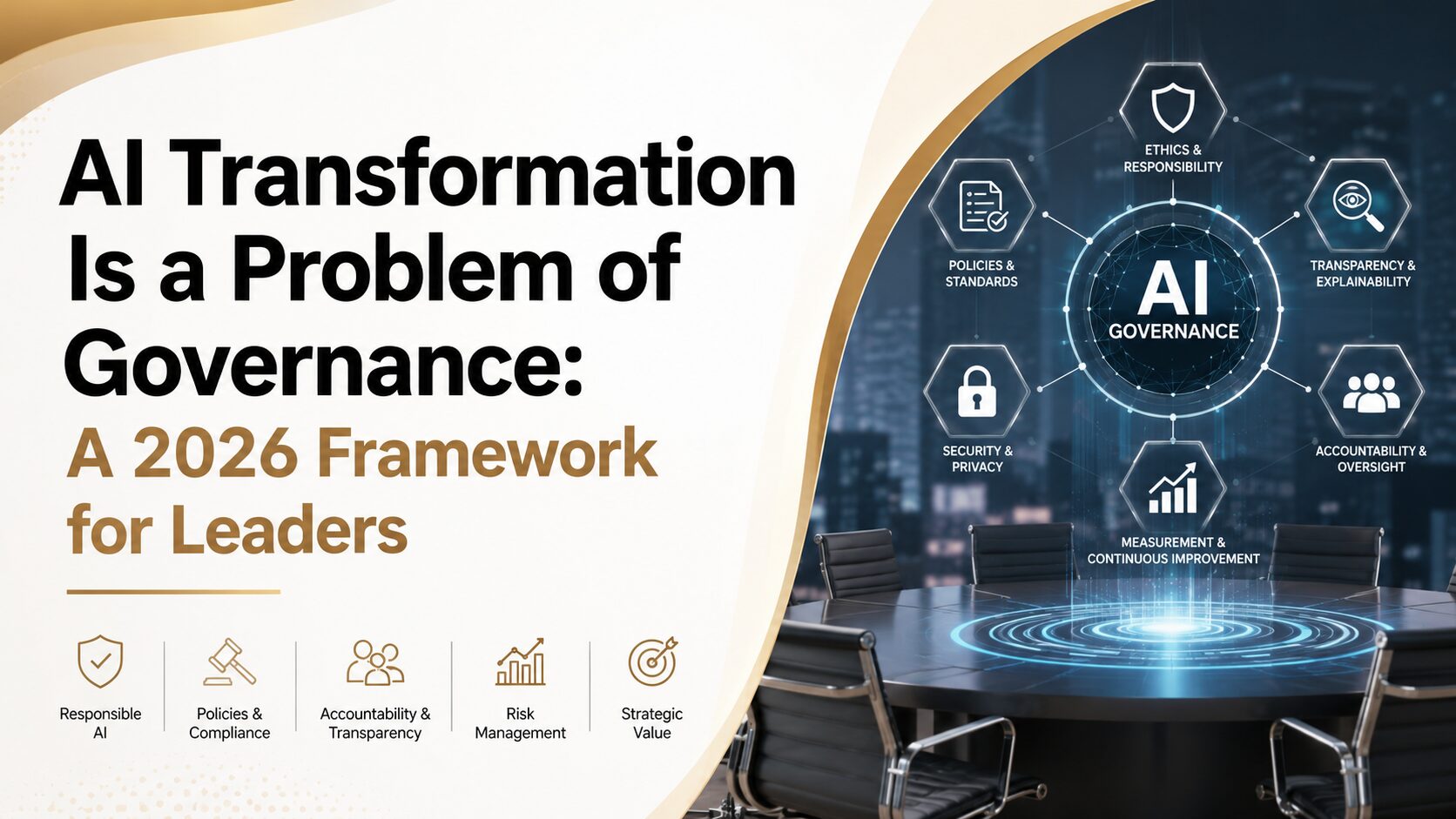
A framework that works tends to rest on five things. Pull one out and the rest starts wobbling. These five pillars exist for one reason: AI transformation is a problem of governance that has to be solved in layers, not with a single policy pinned to an intranet page.
Data integrity and ownership come first, because a model is only as good as what it’s fed. That means actually knowing where your data originates, who’s allowed to touch it, and how it gets checked before a model sees it at all. Picture a retailer feeding a pricing engine competitor data nobody bothered to verify. The output will look confident. It’ll also be wrong, and confidently wrong is worse than obviously wrong.
Model lifecycle management is the second piece, and it’s the one people forget fastest once a launch goes well. Models need validation before they ship and a real plan for retraining or shutting them down once performance slips. Decide ahead of time what counts as unacceptable drift and who gets the alert when it happens.
Continuous monitoring deserves its own place on this list rather than living as a footnote under lifecycle management, and both ISO 42001 and NIST’s framework treat it that way too. A model that passed every test at launch can still start behaving oddly six months later as the world around it changes. Ongoing monitoring is what catches that shift before a customer does.
Human oversight, sometimes called human-centered AI when it’s built in from the start rather than patched on later, matters most in the moments that matter most. Low-stakes recommendations rarely need a reviewer. Credit decisions, hiring calls, and anything touching someone’s health do. This is also where explainable AI, often shortened to XAI, earns its keep. A model that can’t explain why it denied a loan is much harder to defend than one that can point to the actual factors behind the call, and that’s what lets a human exercise real oversight instead of rubber-stamping the output.
Risk and compliance round it out, and this is the one everyone knows they should do earlier than they actually do. Waiting until after launch to think about the EU AI Act or GDPR guarantees rework, usually expensive rework, right around the time a regulator asks for paperwork that doesn’t exist yet.
How You Actually Know If Any of This Is Working
A framework that nobody measures is really just a set of good intentions. Most organizations skip this part entirely, which is a shame, because it’s the piece that turns governance from a policy document into something you can defend to a board. Measuring it properly is where AI transformation is a problem: governance turns from a slogan into an actual scorecard leadership can review each quarter.
Start with a basic AI maturity model, a way of scoring where your organization actually sits, from ad hoc experimentation with no oversight at all up through fully governed systems with continuous monitoring and clear accountability. Most companies, if they’re honest, land somewhere in the middle. Knowing exactly where helps you prioritize instead of trying to fix everything at once.
From there, track a small set of KPIs that mean something: how many systems have a named owner, how many completed a compliance audit this year, how many drift incidents got caught before reaching a customer, and how much business value each system delivers against what it costs to run. A board asking whether governance is actually working deserves a better answer than a shrug.
This is also where governance folds into enterprise risk management, the broader discipline most companies already use to track financial, operational, and reputational risk. AI risk isn’t separate from that system. It belongs on the same dashboard the risk committee already watches.
So Who Actually Signs Off on This
Governance only holds together if responsibility is named clearly, from the board all the way down to the engineer who wrote the model. Naming those names is where AI transformation is a problem: governance stops being an abstract idea and starts showing up on an actual org chart.
| Level | Core Responsibility | Typical Owner |
| Board of Directors | Sets AI risk appetite, approves major initiatives | Board, audit committee |
| Executive Leadership | Translates strategy into policy and ownership | CEO, CIO, CTO, Chief AI Officer |
| Data Leadership | Owns data quality, lineage, and access decisions | Chief Data Officer |
| Governance Committee | Reviews use cases, approves or blocks deployments | Cross-functional risk and compliance leads |
| Technical Teams | Builds, validates, and monitors models | Data scientists, ML engineers |
Boards used to file AI under “IT budget line” and move on. That doesn’t fly anymore. Deloitte’s work on board-level AI oversight found that boards are talking about AI a lot more than they used to, but there’s still a real gap between talking about something and actually understanding it well enough to govern it. Nobody’s asking directors to write Python. They do need enough fluency to push back with real questions about risk appetite and where accountability sits.
The Chief Data Officer role deserves a specific mention here, since it’s often the missing link between technical teams and the executive suite. Data ownership decisions tend to fall through the cracks when nobody specific is accountable for them. Stakeholder management matters too. A committee that only talks to engineers will miss concerns that legal, HR, or customer support could have flagged early.
A Rollout You Could Actually Start Monday
Building this from zero feels like a lot until you break it into pieces, and it helps to remember at every step that AI transformation is a problem of governance you solve in order, not all at once.
Audit → Risk classify → Assign ownership → Set policy → Monitor → Improve
Start with an audit. Write down every AI system running anywhere in the company, including the ones nobody officially signed off on. You can’t manage what you haven’t counted.
Sort by risk next. An internal reporting tool that suggests a chart title is not the same category of risk as a model deciding who gets a loan. Spend your energy where a mistake would actually hurt.
Name an owner for each system, and make it a person, not a department. Departments don’t pick up the phone at two in the morning when a model starts misbehaving.
Write the standard down. Decide what validation, monitoring, and paperwork every system needs before it ships, and make it a rule rather than a polite suggestion.
Monitor continuously once it’s live, and then use what you learn to improve the framework itself. Governance built once and never revisited ages just as badly as a model that never gets retrained.
What You Actually Get Out of Doing This Right
It’s easy to file governance under “cost of doing business,” a tax you pay to avoid fines. That undersells it pretty badly, and it misses the point that AI transformation is a problem of governance whose payoff shows up directly on the balance sheet, not just in an audit report.
Companies with real oversight in place tend to move faster, not slower, because they’ve already answered the questions that usually stall a rollout. Who’s accountable. What happens if it fails. Where the documentation lives. That’s the actual difference between a pilot that stays a pilot forever and one that quietly becomes how the business runs. Responsible AI governance also buys you something harder to quantify: trust, from customers and from regulators, which matters more every year as AI touches more of ordinary life. A company that can explain how a decision got made has a real edge over one that can only shrug and point at the model. Fairness and auditability aren’t just ethical talking points here. They’re what let a company survive a regulator’s audit without a scramble.
It’s cheaper, too, in ways people underestimate until it’s too late. A biased hiring tool, a leaked dataset, or a pricing algorithm quietly discriminating against customers gets expensive fast once lawyers and headlines get involved. Catching it early is a fraction of the cost of cleaning it up after, which is really the whole financial case for why AI transformation is a problem of governance rather than an afterthought bolted on at the end.
Where This Goes From Here
The next stretch of AI governance won’t look much like the current one, and it’s already clear that AI transformation is a problem of governance that keeps evolving rather than one you solve once and file away. As companies move from a single model doing one job to a mesh of agents working together, oversight has to stretch past individual systems and start covering how they talk to each other, including foundation models, cloud-hosted AI services, and intelligent automation tools that increasingly run in the background without much visibility at all.
New job titles are already showing up to handle it: AI risk officer, governance architect, agent operations lead, because the old IT org chart wasn’t built for systems making autonomous calls across a dozen linked processes at once. A newer idea gaining ground alongside all this is AI assurance, essentially independent verification that a system actually does what it claims to do and holds up under scrutiny, similar to how financial audits work today. Governance itself is turning into something closer to a live process than a static document, updated as fast as the regulations and the technology move. The companies getting ahead of this treat it as responsible innovation in practice, not just a phrase on a slide, something that has to keep breathing rather than sit filed away until the next incident forces a review.
FAQs
What is an AI governance framework?
It’s a structured set of policies, roles, and controls that define how an organization builds, deploys, and monitors AI systems responsibly, covering everything from data quality to who signs off on a model going live.
Why is AI governance important in digital transformation?
Because without it, AI initiatives stay stuck as isolated pilots. This is the clearest everyday example of why AI transformation is a problem of governance: the accountability and trust needed to scale AI simply don’t exist without it.
What’s the difference between AI governance and data governance?
Data governance focuses specifically on data quality, access, and lineage. AI governance is broader, covering the models themselves, how they’re monitored, and who’s accountable for their decisions.
How do ISO/IEC 42001 and NIST AI RMF differ?
ISO 42001 is a certifiable management system standard, similar in spirit to ISO 27001 for security. NIST’s framework is a flexible risk management guide rather than a certification, more focused on mapping and measuring risk than on formal audit.
How can small businesses implement AI governance?
Start small. Name one person accountable for every AI tool in use, keep a simple log of what’s running, and apply basic checks like human review for anything touching customer decisions before scaling up to a formal framework.
Why do most AI projects fail to scale?
Usually not because the tech doesn’t work. It’s because nobody owns it clearly, nobody’s watching it consistently, and nobody’s accountable once it moves past the pilot stage.
Conclusion
The companies actually pulling ahead right now usually aren’t running the flashiest models. They’re the ones who bothered to figure out, in advance, who owns what, who’s watching, and who answers when something goes wrong. AI transformation is a problem of governance at its core, and treating it like anything smaller just guarantees you’ll end up in the same pile of stalled pilots as everyone else who skipped this step. Start with an honest count of what you’re already running. Name real owners. Build the monitoring in before launch, not after the first incident. That’s the difference between AI as an expensive experiment and AI as something your business can actually stand on.

Senior SEO Content Marketing Manager at Trendusai.com
Rashida Hanif is a Senior SEO Content Marketing Manager, specializing in data-driven content strategy and SEO. She helps brands improve online visibility through keyword research, content planning, and AI-powered marketing insights.