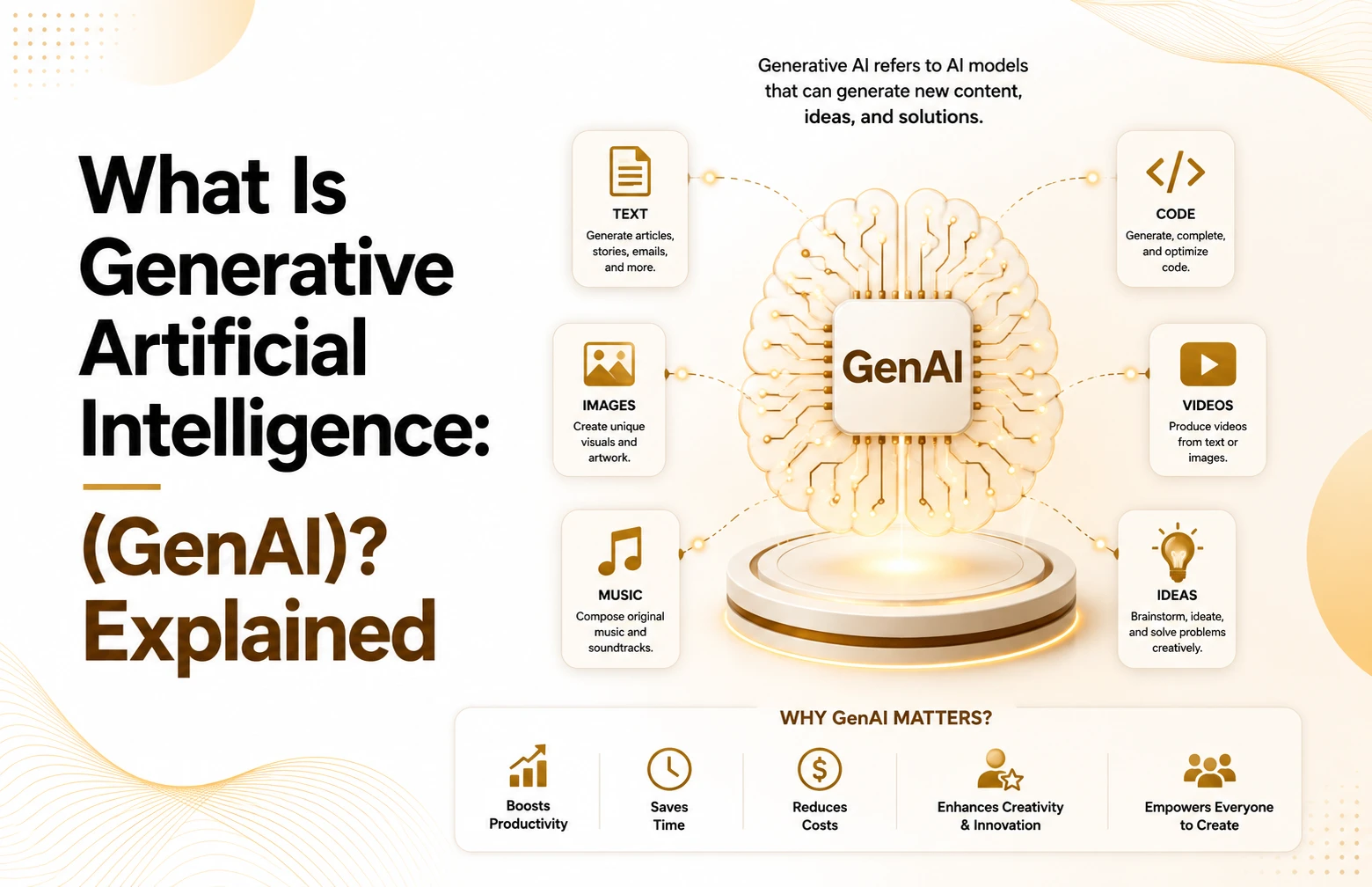
Machines now write novels, generate photorealistic images from a single sentence, compose original music, and produce working software code. This is not a future scenario. It is happening today, at scale, across industries. That is generative artificial intelligence in practice. It has moved from a narrow research discipline into one of the most commercially significant technologies of this decade.
Understanding what generative AI is no longer optional for business leaders, developers, or anyone building products and services. It shapes how software gets built, how content reaches audiences, how drug candidates get discovered, and how entire teams operate. This guide covers the definition, mechanics, model types, real-world applications, benefits, risks, and the direction this technology is heading. No jargon overload. No skipped substance.
Generative AI: Definition and Core Meaning
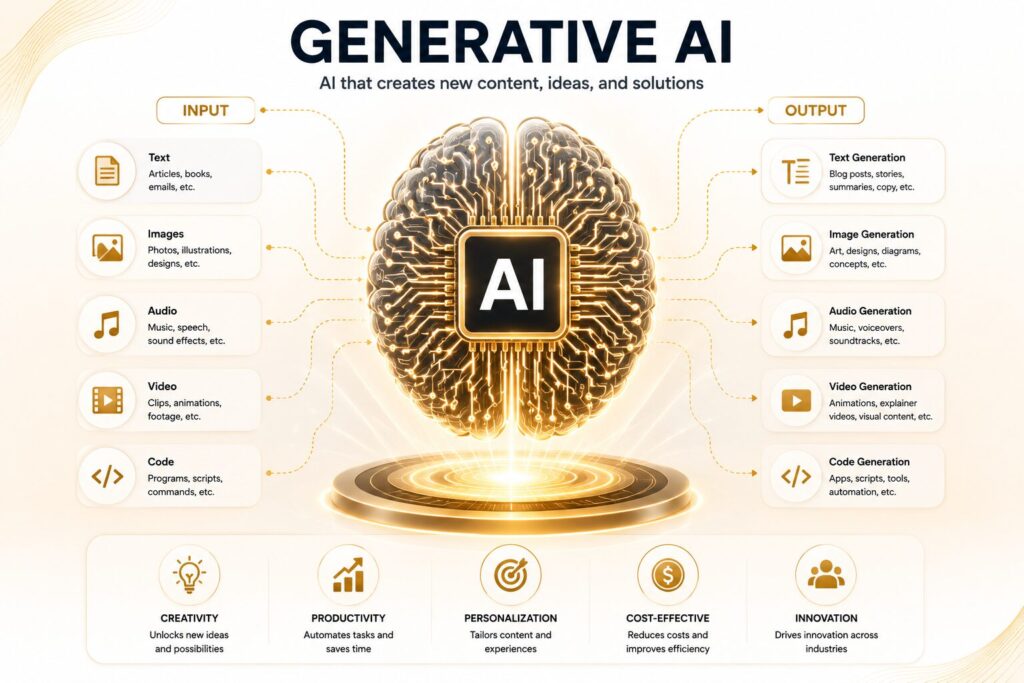
Generative AI (also called gen AI) is a class of artificial intelligence systems built to produce new, original content in response to a user prompt or structured input. That content can be text, images, audio, video, code, or synthetic data. Traditional AI systems classify inputs, detect anomalies, or predict outcomes from existing data. Generative AI creates outputs that did not exist before the request was made.
The generative AI definition is simple on the surface: it is AI that generates. Beneath that simplicity sits considerable technical depth. These models have absorbed the statistical structure of enormous datasets. Billions of text documents, millions of images, hours of recorded audio. They do not retrieve stored answers. They synthesize new ones that fit the patterns they learned during training.
A practical example makes this concrete. When you ask ChatGPT to write a product description, the model does not search a database. It predicts, token by token, what a convincing product description looks like, based on patterns it absorbed during training. The output is contextually coherent, and it is genuinely new text that did not exist before you typed your question.
How Generative AI Works: The Technical Foundation
To understand how generative AI works, three layers of technology matter: machine learning, deep learning, and the transformer architecture. Each builds on the one before it.
From Machine Learning to Deep Learning
Machine learning is the broader field where algorithms learn patterns from data instead of following rules written by programmers. Deep learning is a subset that uses multilayered neural networks to detect complex, hierarchical patterns. These networks are loosely modeled on how neurons connect in the human brain. Generative AI sits within deep learning, using these architectures not just to recognize patterns but to reproduce and extend them.
The Transformer Architecture and Attention Mechanism
The modern generative AI era began in 2017 when Google researchers published “Attention Is All You Need,” introducing the transformer model. Transformers replaced earlier recurrent neural networks because they process entire sequences in parallel. They use self-attention to weigh the relevance of every word or token against every other word in the same sequence. This makes transformers faster to train and better at capturing long-range context in language.
The attention mechanism allows a model to understand that in the sentence “The trophy did not fit in the suitcase because it was too large,” the word “it” refers to the trophy and not the suitcase. That kind of disambiguation requires reasoning across the full sentence. The attention mechanism makes that possible.
Training: How Generative AI Models Learn
Generative AI models are trained on enormous datasets through a process of predicting outputs and adjusting internal parameters to reduce error. For large language models, this means predicting the next token in a sequence of text. For image diffusion models, it means learning to reverse a deliberate noise-addition process to reconstruct clean images from corrupted ones.
After initial pre-training, most production models go through fine-tuning. This is a second stage of training on smaller, task-specific datasets that shapes behavior for particular applications. Most leading models also use reinforcement learning from human feedback (RLHF), where human raters score model responses and those scores steer the model toward more helpful and accurate behavior.
Retrieval-augmented generation (RAG) connects a base model to external knowledge sources, giving it access to current information beyond what was encoded during training. Tokenization is the process of breaking text into subword units before the model processes it. Embeddings are dense numerical representations that capture semantic meaning. These are the core mechanics that make every modern generative system function.
Types of Generative AI Models
Several distinct architectures power today’s generative AI models. Each was built to address a specific kind of generation problem.
| Model Type | How It Works | Primary Use Cases |
| Large Language Models (LLMs) | Transformer-based; predicts the next token in a sequence | Text generation, coding assistants, chatbots, summarization |
| Generative Adversarial Networks (GANs) | Generator and discriminator networks compete to produce realistic outputs | Image synthesis, video generation, synthetic data |
| Diffusion Models | Learns to reverse a noise process to reconstruct clean data | Photorealistic images: DALL-E, Stable Diffusion, Midjourney |
| Variational Autoencoders (VAEs) | Encodes input into a compressed latent space, then decodes to generate new samples | Image generation, drug molecular design, anomaly detection |
| Multimodal AI Models | Processes and generates across multiple data types simultaneously | Vision-language tasks, audio-visual interfaces, video generation |
LLMs such as GPT-4 from OpenAI, Gemini from Google, and Claude from Anthropic are the most widely used examples of generative AI today. Image generation systems like DALL-E and Midjourney run primarily on diffusion architectures. For a current look at which tools are gaining the most commercial traction, the TrendusAI guide to AI tools dominating search in 2026 provides a regularly updated breakdown.
Foundation Models: The Infrastructure Behind Generative AI
A foundation model is a large AI model trained at scale on broad, general-purpose data. It serves as a base that developers and enterprises adapt through fine-tuning or structured prompting to handle a wide range of tasks. GPT-4, LLaMA 3, and Google Gemini are all foundation models. Building on these pre-trained foundations cuts costs and development time significantly compared to training a new model from scratch for every use case.
Foundation models make two capabilities commercially practical at scale. Zero-shot learning is the ability of a model to handle a task it was never explicitly trained on because its broad pre-training gave it enough coverage of the concept. Few-shot learning goes further: given two or three examples in the prompt, the model generalizes the pattern to new instances. One foundation model can power a customer support chatbot, a code assistant, a document summarizer, and a marketing copy tool with minimal task-specific work required per application.
Generative AI Applications Across Industries
The range of generative AI applications that have moved into active production is now genuinely broad. The following industries show the most mature deployments and the most measurable results.
Software Development and AI Code Generation
AI code generation tools, including GitHub Copilot and Amazon CodeWhisperer, write functions, suggest completions, explain legacy code, and auto-generate test cases. McKinsey research found that developers using AI coding assistants complete tasks up to 55% faster. This is one of the clearest productivity gains documented in generative AI in software development. The same acceleration applies to mobile product teams. The impact of artificial intelligence on mobile app development follows a consistent pattern across design, testing, and deployment cycles.
Content Creation and Marketing
Generative AI for content creation now supports blog drafts, product descriptions, email campaigns, and social media copy at scale. In generative AI in marketing, personalisation is the primary value. Models produce individualized messages for segmented audiences faster than any human team can. In content and entertainment, platforms like Magic Hour AI extend this into AI face swap, letting creators produce UGC-style ads and social content by replacing faces in footage frame-by-frame without any video editing software. Organisations building serious content operations around these capabilities benefit from understanding how AI development services can be integrated into existing production workflows. Beyond content generation, a paraphrase tool can further strengthen content workflows by refining messaging, improving clarity, and adapting existing copy for different audiences without losing the original meaning. As content operations expand beyond brand-owned channels, influencer marketing platforms can support the creator side of distribution by helping teams coordinate influencer campaigns alongside AI-assisted production
Healthcare and Drug Discovery
Pharmaceutical researchers use generative models to simulate molecular structures, predict protein folding behavior, and propose new drug candidates. Insilico Medicine has already advanced AI-discovered drug candidates into clinical trials. In diagnostics, multimodal models analyze imaging data and produce structured clinical summaries that reduce radiologist workload in measurable ways.
Finance and Business Operations
In financial services, generative AI in business automates document analysis, generates regulatory compliance The same kind of models also power tools that translate documents such as contracts, reports, and invoices while keeping the original layout, which matters for teams working across countries. summaries, produces risk reports, and powers customer-facing assistants. The operational pattern is consistent: similar output with fewer labour hours, or higher throughput with the same team.
Research and Scientific Discovery
In academic and applied generative AI in research settings, the technology accelerates literature synthesis, hypothesis generation, and experimental design. DeepMind’s AlphaFold resolved the protein structure prediction problem that had challenged scientists for decades. Successor systems are now being applied to materials science, climate modeling, and genomics.
Generative AI vs. Predictive AI: Understanding the Difference
A common source of confusion is the boundary between generative and predictive AI. Both use machine learning. The distinction is in the output.
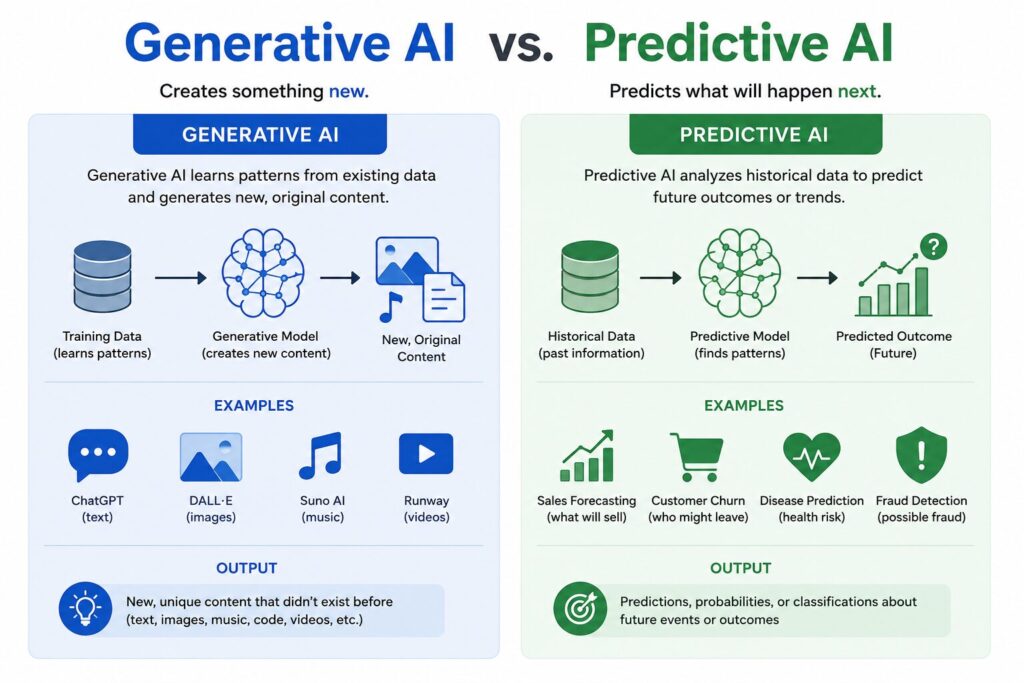
Predictive AI takes input data and produces a prediction about that data. A credit risk score, a churn probability, a fraud flag. Its output is a decision or classification drawn from existing data.
Generative AI takes input and produces new content. A paragraph of text, an image, a molecule, a block of code. It creates rather than classifies.
In enterprise practice, the two are increasingly combined. A fraud detection system (predictive) might use a generative model to produce a plain-language explanation of why a transaction was flagged. The governance challenges of enterprise AI transformation often come from conflating both model types and applying the wrong evaluation criteria to each.
Benefits of Generative AI
The documented benefits of generative AI are consistent across industries and use cases:
- Productivity at scale: tasks that previously took hours now take minutes. First-draft writing, code scaffolding, data summarisation, and design iteration all fall into this category.
- Personalisation at volume: content and communications can be tailored to individual preferences dynamically, across millions of interactions at once.
- Broader access to expertise: a non-developer can generate working code. A non-designer can produce usable visuals. A non-specialist can produce a structured first draft of a complex document.
- Faster research cycles: in scientific domains, AI-generated hypotheses and simulations compress experimental timelines from years to months.
- Lower cost per unit of digital work: replacing or supporting high-cost creative, analytical, and operational workflows reduces the marginal cost of producing quality digital outputs.
Realizing these benefits at an enterprise level requires selecting use cases where generative AI can deliver measurable value and determining whether existing data, infrastructure, and workflows can support them. Generative AI consulting can help organizations assess these factors, prioritize suitable applications, select appropriate models and architectures, and develop an implementation roadmap that accounts for integration, security, governance, and expected business outcomes.
Generative AI Market Growth: Key Data Points
Commercial investment in generative AI reflects the scale of the perceived opportunity. Research firms vary in their market scope definitions, but they agree strongly on direction.
| Year | Market Size (Approx.) | Projected CAGR | Primary Growth Driver |
| 2025 | $37B to $104B | N/A | Enterprise LLM adoption |
| 2026 | $55B to $161B | 31 to 40% | Multimodal and agentic AI |
| 2030 | $200B and above | 31 to 40% | Industry-specific fine-tuning |
| 2034 to 2035 | $677B to $1.2T | 31 to 40% | Autonomous agents and GenAI infrastructure |
North America accounts for roughly 41 to 49% of current global revenue. The US market alone is projected to exceed $52 billion by 2026. The top AI development companies in the USA are central to this growth, attracting the majority of enterprise investment and venture capital. A 2025 McKinsey survey found that 88% of organisations now use AI in at least one core business function.
Generative AI Risks, Limitations, and Ethical Considerations
Responsible use of generative AI requires an honest understanding of where it fails. These limitations are not minor footnotes. They are active constraints on how the technology should be deployed.
Hallucination
LLMs produce confident, grammatically clean, and sometimes completely wrong information. Because the model predicts statistically likely text rather than retrieving verified facts, it can fabricate citations, statistics, names, and events. Human review is non-negotiable for any output that carries real-world consequences.
Bias and Fairness
Models trained on internet-scale data inherit the biases present in that data. Outputs can reflect racial, gender, cultural, or political biases in ways that are hard to detect systematically. This matters most in HR screening tools, financial assessment systems, and any context where AI outputs influence decisions about real people.
Intellectual Property and Copyright
Training on copyrighted material and producing outputs that resemble protected works has triggered significant litigation. The legal landscape around AI and intellectual property is unsettled in most jurisdictions. Enterprises using generative AI tools need legal guidance on both data sourcing for custom training and the commercial use of generated outputs.
Security and Misuse
Generative AI reduces the technical barrier for phishing attacks, synthetic identity fraud, disinformation, and malicious code. This is among the most concrete near-term generative AI risks. Security teams, regulators, and platform providers are working to address it through technical guardrails and emerging legal frameworks.
Environmental Cost
Training large foundation models requires substantial compute and energy. GPT-4’s training reportedly consumed energy equivalent to hundreds of average US households running for a full year. Inference at scale compounds that cost. For large organisations, sustainable AI development has become both an ethical concern and a reputational one.
For teams building ethical generative AI frameworks, Stanford University’s annual AI Index Report provides rigorous benchmarking of safety, capability, and societal impact across leading models and providers.
Agentic AI: What Comes After the Prompt
A significant development in generative AI is the emergence of AI agents. These are systems that do not simply respond to isolated prompts. They execute multi-step tasks with a degree of autonomy. An agentic system receives a high-level goal, breaks it into subtasks, selects and uses tools such as web search, code execution, and file access, evaluates intermediate results, and delivers a finished output with minimal human instruction at each step.
This changes the relationship between humans and AI from tool-use to genuine collaboration. Leading examples include OpenAI’s operator-class models, orchestration frameworks such as LangChain and AutoGen, and enterprise agent platforms deployed in legal research, customer operations, and software testing. Generative AI for AI agents and generative AI for software automation are converging. The same foundation model that writes code can now also execute it, evaluate the result, and iterate independently.
Generative AI Tools: A Practical Orientation
The landscape of generative AI tools has grown rapidly. Selecting the right tool means matching capability to the use case, data sensitivity requirements, and integration needs.
- ChatGPT (OpenAI): strongest for general-purpose text generation, structured reasoning, and coding assistance. Available at the consumer and enterprise tiers.
- Midjourney and DALL-E: the leading image generation platforms for creative and commercial visual work. Both run primarily on diffusion architectures.
- GitHub Copilot: built specifically for software development. Integrates deeply with VS Code, JetBrains, and major CI/CD pipelines.
- Gemini (Google): a multimodal foundation model with strong integration across Google Workspace, Search, and Cloud infrastructure.
- Enterprise API platforms: Anthropic, OpenAI, and Cohere offer enterprise-tier API access with data privacy controls, custom fine-tuning options, and SLA guarantees suited to regulated industries.
For an ongoing view of which tools are gaining adoption across industries, Trendusai tracks emerging tools and commercial deployment patterns.
Conclusion
Generative artificial intelligence is not a passing trend. It represents a genuine shift in what software can do and how people interact with machines. Organisations and individuals who understand the mechanics, where risks sit, and which tools suit which tasks will make better decisions than those who treat it as background noise.
The real limitations are worth taking seriously. Hallucination, bias, copyright uncertainty, and energy cost are not theoretical problems. They affect production deployments today. At the same time, the productivity gains are documented, the new research capabilities are real, and commercial adoption continues to grow across every major industry. Generative AI deserves serious strategic attention from every organisation, not as an experiment but as a core part of how work gets done.

Senior SEO Content Marketing Manager at Trendusai.com
Rashida Hanif is a Senior SEO Content Marketing Manager, specializing in data-driven content strategy and SEO. She helps brands improve online visibility through keyword research, content planning, and AI-powered marketing insights.