You paste your essay into an AI detector, and it says 60% AI. You wrote every word. Or you’re an editor with fifty freelance drafts and no clue which ones to trust. Both problems end at the same question: can the Winston AI AI Checker make a real decision? This review looks at the numbers Winston publishes, the tests other people ran, the price, and the limits. We didn’t run our own sample tests, and we say so below. You’ll see where the 99.98% claim comes from, where independent results differ, and who should rely on a score.
Winston AI AI Checker at a Glance
| Item | Details |
| User rating | 4.1 out of 5 from 67 reviews on G2, Capterra and Trustpilot (Toolradar, checked August 26, 2026) |
| Best for | Checking long prose such as essays, articles, and reports |
| Price | 14-day free trial. Paid plans from $18 a month, or $10 a month billed yearly |
| Accuracy | Winston claims 99.98% AI detection. Independent tests report lower figures |
| Main risk | False positives, plus weaker results on short, edited, or translated text |
What Is Winston AI AI Checker?
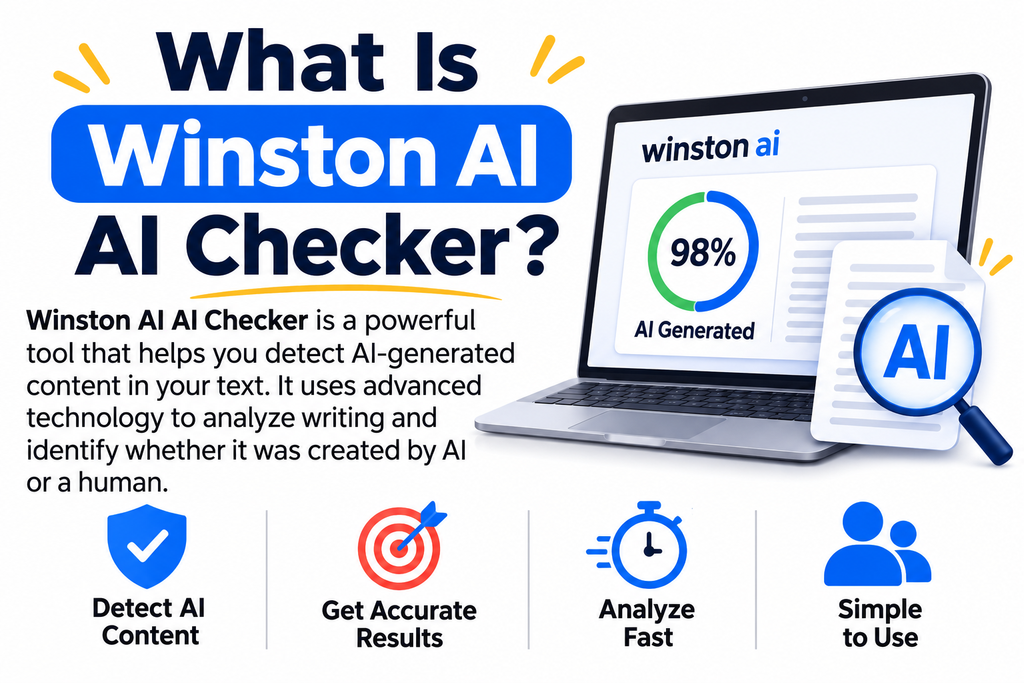
Winston AI is an AI content detector. You copy/paste or upload text, and it rates the text for machine authorship. The Winston AI checker also checks for plagiarism and scans images. It is considered by many as a “content integrity tool for educators and publishers” by reviewers.
Key features
- AI detection: Winston states its support for ChatGPT, Claude, Gemini, and other models.
- Plagiarism checking: Winston’s aid center lists sophisticated plagiarism detection in its Superior package.
- Image detection: The Essential plan includes AI image detection, and Winston lists deepfake scans too.
- Reports: You get a Human Score, an AI Prediction Map, highlighted sentences, and an explained summary.
- Readability: A Flesch-Kincaid grade level appears in the report. It has nothing to do with AI detection.
- Extras: Fast.io’s review lists OCR for scanned and handwritten text. Winston also sells HUMN-1 website certification.
Who it’s built for
Students use it to submit assignments. Teachers use it to review assignments submitted by students. It is used by agencies and SEO publishers to test the freelance drafts before publishing them. Students can use it to observe the result of their own writing submitted to an AI writing detector. There are different levels of caution, as you’ll see later, for each group.
How Winston AI AI Checker Works
So, how does Winston AI work? The majority of AI writing detectors search for patterns. The two most popular are that there is some unpredictability in the next word (perplexity) and a variation in sentence length and rhythm (burstiness). The smoothness and evenness of the text are more of a machine feature.
Winston claims its engine is trained on a broad spectrum of written material. It doesn’t disclose its entire formula on the pages we read, so we can’t tell you which signals are most important. What we can describe is the output.
How the score is calculated
The main result is the Human Score, from 0% to 100%. A score near 100% means the text strongly resembles verified human writing. A score near 0% means it resembles AI-generated content. The middle is inconclusive.
Think of it as a probability score, not a measurement. Winston gives an example: a 20% Human Score doesn’t mean exactly 80% of the words came from AI.
The AI Prediction Map splits the text into smaller sections and colors each one:
| Section score | Label | What it suggests |
| 0 to 20 | AI Generated | Strong AI signal |
| 20 to 40 | Likely AI | Leans AI |
| 40 to 60 | Uncertain | No clear signal |
| 60 to 80 | Mostly Human | Leans human |
| 80 to 100 | Human Written | Strong human signal |
Winston warns that sentence-level scores rest on small samples. Don’t average them, and don’t treat one highlighted sentence as proof.
How to read the Winston AI human score (safe range)
People often ask what Winston AI score is safe. Winston doesn’t publish a pass mark. Scores near 100% read as human, and the map treats 60 and above as mostly human. Your school, client, or editor decides where the line sits.
Length matters more than most users expect. Winston requires at least 500 characters to run a scan and recommends 300 words or more. A short excerpt gives a weaker score, so scan the full document when you can.
How We Tested Winston AI AI Checker (and What We Didn’t)
Here’s the honest part. We didn’t write our own batch of ChatGPT, Claude, Gemini, edited, or humanized samples and run them through the tool. Making up results would help nobody. Instead, we compared published evidence and marked who produced each number.
Test samples
The evidence we used came from four places:
- Winston’s own model evaluations, called Luka and Curia.Third-party tests reported by Fast.io, including a 150-sample test by supwriter.com and University of Florida data.
- Winston’s help center guidance on text types, languages, and limits.
- Public review scores and Trustpilot comments.
Scoring criteria
We looked at five things: how strong the AI detection accuracy evidence is, how often human writing gets flagged, how clear the price is, how the tool handles your data, and who it suits. Where sources disagree, we show both.
Is Winston AI AI Checker Accurate? Claim vs Test Results
Is Winston AI accurate? The answer depends on whose test you read.
The Winston AI 99.98% accuracy claim
The 99.98% figure comes from Winston’s Luka (version 3.0) evaluation. It is the AI detection accuracy, meaning how often AI text was caught. The same evaluation reported 99.5% human accuracy and 99.74% overall. The human samples were written before 2021, so they predate common AI writing tools, and each had at least 600 characters.
A later Curia evaluation, dated February 5, 2025, used 10,000 English samples. Winston reports 99.97% human accuracy and 99.95% overall. Winston owns both tests.
Results table
| Source | Who ran it | What was tested | Reported result |
| Luka evaluation | Winston | 10,000 texts, half human and half AI | 99.98% AI, 99.5% human, 99.74% overall |
| Curia evaluation | Winston | 10,000 English samples | 99.97% human, 99.95% overall |
| Information Research study | Peer-reviewed paper, as described by Winston | Comparison of detectors | Winston ranked first with a 99% standardized average |
| supwriter.com test | Independent site, via Fast.io | 150 AI samples from five models | 76.3% overall |
| University of Florida data | Researchers, via Fast.io | Academic text | 75.9% detection |
| DetectArena | Benchmark, via Fast.io | Human text | 0.5% false positives |
The gap is big. Winston’s own numbers sit above 99%, while the independent tests Fast.io reports land far lower. Test design explains part of it. Different datasets, model versions, and text types give different scores.
So does Winston AI detect ChatGPT, Claude, and Gemini? Winston says yes. The supwriter.com test, as reported by Fast.io, shows the catch rate varied by model:
| AI model tested | Share detected | Source | Note |
| DeepSeek R1 | 88% | supwriter.com via Fast.io | Older model versions |
| GPT-4 Turbo | 82% | supwriter.com via Fast.io | Older model versions |
| GPT-4o | 80% | supwriter.com via Fast.io | Older model versions |
| Gemini 1.5 Pro | 73% | supwriter.com via Fast.io | Older model versions |
| Claude 3.5 Sonnet | 66% | supwriter.com via Fast.io | Older model versions |
Those are older models. We found no matching public test for the newest versions, so treat the table as a guide, not a current ranking.
Accuracy on edited and humanized text
Can Winston AI detect humanized text? Winston says it trains for humanized content, yet admits that heavily rewritten text lowers its confidence. Its help center adds that a moderately raised Human Score on paraphrased text doesn’t prove a person wrote it.
Edited AI text is harder still. Winston notes that heavy human editing can lower the AI score even when the original came from AI. Fast.io says running text through Quillbot or editing by hand cuts detection rates across all detectors, not only this one. In short, Winston AI humanized text results depend on how much rewriting happened.
Does Winston AI Have False Positives?
Yes, any detector can flag human work, and Winston says so. A false positive is when the writing is incorrectly identified as written by AI.
Winston’s human writing figure is 0.03%, and Luka’s is 0.50%. Other tests are not so friendly. According to Fast.io, it was one test with 4 of 40 human samples being flagged, or 10%. DetectArena measured 0.5%. One Trustpilot user also griped that the human was flagged as AI.
Why it flags human writing
Does Winston AI flag human writing? At times, Winston cites the usual suspects: official language, repeated phrasing, boilerplate, quotations, and abrupt changes of style. Content that is not appropriate for scanning, such as source code, tables, formulas, and legal boilerplate, also appears on the Winston list.
In the Luka test, human categories varied:
| Human writing type | Correctly marked human | False positive rate | Source |
| Essays and theses | 100.00% | 0.00% | Winston Luka test |
| News and blog writing | 99.56% | 0.44% | Winston Luka test |
| Reddit posts | 99.15% | 0.85% | Winston Luka test |
| Poems | 98.85% | 1.15% | Winston Luka test |
| Stack Overflow posts | 98.05% | 1.95% | Winston Luka test |
Risk for ESL and academic writing
Here’s a gap worth knowing. Winston says it hasn’t published a separate false positive rate for nonnative English writers or for students as a group. Its 0.03% figure covers English only. Fast.io says ESL writing may trigger higher rates because some phrasing overlaps with patterns detectors tie to AI. That’s a caution, not a measured number.
If you grade or review ESL work, don’t lean on the score alone. Look at drafts and notes too.
Winston AI AI Checker Pricing and Free Plan
How much does Winston AI cost? Winston’s help center, last updated August 24, 2026, lists these plans.
Plans and credits table
| Plan | Monthly price | Yearly price | Credits per month |
| Free | $0 | Not applicable | 2,000 credits for 14 days |
| Essential | $18 | 120ayear(10 a month) | 100,000 |
| Advanced | $29 | 192ayear(16 a month) | 200,000 |
| Elite | $49 | 312ayear(26 a month) | 500,000 |
Essential suits solo users who need AI detection, image detection, and writing feedback. Advanced adds advanced plagiarism detection, team access, and website certification. Elite adds the most credits and top-ups. Schools and larger firms can contact sales for volume pricing.
Credits drop with each scan. Older Winston pricing pages listed 1 credit per word for AI detection and 2 per word for plagiarism checking. The current help center says cost depends on content and tools, so confirm the rate in your dashboard. Monthly credits refresh each billing cycle and don’t roll over.
Free trial, cancellation, refunds
Is Winston AI free? Only as a trial. You get 14 days and 2,000 credits, and Winston says no credit card is needed. The trial covers AI content detection and selected features, not every paid feature.
Can I cancel Winston AI? Monthly plans carry no long-term contract, and Winston has a help page on cancelling and another on pausing. Annual plans are paid for the year and, per Toolradar, can’t be cancelled mid-term. We didn’t find a refund policy in the pages we read, so check Winston’s terms before paying for a year.
Is it worth paying?
Do the math for your own volume. If the old 1 credit per word rate still applies, 100,000 credits cover roughly 100,000 words of AI scanning a month, about 33 articles of 3,000 words. That’s an estimate, not a promise.
For a quick personal check, the trial may be enough. For a team that scans every week, yearly billing cuts the monthly cost, but you lock in for twelve months. Try the trial on your real content first.
Winston AI AI Checker Features, Limits and Languages
Report clarity, file support, word limits, API and integrations
The report is the tool’s strongest point. The Human Score comes first, the map shows where to look, and Explain gives a plain summary. That makes the Winston AI detector easier to read than a bare percentage.
Limits are clear too. A scan needs 500 characters minimum, and 300 words or more works best. Here’s how Winston rates content types:
| Content type | Works well? | Winston’s note |
| Essays and blog posts | Yes | Best results with full prose |
| Emails and product descriptions | Yes | Good when full sentences exist |
| Social media posts | Limited | Usually too short |
| Translated text | Limited | Translation changes writing patterns |
| Source code and tables | No | No natural prose signal |
AI text detection covers 16 languages: English, German, French, Dutch, Spanish, Portuguese, Italian, Polish, Indonesian, Tagalog, Chinese, Romanian, Russian, Ukrainian, Bulgarian, and Azerbaijani. Winston says reliability can differ by language. It lists a separate Developer API, so check that page for limits. We didn’t verify a full list of upload formats, so look at the upload screen before you buy.
Privacy and data handling
Winston stores submitted text and images with the report, so you can return to scans. Delete a report and the content leaves active storage within 30 days. Encrypted backups can hold it up to 90 more days. Content is encrypted at rest and in transit. FrontDesk Review confirms GDPR coverage and found no mention of SOC 2 or HIPAA. If you scan student work or client drafts, read the privacy policy first.
Winston AI AI Checker Pros and Cons
| Pros | Cons |
| Publishes detailed accuracy tests | Biggest numbers come from Winston’s own tests |
| Clear report with map and explanation | Weaker on short, edited, and translated text |
| AI, plagiarism and image checks in one place | Free access is a 14-day trial, not a lasting plan |
| Supports 16 languages for AI text detection | No published false positive rate for ESL writers |
| Yearly billing drops the price | Annual plans can’t be cancelled mid-term |
| Trial needs no credit card | Stores your documents until you delete them |
Winston AI vs Turnitin, GPTZero, Originality.ai and Grammarly
Is Winston AI better than Turnitin or GPTZero? We can’t say. We found no trustworthy head-to-head test, and the tools are sold differently. The table compares how each one is bought and used, not which wins.
| Tool | Built for | How you buy | Worth knowing |
| Winston AI | Educators and publishers | Self-serve plans from $18 a month | Adds image detection and OCR |
| Turnitin | Schools and universities | Institutional license, no public price | AI detection sits inside school workflows |
| GPTZero | Students and teachers | Free tier plus paid plans | Fast.io lists a free 10,000 words a month tier |
| Originality.ai | Publishers and SEO teams | Paid credits | Check current pricing on its site |
| Grammarly | Writers already in Grammarly | Free basic detection, paid Premium | Fast.io calls it suited to casual checks |
| Copyleaks | Schools and businesses | Paid plans | Combines plagiarism and AI detection |
On Winston AI vs Grammarly, the split is purpose. Grammarly is a writing assistant with a detector attached. Winston is a detection product first. Prices change often, so check each vendor’s page before you decide.
Who Should Use Winston AI AI Checker (and Who Shouldn’t)
Teachers, writers and agencies, SEO publishers, students
- Teachers: Can teachers rely on Winston AI? Use it to decide which essays deserve a closer look. Winston itself says high-stakes decisions need a wider review.
- Writers and agencies: Good for screening long drafts before delivery. Run full articles, not snippets.
- SEO publishers: Useful for spot checks on content authenticity across many freelancers, if the credit math works.
- Students: Handy to see how your draft reads. Keep your notes and version history anyway.
When it is the wrong tool for an authorship decision
Skip it as sole proof when the text is short, translated, mostly bullets or code. Skip it for legal boilerplate. And never use one score for academic integrity cases or hiring decisions. Authorship verification needs drafts, sources, and a conversation.
What Users Say About Winston AI AI Checker (Trustpilot, G2, Reddit)
Toolradar puts the average at 4.1 out of 5 across 67 reviews on G2, Capterra, and Trustpilot, checked August 26, 2026. Trustpilot praise centers on easy use, quick results, and fair billing. One reviewer says the detection produced false positives on text they wrote themselves.
We didn’t count Reddit threads for this update, so we report no numbers from there. Threads are anecdotes anyway. Read a few before you pay, and look for people who share their text length and what they scanned.
What to Do If Winston AI Flags Your Writing
- Scan the full document, not a short excerpt. Winston recommends 300 words or more.
- Remove headers, footnotes, and bibliographies, which Winston says can add noise.
- Check the highlighted passages. Quotes and templates can pull a score down.
- Collect proof: drafts, notes, sources and version history.
- Share that proof with the teacher or editor and ask for a review.
Don’t run your text through an AI humanizer to chase a better number. It changes your writing and doesn’t prove who wrote it.
Best Winston AI Alternatives
Pick by job, not by hype.
- GPTZero: a free tier exists, so it’s the easy answer to “is there a free alternative to Winston AI?” Limits change, so confirm them.
- Turnitin: for schools that already hold a license. Individuals can’t buy it directly.
- Originality.ai: aimed at publishers who check content in bulk.
- Copyleaks: pairs an AI plagiarism checker with AI detection for schools and businesses.
- Grammarly: free basic detection inside a tool many writers already use.
- Clever AI Detector: another option on the list. We haven’t verified its price or accuracy, so read its own page.
These are Winston AI alternatives worth a trial, not a ranking.
Final Verdict: Is Winston AI AI Checker Worth It in 2026?
The Winston AI AI Checker is worth a trial if you check long prose and want a readable report. The reporting is clear, the language list is wide, and the trial needs no card. The price is fair for teams that scan often.
It isn’t worth treating as proof. The 99.98% figure measures AI detection on Winston’s own test, and outside tests found lower results on some models. Edited text, translations, and short passages further reduce reliability. Use the score to start a conversation, and let drafts and sources finish it.
Frequently Asked Questions
Is Winston AI AI Checker accurate?
Winston reports 99.98% AI detection and 99.5% human accuracy in its Luka test. Independent tests reported by Fast.io show lower results, such as 76.3% overall in one 150-sample test.
Is Winston AI AI Checker free?
Only as a 14-day trial with 2,000 credits. Paid plans start at $18 a month, or $10 a month billed yearly.
Does Winston AI have false positives?
Yes. Winston’s own tests show 0.03% to 0.50%, while one outside test flagged 4 of 40 human samples. Formal, repeated, or boilerplate text raises the risk.
Is Winston AI better than Turnitin or GPTZero?
We found no reliable head-to-head test. Turnitin is sold to institutions, and GPTZero offers a free tier. Choose by use case.
Can Winston AI detect ChatGPT, Claude, and Gemini?
Winston says yes. One outside test caught 80% of GPT-4o, 73% of Gemini 1.5 Pr,o and 66% of Claude 3.5 Sonnet text, using older model versions.
Can Winston AI detect humanized text?
Winston trains for it, but says heavy rewriting lowers confidence. A raised Human Score on paraphrased text doesn’t prove human authorship.
What Winston AI score is considered safe?
Winston sets no pass mark. Scores near 100% read as human, and 60 to 80 reads as mostly human. Your institution or client sets the line.
Does Winston AI check plagiarism?
Yes. Advanced plagiarism detection is listed with the Advanced plan. Plagiarism checking and AI detection are separate checks.
Can teachers rely on Winston AI?
As a screening step, yes. For misconduct decisions, Winston advises using the score as one piece of evidence alongside drafts and context.
Is there a free alternative to Winston AI AI Checker?
GPTZero and Grammarly both offer free basic detection. Check current limits on each site.

Senior Content Manager at TrendusAI
Rashida Hanif is a content strategist at Trendusai.com, creating informative articles on artificial intelligence, emerging technologies, and digital solutions. She focuses on delivering valuable insights that help readers understand AI innovations, software development, and technology trends.