
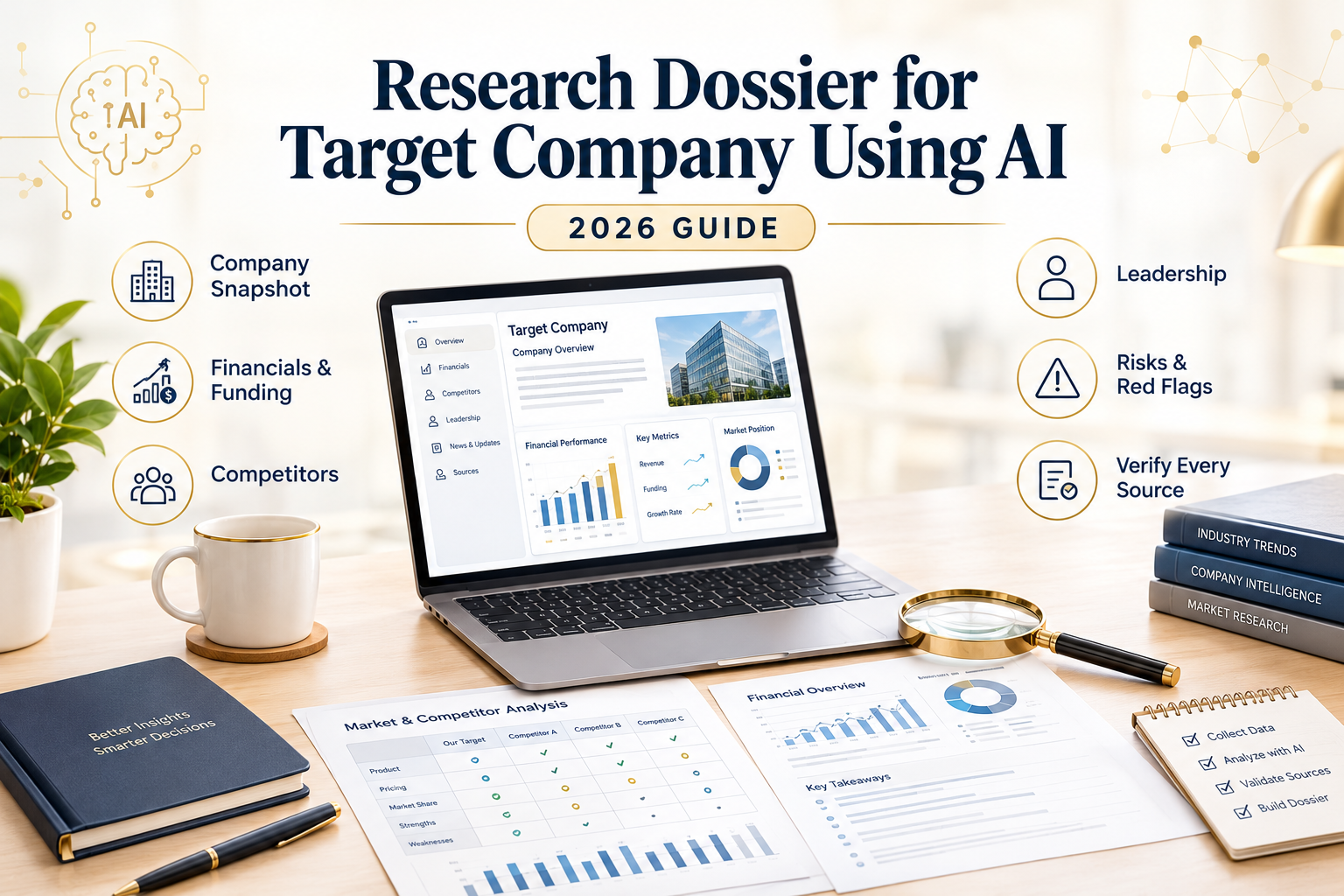
Research Dossier for Target Company Using AI
A research dossier for target company sounds simple until you start. You open ten tabs, copy numbers into a document, and lose track of where each fact came from. A sales call is two hours away, or a partner deal needs an answer by Friday. AI tools promise a finished report in minutes. They can also invent dates, cite pages that don’t exist, and hand you a polished answer you can’t trust. This guide shows you how to build one you can defend. You’ll get the sections to cover, the sources to use, a copy-paste prompt, a tool list, and a checklist for checking every claim.
1. What Is a Research Dossier for Target Company?
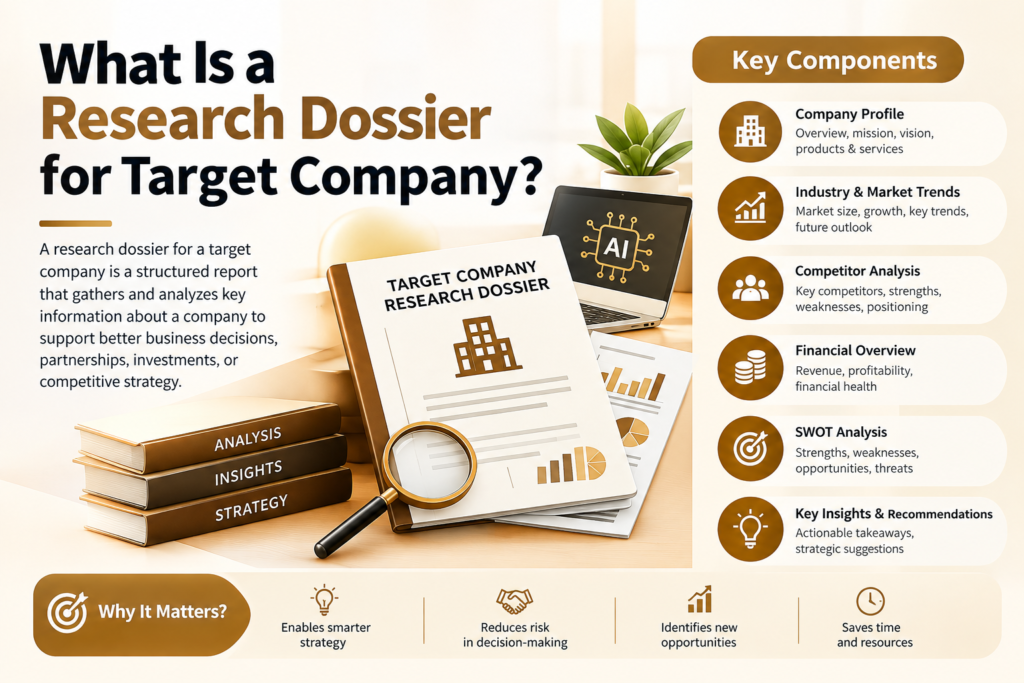
A research dossier for target company analysis is a structured file about one organization. It compiles information from a variety of sources into a single location, and connects each claim to its source. Most cover what the company sells, who runs it, how it earns money, and what could go wrong. You’ll also hear it called a company research dossier, a target company dossier, or a company deep-dive dossier. A business research dossier is the same idea, written for a work decision.
A dossier of a target company you plan to sell to looks different from one for a company you plan to buy. Pick the decision first, then collect facts.
Research dossier vs. company profile
A company profile is a short summary. It lists the name, size, location, and industry. A dossier goes further. It adds competitive positioning, risks, open questions, and a recommended next step. A profile tells you who the company is. A dossier helps you decide what to do about it.
Common business use cases
The same structure serves four jobs. What changes is which sections you read first.
| Use case | Who uses it | What the dossier settles |
| Sales and account planning | Sales and account executives | Who sits on the buying committee, what they need, and what goes in the account plan |
| Investment and due diligence | Investors and due diligence analysts | Financial health, ownership structure, funding rounds, and risk |
| Partnership and vendor evaluation | Business development, procurement, and vendor managers | Partner evaluation, vendor risk, and long-term fit |
| Competitive analysis | Strategy and competitive intelligence teams | Competitive intelligence, market analysis, and go-to-market differences |
2. Why Use AI for a Research Dossier?
Here’s what you gain when you research a company using AI, and where the tools fall short.
Faster company research
A deep research agent plans a search, reads many pages, and writes a cited report in one run. You skip the tab hopping and the copy and paste. An AI draft of a research dossier for target company work gives you something to check. The final call stays with you.
Broader information coverage
One run can touch filings, news, job posts, patents, and reviews. A person with one hour rarely reads all of those. Wide coverage helps you spot gaps early. It doesn’t tell you which claims are true.
Consistent research structure
A structured dossier follows the same outline every time. Your team can compare two vendors or ten accounts side by side. Missing sections stand out. Handoffs between teammates get easier.
AI limitations and the importance of human analysis
AI tools can state wrong facts in a confident tone. That error is called a hallucination. An AI-generated company report can read smoothly and still hold mistakes. Tools also pick weak sources, mix up similar company names, and skip details that matter to one firm. A person needs to check the claims that drive the decision.
What the 2026 Deep FinResearch Bench reveals
JPMorganChase AI Research released Deep FinResearch Bench in April 2026. The team compared reports from four deep research agents, built by OpenAI, Gemini, Perplexity, and Grok, with reports written by professional analysts. The test used 100 analyst reports on 25 S&P 500 companies.
On a four-point scale for report quality, analysts scored 2.84 on the first report set. The best agent, Gemini, scored 2.31. The authors say agent reports lacked sector-specific metrics, clear reasons for assumptions, and scenario analysis. A second analyst set showed the same direction at lower scores.
Claim checks varied more. On the first set, the share of claims backed by their cited source ran from 86.0% for OpenAI’s agent to 53.2% for Grok’s. The paper also says roughly 10 to 20 percent of claims in agent reports still can’t be confirmed from their citations. In the same paper, deep research agents scored higher than models with plain web search.
Two limits apply. The study covered equity research on public companies, and the agents were the versions available when the reports were run. Results for sales or vendor research may differ. The paper also cites two earlier benchmarks, DeepResearch Bench and FinDeepResearch, if you want more background.
3. Core Sections of a Research Dossier for Target Company
Ten sections cover what most readers need from a research dossier for target company work. Build them in order, but put the summary on page one when you share the file. Use the list as your research dossier template, and drop any section that doesn’t serve your decision.
3.1. Company Snapshot
Start with the legal name, founding year, headquarters, headcount, industry, and website. Add one plain sentence on what the company does. Confirm the legal name in business registries, such as Companies House for UK firms. A short company profile here stops name mix-ups later.
3.2. Business Model
Explain who pays, for what, and how often. Note the pricing style, the main revenue lines, and any customer concentration. Add the go-to-market approach: direct sales, partners, or online sign-up. One clear paragraph is enough.
3.3. Market and Competitors
Name the market and cite one source for its size. List three to five rivals, with a line each on competitive positioning. Say where the target wins and where it trails. Keep the market analysis tied to your decision.
3.4. Leadership and Ownership
List the leadership team, their past roles, and any recent exits. Show the ownership structure: founders, investors, a parent company, or public shareholders. Board members and major backers help explain priorities. Check names across two sources.
3.5. Financials or Funding
For public companies, read the 10-K for the year, the 10-Q for each quarter, and the 8-K for sudden events. An S-1 is the filing a company submits before listing its stock, and it contains rich detail. For private firms, list funding rounds with dates, amounts, and lead investors. Mark any figure that comes from news rather than a filing.
3.6. Products and Technology
List core products, key features, and the product roadmap if the company shares one. Check patents in USPTO records and Google Patents. Note main technology choices, such as the cloud provider, when they’re public. Flag claims that appear only in marketing copy.
3.7. Hiring and Growth Signals
Job posts show where a company invests. Count open roles by team and location. A run of sales hires can point to a push for new customers. Hiring signals are hints, so label them that way.
3.8. Recent News
Cover the last 12 months. Record the date, the outlet, and a link for each item. Look for funding news, lawsuits, layoffs, product launches, and partnerships. Skip rumors and unnamed sources.
3.9. Risks and Red Flags
Group risks into legal, financial, operational, and reputation. Examples include open lawsuits, falling revenue, one customer making up most sales, leadership churn, and weak reviews. Add a list of information gaps for anything you couldn’t confirm. Gaps are findings too.
3.10. Summary and Recommended Next Steps
End with one page an executive can read in two minutes. Give the three main findings, the top risks, and one next step with an owner and a date. Here’s a short research dossier example for that page:
4. Best Sources to Feed the AI
A research dossier for target company projects stands on its sources. Pull primary sources first, then add news and opinion. Rank each source by reliability tier so the AI knows which one wins when two disagree.
| Reliability tier | Source types | Best use |
| Tier 1 | SEC EDGAR filings, Companies House, other business registries, USPTO, Google Patents, company investor relations pages | Financials, ownership, legal status, patents |
| Tier 2 | Company websites, reputable news outlets, industry publications, job postings | Products, news, hiring signals, market context |
| Tier 3 | Review sites, forums, social media | Customer sentiment and leads to verify |
Company websites and investor relations pages
Company sites show how a firm describes itself. Investor relations pages post earnings decks, annual reports, and press releases. Treat claims here as the company’s own view.
Business registries and SEC EDGAR filings
SEC EDGAR is the free public database of US filings, including 10-K, 10-Q, 8-K, and S-1 forms. Companies House holds filings for UK companies, and other countries run their own business registries. Registries confirm legal names, directors, and filing dates.
Reputable news outlets and industry publications
Use outlets that name their sources and correct errors. Pull the date and the original link. Trade publications can add detail on customers and competitors.
Job postings and hiring announcements
Postings show the roles, tools, and locations a company wants. They show plans, and plans change. Pair them with other evidence before you draw a conclusion.
USPTO and Google Patents
Patent records show what a company has filed and when. A filing doesn’t mean a product exists. Use patents to read the technical direction.
Review sites, forums, and social media
These sources show how customers talk. Anyone can post, so treat them as leads to check. One angry thread proves little. A repeated complaint across several sites deserves a note.
How to prioritize sources by reliability
Tell the AI the tier order in this prompt. Ask it to flag any claim that rests on Tier 3 alone. Source prioritization also helps you settle conflicts fast.
Deep FinResearch Bench used the same idea. The authors treated SEC filings and company investor relations pages as high trust and social media posts as low trust. On the first report set, OpenAI’s agent took 88.21% of its citations from high-trust sources. Grok’s agent took 54.81%.
5. How to Build a Research Dossier for Target Company Using AI
If you’re asking how to build a research dossier, follow eight steps. The same steps show how to write a company dossier by hand. Once the process is set, you can build a dossier in a few hours, create a dossier for one deal, or compile a dossier for a whole account list.
Step 1: Define the Research Objective
Write one sentence on the decision. Example: “Decide if we start a vendor trial by June 30.” Add the reader, the deadline, and the depth you need. Every later step depends on that line.
Step 2: Identify the Target Company
Confirm the exact legal entity, parent company, website, and country. Many firms share names. Match the name against a business registry before the AI starts.
Step 3: Create a Standardized Research Outline
Copy the ten sections from part 3. Mark the ones that matter most for your objective. A written research outline keeps the AI on topic. It also lets you compare dossiers across companies.
Step 4: Collect Primary Sources
Gather filings, investor pages, registry records, and patent pages first. Give those links to the AI. Ask it to use them before it searches the open web.
Step 5: Generate the Dossier Section by Section
Ask for one section at a time. Short runs are easier to check than one long report. Running each part of the research dossier for target company analysis separately helps you catch errors early. Require inline citations after every claim.
Step 6: Verify Facts and Citations
Open every link behind a number, date, or name. Confirm the page says what the AI claims. Claim-level verification is the step people skip. Do it anyway.
Step 7: Analyze Risks and Opportunities
Read the draft for red flags and information gaps. List what could block the decision and what could help it. Write your own view. The AI can draft the list, and you own the judgment.
Step 8: Prepare the Final Summary and Update Schedule
Write the executive summary last. Add the report date and version. Set a refresh schedule, such as after each quarterly filing or major news event. Store the file where your team can find it.
6. Copy-Paste AI Prompt for a Target Company Dossier
Here’s a ready company research prompt. Save it as your company dossier template and swap the brackets for your details. It works as an AI prompt for company research in most deep research tools.
Ready-to-use company research prompt
You are a research analyst. Build a research dossier for target company. Write the company name, website, and country.
Mention your goal, such as decision, reader, deadline.
Use sources in this order: filings and business registries, company investor relations pages, reputable news, company website, job postings, then reviews and forums.
Write each section below in short, plain sentences.
Required research sections
Sections: company snapshot; business model; market and competitors; leadership and ownership; financials or funding; products and technology; hiring and growth signals; recent news; risks and red flags; summary and recommended next steps.
Source citation and fact-checking rules
Rules: Put a source link after every fact, number, and date. State the date of each source. Mark any claim with no source as UNVERIFIED. When sources conflict, show both. List what you could not find. Do not guess. Do not use information you cannot link.
The rules push the AI toward source citation and away from guessing. You still run the fact-checking. Ask for a separate list of the ten claims that matter most, then verify each one.
How to customize the prompt for sales, partnerships, investment, and vendor evaluation
| Goal | Add this to the prompt |
| Sales | Buying committee roles, likely pain points, recent triggers such as funding or new leaders, and a first outreach angle |
| Partnerships | Strategic fit, overlap with our products, past partners, and integration or legal obstacles |
| Investment | Revenue and margin trends, debt, ownership structure, funding rounds, and downside scenarios |
| Vendor evaluation | Financial stability, customer concentration, security and compliance records, support reviews, and vendor risk |
7. AI Tools for Company Research Dossiers
Pick the tool by the job. Tools for a research dossier for target company projects change often, so check each vendor’s current features and pricing before you buy. General assistants from OpenAI, Gemini, Perplexity, Grok, and Claude also offer deep research modes. The notes below are general, and you should confirm details on each vendor’s site. If you’re comparing AI tools for company research, start with the job in the table at the end.
7.1. AI Web Research and Citation Tools
Nimble Web Search Agents, Parallel Task API, Tavily Research API, Perplexity Agent API, Firecrawl Agent, and Yutori Research API help an AI agent search the web and return sourced results. Most suit teams with a developer who can connect an API. Firecrawl focuses on turning web pages into clean text that an AI can read.
7.2. Company Discovery and Prospecting Tools
Exa Websets builds lists of companies that match criteria you describe, such as logistics software firms in Germany with a recent funding round. Use it before the dossier to decide which target company deserves one.
7.3. Browser Automation and Web Scraping Tools
Browser Use lets an AI agent click through and read pages in a browser. That helps with sites that need login or several clicks. Gumloop’s AI web scraping agent builds scraping flows without code. Follow each site’s terms before you collect data.
7.4. Sales and Account Research Tools
Clay Account Research Agents and Relevance AI Sales Researcher pull company facts into account records for sales teams. They suit account research for sales and account planning.
7.5. Financial Research and Due Diligence Tools
Hebbia Matrix, AlphaSense Deep Research, and Rogo serve finance teams that read filings, transcripts, and market data. They fit company due diligence research and AI due diligence work. Access and pricing vary, so ask each vendor.
7.6. How to Choose the Right AI Research Tool
| Your need | Tool group | Check before buying |
| Cited web research in your own workflow | 7.1 | Citation format and source control |
| A target list to start from | 7.2 | Filters and export options |
| Pages that need clicks or log in | 7.3 | Site terms and setup effort |
| Sales account records | 7.4 | CRM connection and data fields |
| Filings and diligence | 7.5 | Source coverage, audit trail, and data privacy terms |
Products such as Cassidy and Actionbook also appear in AI research tool lists. Review their current features against the same checks. No tool removes the need for claim-level verification, so test two of them on one company you already know well.
8. Risks of Using AI for Company Research
Each risk below can affect any research dossier for target company file. Knowing them helps you plan your checks.
AI hallucinations and inaccurate claims
Deep FinResearch Bench counted a claim as hallucinated when the cited pages didn’t contain it. On the first report set, hallucination rates ran from 11.2% for OpenAI’s agent to 34.1% for Grok’s. Numbers and dates were common weak spots. Treat every figure as unconfirmed until you open the source.
Broken or misleading citations
The paper gives three examples. One claim put a UK regulator’s closing decision in February, while the cited page showed 3 November. One press release link returned a 404 error. One share count appeared in the report but not on the cited page. A link next to a claim is no proof, so click it.
Outdated financial and company information
Models learn from data with a cutoff, and web pages go stale. A 10-K from last year can hide a change that a newer 10-Q or an 8-K reveals. Ask for the date of every source. Check for newer filings before you rely on a number.
Source verification and fact-checking
Pick the claims that drive the decision. Usually that means revenue, funding, ownership, legal cases, leadership, and key customers. Verify each against a primary source. Keep a log of what you checked and when.
Data privacy and confidentiality
Don’t paste private deal terms, customer lists, or internal files into a tool until you’ve read its data policy. Retention and training settings differ by vendor. Ask your security team for rules on data privacy and confidentiality in AI due diligence work.
Cross-checking information with a second research tool
Run the same prompt in a second tool and compare the claims. Where the answers differ, go to the primary source. Agreement between two tools doesn’t prove accuracy, since both can repeat the same bad page.
9. Research Dossier Checklist
Use this company research checklist before you share any research dossier for target company file.
- Confirm the research objective and company identity. One sentence states the decision. The legal entity matches a registry record.
- Complete all relevant dossier sections. Each of the ten sections or mark it as not needed.
- Add source links for factual claims. Every number, date, and name has an inline citation.
- Verify dates, figures, and citations. Citation verification is done on the key claims, and your verification checklist is logged.
- Identify risks and information gaps. Red flags and open questions are listed.
- Include a one-page executive summary. It holds the findings, risks, and next steps.
- Add the report date, version, and refresh reminder. Readers can tell how fresh the file is.
FAQs
What is a research dossier for target company analysis?
It’s a structured file that collects sourced facts about one company to support a decision. It covers the company’s business, people, money, products, news, and risks. It ends with a summary and a next step.
Can AI create a complete company research dossier?
AI can draft most of a research dossier for target company work. It collects and organizes facts quickly. Deep FinResearch Bench found that agent reports still trailed analysts and held claims that couldn’t be verified. Plan to check key facts and add your own judgment.
Which sources are most reliable for company research?
Primary sources rank highest. These include SEC EDGAR filings, Companies House and other business registries, USPTO records, and company investor relations pages. Reputable news comes next. Reviews, forums, and social media work best as leads to verify.
How long should a company research dossier be?
Length should follow the decision. A one-page executive summary plus a few pages of sections suits many sales calls. Due diligence can run longer. Cut any section that doesn’t change the decision.
How often should a research dossier be updated?
Set a refresh schedule when you finish the file. Update it after each quarterly filing, 8-K, funding round, or leadership change. For a live deal, check the news every week.
Is it safe to research companies using AI tools?
Public sources carry little risk. Private files and deal terms need care. Read each tool’s data policy, follow your company’s rules, and keep confidential material out of tools you haven’t approved.
Conclusion
A good research dossier for target company decisions shows its sources on every page. Deep FinResearch Bench found that AI agent reports still trail analysts and still carry claims that can’t be verified. Use AI to speed up research and information collection. Then verify important claims using primary sources, because a link beside a number proves nothing until you open it.
Human judgment comes last and counts most. Apply it before making any business decision, since the tool can’t weigh your deadline, your risk tolerance, or what the deal means for your team. Start with one target company and use the checklist to improve future dossiers. Each run will show you which sections need more detail and which sources earn your trust.

Senior SEO Content Marketing Manager at Trendusai.com
Rashida Hanif is a Senior SEO Content Marketing Manager, specializing in data-driven content strategy and SEO. She helps brands improve online visibility through keyword research, content planning, and AI-powered marketing insights.