
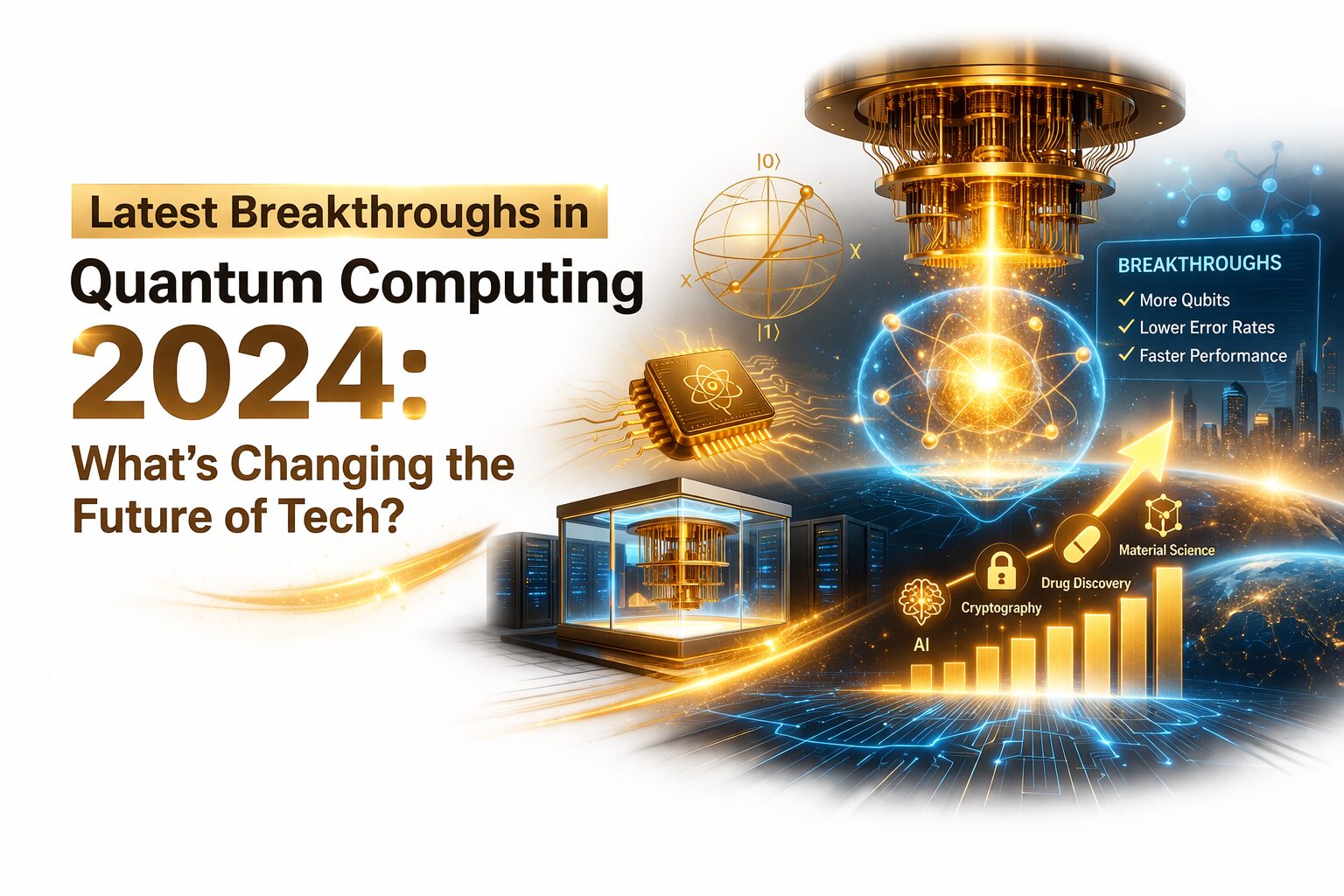
For years, quantum computing lived mostly in research papers and press-release promises. 2024 was the year that changed. Google proved that adding more qubits to a chip can reduce errors instead of increasing them. IBM pushed past the 150-qubit mark with a processor built for real workloads. The U.S. government finalized the encryption standards the world will use once quantum machines become powerful enough to threaten today’s security. And across chemistry, drug discovery, and materials science, quantum hardware started running experiments that classical supercomputers simply couldn’t touch.
This guide breaks down the latest breakthroughs in quantum computing 2024, explains what each one actually means in plain language, and looks at where the technology is headed next — including the challenges that still stand between today’s fragile qubits and tomorrow’s fault-tolerant machines.
Quantum Computing in Plain English
Classical computers store information as bits — a 0 or a 1. Quantum computers use qubits, which can hold a 0, a 1, or a blend of both at once through a property called superposition. Qubits can also be linked through entanglement, so that measuring one instantly tells you something about another, even when they’re physically separated.
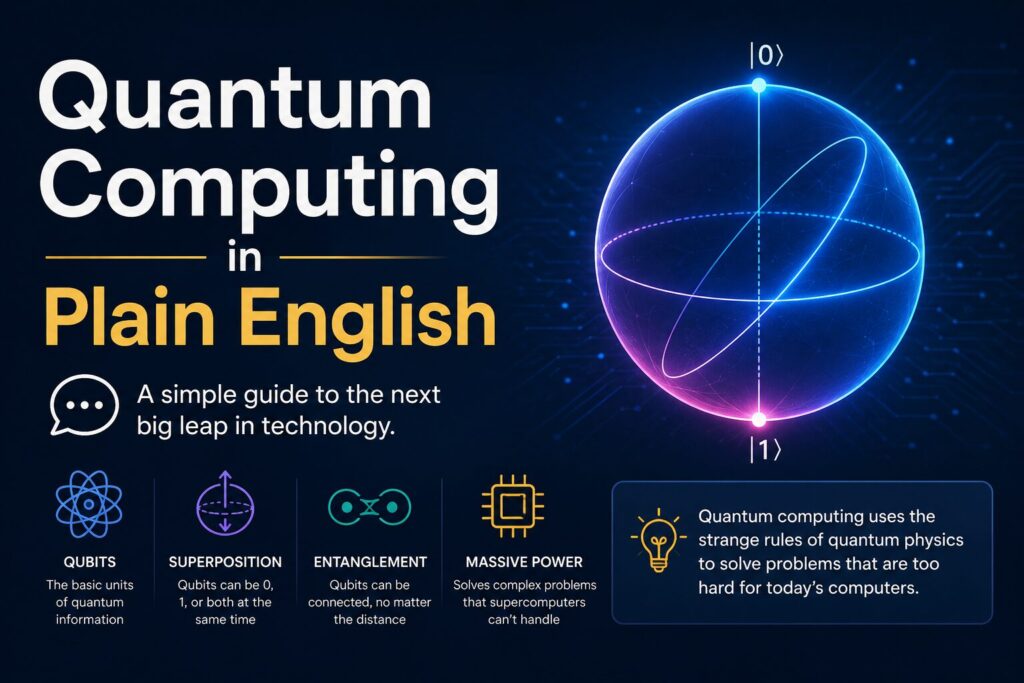
Together, superposition and entanglement let a quantum processor explore a huge number of possibilities in parallel. For the right kind of problem — simulating molecules, searching unsorted data, factoring large numbers — that parallelism can translate into a real speed advantage over classical machines.
Three terms matter most when you’re reading about quantum computing news:
- Physical qubits — the raw hardware units on a chip (superconducting circuits, trapped ions, or neutral atoms).
- Logical qubits — a more stable, error-corrected unit built by combining many physical qubits.
- Fault-tolerant quantum computing — a future stage where logical qubits are reliable enough to run long, complex programs without errors taking over.
Today’s machines sit in what researchers call the NISQ era — Noisy Intermediate-Scale Quantum — meaning tens to a few hundred qubits that are useful for narrow experiments but not yet ready to run large, general-purpose algorithms like breaking modern encryption. The breakthroughs of 2024 are best understood as the field’s most convincing steps yet toward closing that gap.
Breakthrough 1: Google’s Willow Chip Cracks the Error Correction Threshold
The single biggest quantum computing story of 2024 came from Google Quantum AI. On December 9, 2024, the company unveiled Willow, a 105-qubit superconducting processor, alongside a paper in Nature describing a result researchers had chased since the 1990s: below-threshold quantum error correction. Google’s own research documented the milestone in detail on the official Google Research blog
Here’s why that matters. In every quantum system built before Willow, adding more physical qubits to a logical qubit tended to introduce more opportunities for error, not fewer. Google’s team arranged qubits into grids of increasing size — 3×3, then 5×5, then 7×7 — and tested each configuration. According to Google, the pattern held consistently: each step up in grid size roughly halved the logical error rate rather than increasing it, a result the team’s researchers called a genuine milestone for the field.
This is the “below threshold” milestone: Willow is the first quantum chip to demonstrate error rates that improve exponentially as more qubits are added, a key proof-of-concept for building much larger fault-tolerant quantum computers.
Willow also ran a random circuit sampling benchmark — a standard test of raw computational power. A Nature study published in December 2024 showed Willow completing the benchmark in under five minutes, a calculation Google estimated would take one of today’s fastest classical supercomputers an astronomically long time to reproduce.
Why this breakthrough matters for the future of quantum computing:
- It’s the first hard evidence that scaling a real quantum processor can make it more reliable, not less.
- It validates the surface-code approach most of the industry has bet on for fault tolerance.
- It doesn’t solve a business problem on its own, but it removes a major theoretical doubt about whether large, error-corrected machines are physically achievable.
Breakthrough 2: IBM Pushes Toward “Utility-Scale” Quantum Computing
While Google chased error correction, IBM focused on making today’s noisy qubits do useful work right now. In late 2023 IBM introduced Heron, a 133-qubit processor built on its heavy-hex superconducting architecture, then followed up in November 2024 with Heron R2, a refined 156-qubit version.
IBM reported that Heron R2 can execute quantum circuits with up to 5,000 two-qubit gate operations — nearly double the gate depth IBM achieved in its 2023 benchmark. More importantly, the efficiency gains were dramatic: workloads that previously took more than 120 hours on IBM’s best quantum machine could be completed in roughly 2.4 hours, an almost 50x speedup.
IBM also extended its public roadmap out to 2033, with clear generational targets:
- Heron (2023–2024): the workhorse chip behind IBM’s “quantum utility” push, aiming for circuits with around 5,000 gates.
- Starling (targeted 2029): IBM’s projected inflection point — executing 100 million gates across 200 qubits using error correction.
- Blue Jay (targeted 2033): a system IBM projects will run 1 billion gates across 2,000 qubits.
The takeaway from IBM’s 2024 progress is less about raw qubit counts and more about circuit depth and reliability — how many operations a chip can run in sequence before noise destroys the result. That’s the metric that actually determines whether quantum hardware can tackle real chemistry, optimization, or machine-learning problems.
Breakthrough 3: A New Path Toward Topological Qubits
A quieter but scientifically significant 2024 result came from work connecting Quantinuum’s trapped-ion hardware with theoretical predictions from Caltech and Harvard researchers. The team demonstrated one of the first convincing experimental signatures of topological qubit behavior, using three-level “qutrit” systems on Quantinuum’s H2 trapped-ion processor.
Unlike superconducting qubits, which store information in a single physical location, a topological qubit encodes information in the global pattern of a system. That architecture makes the stored information inherently more resistant to local noise — potentially requiring far fewer physical qubits to build one stable logical qubit than today’s surface-code approach.
The demonstration was small-scale, but it matters because it suggests an alternative — and possibly cheaper — engineering path toward fault-tolerant, large-scale quantum machines, rather than relying solely on brute-force error correction.
Breakthrough 4: Quantum Computing Starts Solving Real Chemistry and Materials Problems
Better hardware only matters if it can be pointed at real problems, and 2024 produced some of the field’s most convincing “hybrid” results — quantum hardware working alongside classical supercomputers and AI rather than replacing them.
- Microsoft Azure Quantum Elements combined AI, high-performance computing, and quantum-inspired techniques to run more than a million advanced chemistry calculations, generating highly accurate energy estimates for candidate materials.
- Pasqal, using neutral-atom qubit processors, modeled how water molecules organize themselves inside protein pockets — a detail that strongly influences how drugs bind to their targets and is notoriously difficult to simulate with classical methods alone.
- Quantinuum built quantum-native natural language processing circuits that represent sentence grammar structurally, exploring whether quantum models can complement classical AI in specific niches. This kind of quantum-AI convergence is still early, but it points toward a future where specialized generative AI development services increasingly draw on quantum-assisted models for tasks classical architectures struggle with.
- Research groups including Riverlane and MIT applied quantum hardware to plasma physics relevant to fusion energy, while other teams explored quantum-assisted fluid dynamics and cosmology simulations.
None of these results replace classical computing. What they show is that in a growing number of carefully chosen use cases, quantum tools are now contributing real value to research pipelines rather than just running proof-of-concept demos.
Breakthrough 5: Post-Quantum Cryptography Becomes Official Policy
Quantum computers aren’t yet powerful enough to break modern encryption — but the risk that they eventually could is no longer theoretical planning. In August 2024, the National Institute of Standards and Technology (NIST) finalized the first three federal standards for post-quantum cryptography (PQC), capping an eight-year international evaluation process.
On August 13, 2024, NIST published FIPS 203, 204, and 205, officially establishing Kyber, Dilithium, and SPHINCS+ as approved federal cryptographic standards, with a fourth algorithm, FALCON, following as FIPS 206. These new standards are designed to resist attacks from both classical and future quantum computers — protecting against a scenario known as “harvest now, decrypt later,” where encrypted data intercepted today could be decrypted once a sufficiently powerful quantum machine exists.
Why this matters even though no quantum computer can break RSA or elliptic-curve encryption today: a large, fault-tolerant quantum machine running Shor’s algorithm could theoretically do so in the future. Organizations handling long-lived sensitive data — governments, banks, healthcare systems — are already migrating to quantum-safe cryptography well ahead of that theoretical threat, and NIST’s 2024 standards gave them a concrete target to build toward.
Quantum Hardware Approaches Compared
Different companies are betting on different physical platforms to build qubits. Here’s how the leading approaches compared in 2024:
| Qubit Type | Leading Players | Strengths | Challenges |
| Superconducting | Google, IBM | Fast gate speeds, mature fabrication | Needs near-absolute-zero cooling, short coherence |
| Trapped-ion | Quantinuum, IonQ | High gate fidelity, long coherence | Slower gate speeds, complex laser control |
| Neutral atom | Pasqal, QuEra | Highly scalable qubit arrays | Newer platform, still maturing |
| Topological | Quantinuum (early research) | Potential built-in error resistance | Still experimental, unproven at scale |
The Challenges Still Holding Quantum Computing Back
Even after a landmark year, quantum computing remains an early-stage technology. The main obstacles researchers are still working through include:
- Scaling to millions of qubits. Useful fault-tolerant algorithms may require thousands of logical qubits — and each logical qubit currently needs many physical qubits to support it. Getting from hundreds of physical qubits to that scale is one of the hardest engineering problems in modern technology.
- Noise and environmental sensitivity. Superconducting qubits must run near absolute zero; trapped-ion and neutral-atom systems need precise laser control. Tiny vibrations, stray electromagnetic fields, or fabrication defects can all corrupt a computation.
- Algorithm and verification limits. Only a handful of problem classes — like factoring, certain search problems, and some physics simulations — have proven quantum speedups. Many proposed optimization and machine-learning algorithms are still unproven against the best classical alternatives.
- Security transition costs. Migrating global infrastructure to post-quantum cryptography is a massive, multi-year undertaking that has only just begun in earnest.
- Talent and cost. Building and operating quantum hardware demands rare, cross-disciplinary expertise in physics, engineering, and computer science, and the equipment remains expensive — which is why most organizations still access quantum hardware through cloud platforms like IBM Quantum, Amazon Braket, and Azure Quantum rather than owning it outright.
Real-World Quantum Computing Use Cases Emerging From 2024
- Drug discovery and healthcare — modeling molecular binding and solvent behavior to accelerate early-stage drug research.
- Materials and energy — designing better batteries, catalysts, and fusion-relevant plasma models.
- Finance and logistics — early-stage portfolio optimization and routing experiments, mostly still running on simulators.
- AI and data analytics — quantum subroutines for tasks like matrix operations and dimensionality reduction, designed to slot into larger classical AI pipelines.
What Comes After 2024?
Taken together, the quantum computing breakthroughs of 2024 point to a field moving from “can this work at all?” to “how do we make this reliable and useful?” Over the next few years, expect:
- Continued improvements in logical qubit count and error rates, building on Willow’s below-threshold result.
- Broader adoption of hybrid quantum-classical workflows in chemistry, materials science, and finance.
- Accelerating enterprise migration to post-quantum cryptography as NIST’s standards roll out.
- Competing hardware bets — superconducting, trapped-ion, neutral-atom, and topological — continuing to mature in parallel, since no single approach has definitively “won.”
Quantum computing isn’t arriving overnight, and the challenges of noise, scale, and cost mean progress will stay gradual rather than sudden. But the latest breakthroughs in quantum computing 2024 gave the field something it hadn’t had before: hard, peer-reviewed evidence that the path to large-scale, fault-tolerant quantum computers is not just theoretical — it’s engineering, and engineering problems get solved.
FAQ: Latest Breakthroughs in Quantum Computing 2024
Is quantum computing real today, or still theoretical? It’s
real but limited. Cloud-accessible quantum devices with tens to a few hundred qubits are already running research and pilot workloads, but they can’t yet outperform classical computers on most everyday tasks.
What was the single biggest quantum computing breakthrough of 2024?
Most experts point to Google’s Willow chip achieving below-threshold quantum error correction — the first clear proof that adding qubits can reduce, rather than increase, error rates.
Can quantum computers break encryption yet?
No. Today’s machines are far too small and noisy to run Shor’s algorithm against real-world encryption. That said, NIST finalized post-quantum cryptography standards in August 2024 specifically to prepare for that long-term possibility.
What’s the difference between a physical qubit and a logical qubit?
A physical qubit is a single hardware unit. A logical qubit is a more stable, error-corrected unit built by combining multiple physical qubits — logical qubits are what fault-tolerant quantum computing depends on.
Which industries are likely to benefit first from quantum computing?
Chemistry, materials science, and drug discovery are furthest along, since molecular simulation problems align naturally with what near-term quantum hardware does well.

Senior SEO Content Marketing Manager at Trendusai.com
Rashida Hanif is a Senior SEO Content Marketing Manager, specializing in data-driven content strategy and SEO. She helps brands improve online visibility through keyword research, content planning, and AI-powered marketing insights.