
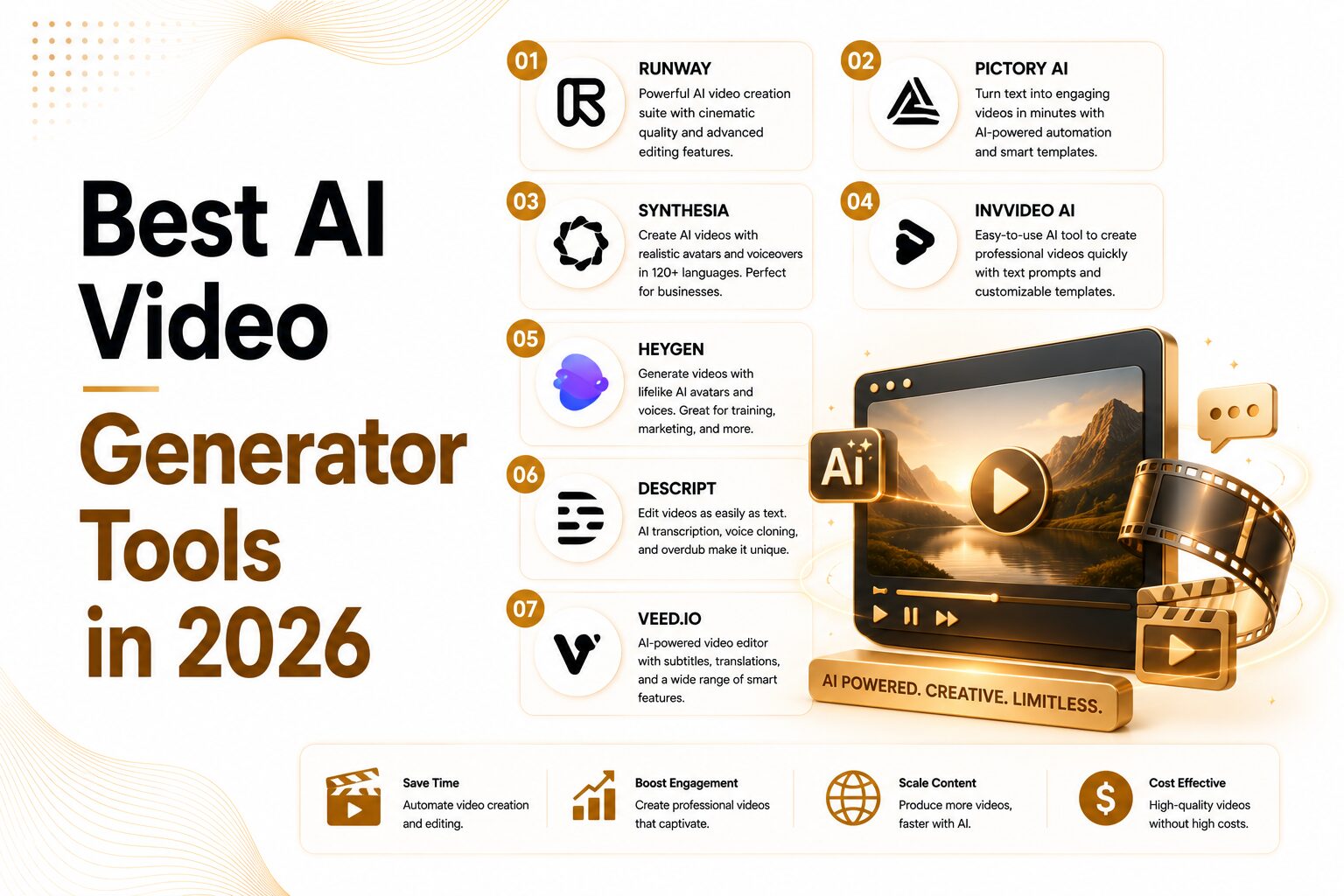
The video content game has changed forever. What used to demand a studio, a crew, and a five-figure budget can now be done from a laptop, sometimes in under five minutes. The AI video generator market has exploded in 2026, with tools ranging from beginner-friendly one-click platforms to professional-grade cinematic suites that rival traditional production pipelines.
But with so many options flooding the market, choosing the right tool feels overwhelming. To help you find the right platform, we evaluated the leading AI video generators across quality, usability, creative control, and pricing.
1. OpenArt
If there’s one platform that has genuinely earned its place at the top of the AI video conversation in 2026, it’s OpenArt. What started as an AI image generation tool has evolved into one of the most comprehensive creative suites available, and its video capabilities are where it truly separates itself from the competition.
What makes OpenArt stand out is the sheer breadth of what it puts under one roof. Rather than locking you into a single video model, OpenArt gives you access to over 100 premium AI models, including Kling, Veo, Wan, Hailuo, Seedance, and more, from a single dashboard. No juggling multiple subscriptions. No learning five different interfaces. Everything lives in one place.
Key Features:
- Multi-model access: Switch between the world’s top video models (Kling 3.0, Veo 3.1, Seedance 2.0, Wan, Hailuo) without leaving the platform, and compare results side by side
- Text-to-video: Describe a scene in plain language and watch it come to life; all major models support this
- Image-to-video: Upload a still image and animate it with precise visual consistency
- Multi-reference video generation: Upload a character, a background, and a product separately, and the AI blends them into a single cohesive clip, a game-changer for commercial content
- Motion Sync: Upload a reference video of any movement and transfer that motion onto your custom AI character
- Lip Sync: Upload a character image and an audio file; OpenArt generates a perfectly synchronized speaking video
- One-Click Story: Feed it a single sentence or a script, and it auto-generates a complete one-minute video with scenes, transitions, music, and voiceover
- Restyle Tool: Transform existing footage into entirely different visual aesthetics
- Extend Tool: Build longer videos in controlled segments for better editorial pacing.
- OpenArt Spaces: A node-based canvas for building advanced creative workflows
OpenArt is also the most cost-efficient option for high-volume creators. Its credits stay valid for a full year with no monthly resets, a practical advantage that most competitors don’t offer. Paid plans start from just $4.85/month on yearly billing, making it accessible without compromising on capability.
For brands producing regular social content, marketers building ad campaigns, or creators who want one platform that handles everything from AI image generation to full video production, OpenArt is the clear first choice in 2026.
Best for: Content creators, social media marketers, e-commerce brands, small businesses, and anyone who wants maximum model variety without maximum spending. Pricing: Free tier available | Paid plans from $4.85/month (yearly billing). Try it: openart.ai
2. Google Veo 3.1
Google’s Veo 3.1 has set a new benchmark for what AI-generated video can look like. The realism is extraordinary, the lighting behaves correctly, the physics feel grounded, and the model’s prompt adherence is among the tightest in the industry.
What pushed Veo 3.1 ahead of its predecessor is native audio generation. Music, ambient sound, and dialogue can now be generated alongside the video rather than added in post — a workflow improvement that professional creators have been waiting for.
The trade-off is accessibility. Veo 3.1 is available through Google’s Flow platform, which has a steeper learning curve than consumer-friendly tools. It rewards users who know exactly what they want and how to ask for it. For those who just want to experiment quickly, other platforms on this list are more forgiving.
Best for: Filmmakers, high-end brand content, creators who prioritize visual realism above everything else. Pricing: Available via Google One AI Premium and Google Flow subscriptions
3. Kling 3.0
Kling 3.0 by Kuaishou has built a reputation for one thing above all else: motion. If your video needs convincing human movement, dancing, athletics, expressive gestures, physically dynamic scenes, Kling handles it better than almost anything else on the market.
With over 60 million creators having generated more than 600 million videos on the platform by the end of 2025, Kling has proven its reliability at scale. The 3.0 update added native voice-controlled audio and significant improvements to camera control, making it a genuine professional tool rather than just an impressive demo.
Where Kling gives ground is on heavily stylized or experimental concepts; it interprets prompts faithfully but rarely surprises you with unexpected creative choices. For structured, dynamic content, it’s excellent. For abstract visual experimentation, other tools serve better.
Best for: Action content, dance and movement sequences, sports brands, creators who need physically convincing motion. Pricing: Free daily credits available | Paid subscription plans available on kling.ai
4. Seedance 2.0
Seedance 2.0 ranks number one on blind ELO testing with a score of 1,215, the highest of any model tested in 2026, and its commercial content capabilities explain why brands are paying attention.
The standout feature is its support for up to 12 reference inputs simultaneously. In practice, this means you can lock in a spokesperson’s face, a specific product, and a branded environment all at once, then vary everything else across a campaign. For businesses that need visual consistency across multiple video assets, this is genuinely transformative.
Seedance is best accessed through platforms like Higgsfield or OpenArt, which add production layers, campaign management, ad variant generation and export pipelines that the raw model alone doesn’t provide.
Best for: Brand marketing, product campaigns, advertising content, businesses needing visual consistency at scale. Pricing: Accessible via third-party platforms; pricing varies by platform.
5. Runway Gen-4.5
Runway has always been the filmmaker’s AI tool, and Gen-4.5 continues that tradition. Its camera movement control is the most sophisticated available in a consumer-accessible platform, dolly shots, rack focus, crane movements, and complex multi-shot sequences all behave with the kind of intentionality that cinematographers expect.
Character consistency across scenes is another area where Runway excels. If you’re building narrative video content, a short film, a branded story series or an episodic social campaign, Runway maintains visual continuity better than most competitors.
The learning curve is real, and the pricing reflects its professional positioning. But for creators who take video seriously as a craft, Gen-4.5 offers creative control that more automated tools deliberately remove.
Best for: Filmmakers, narrative content creators, advanced users who want granular production control. Pricing: Standard plan from $15/month | Pro from $35/month
6. Pika 2.2
Pika occupies a unique space in the AI video landscape; it’s fast, fun, and genuinely good at producing the kind of expressive, stylized content that performs well on social platforms.
Its Pikaffects feature allows users to apply creative visual transformations to existing footage, melting, exploding, morphin, andmorphing between styles, that give social content an immediately distinctive look. For brands and creators building identity through visual style rather than cinematic realism, Pika’s aesthetic toolkit is hard to match.
The free tier is generous enough for regular experimentation, and the platform’s ease of use makes it accessible to creators with zero video editing background.
Best for: Social media content, creative visual experiments, brand identity videos, beginners. Pricing: Free tier available | Paid plans from $8/month
7. HeyGen 3.0
HeyGen has carved out a dominant position in a specific but enormously valuable niche: AI-generated spokesperson video. If your content strategy depends on consistent on-camera presence, explainers, product walkthroughs, educational content and localized campaigns, HeyGen’s avatar technology is the most refined available.
As an AI movie trailer generator for business communication, HeyGen is in a category of its own. Create a digital avatar from a short video sample, then generate unlimited spokesperson videos in multiple languages without ever stepping in front of a camera again. The lip-sync quality and natural movement are convincing enough for professional brand content.
The 2026 update added real-time translation with synchronized lip movement across 40+ languages, a capability that has made it indispensable for global brands running localized campaigns.
Best for: Business explainers, e-learning content, multilingual campaigns, sales enablement videos. Pricing: Free tier available | Creator plan from $24/month
8. Synthesia 2.0
Synthesia has positioned itself squarely in the enterprise market, and the 2026 version makes that positioning impossible to miss. The platform is built around one core insight: large organizations need to produce enormous volumes of video content, training materials, internal communications, product updates, and compliance videos, and they need to do it without a production team.
Synthesia’s avatar library, branded template system, and multi-language support make it the most complete enterprise video solution available. The output doesn’t try to compete with cinematic AI tools on visual artistry; it competes on reliability, consistency, and workflow integration with enterprise software stacks.
Best for: Corporate training, internal communications, HR content, enterprise-scale video production. Pricing: Starter from $18/month | Enterprise pricing available
9. PixVerse 5.5
For creators and businesses who need volume without a large budget, PixVerse 5.5 punches well above its price point. Camera movement tools, pan, zoom, orbit and dolly, are available at resolutions and speeds that competing budget tools can’t match.
The 2026 update’s built-in audio sync, which generates sound effects timed precisely to on-screen action, addresses one of the most persistent weaknesses in affordable AI video tools. The free plan includes daily login credits, which are genuinely useful for regular experimentation.
Best for: High-volume social content, budget-conscious creators, businesses testing AI video before committing to premium tools. Pricing: Free tier available | Paid plans from $8/month
10. Sora 2 Pro
OpenAI’s Sora 2 Pro entered 2026 as the benchmark for long-form AI video, narrative sequences up to several minutes in length with consistent world simulation and synchronized dialogue.
Where most AI video tools produce strong individual clips, Sora’s strength is continuity across extended sequences. Characters maintain consistent appearance, environments follow physical rules reliably, and the narrative coherence over longer runtimes is unmatched.
Access remains limited to ChatGPT Pro subscribers, which constrains its reach. But for creators building serialized content, documentary-style video, or any format that requires sustained narrative consistency, Sora 2 Pro is the most capable tool available.
Best for: Long-form narrative content, documentary-style video, episodic creators, advanced storytelling formats. Pricing: Available with ChatGPT Pro subscription ($20/month)
How to Choose the Right AI Video Generator for You
With ten strong options on this list, the right choice comes down to a few honest questions:
What kind of content are you making? Short social reels, long-form narrative videos, product demos, and spokesperson content all have different tool requirements. Match the tool to the format, not the other way around.
How much production control do you need? Beginners benefit from more automation. Experienced creators often find heavily automated tools frustrating. Know where you sit on that spectrum before committing.
What’s your volume? If you need to produce content daily, credit structures and monthly limits matter as much as output quality. A tool that produces beautiful videos but runs out of credits by week two doesn’t serve a high-volume workflow.
What’s your budget? The good news: the free tiers on most of these tools are generous enough for genuine evaluation. Start there, test with real projects, and upgrade when the ceiling becomes visible.
For most creators and businesses starting in 2026, OpenArt offers the best entry point, widest model access, lowest cost per generation, and enough depth to grow into as your video ambitions scale.

Senior SEO Content Marketing Manager at Trendusai.com
Rashida Hanif is a Senior SEO Content Marketing Manager at Trendusai.com, specializing in data-driven content strategy and SEO. She helps brands improve online visibility through keyword research, content planning, and AI-powered marketing insights.