

Every company wants to use AI. Few know where to start. That’s where AI business consulting helps. It shows you which ideas deserve your time and money.
Here’s a common story. A leader hears about a new AI tool. The team builds a pilot in a few weeks. Everyone claps at the demo. Then the project goes nowhere. Months later, nobody remembers the tool.
Why does this keep happening? The idea sounded exciting, but nobody checked if it solved a real problem. Nobody looked at the data. Nobody asked who would own the result.
The fix is simple. Pick your AI use cases with care. Start with problems that cost real money. Skip the ones that only sound cool.
A good idea has three things. It solves a real problem. It has data behind it. And it has an owner. Most of this is common sense. You just need a clear process. No technical background is needed. This guide shows you how to find good ideas and pick the best one first.
Why Many AI Projects Fail
Most failed projects started with a good idea. They just had a bad starting point. Three mistakes show up again and again.
- Chasing Trends
Many leaders pick a project because it’s popular. A competitor launched a chatbot, so they want one too. That’s a weak reason. A good AI business strategy starts with your own problems. The competitor may have very different customers. It may also have different problems. A retailer once built a chatbot that nobody used. Customers just wanted faster refunds. The team had copied a trend and missed the need. Ask what hurts in your company today. Then look for a tool that fixes it.
- Skipping the Data Check
Every AI idea needs data. Some companies learn too late that they don’t have it. The records are messy. Some are missing. Others sit in five different systems. Imagine a team that wants to predict which customers will leave. Then it finds out that cancellation reasons were never recorded. The project stops before it starts. That’s a costly surprise. A quick AI readiness assessment catches this early. It checks your data first. Then it checks your tools. Last, it checks your team’s skills. Fixing data later takes far more time than checking it first. Teams often blame the tool when the real issue is the data.
- No Clear Owner
Every project needs one person in charge. Without one, nobody makes decisions. Nobody fights for budget either. Say a team builds a tool for the sales group. Sales never asked for it. So sales never uses it. The tool works fine. It just solves a problem nobody feels. The owner should be someone who feels the pain every day. That person tests the tool. That person pushes for changes. Good AI business consulting names this owner before the work starts.
How to Find Good AI Opportunities
You don’t need a fancy tool for this. You need to talk to the right people. Here are three easy ways to start.
- Ask Your Teams
Start with simple conversations. Ask each team what slows them down. Ask what they repeat every day. Ask what they hate doing. People will tell you. They often have a long list ready. A finance clerk may spend two days each month matching invoices. A support agent may copy the same answer fifty times a week. These small stories point to real problems. Talk to five teams. You’ll get a long list fast. A basic AI opportunity assessment is often just a set of good questions.
- Look for Repeated Work
AI often works well on tasks that happen again and again. Think about reading invoices. Think about sorting support emails. Think about checking forms for mistakes. People do these jobs over and over, and the pattern barely changes. A task done 500 times a week is often a good place to start.
But volume is only one clue. A repeated task still needs to be worth the effort. Ask how much value it creates. Ask if the data and tools are ready. Check the risk if the AI gets it wrong. Then compare all that against the cost to build it.
Rare tasks can pay off too. A contract review that happens twice a month may take days of expert time. Or one wrong call may cost a lot of money. In cases like that, a low-volume job can be your best choice. Your busiest teams are a good place to look first. They often hold the strongest AI use cases.
Check If the Data Exists
Every idea needs data to learn from. The table below shows a few examples.
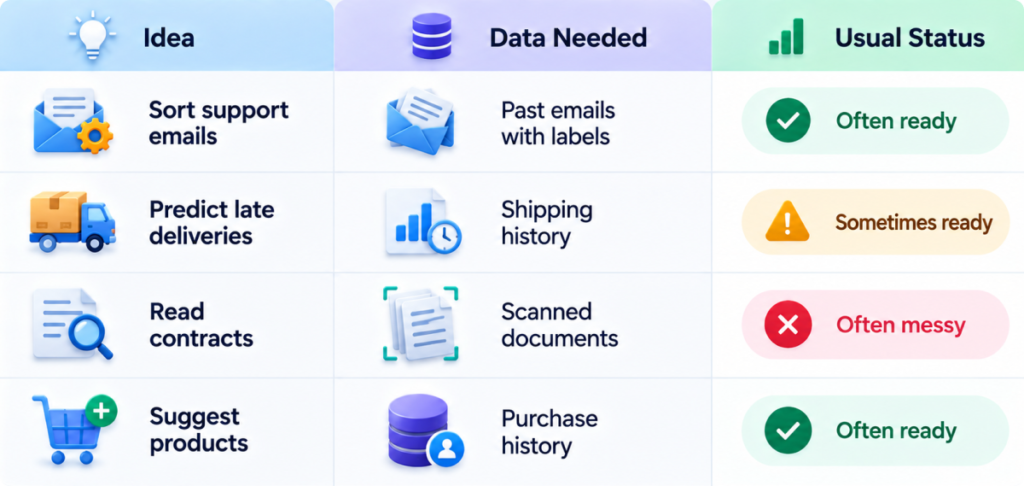
Data in one place is much easier to use. Messy data adds weeks. Sometimes it adds months. Check where the records live. Check how old they are. Ask who can approve access. Plan for all of this in your artificial intelligence strategy.
How to Score and Rank Your Ideas
Now you have a long list. You can’t build everything. Scoring helps you pick.
- Score the Value
Ask one question first. How much will this save or earn? Use real numbers. A tool that saves 10 hours a week saves about 500 hours a year. Multiply that by the hourly cost. You now have a rough dollar value. Do this for every idea on your list. Keep the math simple. A rough number beats a perfect guess. Nobody needs a long spreadsheet here. This is the first step of AI use case prioritization.
- Score the Effort and Risk
Next, check how hard the idea is. See if the data exists. See if it needs new systems. Estimate how long it will take. Then look at what could go wrong. Some ideas touch customer data. Others affect big decisions. Those carry more risk. Effort is about time and work. Risk is about what could go wrong. Both matter as much as value. A cheap idea with high risk can cost you more later. Give each idea a score from one to five for effort. Do the same for risk. Strong AI business consulting teams usually run this as a short workshop.
Put It in a Table
A simple table makes the choice clear. Here is an example.
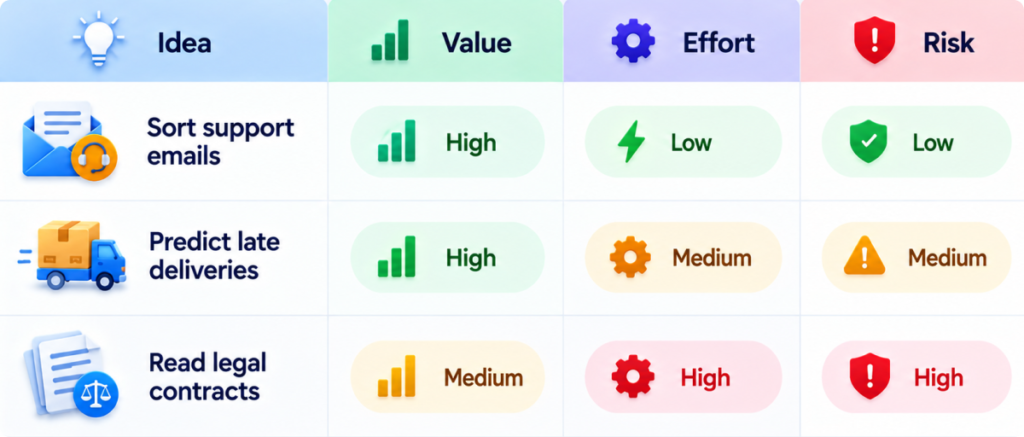
The first idea wins. It pays off and it’s easy to build. Start there. The second idea is worth doing later. It needs more work first. The third idea can wait. It costs a lot and carries high risk. Build trust with a quick win. Then move to the harder ones. Real AI business solutions often start small.
How a Consulting Partner Helps
You can do this work alone. A partner just makes it faster.
- Runs the Assessment
Most teams have never done this before. That’s normal. A partner shortens the learning curve. A partner has seen many projects. They know the usual traps. They also bring a tested checklist. That saves you weeks. The team starts by listening. It learns your goals first. Then it reviews your data. After that, it reviews your systems. You get a clear picture without months of guesswork. Good AI strategy consulting also gives you an honest view. It will tell you when an idea isn’t ready.
- Builds the Plan
Next comes the plan. It lists each project and its owner. It sets dates. It sets budgets too. It also picks one number to track for each project. Leaders can see what comes first. They can see what waits. They can also see why. Nothing gets lost in a long deck. Plans often fail because they’re too long. Keep yours short and clear. One page per project is plenty. A clear AI business strategy keeps everyone on the same page.
- Stays Through Launch
Some partners hand you a report and leave. That’s not enough. Ask for help through launch. Ask what happens after it too. Launch is when real users show up. That’s when the surprises start. A good partner stays for that part. It fixes issues fast and keeps the tool running. Ask for a named contact too. Ask how fast they respond. Ask any partner how they handle problems after launch. Their answer tells you a lot. Mobisoft Infotech offers enterprise AI consulting that runs from planning to deployment. Its team also provides ongoing support.
Next Steps for Your Team
You have the basics now. Here’s how to put them to work.
- Start With One Project
Pick one idea from your table. Make it small. Give it a clear goal. Set a 90-day window. A small win builds trust. It also teaches your team what works. Leaders will back the next project more easily. Choose a project that one team can finish alone. Avoid ideas that need five departments to agree. Bring in AI business consulting support if you want a second pair of eyes.
- Track the Results
Pick one number to watch. Measure it before you start. Measure it again after launch. Say your tool cuts email sorting time from ten minutes to two. That’s a clear win. Numbers settle debates. Without them, people argue about opinions. A before and after picture is enough. Do not wait for a perfect report. Share it with finance. Share it with the team too. People like seeing proof. Keep the report to one page. Good AI business solutions always have a number attached.
- Check Again Every Quarter
Your list will change. New tools show up. Your data gets better. Tools that cost too much last year may be cheap now. Talk to your teams again. Their problems change too. Some ideas that failed last year may work today. Some ideas that looked great may no longer fit. Check what changed since the last review. Note any new tools your teams started using. Set a calendar reminder. Drop ideas that no longer fit. Add new ones. Keep the list short. Repeat your AI readiness assessment every quarter. Treat it like a habit. It only takes an afternoon. Write down what changed and why. That record helps the next review go faster. Share it with your leader. Keep it somewhere easy to find.
Final Thoughts
Finding the right AI project isn’t about luck. It’s about asking good questions. Start with real problems. Check your data. Score each idea. Then pick the one that wins. Most teams skip this and jump to tools. That’s the mistake behind many failed pilots. Slow down at the start.
That’s what AI business consulting does best. It saves you from expensive guesses. It shows you where AI can pay off. It also tells you what to skip. Most companies already have good ideas. They just need a way to sort them.
Try this next week. Ask five teams what slows them down. Write down every answer. Pick the top three ideas. Score each one for value. Then score it for effort. Then score it for risk. Share the results with your leader.
Which problem costs your company the most time? Start there. A small win teaches more than a big plan. Add expert AI strategy consulting when you want to move faster. Mobisoft Infotech can help you plan each step and support it after launch.

Senior Content Manager at TrendusAI
Rashida Hanif is a content strategist at Trendusai.com, creating informative articles on artificial intelligence, emerging technologies, and digital solutions. She focuses on delivering valuable insights that help readers understand AI innovations, software development, and technology trends.