
You open three pricing pages, and every plan looks the same. Credits, projects, seat limits, add-ons. One tool starts at $29, and another climbs to $1,499. None of them tells you what you’ll really pay. You don’t want to burn a month’s budget on the wrong subscription. Ahrefs vs SpyFu vs Semrush is the choice most beginners, freelancers, and agency owners face in 2026. Each tool has a clear strength and a few gaps.
This SEO tools comparison covers keywords, backlinks, PPC, audits, local SEO, AI features and cost. Prices come from vendor and review pages checked in September 2026, so confirm them before you pay.
Quick Verdict: Ahrefs vs SpyFu vs Semrush at a Glance
Short on time? Start with the table. Each tool wins a different job, so your pick depends on what you do most. This is the short answer to “which SEO tool is worth your money.”
| Category | Ahrefs | SpyFu | Semrush | Best fit |
| Keyword research | Clear difficulty score | Competitor keyword lists | Intent labels, large toolkit | Ahrefs or Semrush |
| Backlinks | Core strength | Basic competitor view | Backlink Audit, link building | Ahrefs |
| PPC research | Paid keywords and ads | Core strength, long ad history | Advertising research tools | SpyFu |
| Site audit | Included | Limited | Detailed, project-based | Semrush |
| Local SEO | Location-level rank tracking | No dedicated local toolkit | Local toolkit as add-on | Semrush |
| Entry price (monthly) | $29 Starter, $129 Lite | About $33 to $39 | $139.95 Pro | SpyFu |
Best for, in one line each:
- Ahrefs: backlink research and clean keyword data for content teams.
- SpyFu: PPC competitor research when money is tight.
- Semrush: one login for SEO, PPC, content, local and AI tracking.
1. Quick Overview: What Each Tool Does Best
Ahrefs: The Backlink Powerhouse
Ahrefs began as a backlink checker, and Site Explorer is still the heart of the product. It scores sites with Domain Rating, which runs from 0 to 100. Keywords Explorer, Rank Tracker and Site Audit sit around it. If links drive your strategy, you’ll spend most of your time here.
SpyFu: The Competitor and PPC Spy
SpyFu shows what your rivals rank for and what they buy on Google Ads. One 2026 review says it holds more than 15 years of Google Ads history. The tool is built for competitor intelligence, not for every SEO task. That focus keeps the price low.
Semrush: The All-in-One Suite
Semrush is an all-in-one SEO suite. It covers keyword research, backlinks, ads, content, rank tracking and local listings under one account. It scores sites with an Authority Score. The breadth is useful, but the menus take time to learn.
2. Ahrefs, SpyFu, Semrush: Full Tool Profiles
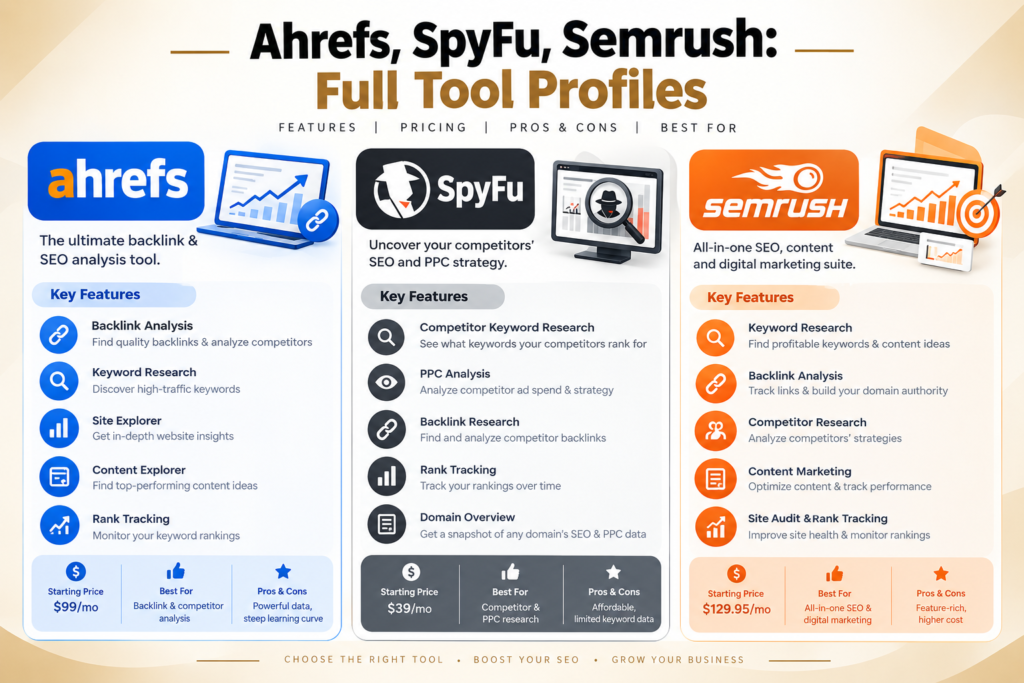
Ahrefs: Top Features, Pros and Cons, Who Should Use It
Top features: Site Explorer, Keywords Explorer, Rank Tracker, Site Audit and Content Gap. Keywords Explorer also pulls data for Bing, YouTube and Amazon.
Pros:
- Strong backlink checker with referring domains data
- Clean interface
- Unlimited credits from the Standard plan up, per 2026 pricing reviews
Cons:
- Lite uses a monthly credit pool
- Base prices rose in 2024, when Lite went from $99 to $129
- No dedicated local listing tools
Who should use it: SEO teams and content marketers who care about links and keyword data.
SpyFu: Top Features, Pros and Cons, Who Should Use It
Top features: organic and paid competitor research, ad history, Kombat for domain keyword overlap, rank tracking and backlink outreach.
Pros:
- Lowest entry price of the three
- Deep Google Ads history
- 30-day money-back guarantee, per a 2026 review
Cons:
- No free plan
- Fewer technical SEO tools
- One 2026 review calls the interface dated
Who should use it: PPC managers, freelancers and small businesses that mainly study competitors.
Semrush: Top Features, Pros and Cons, Who Should Use It
Top features: Keyword Magic Tool, Site Audit, Position Tracking, Backlink Audit, advertising research, content tools and a local toolkit.
Pros:
- Widest feature range of the three
- Intent labels on keywords
- Connects with Google Search Console and Google Analytics
Cons:
- Pro allows 5 projects and 500 tracked keywords
- Extra seats cost $45 to $100 a month, depending on plan
- Many toolkits mean a steeper learning curve
Who should use it: agencies and in-house marketers who want one platform.
3. Ahrefs vs SpyFu vs Semrush: Keyword Research and Difficulty
Database size and data accuracy
Each vendor publishes its own database size. The numbers come from different crawls and data sources, so you can’t compare them directly. Search volume is an estimate in all three tools. Check key terms against Google Search Console, which shows your real impressions and clicks. Treat any keyword database as a guide, not a count.
How Ahrefs calculates difficulty and volume
Ahrefs scores Keyword Difficulty from 0 to 100. The score is based on how many referring domains link to the pages ranking in the top 10. That makes it easy to judge link effort. Ahrefs also shows monthly search volume, estimated clicks and a parent topic. The parent topic tells you whether one page can target several related terms.
Semrush and search intent
Semrush shows a Keyword Difficulty percentage and labels each keyword by search intent: informational, navigational, commercial or transactional. Keyword Magic Tool groups large lists into topics. Intent labels help when you plan pages. A “best CRM software” query needs a comparison page, not a definition.
SpyFu’s budget-friendly SEO plus PPC approach
SpyFu lists the organic and paid keywords a competitor already uses. Kombat compares domains and shows where their keywords overlap. You don’t get as many research features as the other two. You do get competitor keyword lists at the lowest price.
Real use cases and the winner
- Planning a blog calendar: Ahrefs or Semrush, depending on whether you prefer link-based difficulty or intent labels.
- Finding terms a rival pays for: SpyFu.
- Checking Bing, YouTube or Amazon demand: Ahrefs.
No single keyword research tool wins every case. Pick by the job you repeat most.
4. Backlink Analysis: Who Has the Cleanest Index?
Ahrefs and link profile depth
Backlinks are where Ahrefs vs SpyFu vs Semrush differ most. Ahrefs puts the backlink profile first. You see referring domains, anchor text, new and lost links, and top linked pages. You can also compare link gaps against a rival. For link building research, many SEO professionals start here.
Semrush Backlink Audit and link building tools
Semrush offers a Backlink Audit that flags risky links and helps you decide which to disavow. Its Link Building Tool tracks prospects and outreach in one place. Backlink analysis is one feature among many, not the main event.
SpyFu competitor backlink tracking
SpyFu shows the competitor backlinks pointing at a domain and includes an outreach tool. Use it as a quick check. It isn’t built for deep link audits.
Key numbers that matter and the verdict
Watch referring domains more than total backlinks. Ten links from one site count as one referring domain. Domain Rating (Ahrefs), Authority Score (Semrush) and Moz’s Domain Authority are different scores from different companies. A 60 in one doesn’t equal a 60 in another. Majestic runs its own backlink index and is worth a second look when results look odd.
Verdict: Ahrefs for link research. Semrush for audits and outreach. SpyFu for fast competitor checks.
5. Competitor Intelligence and PPC Research
Unmasking competitor ad budgets with SpyFu
PPC is where Ahrefs vs SpyFu vs Semrush splits most cleanly. SpyFu shows the keywords a competitor bids on, past ad copy and estimated ad budget. The long history lets you see which ads ran for years. Long runs often mean the ad works. For the best tool for PPC competitor research on a small budget, SpyFu is the usual starting point.
Semrush also has advertising research, with ad copy and paid keywords. Ahrefs shows paid keywords and ads inside Site Explorer, but PPC isn’t its main focus. All three pull Google Ads data.
Organic competitor research across all three
Enter a rival’s domain in each tool, and you’ll see organic keywords, estimated organic traffic and top pages. Traffic figures are estimates. For site-level visitor numbers across the web, SimilarWeb gives a second opinion on traffic estimation.
Content gap analysis: finding low-hanging fruit
A content gap shows keywords your rivals rank for and you don’t.
- Ahrefs has a Content Gap.
- Semrush has a Keyword Gap.
- SpyFu has Kombat.
Start with terms where two or more rivals rank and your site has no page.
Who wins?
SpyFu for PPC on a budget. Semrush for ads plus SEO in one place. Ahrefs for organic and link gaps.
6. Site Audit, Position Tracking and Local SEO
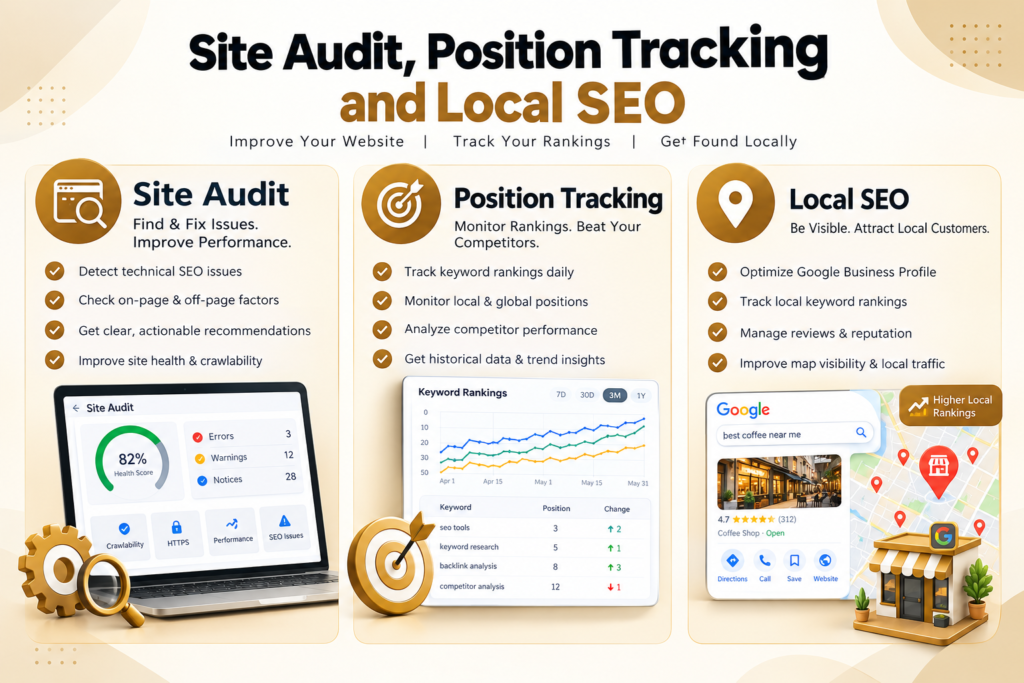
Semrush’s all-in-one site audit engine
Semrush Site Audit is a core part of the platform. It crawls your site, groups technical SEO issues by severity, and lets you recrawl on a schedule. Its free account limits audits to 100 pages a month, which is enough to test it on a small site.
Ahrefs Site Audit vs SpyFu’s limited audit
Ahrefs Site Audit covers the same ground with a cleaner layout. Ahrefs Webmaster Tools is free for sites you verify so that you can run audits on your own site without a paid plan. SpyFu offers only a limited audit. If you need deeper crawling, Screaming Frog is a common addition.
Rank/position tracking comparison
| Tool | Tracking limits (per 2026 pricing reviews) |
| Ahrefs | Advanced: 5,000 keywords. Enterprise: from 10,000 |
| SpyFu | Professional: 15,000 weekly rankings. Team: 40,000 weekly rankings |
| Semrush | Pro: 500. Guru: 1,500. Business: 5,000 |
Limits count differently, so read each plan page closely before you compare numbers.
Local SEO: which tool is best?
Semrush is the best SEO tool for local SEO among the three, because it sells a local toolkit with listing and map tracking features as an add-on. Ahrefs tracks rankings by location, which helps with city-level checks. SpyFu doesn’t sell a dedicated local SEO toolkit. For a single shop or clinic, Google Business Profile and Google Analytics often do half the work.
7. Content Optimization and AI Features
Content optimization tools compared
Semrush includes content tools, and its Content Marketing Toolkit sits in the Guru plan and above. Ahrefs offers a content helper that grades topic coverage. SpyFu focuses on research, not drafting. Surfer SEO is a dedicated on-page SEO tool, and many teams pair it with one of the big three.
AI Overviews, AI search visibility and brand tracking (2026 angle)
People now get answers in Google AI Overviews, ChatGPT, Perplexity and Gemini. Your brand can be named there without a click. Ahrefs vs SpyFu vs Semrush also differ on AI search visibility. Ahrefs sells Brand Radar for brand tracking across AI answers, priced separately. Semrush offers AI visibility tracking too. SpyFu’s strength remains Google Ads and organic competitor data, so check its current plan page before you count on AI tracking.
Why AI is shifting the SEO paradigm
An AI answer can satisfy a searcher on the results page itself. That means ranking alone no longer tells the full story. You also want to know whether AI tools cite your pages and how they describe your brand. Plan for both: classic SERP analysis and AI search visibility checks.
8. Ease of Use and Time to Value
Interface design
Ahrefs has a clean layout with few menus. Semrush has more toolkits, so the left menu is long. SpyFu is simple, though one review calls the design dated. A plain interface isn’t a flaw if it gets you answers faster.
Learning curve and getting up to speed
Every tool in Ahrefs vs SpyFu vs Semrush asks for some practice. SpyFu is quick to learn because it does less. Ahrefs takes a few sessions. Semrush takes the longest because of its size. Plan a first week for one goal, such as finding ten keywords or auditing one site. Ease of use matters most for the best SEO tool for beginners.
9. Ahrefs vs SpyFu vs Semrush: Pricing Compared
Ahrefs vs SpyFu vs Semrush pricing plans and feature caps
Prices below are monthly list prices in USD. Annual billing lowers the cost by up to 17% on Ahrefs and about 17% on Semrush, per 2026 pricing reviews. Directories disagree on SpyFu’s price by a few dollars, so verify it on SpyFu’s own page.
| Tool | Plan | Monthly | Effective monthly, billed annually | Key limits |
| Ahrefs | Starter | $29 | Monthly only | Limited access |
| Ahrefs | Lite | $129 | $108 | 1 user, 5 projects, credit pool |
| Ahrefs | Standard | $249 | $208 | 20 projects, unlimited credits |
| Ahrefs | Advanced | $449 | $374 | 50 projects |
| Ahrefs | Enterprise | $1,499 | Annual commitment | 100 projects |
| Semrush | Pro | $139.95 | $117.33 | 5 projects, 500 keywords |
| Semrush | Guru | $249.95 | $208.33 | 15 projects, 1,500 keywords |
| Semrush | Business | $499.95 | $416.66 | 40 projects, 5,000 keywords |
| SpyFu | Basic | About $33 to $39 | About $29 | Entry plan |
| SpyFu | Team | About $199 billed annually | Not applicable | 5 user logins |
Value by budget
- Under $50 a month: SpyFu Basic or Ahrefs Starter.
- Around $100 to $150 a month: Semrush Pro or Ahrefs Lite.
- Around $250 a month: Ahrefs Standard or Semrush Guru.
- Agencies and larger teams: Ahrefs Advanced or Semrush Business.
Spend what you can use. A plan you outgrow in two months costs more than one step up.
Hidden costs (credits, add-ons, user seats, project limits)
The base price is rarely the final price. Seats add up fast.
| Setup | Calculation | Monthly total |
| Ahrefs Standard, 3 users | $249 + 2 seats at $60 | $369 |
| Ahrefs Advanced, 5 users | $449 + 4 seats at $80 | $769 |
| Semrush Pro, 3 users | $139.95 + 2 seats at $45 | $229.95 |
| Semrush Guru, 3 users | $249.95 + 2 seats at $80 | $409.95 |
Ahrefs Lite’s credit pool can also push you to pay as you go or upgrade. Semrush’s project limits fill up when you track competitors as separate projects.
Free vs paid: Semrush’s free account allows 10 keyword results per report and tracking for 10 keywords. Ahrefs Webmaster Tools is free for your own verified sites. SpyFu has no free plan. A free trial or money-back window is the safest way to test. Semrush lists a 7-day trial on its SEO plans, per one 2026 review. Confirm the current terms on each signup page.
10. Trend Tracking: What the Big Three Miss
Search tools show what people already search for. They lag behind brand new topics because volume data takes time to build. A rising topic can show zero volume for weeks. Traffic and keyword numbers are also estimates, so treat them as direction.
Complementary tools for spotting early trends
| Tool | What it adds |
| Exploding Topics | Early signals on rising topics |
| Google Search Console | Your real queries, clicks and impressions |
| SimilarWeb | Traffic estimation across sites |
| Ubersuggest | Low-cost keyword ideas |
| Moz | Domain Authority and a second keyword database |
| Screaming Frog | Deep technical crawling |
| Majestic | A separate backlink index |
| Surfer SEO | On-page SEO and content scoring |
11. Which Tool Should You Buy? Ahrefs vs SpyFu vs Semrush Decision Framework
Ask one question: which task will you repeat every week? Then use the lists below to answer “which one should I choose?”
Choose Ahrefs if you…
- Build links or study backlink profiles often.
- Want a clean tool for keyword research and content planning.
- Can pay for Standard so credits stop being a concern.
Choose SpyFu if you…
- Run Google Ads and want to study rivals.
- Need competitor intelligence at the lowest price.
- Don’t need advanced technical audits.
Choose Semrush if you…
- Want SEO, PPC, content and local tools under one login.
- Manage several clients or sites.
- Can spend time learning a large platform.
Hybrid approaches
Many teams pair two tools instead of paying for the largest plan. SpyFu for PPC plus Ahrefs Lite for links is one pairing. Semrush Pro plus Screaming Frog for deep crawls is another. Each pair costs less than a top-tier plan.
When to avoid each tool
- Ahrefs: skip it if PPC research is your main job.
- SpyFu: skip it if you need audits, content tools or local SEO.
- Semrush: skip it if you want something simple, or if seat costs will stack up for a large team.
Ahrefs alternatives / Semrush alternatives / SpyFu alternatives
If none of the three fits, look at alternatives to each. Ubersuggest and Moz suit tight budgets. Majestic suits link research. Surfer SEO suits content work. SimilarWeb suits traffic comparisons. Ahrefs alternatives, Semrush alternatives and SpyFu alternatives each cover a slice, so match the slice to your gap.
Recommendations by user type
| User type | Best for | Starting point |
| Freelancers | Low-cost research | SpyFu Basic or Ahrefs Starter |
| Small business | Local and basic SEO | Semrush Pro |
| Growing agencies | Many clients and reports | Ahrefs Advanced or Semrush Guru |
| Enterprise teams | Scale, API, many seats | Semrush Business or Ahrefs Enterprise |
FAQs
Is SpyFu as good as Semrush?
It depends on the job. SpyFu is a strong fit for PPC and competitor research, and it costs less. Semrush covers far more tasks, including audits, content and local SEO. Choose SpyFu for focus and Semrush for range.
Is Ahrefs better than Semrush?
Neither wins everywhere. Ahrefs is known for backlink research and a clean interface. Semrush offers a broader toolkit, including a local toolkit and content tools. Ahrefs vs Semrush is mostly a choice between depth in links and breadth across tasks.
Can I get by with just one of these tools?
Yes, if your needs are narrow. A blogger can work with Ahrefs or Semrush alone. A PPC manager can work with SpyFu alone. If you do links, ads and local SEO together, you’ll likely need a second tool or a bigger plan.
Which tool is best for local SEO?
Semrush, because it sells a local toolkit with listing and map tracking features. Ahrefs adds location-level rank tracking. SpyFu has no dedicated local toolkit.
Which tool is best for beginners?
Which is better: Ahrefs vs SpyFu vs Semrush for beginners? If you want the lowest cost, start with SpyFu Basic or Ahrefs Starter. If you want a guided platform with many tools, pick Semrush Pro. Ahrefs has the cleaner interface of the three. Test each one before you commit.
Which is cheapest for PPC research?
SpyFu. Its entry plan is the lowest priced of the three, and PPC competitor research is its main purpose.
Final Verdict and Next Steps
The honest answer to Ahrefs vs SpyFu vs Semrush is that each one wins a different job. No single winner exists for every buyer. Match the tool to your weekly task and your budget.
Key takeaways:
- Backlinks: Ahrefs.
- Keywords: Ahrefs or Semrush, depending on whether you prefer link-based difficulty or intent labels.
- PPC: SpyFu.
- All-in-one: Semrush.
- Value for money: SpyFu at the low end, Ahrefs Standard or Semrush Guru in the middle.
Action steps:
- Write down your top three weekly SEO tasks.
- Pick the tool that matches the most tasks.
- Use a free trial, a money-back window or a low-priced entry plan first.
- Cross-check key numbers in Google Search Console.
- Review your plan after 60 days and downgrade or add a second tool if needed.

Senior SEO Content Marketing Manager at Trendusai.com
Rashida Hanif is a Senior SEO Content Marketing Manager, specializing in data-driven content strategy and SEO. She helps brands improve online visibility through keyword research, content planning, and AI-powered marketing insights.