
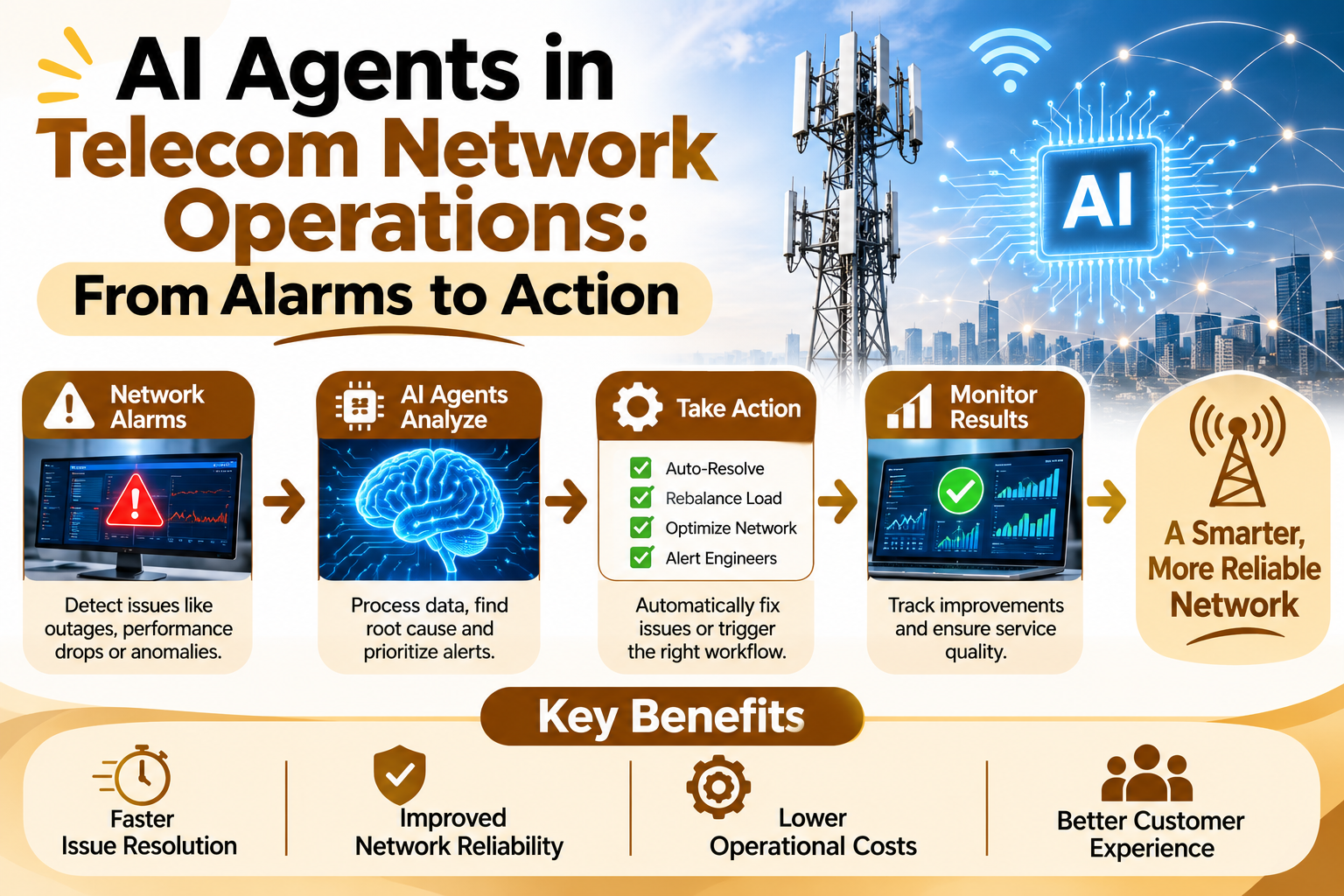
Running a telecom network on dashboards and ticket queues alone gets harder every year. 5G, cloud-native cores and edge sites add more signals to read and more dependencies to trace when something breaks. NOC teams have to move fast, yet one hasty change can turn a local fault into a regional outage.
At Trinetix, we see AI agents as the link between detection and controlled action. An agent can pull evidence from approved systems, test possible explanations, propose or carry out a fix and then check that the service actually recovered. In our work on ai agents for telecom, the biggest gains come from wiring that loop into the operational tools teams already trust, with the model as one component inside it.
Why traditional network operations hit a ceiling
A monitoring platform can raise thousands of alarms in an hour, and each one tells an engineer that something happened. It rarely says why. Ten alarms may trace back to a single fiber cut, while a real drop in service quality shows up as faint signals spread across separate tools. Engineers end up correlating telemetry, recent config changes, topology and incident history by hand.
That is where the delay sits. A team can spot the affected node in minutes and then spend hours confirming the root cause, agreeing on a safe action and checking that it worked. In a densely interconnected network, coordinating decisions slows things down far more than any shortage of data.
The industry push toward autonomous networks grows out of this problem. TM Forum’s Autonomous Networks Implementation Guide lays out a path from human-defined automation to systems that make more decisions on their own. Agents fit that path well, as long as they sit on reliable operational data and governed execution tools.
What an AI agent brings to the NOC
An AI agent is software that works toward a defined goal through a sequence of actions. In network operations, that could mean picking up a service-quality alert, collecting evidence from several platforms, matching it against known failure patterns, and drafting a remediation plan. Depending on risk and policy, the agent either runs the fix itself or asks an engineer to approve it. The broader development of agentic AI frameworks is also making it easier to coordinate tools, workflows and autonomous decision-making across complex enterprise environments.
A conventional script follows a fixed path. A standalone language model can give a plausible answer without ever checking live systems. A production-ready agent sits between the two: it has tool access, context, explicit permissions and logging, and it validates outcomes. Just as important, it knows when to stop and escalate.
How the incident workflow changes
Today the steps of an incident are spread across monitoring, service assurance, ticketing and configuration tools. An agent can tie them together in a sequence like this:
- Detect: a monitoring or analytics system flags an anomaly or an SLO breach.
- Investigate: the agent pulls related alarms, topology, recent changes and performance metrics.
- Diagnose: it compares the evidence with past incidents and ranks likely root causes.
- Decide: policy rules set whether the next step is an automated action, a recommendation or a request for approval.
- Act and verify: the agent starts an approved remediation and checks that the network and the affected service are back to normal.
- Record: findings, decisions and results go into the incident record for audit and later analysis.
| Operational step | Traditional approach | Agent-assisted approach |
| Fault detection | Alerts reviewed across separate dashboards | Alerts correlated with related signals |
| Investigation | Engineer gathers data manually | Agent retrieves evidence from connected systems |
| Root cause analysis | Experience-led, often one hypothesis at a time | Candidate causes evaluated across domains |
| Remediation | Engineer follows a runbook | Policy-bounded action or approval request |
| Verification | Manual checks and ticket updates | Automated post-action checks with evidence |
| Knowledge capture | Notes recorded inconsistently | Structured incident history ready for reuse |
Network expertise stays essential. What changes is where engineers spend their time: less on collecting and reconciling data, more on exceptions, risk calls and better operational policy.
Where agents add the most value
Fault management and root cause analysis
When one fault ripples through radio access, transport, core and service layers, an agent can build a single cross-domain picture instead of opening a ticket per alarm. It ranks likely causes, shows the evidence for each and suggests which extra check would narrow things down fastest. Teams get shorter investigations and a clearer view of which incidents hurt customers most.
Predictive maintenance and capacity planning
Agents can watch trends in performance, resource use and equipment health and flag conditions that usually come before degradation. They compare forecasts with capacity thresholds, suggest moving workloads or prepare maintenance before a limit is hit. Every forecast should carry a confidence level and the signals behind it. A prediction on its own should never trigger a high-risk change.
Configuration and change management
Configuration work suits agents well because the procedures repeat and the validation steps are clear. An agent can check a proposed change against policy, map dependencies, build the change plan and verify the result once it runs. High-impact changes still need sign-off, a rollback path and a record of what changed and why.
The engineering behind autonomous operations
Connecting agents to legacy OSS and BSS
A typical operator runs systems from many vendors and several generations, each with its own data model and interface. Agents need a dependable way to read normalized data and call approved actions without going around existing controls. In our projects, API layers, event pipelines, identity management and clear data ownership often take more effort than the model itself.
Keeping autonomy from hurting stability
The safest designs give each action a risk level. Reading telemetry or drafting an incident summary needs little oversight. Changing routing, restarting a network function or touching customer-facing configuration needs much stronger checks. Permissions, approval thresholds, rate limits, rollback procedures and escalation paths should all be in place before an agent moves from recommending to executing.
Coordinating several agents
One agent may handle fault triage while others look after capacity, security or service assurance. Without shared context, they duplicate work or propose conflicting actions. A coordination layer keeps priorities straight, holds a common incident state and makes every consequential decision traceable.
How to introduce agents into network operations
Pick a bounded workflow first, one where data is easy to reach, the process repeats and a mistake is cheap to undo. Incident summaries, evidence collection and remediation suggestions are good early candidates. Run the agent in observation mode, compare its output with what senior engineers decided and switch on execution only after it meets the agreed criteria.
Judge the pilot by operational results. Mean time to detect and repair, hours spent on manual investigation, repeat-incident rate, escalation volume, change failure rate and SLA performance all give a clear signal. Count false positives and unsafe recommendations too, since they show whether the agent is improving operations or just adding one more tool to maintain.
Frequently Asked Questions
How are AI agents used in telecom network operations?
AI agents help telecom providers automate incident investigation, alarm correlation, root cause analysis and network performance monitoring. They collect information from connected systems, identify potential problems and recommend corrective actions. Depending on operational policies, agents can also execute approved remediation workflows.
What is the difference between AI agents and traditional network automation?
Traditional network automation follows predefined rules and workflows. AI agents can evaluate changing network conditions, gather information from multiple systems and select appropriate actions based on available evidence. However, production deployments still require permissions, monitoring and human approval for high-risk operations.
Can AI agents reduce network downtime?
AI agents can help reduce downtime by accelerating fault detection, investigation and remediation. They can correlate related alarms, identify likely root causes and recommend corrective actions before minor incidents become larger service disruptions. Actual improvements depend on integration quality, network complexity and the reliability of automated decisions.
How can telecom providers implement AI agents safely?
Telecom providers should begin with low-risk workflows such as incident summaries, alarm analysis and evidence collection. Before enabling autonomous actions, they should introduce access controls, approval procedures, rollback mechanisms and continuous monitoring. Testing agents against real operational scenarios helps establish whether they are reliable enough for production use.
Can AI agents work with existing OSS and BSS platforms?
Yes. AI agents can integrate with existing Operations Support Systems (OSS) and Business Support Systems (BSS) through APIs, middleware and event-driven architectures. These integrations allow agents to retrieve operational data, analyze service conditions and initiate approved workflows without requiring telecom providers to replace their existing infrastructure.
Building the next generation of network operations
For telecom providers, agents make the most sense as part of a full operating loop: dependable data, integration with existing systems, guardrails, human oversight and outcomes you can measure. Day-one autonomy is the wrong target. A better one is to automate a few specific decisions safely, learn from the results and widen the scope as reliability grows. Built that way, agents become a working part of the NOC, and the project doesn’t stall as one more AI pilot in a lab.

Senior Content Manager at TrendusAI
Rashida Hanif is a content strategist at Trendusai.com, creating informative articles on artificial intelligence, emerging technologies, and digital solutions. She focuses on delivering valuable insights that help readers understand AI innovations, software development, and technology trends.