
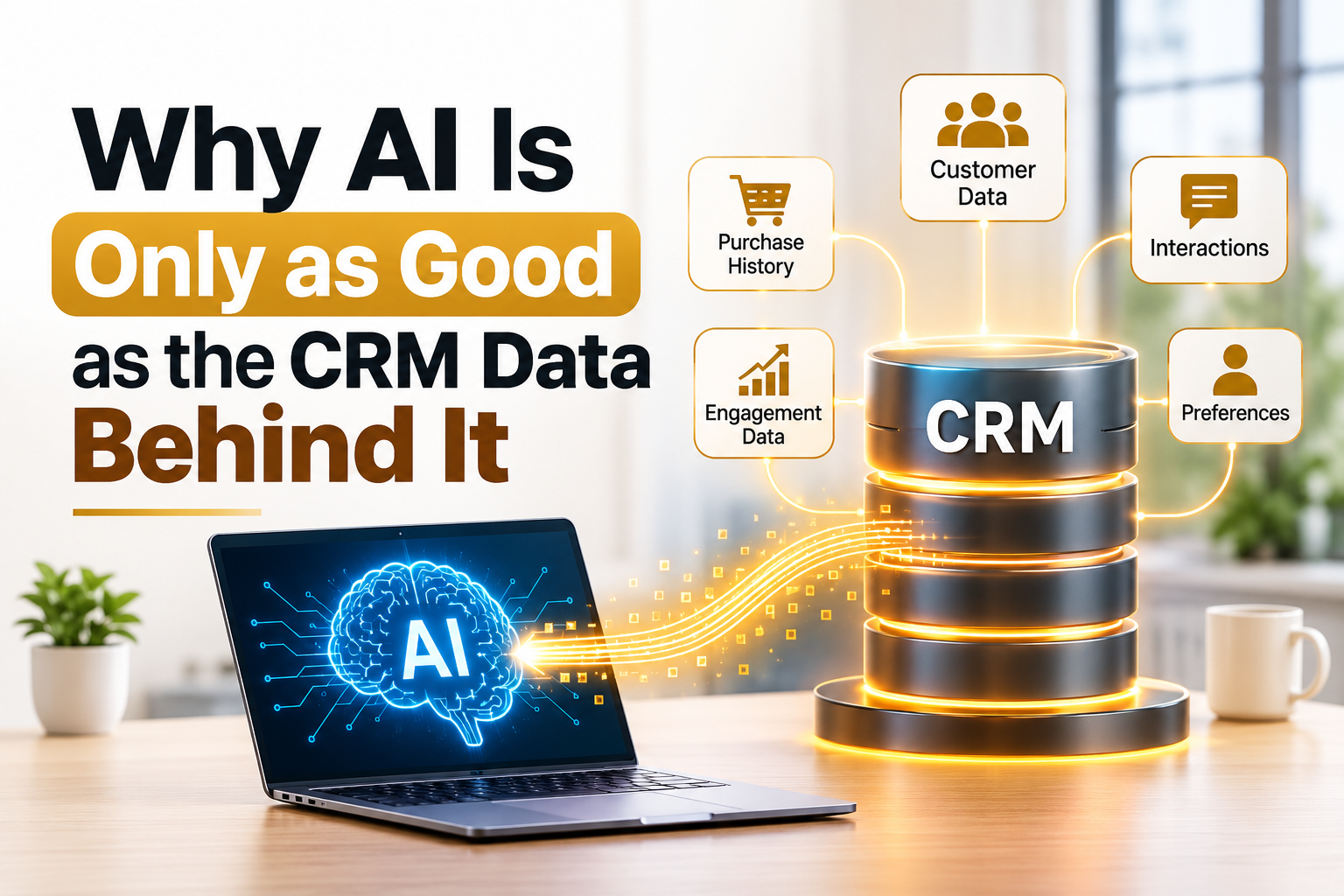
Every sales team wants the same thing from AI: lead scoring, call summaries, revenue forecasts, pipeline analytics. Vendor demos always look brilliant, and the pitch is some version of “plug it in, switch it on, watch everything improve.” Gartner predicted that at least 30% of generative AI projects would be abandoned after proof of concept by the end of 2025, though, and poor data quality was the biggest reason why.
That stat should worry any go-to-market team running its pipeline out of a CRM. So what actually goes wrong when the data underneath is a mess, and how clean does it really need to be before anyone spends money on AI features?
How Bad Data Breaks the AI Layer
AI features in a CRM don’t invent anything on their own. They pull from what the team has actually put in: deal stages, contact details, notes, call logs, activity timestamps. When those records are incomplete or full of inconsistencies, every output the AI spits out will reflect that same mess.
Take duplicate contacts as an example of how quickly this falls apart. One prospect living in the CRM as three separate records, each with a slightly different email address, will have their lead score split across all three entries, their activity history will look much thinner than it actually is, and the system might flag a genuinely warm lead as cold because the data is scattered across records that don’t talk to each other.
Stale deals create a similar problem, because a pipeline stuffed with opportunities nobody has updated in months will make revenue projections look healthier than they have any right to be. What makes this especially dangerous is how confident AI outputs appear even when they’re flat wrong, so it only takes one bad recommendation that a rep acts on to wreck the whole team’s trust in the tool faster than any manual mistake ever would.
What “Clean Enough” Actually Means
No CRM will ever have perfect data, but there’s a clear baseline that separates useful AI from unreliable AI. Structured fields should come first. When reps type deal updates into a free-text box, every entry looks different, and an AI model trying to make sense of that language is guessing at best. Dropdown menus, standardised deal stages, and required fields at each pipeline step will give the system something consistent to actually work with.
Where things really start to improve, though, is when data gets captured at the source instead of typed in after the fact. Call transcription and automatic activity logging close the gap between what happened on a call and what ends up in the CRM, and tools that record, transcribe, and tag conversations in real time will hand the AI layer a much richer dataset to learn from.
CRM platforms differ most at exactly this point, because some of them bolt AI features onto a data structure that was never built to support it. When comparing AI-powered CRM platforms for startups, it’s worth looking beyond flashy feature lists to how well each platform captures and structures data from day one, with independent testing consistently showing that AI reliability tracks the quality of the underlying data model.
The Real Order of Operations for GTM Teams
Most teams are tempted to buy the AI tool first and hope it sorts out the mess on its own, and vendors actively encourage that thinking because it’s far easier to sell a product that promises to fix a problem than one that asks you to put the work in upfront. But the companies actually getting real results from AI in their go-to-market stack are almost always the ones that cleaned up their data before they bolted anything new on top.
That doesn’t mean running a six-month data migration before anyone can switch anything on. It means picking a CRM that reduces the data problem by design, through automatic logging, structured fields, and smart defaults that keep records consistent without piling extra work onto the team. AI will handle the rest, but only if it has something solid underneath it. So if your team is arguing about which AI features to pay for, go and look at the records those features will rely on first, because when someone asks “why isn’t our AI working?” the answer is almost never the model.

Senior Content Manager at TrendusAI
Rashida Hanif is a content strategist at Trendusai.com, creating informative articles on artificial intelligence, emerging technologies, and digital solutions. She focuses on delivering valuable insights that help readers understand AI innovations, software development, and technology trends.