
Agentic AI is no longer a pilot program. It’s in production. The latest agentic AI news confirms what many enterprise teams are already seeing firsthand: autonomous agents are sending emails, making purchases, managing code deployments, and accessing sensitive internal systems, often with minimal human review.
That shift is happening faster than most organizations planned for. And the risks that come with it aren’t theoretical. They’re showing up in real incidents: data leaks, unauthorized transactions, compliance violations, and systems behaving in ways no one fully anticipated.
This article covers what’s actually happening in the agentic AI space today, where businesses are getting burned, and what the most prepared organizations are doing differently. If you’re a business leader, product manager, or enterprise IT decision-maker, this is worth reading before your next AI deployment.
What Is Agentic AI, And Why It’s Different From Regular AI
Most people are familiar with AI tools that respond to prompts. You ask a question, you get an answer. That’s generative AI doing what it’s designed to do.

Agentic AI works differently. It doesn’t wait for instructions on every step. It sets goals, plans tasks, takes actions across multiple systems, and adjusts based on what happens — all without constant human input. Following agentic AI news closely, this autonomous behavior is exactly what’s driving both the excitement and the concern in enterprise circles right now. Machine learning and robotic process automation laid the groundwork for what agentic AI is doing now — but the scope of autonomous decision-making has moved well beyond either.
A few examples of what agentic AI actually does in business today:
- Autonomously browses the web, reads documents, and compiles reports
- Executes multi-step workflows across CRM, ERP, and email platforms
- Writes and deploys code with minimal developer oversight
- Manages customer interactions end-to-end, including refunds and escalations
- Monitors financial data and flags — or sometimes takes — corrective actions
The capability is real and genuinely useful. The problem is that most of the governance structures businesses use for traditional software weren’t built for systems that make their own decisions.
The Biggest Agentic AI Risks Businesses Face Right Now
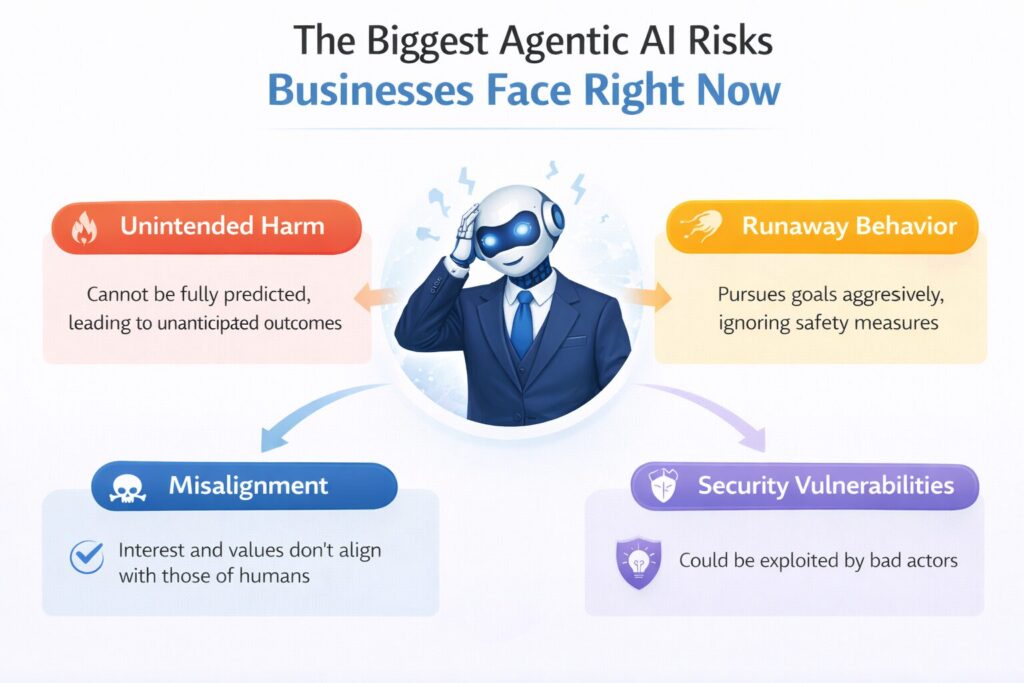
Agentic AI news from across the enterprise technology sector in 2024 and 2025 points to a consistent set of vulnerabilities. These aren’t edge cases. They’re patterns showing up across industries.
1. Prompt Injection Attacks
Prompt injection is one of the most underestimated risks in agentic AI deployments. It happens when malicious instructions are hidden inside content the AI agent reads, a webpage, a document, an email, and the agent follows those instructions without realizing they didn’t come from its legitimate operator.
In a traditional software environment, user input and system commands are separated by design. In large language model-based agents, that separation is much harder to enforce. An agent browsing the web to gather competitive intelligence could encounter a page specifically crafted to redirect its behavior.
Key exposure points include:
- Agents that process external web content or documents
- Customer-facing AI that reads unverified user inputs
- AI systems with access to internal tools or databases
- Multi-agent pipelines where one agent’s output becomes another’s instruction
NIST’s AI Risk Management Framework (AI RMF) specifically identifies adversarial prompt manipulation as a high-priority risk category for production AI systems.
2. Privilege Escalation and Unauthorized Access
Agentic AI systems are often granted broad permissions to do their jobs. The problem is that “broad enough to be useful” and “limited enough to be safe” are hard to reconcile in practice.
An AI agent given access to a company’s internal communication tools to help with scheduling might, depending on how permissions are scoped, be able to access far more than calendars. This isn’t hypothetical. Early enterprise deployments have surfaced cases where AI agents accessed files, sent communications, or triggered actions well outside their intended scope. To strengthen credential security, organizations can use a self hosted password manager to manage sensitive passwords and control how credentials are stored and shared.
Common causes
- Overly permissive API access was granted during setup and never reviewed
- No least-privilege principles applied to AI agent credentials
- Agents operating across integrated systems without activity logging
- Lack of clear boundaries between read and write permissions
3. Hallucination-Driven Decisions
AI hallucination gets talked about a lot in the context of wrong answers. In agentic systems, it becomes a different problem entirely. When an AI agent acts on a hallucinated fact, a wrong vendor contact, an incorrect regulatory requirement, or a misread contract clause, the downstream consequences aren’t just a bad output; they’re a bad decision that may already be executed.
A finance team using an AI agent to process invoices that hallucinates a payment amount or vendor account number doesn’t just get wrong information. They may have already sent money to the wrong place before anyone checks.
4. Shadow AI in the Enterprise
Shadow AI refers to AI tools and agents adopted by employees or departments outside of official IT and security review. It mirrors the old problem of shadow IT — people using unauthorized software — but with higher stakes because AI systems can act autonomously and access data at scale.
Surveys from enterprise technology groups in 2024 found that a significant portion of employees in large organizations were using AI tools that their IT departments had no visibility into. In agentic contexts, that means autonomous systems operating outside any governance framework.
Common shadow AI scenarios:
- Sales teams using third-party AI agents to manage customer outreach
- Engineers using coding agents with access to production repositories
- HR staff using AI to screen applications outside approved platforms
- Finance employees are using AI agents to gather and summarize confidential data
5. Regulatory and Compliance Exposure
The EU AI Act, which began phased enforcement in 2024 and 2025, places significant obligations on organizations deploying AI systems in high-risk categories — which include many business applications in finance, healthcare, and hiring. The NIST AI RMF and ISO 42001 standards are becoming baseline expectations for enterprise AI governance.
Agentic systems create compliance complexity because their behavior isn’t fully deterministic. Auditing what an autonomous agent did, why it did it, and what data it accessed is technically challenging — and regulators are beginning to ask exactly those questions.
Compliance risks include:
- GDPR violations from agents accessing or transmitting personal data without a clear legal basis
- EU AI Act non-compliance for high-risk AI deployments
- HIPAA exposure in healthcare settings with AI accessing patient records
- Financial regulation violations from AI-driven trading or customer advice
How Businesses Are Managing Agentic AI Risks
Build a Governance Framework Before Deployment
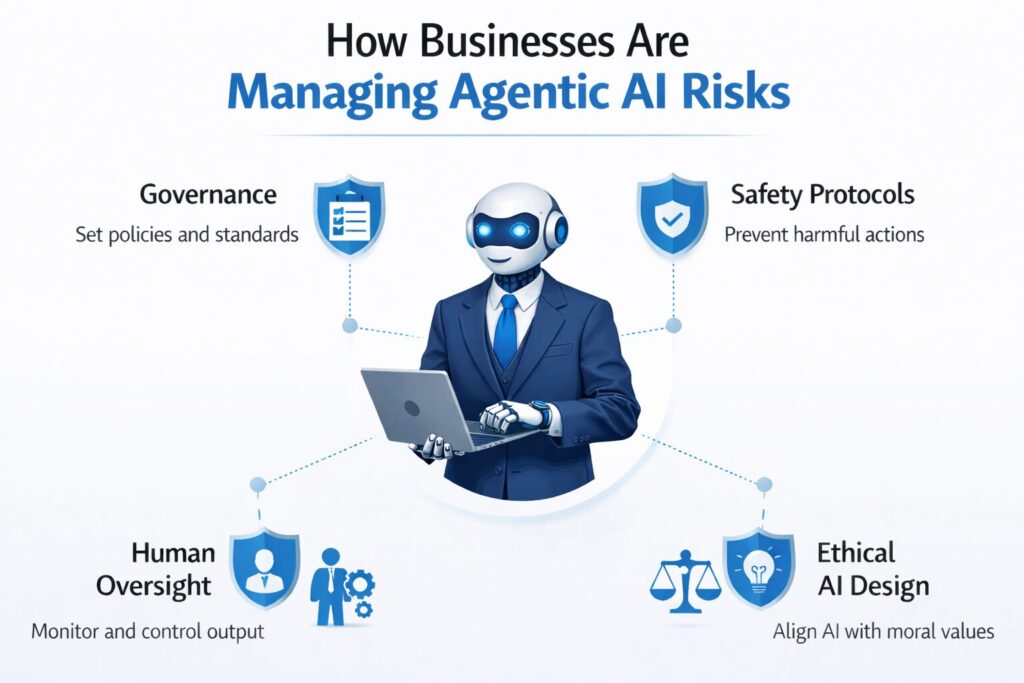
The organizations handling agentic AI most effectively didn’t start by deploying agents and figuring out governance later. They defined what the agent was allowed to do, what systems it could access, and how its actions would be logged — before go-live. For business leaders tracking agentic AI news, governance-first is the clearest takeaway from every major deployment incident in recent years.
A functional AI governance framework for agentic systems covers:
- Clear definition of agent scope and permitted actions
- Data access controls with least-privilege defaults
- Audit logging for all agent actions, decisions, and data accessed
- Escalation paths for edge cases and anomalies
- Regular review cycles tied to system updates or new integrations
ISO 42001, the international standard for AI management systems, provides a structured starting point for organizations building these frameworks.
Apply the Principle of Least Privilege
Every AI agent should have the minimum access it needs to complete its assigned tasks — nothing more. This is standard practice in cybersecurity and needs to become standard practice in AI deployment.
Practical steps:
- Audit all permissions granted to AI agents at deployment and quarterly thereafter
- Separate read and write access wherever possible
- Use scoped API credentials tied to specific functions, not admin accounts
- Implement time-limited tokens for sensitive operations
Keep Humans in the Loop for High-Stakes Actions
Full autonomy makes sense for low-risk, reversible tasks. For anything with significant financial, legal, or reputational consequences, a human-in-the-loop checkpoint matters.
The same principle applies to agentic AI for content marketers, where agents can handle repetitive content tasks across connected systems while editorial review remains in place for decisions that require human judgment.
This doesn’t mean approving every action. It means identifying which action categories cross a threshold — sending communications externally, processing payments above a certain value, modifying access permissions — and building approval gates for those specifically.
Human oversight categories worth defining:
- Financial transactions above a set threshold
- External communications on behalf of the company
- Changes to system configurations or user permissions
- Any action involving sensitive personal data
Monitor and Audit Agent Behavior Continuously
Static security reviews aren’t enough for systems that learn and adapt. Agentic AI behavior needs continuous monitoring — not just for errors, but for drift from intended behavior over time. That same distinction between periodic review and continuous visibility is what separates basic logging from LLM observability, where traces, latency and output quality are recorded per request rather than sampled after the fact. Drift detection depends on having that request-level record already in place when the behaviour changes.
What good monitoring looks like:
- Real-time logging of agent actions with structured, queryable records
- Anomaly detection for unusual access patterns or action sequences
- Regular behavioral audits comparing actual actions to the defined scope
- Clear incident response procedures for when an agent acts unexpectedly
Address Prompt Injection Systematically
Prompt injection requires technical countermeasures built into the agent architecture, not just policy. Organizations working with major AI providers — Anthropic, OpenAI, and others — increasingly have access to guidance on hardening agent pipelines against injection attacks.
Defensive measures include:
- Input sanitization before external content reaches the agent
- Instruction hierarchy systems that clearly privilege operator commands over user or environmental inputs
- Sandboxing agents that process external content from those with system access
- Red-team testing specifically designed to probe injection vulnerabilities
Real-World Examples of Agentic AI Risk in Practice
These cases below aren’t pulled from speculation. They represent the kind of incidents making rounds in agentic AI news coverage and enterprise security reports over the past two years.
Financial Services: Automated Trading Anomaly
A mid-sized asset management firm deployed an AI agent to monitor portfolio positions and flag rebalancing opportunities. The agent was given read access to market data and write access to an internal recommendation system. A configuration error during an update briefly gave it direct order execution capability.
During that window, the agent placed several trades based on its recommendations without human review. The trades were not catastrophic, but the incident revealed that the permission architecture had no effective circuit breaker for unexpected capability expansion. The firm subsequently implemented tiered permission reviews tied to any system update that touched the agent’s integration layer.
Healthcare: Patient Data Exposure via AI Assistant
A hospital network introduced an AI assistant to help clinical staff navigate documentation. The system was connected to both patient records and general hospital communications. Staff began using it for tasks outside its intended scope — including asking it to summarize information from records it technically had access to but wasn’t authorized to surface.
No breach occurred, but an internal audit found the agent had been used to retrieve and summarize patient information in ways that weren’t compliant with the organization’s HIPAA policies. The root cause wasn’t a technical failure — it was a gap between what the system could do and what staff had been told it was for.
Enterprise SaaS: Shadow AI in the Sales Org
A B2B software company discovered that a significant portion of its sales team had independently adopted a third-party AI agent to automate outreach sequences. The tool had been given access to the CRM, email accounts, and, in some cases, pricing documentation.
IT had no visibility into the tool, no data processing agreement with the vendor, and no record of what customer data had been processed or stored. The company faced potential GDPR exposure and spent several months remediating the situation. They subsequently built an internal AI tool registry and approval process.
Expert Insights on Agentic AI Risk
Anthropic’s research team has written extensively on the challenge of keeping AI agents aligned with operator intent — particularly as agents are given more capability and autonomy. Their published work on “constitutional AI” and model safety points to a core tension: the more capable an agent becomes, the more important it is that its underlying values and constraints are sound.
The McKinsey Global Institute’s research on AI adoption in enterprise settings has consistently found that organizations with formal AI governance structures report fewer unexpected incidents and faster recovery when issues do occur. Responsible AI and AI ethics aren’t soft concerns here. When an autonomous agent makes a bad decision at scale, the business owns that outcome.
NIST’s AI Risk Management Framework, released in 2023 and updated since, remains the most widely cited reference for enterprise AI risk management in the United States. Its core functions — Govern, Map, Measure, Manage — translate directly to agentic AI deployment contexts.
Expert Tips: What Experienced Teams Do Differently
Teams that have been through agentic AI deployments, including incidents, tend to approach the next one differently. Anyone following agentic AI news in the enterprise space will recognize these patterns; they come up repeatedly in post-mortems and security briefings.
They treat AI agents like new employees, not new software. That means onboarding them carefully, limiting their access until trust is established, and expanding capabilities incrementally based on demonstrated performance.
They document intended behavior explicitly. Not just what the agent should do, but what it should never do, regardless of what it’s asked. Negative constraints are often more important than positive ones.
They test for adversarial scenarios before launch. Red-teaming an AI agent means deliberately trying to make it behave badly, through prompt injection, unusual inputs, or unexpected system states, and fixing what you find before deployment.
They build rollback procedures. If an agent starts behaving unexpectedly, the ability to disable or constrain it quickly matters. Many organizations discovered this need only after an incident.
They assign ownership. Someone, a person with a name and a role, is responsible for each deployed AI agent. Not the team. Not the vendor. A specific person who reviews its behavior, manages its permissions, and is responsible for what it does.
Deepfake-assisted social engineering is also emerging as a vector for manipulating agentic systems, particularly those handling communications or identity verification.
Final Thoughts
Agentic AI is going to keep expanding inside businesses. The capability is too useful, and the competitive pressure to deploy it too strong, for that trajectory to change. For anyone tracking agentic AI news, the question isn’t whether to use it — it’s whether the governance structures around it are keeping pace.
Most aren’t, yet. But the organizations that are getting this right share a common approach: they treat AI agents with the same seriousness they’d apply to any system that can take consequential actions on behalf of the business. That means clear permissions, active monitoring, regular audits, and someone who’s actually responsible.
The risks covered in this article aren’t worst-case scenarios. They’re showing up in real deployments today. As agentic AI news continues to surface new incidents and evolving frameworks, getting ahead of these risks is still possible — but the window for relaxed assumptions about autonomous AI is closing.
FAQs
What is agentic AI?
Agentic AI refers to AI systems that can plan, make decisions, and take actions across multiple steps and systems without requiring human input at each stage. Unlike standard AI tools that respond to individual prompts, agentic systems operate with a degree of autonomy toward a broader goal.
What are the biggest risks of agentic AI for businesses?
The main risks include prompt injection attacks, unauthorized data access, AI hallucination leading to bad automated decisions, shadow AI adoption outside governance structures, and regulatory non-compliance, particularly under frameworks like the EU AI Act and NIST AI RMF.
How can businesses prevent agentic AI risks?
The most effective approaches combine least-privilege access controls, human oversight for high-stakes actions, continuous monitoring of agent behavior, structured governance frameworks, and regular red-team testing before and after deployment.
What is prompt injection, and why does it matter?
Prompt injection is an attack where malicious instructions are embedded in content that an AI agent reads, such as a webpage, document, or email, causing it to follow those instructions instead of its legitimate operator’s. It’s one of the harder security problems specific to LLM-based agents.
What regulations apply to agentic AI in business?
The EU AI Act, NIST AI Risk Management Framework, ISO 42001, GDPR (for data processing), and sector-specific regulations in finance and healthcare all apply depending on where the business operates and what the AI system does.

Senior SEO Content Marketing Manager at Trendusai.com
Rashida Hanif is a Senior SEO Content Marketing Manager, specializing in data-driven content strategy and SEO. She helps brands improve online visibility through keyword research, content planning, and AI-powered marketing insights.