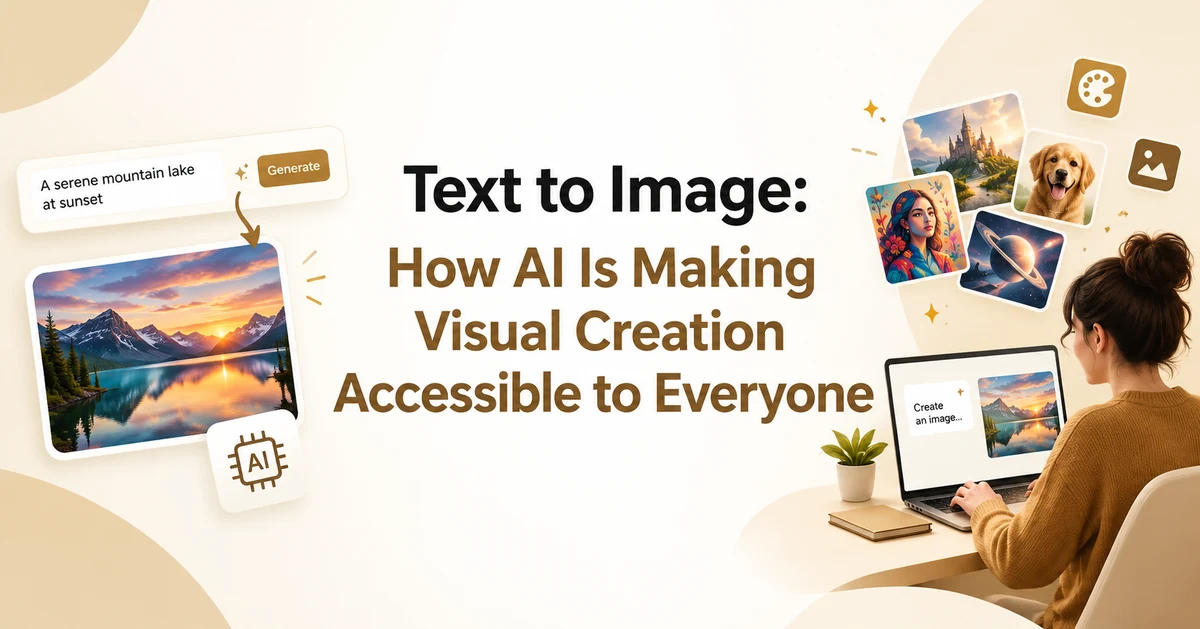
The ability to describe something in words and receive a visual representation of it back within seconds is one of those capabilities that sounds like science fiction until you actually use it. Text to image AI has moved from research demonstration to practical production tool over the past few years, and the pace of improvement has been significant enough that the tools available today bear little resemblance to the early outputs that gave the technology a reputation for generating distorted hands and incoherent backgrounds.
What has not changed is the fundamental premise: you describe what you want, the AI produces it. What has changed is how accurately, how quickly, and how consistently that premise now delivers on its promise.
Why the Text Interface Matters
The choice of text as the input method for image generation is not arbitrary. It reflects something true about how creative people think about visual ideas. When a designer, a writer, or a marketing professional imagines an image, they think about it in descriptive terms: the subject, the mood, the style, the lighting, the composition. They reach for language to communicate that vision to a photographer, an illustrator, or a colleague.
Text to image AI makes that same natural process productive without requiring an intermediary. The description that was previously a creative brief for another person to interpret becomes a direct instruction that the system acts on. The friction between having an idea and having a visual representation of it is reduced to the time it takes to type a description.
This matters practically because that friction has historically been significant. Commissioning an illustration takes days. Photography requires scheduling, equipment, and access. Stock libraries offer what exists rather than what is needed. The text interface removes all of these constraints and replaces them with a single question: can you describe what you want clearly enough for the system to understand?
How Text to Image Generation Works
The underlying mechanism that makes text to image generation possible is a class of machine learning model called a diffusion model. These models are trained on large datasets of images paired with text descriptions, which allows them to learn the statistical relationships between visual content and the language used to describe it.
When you enter a prompt, the model starts from random noise and progressively refines it toward an image that matches your description. It is balancing multiple constraints simultaneously: the subject you described, the style you referenced, the mood you indicated, the compositional elements you specified. The result is an image that reflects the intersection of all those constraints as the model has learned to understand them.
An AI image generator from text that has been trained well on diverse, high-quality data produces outputs that are coherent, detailed, and stylistically consistent with the description provided. The practical quality of what different tools produce varies significantly, and that variation reflects differences in training data quality, model architecture, and the care taken in building the interface between the user and the underlying model.
The Skill of the Prompt
One of the more interesting developments that has accompanied the rise of text to image generation is the emergence of prompt writing as a distinct creative skill. The quality of AI generated images is heavily influenced by how the prompt is constructed, and the relationship between input and output is not always intuitive.
Vague prompts produce generic results. A prompt that says “a city at night” produces something technically correct but visually unspecific. A prompt that describes a city at night with specific atmospheric detail, a defined architectural style, a particular time period, a specific lighting quality, and a named photographic or artistic style produces something substantially more directed and useful.
Learning to write effective prompts requires understanding how to communicate visual concepts in language and how the specific tool being used interprets different types of instructions. Users who invest time in developing this skill produce outputs that are significantly better than casual users generate with the same tools. This is worth noting because it means the technology rewards engagement and skill development rather than replacing the need for any creative input from the user.
The most effective prompt writers tend to approach the process iteratively. They generate an initial result, identify what it got right and what it missed, adjust the prompt to address the gaps, and generate again. Over time this process builds an understanding of how the tool interprets different types of language that makes each subsequent generation more accurate and efficient.
Practical Applications Across Different Contexts
The range of contexts in which text to image generation is now embedded in real working practice is broader than most people who have not used these tools would guess.
Content creators producing articles, newsletters, social media posts, and video thumbnails at volume need images that reflect the specific content of each piece rather than generic visuals that could apply to anything. A writer publishing multiple pieces per week can generate relevant, original images for each one without waiting on a designer or spending hours searching stock libraries for something that approximately fits.
Marketing teams use text to image generation for concept exploration and rapid prototyping. Generating multiple visual directions for a campaign, an advertising concept, or a product aesthetic in the time it would previously have taken to brief a single direction gives teams more options to evaluate and present before committing resources to production.
Educators producing online courses, presentations, and teaching materials need illustrations that match their specific conceptual needs. A science educator who wants a diagram that does not exist in stock photography, or a history teacher who wants an illustrative image of a specific historical context, can produce it directly from a description rather than spending hours searching for an approximation.
Independent business owners who need visual content for their marketing but cannot sustain a design relationship use text to image tools to produce social media graphics, promotional images, and website visuals that are original and appropriate for their specific context.
Understanding the Limitations
Text to image generation is genuinely capable and continues to improve. It is also not unlimited, and understanding where it falls short helps users incorporate it appropriately.
Strict brand consistency across many generated images requires careful prompt management. The tools can reproduce a described style, but maintaining precise consistency in specific design elements, exact colour relationships, or character appearance across dozens of generated images requires deliberate attention to prompt construction and often iterative refinement.
Technically precise imagery presents challenges. A prompt asking for an accurate representation of specific equipment, a precise architectural detail, or an accurate depiction of a specific documented event will produce something plausible but may not achieve the accuracy required for technical or documentary purposes.
The legal landscape around AI generated images continues to develop. Questions about training data, copyright in outputs, and appropriate disclosure when using AI generated images in commercial contexts are live issues that vary by jurisdiction. Staying informed about relevant policies and legal developments in your specific context is appropriate before incorporating these tools into commercial work at scale.
What Changes and What Does Not
The most accurate framing of what text to image AI changes is not that it replaces creative skill but that it redistributes where creative skill is applied. The execution layer of image production now has an AI capable of handling a significant portion of it. The conceptual layer, deciding what an image should communicate, how it should relate to its context, what emotional register it should operate in, remains entirely a human responsibility.
This redistribution is practically meaningful. Creators who previously spent their time on execution can now spend more of it on concept and direction. People who had clear visual ideas but lacked the technical skill to execute them can now produce images that reflect those ideas. The gap between imagining something and having a visual representation of it is smaller than it has ever been, and that change has real consequences for who can participate in visual content production and at what level of quality.
Senior SEO Content Marketing Manager at Trendusai.com
Rashida Hanif is a Senior SEO Content Marketing Manager, specializing in data-driven content strategy and SEO. She helps brands improve online visibility through keyword research, content planning, and AI-powered marketing insights.