
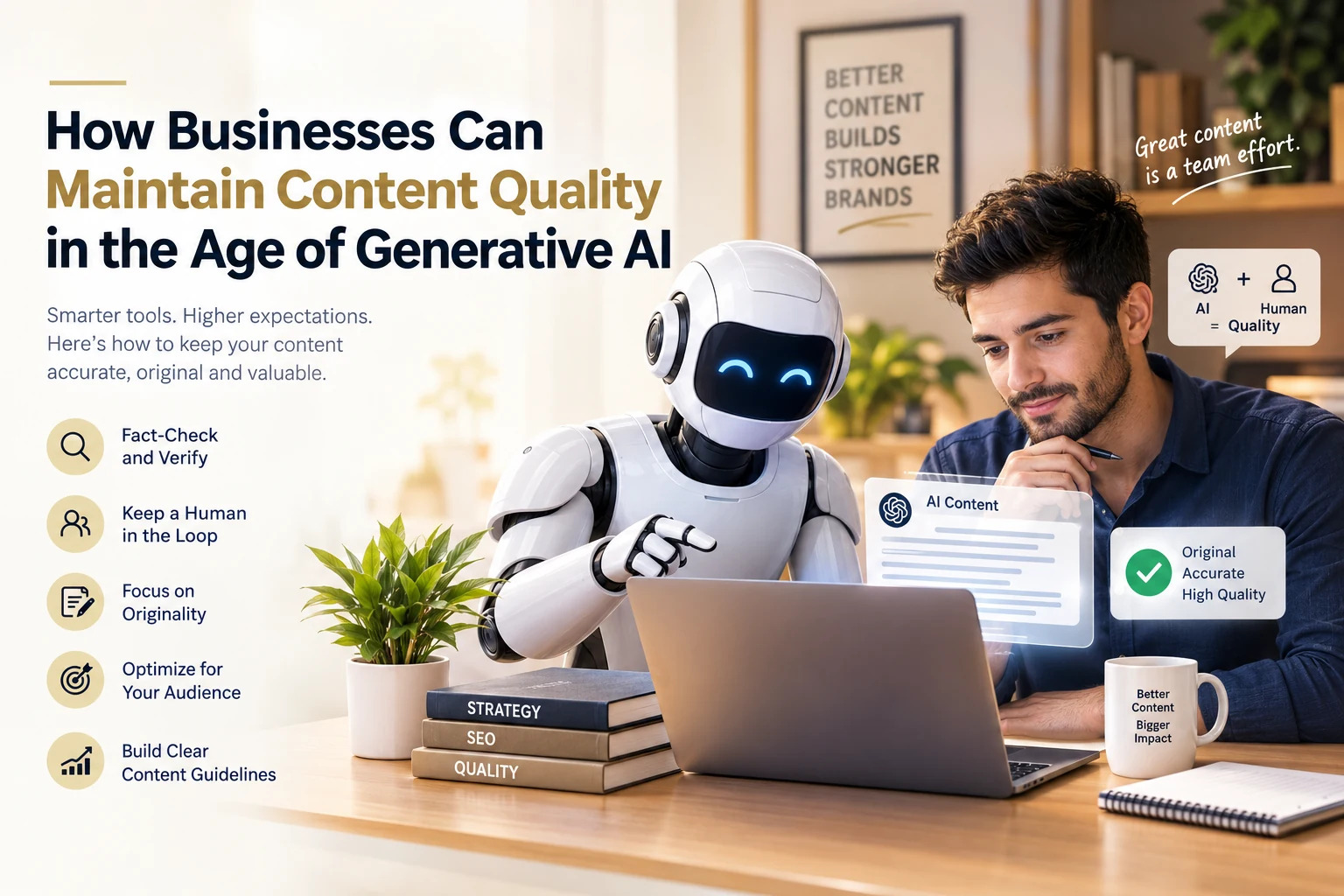
From small businesses to enterprises, everyone is now using AI for content creation. A 2026 survey reported that 84% of small businesses are using AI for content, along with 78% of midsize businesses and 62% of enterprises.
With large businesses, the content goes through a rigorous review process that ensures that only high-quality content makes it through. They have the manpower for it, and a lot more at stake. However, with smaller businesses, AI use for content can mean publishing low-quality, generic writing that ends up doing not much to ensure success.
Now that AI use is the only way we can ensure that businesses are efficient and can scale on a lower budget, how can we be certain that the quality of content is also effective? Let’s explore how businesses can maintain content quality in the age of AI.
Being More Disciplined With AI Use
Just because AI is advanced enough to help you create whole content for your business doesn’t mean you should do that. Remember that the point of using AI is to become more efficient and create content faster; it was never to completely remove humans from the process.
Pick which aspect of content creation you would be automating. It could be ideation, researching topics, creating outlines, editing, or drafting, but you have to choose a few of those steps and not all.
This can be ideation and researching topics, or research and creating outlines, depending on what you need most help with and what can help you save time.
Once you have created a draft using AI, before you publish, you must check the content with an AI detector. Any content with an AI score of more than 30% has too much automation, and you will have to comb through it and remove generic writing to increase the quality of the writing.
Add Unique Human Value
Your brand’s audience is tired and wary of AI. The only way to ensure your AI content flies is by adding unique human value to your content.
Whether you are creating website blogs, social media captions, etc., you need to focus on what you can do differently from your competitors.
Your business is operating within a niche. You need to find what the traffic attracted to this niche is looking for and what their search intent is. This is crucial for SEO, along with adding the E-E-A-T that transforms content quality. Here are a few ways you can add human value to your content.
Use Original Research
If your business has operated in the industry for a while, you may have accumulated plenty of internal knowledge and operational data. You can analyze anonymized product or sales data, test tools, document real implementation results, and survey customers.
You can use AI to analyze years of data and create visuals that will be easier for your audience and peers to understand. This is one of the best ways to establish your brand as a credible, authoritative figure in the industry.
Show First-hand Experience
Adding proof that someone on your team has actually done the thing being discussed in the content can be a great way to establish experiential dominance.
This can include testing notes, before-and-after results, implementation checklists, photos of prototypes, workflow diagrams, or candid observations about what worked and what did not.
This can even be failures, because when you are transparent and unafraid to show your losses, you don’t only gain sympathy; you become relatable. Adding lived experience gives readers the practical context that generic AI writing does not have.
Becoming Trustworthy
We talked about being transparent. Whether it is about AI use or about your operational processes, being transparent is a crucial step for becoming trustworthy. Even when you are transparent about a negative aspect of your business, it can end up benefiting your business.
A famous example of this is the brand Patagonia. In 2007, the brand launched an interactive platform called Footprint Chronicles, which allowed consumers to track the social and environmental impact of specific garments.
This was followed by the “Don’t Buy This Jacket” Campaign in 2011, which detailed the environmental cost needed to produce their best-selling fleece.
Ironically, this made their revenue jump by 30%. Patagonia’s revenue rose from approximately $415 million in 2011 to $543 million in 2012. This is a prime example of how radical transparency builds trust and grows revenue.
Include Expert and Customer Perspective
Expertise is crucial to growing your credibility. You need to incorporate expert advice into your content. There are so many ways you can do this.
You can interview internal specialists and attribute the insight to them. You can ask sales or support teams about questions customers frequently have and ask internal experts for the best way to answer these questions.
You should also get information from your customers by encouraging them to participate in surveys or incorporate their direct quote(with permission) into your content.
You can add a short practitioner note explaining a common mistake. Things like case studies or “lessons learned” from actual projects help your brand gain a reputation as an expert operating in the industry.
You can even ask your customer service team for specific topics they are reached out to for, to create content that meets your audience’s highly specialized search intent.
Upholding Brand Voice
A crucial aspect of ensuring the quality of your content is making sure your brand voice stays accurate. If you are using AI, you have to feed the system enough examples of your brand’s unique voice to ensure the tone stays recognizable to your audience and doesn’t sound basic.
You may have to review and heavily edit automated content to ensure that the tone stays close to what your brand sounds like to the world.
Final Thoughts
Ensuring content quality in the age of AI is difficult, but by curating AI use and adding unique human value to the content, the writing published by your brand can be of higher quality. Remember that AI tools are here to make things easier, while humans add value to enrich the content.

Senior SEO Content Marketing Manager at Trendusai.com
Rashida Hanif is a Senior SEO Content Marketing Manager, specializing in data-driven content strategy and SEO. She helps brands improve online visibility through keyword research, content planning, and AI-powered marketing insights.