Video content creation has never been more demanding. Platforms expect consistent output, audiences have higher production standards than they did five years ago, and the competitive landscape for attention has intensified across every content category. At the same time, the tools available to individual creators and small teams have improved at a pace that has outrun what most people expected even recently. The integration of conversational AI into video editing is one of the developments driving that improvement, and understanding what it actually changes in practice is more useful than the general claim that AI is transforming everything.
The Problem With Traditional Editing Workflows
Professional video editing software is powerful. It is also time-consuming to learn, slow to operate for creators who are not specialists, and poorly suited to the volume and pace at which content now needs to be produced. A creator who publishes three videos a week is spending a significant portion of their working time inside an editing interface, executing operations that require technical knowledge but not creative judgment.
The structure of traditional editing assumes that every decision will be made and executed manually. Every cut point, every transition, every caption line, every colour adjustment, every audio level change requires a deliberate action from the editor. For a feature film with a six-month post-production schedule, this granular control is appropriate and necessary. For a ten-minute tutorial video that needs to be published by tomorrow, the same workflow is a mismatch between the tool and the task.
The cumulative time cost of manual editing at content creator scale is substantial. Research into creator workflows consistently shows that editing is the most time-intensive part of the production process for the majority of video creators, often consuming more time than scripting, filming, and publishing combined. Any tool that meaningfully reduces that time without sacrificing output quality addresses a real and significant problem.
What Conversational AI Adds to the Editing Process
The integration of large language model capabilities into video editing tools introduces something that automation of individual tasks does not provide on its own: the ability to interpret and respond to intent expressed in natural language.
Traditional video editing automation handles predefined tasks. Auto-caption tools generate captions. Auto-colour tools apply a correction pass. These are useful but limited. They do what they were built to do, with no capacity to respond to a specific creative brief or to adjust their output based on a description of what the creator is trying to achieve.
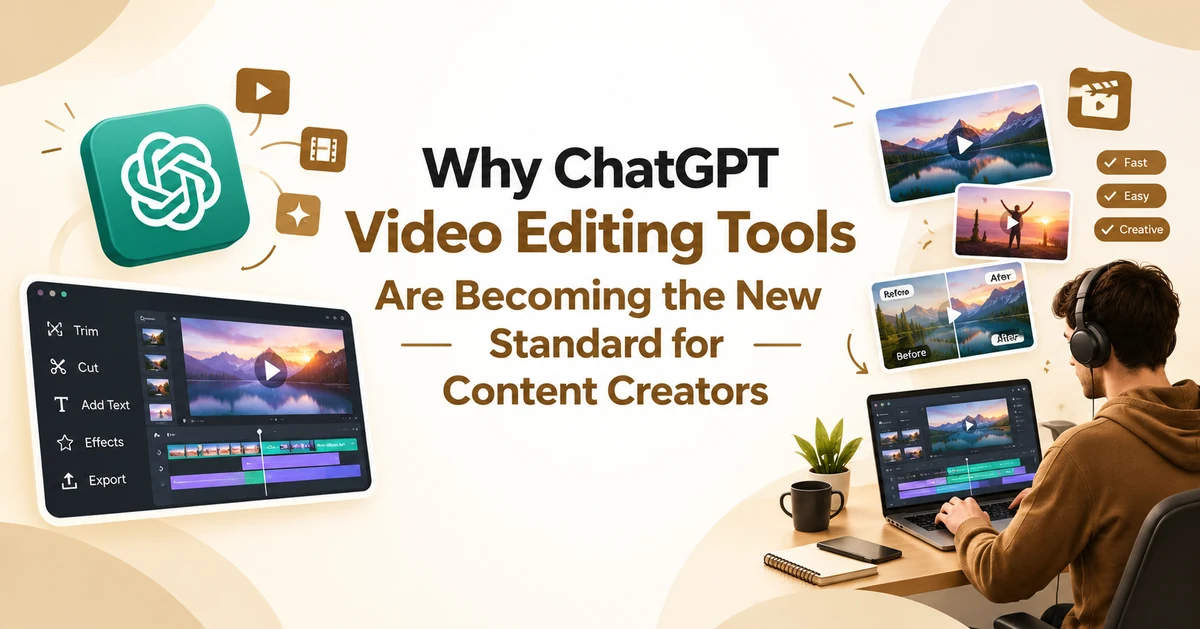
Conversational AI changes this because language models are specifically good at understanding intent expressed in plain language and translating it into structured actions. A creator using a ChatGPT video editing tool like CapCut’s CoDeX integration can describe the edit they want in natural terms, receive a result, and then refine it through continued conversation rather than through manual adjustment of timeline elements. The interface becomes a dialogue rather than a series of technical operations.
This shift matters most for creators who have clear creative vision but limited editing technical skill. The bottleneck in their workflow has never been knowing what they want the video to look like. It has been the gap between that vision and their ability to execute it in software. Conversational AI reduces that gap substantially by making the execution layer responsive to described intent rather than requiring manual implementation of every change.
From Script to Finished Video
One of the most practically significant capabilities that ChatGPT video editing integration enables is the generation of edited video content from a written script or concept description. This is not a simple slideshow generator. It involves selecting or generating appropriate visual content, timing visuals to narration or audio, adding structural elements including titles, transitions, and graphics, and producing output that functions as an edited video rather than raw assembled footage.
For creators producing educational content, product explanations, news commentary, or structured tutorial material, this workflow changes the economics of production fundamentally. Content that previously required a full editing session to produce can reach a publishable draft state in a fraction of that time, with the creator’s attention focused on reviewing and directing rather than building from scratch.
The quality of the output reflects the quality of the input. A well-structured script with clear section breaks, specific visual references, and a defined tone produces a more useful first draft than a loosely described concept. Creators who develop skill in briefing the AI clearly, which is itself a transferable skill, produce results that require less refinement and are closer to publish-ready from the first pass.
Captions, Voiceovers, and the Surrounding Workflow
The most measurable improvements that AI has brought to video editing in the past two years are in the functions that surround the core editorial work. Caption generation, voiceover synthesis, audio transcription, and background music matching have all reached accuracy and quality levels that make them genuinely usable in production workflows rather than experimental features that require extensive manual correction.
Caption generation is the clearest example. Manual captioning is time-consuming enough that many creators deprioritise it despite knowing it improves accessibility and engagement on platforms where video plays silently by default. AI caption generation that is accurate enough to require only a light review pass rather than line-by-line correction removes the practical barrier to including captions consistently, which benefits both audience reach and platform performance.
Voiceover synthesis has developed to the point where synthetic voices are appropriate for a wide range of content types without creating a negative listening experience. For creators who want to produce narrated content without recording narration, or who need to produce the same content across multiple languages for different audience segments, this capability represents a genuine production option rather than a compromise.
Where Human Judgment Remains Central
The honest account of what ChatGPT video editing tools change and what they do not is more nuanced than the marketing language around these tools tends to suggest.
Creative direction is still a human function. The AI executes a defined approach, but identifying which approach is right for a specific audience, platform, and purpose requires contextual understanding that current tools do not provide. A creator who knows their audience well makes different choices than an AI making statistically probable choices, and that difference often determines whether content performs or merely exists.
Brand voice and tonal consistency across a body of work requires active human stewardship. An AI tool can apply a described style to a single video, but maintaining that style coherently across a channel over months and years, and evolving it deliberately as the brand develops, requires a human who understands what the brand is trying to communicate.
The editorial judgment involved in pacing a narrative, deciding when to let a moment breathe and when to cut quickly, when to use music and when silence is more effective, responds to audience psychology in ways that current AI tools handle inconsistently. These decisions benefit from human sensitivity rather than pattern matching against existing successful content.
The Practical Case for Adoption
Creators evaluating whether to incorporate ChatGPT video editing tools into their workflow get the most useful answer by identifying where the specific bottleneck in their current process sits.
If the bottleneck is the time spent on mechanical editing operations, captions, audio balancing, basic colour correction, transition placement, AI automation of those operations produces direct and measurable improvement with minimal adjustment to the creative process.
If the bottleneck is the gap between having footage and knowing how to shape it into a structured video, conversational AI tools that respond to described intent are the most relevant category and address the constraint most directly.
If the bottleneck is raw content volume, tools that help with scripting, concept development, and draft generation address the upstream problem rather than the editing process itself.
The tools producing the most useful results for creators in late 2026 are those that combine AI automation of mechanical tasks with conversational interfaces for creative direction. They reduce execution time and lower the technical barrier without removing the creator from the process. For anyone producing video content at meaningful volume, that combination is worth engaging with seriously.

Senior SEO Content Marketing Manager at Trendusai.com
Rashida Hanif is a Senior SEO Content Marketing Manager, specializing in data-driven content strategy and SEO. She helps brands improve online visibility through keyword research, content planning, and AI-powered marketing insights.