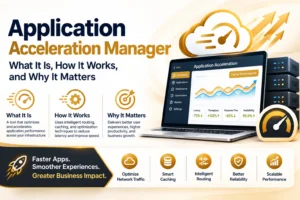

A slow app costs more than a few seconds. A shopper waiting on a checkout page that won’t load usually just leaves. A remote employee stuck on a laggy internal tool loses minutes that add up across a week. None of this fixes itself, and most teams don’t notice how much it’s costing them until performance becomes a real complaint. This is where an application acceleration manager comes in.
It manages how applications move data and respond to requests, wherever the user happens to be sitting. Below is a full breakdown of what an application acceleration manager does, how it works day to day, and what actually matters when picking one.
What Is an Application Acceleration Manager?

At its core, an application acceleration manager is software or a platform built to speed up how applications perform over a network. It does this by controlling traffic, compressing data, and closing the gap between when a user clicks something and when the app responds.
It rarely works alone. Most companies run it next to load balancers, CDNs, and monitoring tools, but its job stays narrow: speed. For a business running apps across multiple offices, cloud regions, or a scattered remote workforce, an application acceleration manager stops being optional pretty quickly.
Why Is Application Acceleration Important?
Speed touches almost every part of a business, whether people notice it or not. A one second delay on a product page can quietly push a buyer toward a competitor’s site instead. Internal software works the same way. When it lags, work slows down, and frustration builds even if nobody says anything out loud.
That’s the real weight behind application acceleration. It protects revenue on one side and protects productivity on the other. A retail site loses sales when checkout stalls. A support team loses hours when their ticketing tool freezes mid task. An application acceleration manager cuts into both problems by handling data more efficiently, so people, customers and staff alike, aren’t left waiting.
Types of Application Acceleration
There isn’t one single way to do this. Most businesses end up combining a few methods depending on what their infrastructure already looks like.
Hardware Based Acceleration
This relies on physical devices, often called application delivery controllers, installed inside a data center. They sit between the servers and the users, handling compression and routing right at the hardware level. Companies with heavy, fairly predictable traffic and full control of their own infrastructure tend to lean this way.
Software Based Acceleration
Here, acceleration runs as a service or application rather than a physical box. It costs less upfront and scales more easily inside virtual environments. A lot of businesses prefer this route simply because it fits cloud and hybrid setups without buying new hardware.
Cloud or SaaS Based Acceleration
This version runs entirely through a cloud provider, who handles the infrastructure, updates, and scaling behind the scenes. The business just configures settings and checks results. Smaller teams without a dedicated IT department often find this the easiest way to get acceleration without managing it directly.
Key Components and Features of an Application Acceleration Manager
Most tools blend several features together to cut delay and speed up response time:
- Content Delivery Networks (CDNs): push content out to servers physically closer to the user
- Data Compression: shrinks files before they’re sent, so less data has to travel
- Load Balancing: spreads traffic across servers so no single one gets buried
- Caching: keeps frequently used data close by for faster repeat access
- TCP Optimization: improves how packets get sent and received during a connection
- SSL Offloading: moves encryption work off the main server onto a dedicated device
- Connection Reuse: keeps existing connections open instead of starting new ones every time
- Traffic Optimization: prioritizes what matters and manages bandwidth during busy periods
None of these work in isolation. Together, they’re what actually gives an application acceleration manager its edge.
How Does an Application Acceleration Manager Work?
The process happens fast, almost instantly, every time someone interacts with an app.
Traffic optimization kicks in first. The system looks at incoming and outgoing traffic and figures out the quickest route for it.
Compression follows right after. Data shrinks in size before it crosses the network, which trims transfer time noticeably.
Caching stores commonly requested data closer to the user, so repeat requests don’t need to travel back to the original server every single time.
TCP optimization adjusts how packets move, cutting down the back and forth a connection normally needs.
SSL offloading handles encryption separately from the app server itself, which frees up processing power for the app’s actual job.
Connection reuse closes the loop. Active connections stay open instead of getting rebuilt for every new request.
All of this happens in a fraction of a second. Users don’t see any of it working. They just notice the app feels quicker.
Benefits of Using an Application Acceleration Manager
Improved User Experience
Pages that load fast keep people around. Fewer drop offs, fewer abandoned carts, fewer frustrated clicks.
Higher Productivity
Employees stop losing time to lag. A task that used to take five minutes because of a slow internal tool might now take one.
Lower Infrastructure Strain
Spreading and optimizing traffic takes pressure off any single server, which stretches the life of existing hardware further than expected.
Better Scalability
As user numbers climb, acceleration tools help systems absorb the extra load without forcing a full infrastructure rebuild.
Cost Efficiency Over Time
There’s an upfront cost, no way around that. But businesses often end up spending less later on emergency upgrades or lost sales, and the payoff builds gradually as traffic keeps growing.
Challenges and Limitations of an Application Acceleration Manager
Complex Initial Deployment
Getting one set up takes real planning. Teams need to map traffic patterns and existing infrastructure before configuration even starts, and a rushed setup tends to cause more problems than it solves.
Additional Costs
Hardware, licenses, or subscription fees for cloud tools all add up. Smaller businesses need to think carefully about whether the performance gain is worth the added spend.
Ongoing Monitoring Needs
It’s not something you set up once and forget. Traffic patterns shift, and the system needs regular checks to stay matched to current demand.
Legacy Application Compatibility
Older apps built before modern network standards existed can be tricky to optimize. Some need custom configuration, others need partial upgrades, before acceleration tools work with them properly at all.
Application Acceleration Manager vs Related Technologies
People mix these terms up constantly. Here’s a cleaner breakdown.
| Technology | Main Focus | Best Used For |
| Application Acceleration Manager | Coordinates multiple acceleration methods together | A full performance strategy across a network |
| Application Accelerator | One tool, one method, like compression alone | Targeted, narrow performance fixes |
| WAN Optimizer | Improves transfer specifically across wide area networks | Connecting distant offices or remote teams |
| Application Performance Monitoring (APM) | Tracks and reports performance issues | Diagnosing problems, not fixing them |
| Load Balancer | Distributes traffic across servers | Keeping any one server from overloading |
An application acceleration manager usually works alongside these tools rather than replacing them outright. A load balancer might handle traffic distribution while the acceleration manager layers compression and caching on top. APM tools tell you where the problem lives, but they won’t fix the speed issue on their own, that part still falls to acceleration.
Real World Use Cases for an Application Acceleration Manager
E-commerce and Online Retail
Checkout speed decides sales more than people realize. Retailers lean on acceleration tools to keep product pages and payment processing fast, especially when a sale event floods the site with traffic.
Remote and Hybrid Work
People working from different cities, sometimes different countries, need stable and fast access to shared systems. Acceleration cuts the lag on video calls, file transfers, and internal apps.
Healthcare
Doctors and staff need quick access to patient records and imaging without delay. This isn’t just inconvenient when it’s slow, it can genuinely affect patient care.
Financial Services
Trading platforms and banking apps run on split second timing. A small delay here can shift a transaction outcome or shake customer confidence.
SaaS and Cloud Applications
Cloud software providers need the same speed for every customer, no matter their location. Acceleration is what keeps that experience consistent across regions instead of patchy.
Key Metrics to Measure Application Acceleration Success
A few numbers tell you whether an application acceleration manager is actually earning its keep:
- Latency: how long data takes to travel from source to destination
- Throughput: how much data moves through the system over time
- Response Time: how fast an app answers a user’s request
- Bandwidth Utilization: how much of the available network capacity gets used
- Error Rate: how often requests fail or time out
Checking these regularly catches problems early, well before users start complaining about them.
How to Choose the Right Application Acceleration Manager

Deployment Model
Figure out whether hardware, software, or a cloud based option actually fits your infrastructure and your budget.
Scalability
Make sure the tool can grow alongside your traffic instead of needing a full swap once demand rises.
Security
These tools touch sensitive data constantly, so encryption support and compliance features matter just as much as raw speed.
Cloud Compatibility
If your business already runs on cloud infrastructure, confirm the acceleration manager plays well with your existing providers before committing.
Monitoring and Analytics
Built in reporting saves you from bolting on a separate tool just to see how performance is trending.
Vendor Support
Support quality matters most during setup and whenever something breaks later. Check response times and available channels before signing anything.
Total Cost of Ownership
Don’t just look at the sticker price. Setup time, ongoing maintenance, and licensing renewals over a few years all factor into the real cost.
Implementation Best Practices
Evaluate Current Infrastructure
Map out existing servers, traffic patterns, and bottlenecks before picking a solution.
Set Clear Performance Benchmarks
Decide what success looks like, response time, latency, uptime, before rollout even begins.
Choose the Right Deployment Model
Match the method to your current setup instead of forcing something that doesn’t fit.
Train Your Team
IT staff need to actually understand how to configure and monitor the tool once it’s live, not just install it and walk away.
Monitor and Optimize Continuously
Traffic needs shift over time. Regular reviews keep the system tuned instead of drifting out of sync.
Consult Experts When Needed
For complicated environments, bringing in outside help during setup can save a lot of trouble later.
Future of Application Acceleration
Things are shifting here too. AI driven optimization is starting to predict traffic spikes and adjust settings on its own, instead of waiting for someone to notice and step in manually.
Edge computing is pushing processing closer to users, shaving off even more travel time. Zero trust security is also getting built directly into acceleration tools now, so speed and security move forward together rather than pulling against each other.
Where this heads is toward tools that adjust in real time, with less manual setup expected from IT teams than there used to be.
Conclusion
An application acceleration manager has a direct hand in how fast and dependable a business’s applications feel to the people actually using them. From checkout pages to patient records, speed shapes outcomes that matter. Knowing the types, the components, and the real benefits of application acceleration gives a business what it needs to make an informed call, whether that’s hardware, software, or a cloud based setup. As traffic keeps climbing and remote work stays normal, having a clear acceleration strategy isn’t really optional anymore. It’s closer to a requirement for staying competitive through 2026 and beyond.
FAQs
What is an application acceleration manager?
It’s a tool that speeds up applications by managing traffic, compression, caching, and connection handling across a network.
How does an application acceleration manager work? It optimizes traffic flow, compresses data, caches frequently used content, and manages connections to shrink the gap between a user and an application’s response.
What does application acceleration mean?
It covers any method used to speed up how applications send and receive data over a network.
What is the difference between an application acceleration manager and an application accelerator?
An application accelerator usually handles one method, like compression, on its own. An application acceleration manager coordinates several methods together as part of a bigger strategy.
How does WAN acceleration differ from network acceleration?
WAN acceleration focuses specifically on wide area networks linking distant locations. Network acceleration is broader and covers other network types too, including local ones.
Is application acceleration the same as APM?
No. APM tracks and reports on performance issues. Application acceleration actually works to fix and prevent those issues by improving speed directly.

Senior SEO Content Marketing Manager at Trendusai.com
Rashida Hanif is a Senior SEO Content Marketing Manager, specializing in data-driven content strategy and SEO. She helps brands improve online visibility through keyword research, content planning, and AI-powered marketing insights.