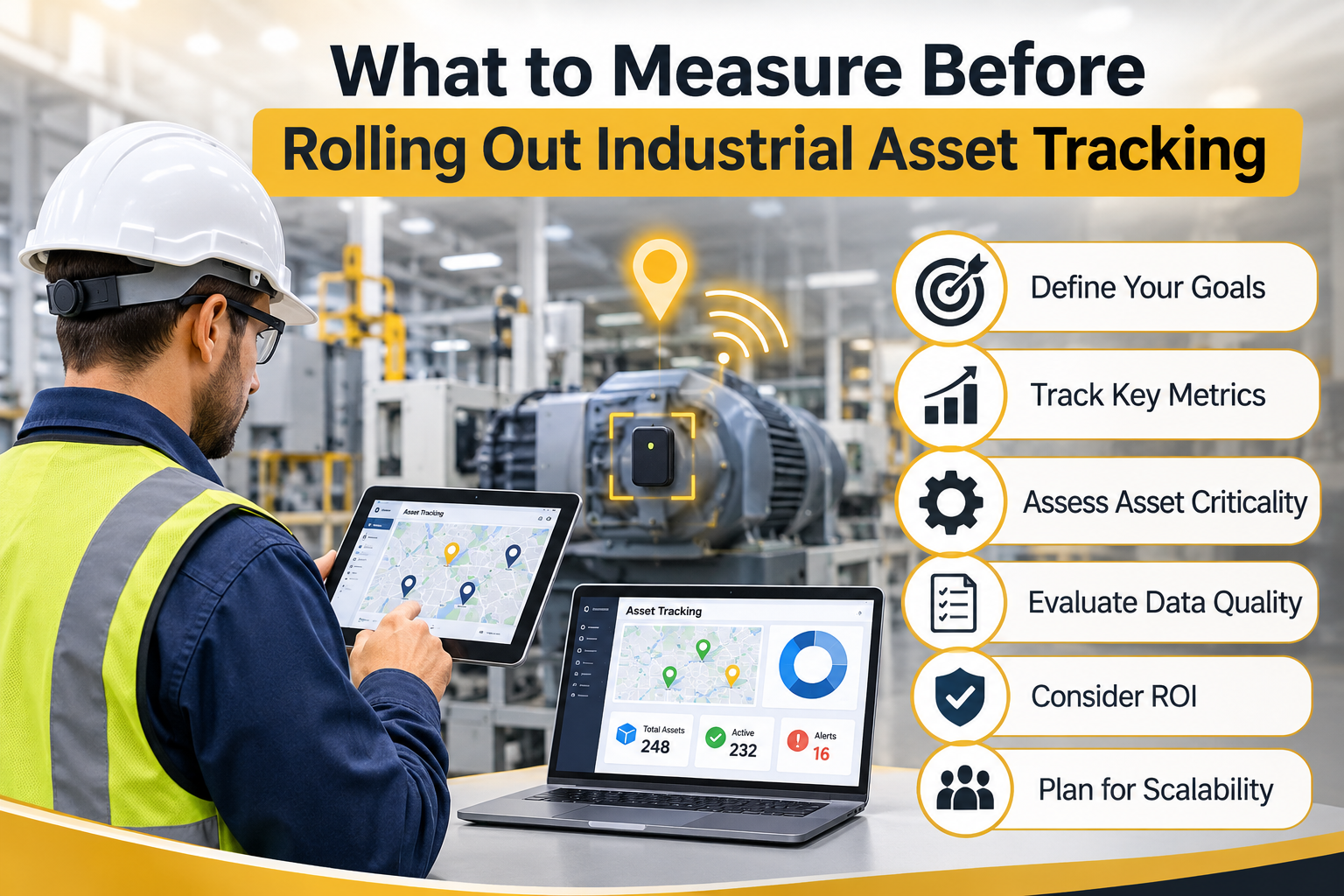
Before rolling out industrial asset tracking, measure five things: how long staff spend searching for assets, how many assets go missing each year, how often each asset is actually used, what the physical site does to radio signals, and which systems need the location data. These numbers form your baseline. Without them, nobody can prove the project paid off, and it’s hard to pick the right technology.
Why does this matter? Hardware is the easy part. The hard part is knowing which problem you’re solving and how big it is. A plant that loses ten pallets a year needs a different setup than one where forklift drivers waste an hour per shift hunting for load carriers.
The Hidden Cost of Not Knowing Where Things Are
Most factories feel the pain of missing assets, even if nobody has measured it.
Why Gut Feeling Isn’t a Business Case
Ask a shift lead how much time goes into searching for tools, and the answer is usually “too much.” Honest, but it won’t get budget approval. Finance wants hard figures:
- Hours lost per week
- Euros spent on replacements
- Units sitting idle
Gut feeling also tends to point at the loudest problem, not the most expensive one.
Putting a Price on Every Tracked Asset
Large enterprises now track more than 166,000 assets on an average day and pay roughly $110 per asset each year to do it, based on IoT Analytics’ 2025 adoption research. That’s a handy reference point for anyone in the asset tracking industry building a cost model. If a business spends that much per asset, it should know what each one costs when it goes missing or sits idle.
Start With Search Time
Search time is often the highest hidden cost, and it’s simple to measure.
How to Record It
Pick two or three typical shifts and ask workers to log every search on a short form:
- What they were looking for (tool, container, trolley, spare part)
- How long it took to find it
- Whether it was found at all
- Whether work stopped while they searched
Multiply the total minutes by the hourly labor rate, then add downtime.
Watch for Indirect Delays
A missing jig can hold up a whole line. A lost container might trigger a rush order. Log these knock-on effects separately – they often cost more than the search itself.
Count Losses and Shrinkage
Next, figure out what disappears and how often. That step is often skipped. Deloitte’s 2025 Smart Manufacturing Survey lists value tracking among the main barriers to smart manufacturing programs, next to leadership buy-in and change management. Without a clear loss baseline, results are hard to prove anywhere in the asset tracking industry.
Go through the last 12 to 24 months of replacement purchases, write-offs, and claims for returnable packaging that never came back. Load carriers and reusable containers are classic trouble spots, since they leave the site and often don’t return.
A simple loss audit should answer these questions:
- How many assets were replaced last year?
- What did each replacement cost?
- Where were they last seen, if anyone knows?
- Did any loss lead to a missed delivery or penalty?
These numbers become the core of your ROI math.
Measure How Often Assets Are Actually Used
Utilization is the forgotten metric, and often where the biggest savings hide.
Idle Assets Hide in Plain Sight
Many plants buy extra equipment because they “never have enough.” Usually the equipment exists – it’s just parked in the wrong corner. A well-planned industrial asset tracking setup often shows that a fleet of 50 trolleys only needs 35 once everyone can see where each one is parked.
For a baseline, run manual spot checks a few times a day for a week, noting which assets are busy, which are idle, and where.
Utilization Benchmarks to Capture
- Average share of time each asset type is in active use
- Peak demand periods (shift changes, month-end, seasonal spikes)
- Number of assets bought “just in case” over the past two years
That last one is a quiet budget leak, and one of the easiest wins to prove later.
Map the Physical Site Before Choosing Technology
Many projects go wrong here: teams choose a tag before they understand the building.
Signal Killers in Industrial Buildings
Metal racks, machines, concrete walls, and liquids all affect radio signals. A tag that shines in a demo room may struggle on a steel-heavy shop floor. Before any pilot, walk the site and note:
- Large metal structures and dense shelving
- Areas with heavy machinery or electrical interference
- Outdoor yards, loading docks, and transfer zones between buildings
- Temperature extremes, dust, moisture, or vibration
Indoor, Outdoor, or Both?
Assets that stay inside one hall need a different approach than containers that travel to suppliers and back. For indoor tracking of many small containers, an active RFID and BLE tracking setup is a common fit. For larger load carriers moving indoors and outdoors, a real-time location system (RTLS) gives finer detail.
Decide How Accurate the Location Data Needs to Be
Not every use case needs pinpoint accuracy, and paying for unused precision is a classic mistake.
Zone-Level vs. Meter-Level Tracking
Ask a simple question: what will people do with the location?
- Zone-level data is enough to know which hall a trolley is in.
- Meter-level accuracy matters when a robot picks a specific container.
- Gate-level reads work when only entries and exits count.
| Need | Typical accuracy | Example |
| Which building or yard | Tens of meters | Returnable containers at partner sites |
| Which hall or zone | A few meters | Trolleys and load carriers |
| Exact spot | Under one to three meters | Tools, small bins, work-in-progress |
Where Industrial RFID Asset Tracking Fits
Industrial RFID asset tracking works well when assets move through defined points, like gates, dock doors, or workstations. Passive tags are cheap and battery-free, so they suit high volumes.
Active tags cost more but broadcast their own signal, which helps when continuous location matters. Many teams combine both – and for buyers comparing industrial asset tracking RFID options with GPS or RTLS, accuracy needs usually settle the debate.
Check How Location Data Will Flow Into Existing Systems
Location data only helps if it reaches the people and software that need it.
Integration Is the Real Success Factor
Feature lists rarely decide whether a project works. Companies that already run tracking say support and integration matter more than extra features, according to IoT Analytics’ 2025 survey of adopters.
Before rollout, list every system that should receive tracking data:
- ERP (for example, SAP) for inventory and asset records
- MES or production planning tools
- Warehouse management software
- Maintenance and service platforms
REST APIs, OPC UA, and ready-made ERP adapters can save months of custom work.
Who Owns the Data?
A tracking system with no owner quickly becomes an expensive screen nobody checks. Decide early:
- Who reviews the dashboard each day
- Who responds to missing-asset alerts
- Who updates asset records when tags are added or retired
Set Clear Success Metrics for the Pilot
Define what “success” looks like before the pilot starts, or results get judged by opinion.
KPIs Worth Tracking From Day One
Tie every metric to your baseline:
- Reduction in average search time per shift
- Drop in lost or replaced assets
- Change in asset utilization rate
- Fewer emergency purchases or rental costs
- Time saved on manual inventory counts
Keep the Pilot Small but Realistic
Cover one area or asset type, but under real working conditions. Testing industrial asset tracking RFID hardware in a quiet office proves nothing about a busy production floor. A focused pilot in production and assembly track and trace or logistics and supply chain gives clean, comparable data.
Turning Your Baseline Into a Working System
Good measurements make every later decision easier. If the numbers are ready and the next step is choosing the right mix of RFID, BLE, RTLS, or GPS, browse the SmartMakers customer references or get in touch with the team to talk through your site and goals.
Frequently Asked Questions
What is industrial asset tracking?
It’s the use of tags, sensors, and software to monitor where physical assets are and what condition they’re in – tools, load carriers, containers, vehicles, and production equipment.
How does industrial RFID asset tracking work?
Tags on assets send data to readers placed around a site. The software then shows the last known location or a live position, depending on the setup.
What’s the difference between active and passive RFID?
Passive tags have no battery, cost little, and need to be close to a reader. Active tags have a battery, reach further, and support continuous tracking. Many industrial asset tracking RFID projects use a mix of both.
How long does it take to see a return on investment?
There’s no single figure across the asset tracking industry. Sites with long search times or frequent losses usually see results faster.
Can asset tracking connect to ERP systems like SAP?
Yes. Most modern platforms offer APIs or ready-made adapters for ERP, MES, and warehouse systems. Checking this early avoids delays.

Senior Content Manager at TrendusAI
Rashida Hanif is a content strategist at Trendusai.com, creating informative articles on artificial intelligence, emerging technologies, and digital solutions. She focuses on delivering valuable insights that help readers understand AI innovations, software development, and technology trends.