
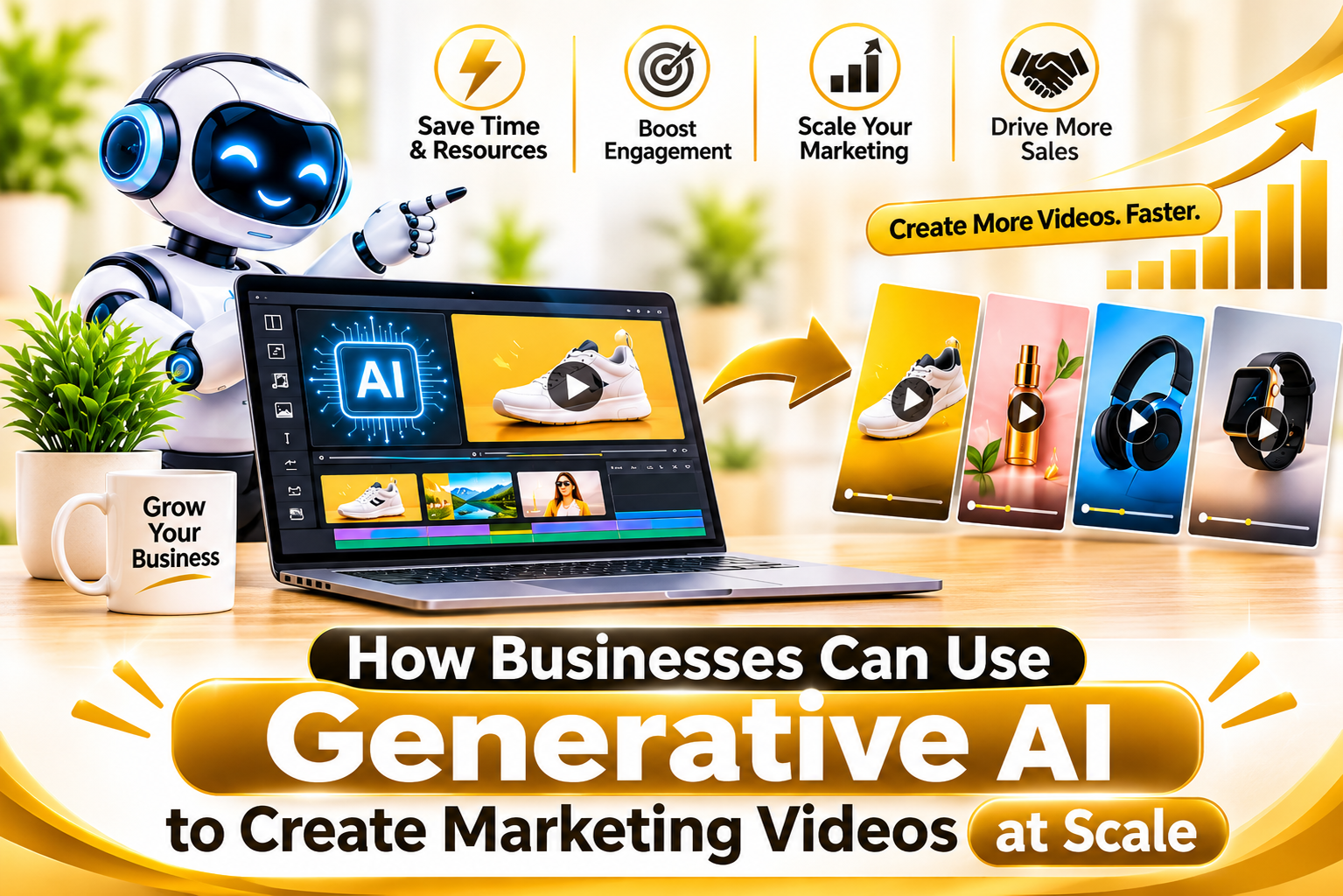
Businesses need video content for product launches, social media campaigns, advertisements, and customer education. Producing all these videos can become difficult when marketing teams have limited time and resources.
Traditional video production involves several stages, from writing scripts and recording footage to editing and publishing. Repeating this process for every campaign can slow down content creation.
Generative AI is changing how teams approach some of these tasks. It can help create video scenes from written instructions, produce supporting visuals, and prepare content for different marketing channels.
For businesses managing multiple campaigns, AI can become a useful part of a more organized video production workflow.
What Is Generative AI in Video Marketing?
Generative AI in video marketing refers to software that creates or changes video content using AI models.
These systems can work with text prompts, scripts, images, and other materials to generate visual scenes or support editing tasks.
Marketing teams can use generative AI to develop product introductions, short advertisements, educational videos, and social media content.
The technology is especially useful during early production, when teams need to explore ideas and prepare different creative options.
However, generative AI still needs clear instructions and human review to produce content that matches a company’s message.
Why Are Businesses Using AI for Video Production?
Businesses are exploring AI video creation because it can make parts of the production process easier to manage.
Faster Creative Development
Marketing teams often spend time preparing visual concepts before producing a final advertisement.
AI tools can generate early scenes from written ideas, giving teams something they can review and improve.
This can help reduce the amount of manual work needed to test initial creative directions.
More Content From Existing Materials
Companies already have blogs, product descriptions, presentations, and marketing documents.
These materials can provide the starting point for new video content.
Instead of writing every video script from scratch, teams can identify important information and adapt it into shorter, more visual messages.
Easier Campaign Experimentation
Marketing teams may want to test several opening scenes, visual styles, or video messages.
AI generation makes it possible to prepare different creative concepts without arranging a new recording session for each idea.
The results still need to be tested with real audiences to determine which versions perform better.
How Can Businesses Create Marketing Videos With Generative AI?
A clear production process helps businesses use AI effectively while maintaining control over quality.
1. Define the Marketing Objective
Start by identifying what the video should achieve.
A product launch may need a short promotional video, while an educational campaign may require a longer explanation.
The goal determines the structure, message, and visual style.
2. Identify the Target Audience
Different audiences respond to different types of information.
A business buyer may want a clear demonstration of how a product solves a problem. A social media audience may prefer a short introduction that quickly explains the main benefit.
Understanding the audience helps teams decide what information should appear in the video.
3. Prepare a Script or Written Brief
AI video generation works better when the instructions clearly describe the intended result.
A useful brief should include the main message, audience, video length, visual style, and preferred format.
Businesses can also prepare separate instructions for individual scenes.
4. Generate the Video From Text
Once the script is ready, the next step is turning the written content into visuals.
AI tools can generate scenes using written descriptions, allowing businesses to explore video concepts without filming every element.
Platforms offering text to video capabilities, such as invideo, can generate video content from prompts or scripts, including visual scenes, animations, and audio elements. Teams can then review the generated material and refine it for their campaign requirements.
This approach is useful when a business already has clear written content but needs to present it in a visual format.
5. Review and Edit the Generated Video
AI-generated content is not always ready to publish.
Teams should check whether the video presents the correct information and follows the intended sequence.
They should also review visual consistency, captions, audio, and branding.
Any inaccurate or confusing scenes should be changed before the final version is prepared.
6. Adapt the Video for Different Channels
A single marketing idea may need different video formats.
Short vertical videos are commonly used for Reels, Shorts, and TikTok. Horizontal videos may be more suitable for websites, presentations, and longer YouTube content.
Rather than publishing the same version everywhere, businesses should adjust the length, framing, and message for each platform.
Where Does Generative AI Fit Into a Marketing Workflow?
Generative AI can support different stages of content production, but it works best when businesses assign clear responsibilities.
| Production stage | How AI can help | What people should review |
| Planning | Develop ideas and initial outlines | Campaign goals and audience needs |
| Scriptwriting | Prepare drafts and scene descriptions | Accuracy, tone, and messaging |
| Video generation | Create visual scenes from prompts | Visual quality and consistency |
| Editing | Assist with selected editing tasks | Pacing, branding, and clarity |
| Repurposing | Prepare content variations | Platform requirements |
| Publishing | Help prepare descriptions and supporting copy | Final approval and compliance |
This structure allows businesses to benefit from AI while keeping important decisions under human control.
What Types of Marketing Videos Can Businesses Create With AI?
Product Introduction Videos
Businesses can create short videos that introduce a product, explain its purpose, and highlight important features.
These videos are useful for product announcements, landing pages, and social media campaigns.
Educational and Explainer Videos
Complicated topics are often easier to understand when information is presented through visuals.
AI can help turn written explanations into scenes, animations, and voiceover-led videos.
These videos may be especially useful for software companies and service providers.
Social Media Advertisements
AI-generated video clips can support social media advertising by providing new visual concepts and promotional content.
Marketing teams can create different versions of an advertisement and compare how they perform.
Customer Onboarding Videos
Businesses can also create instructional videos that explain how a product or service works.
These videos may help customers understand basic features before contacting support.
However, instructions involving software interfaces should be checked against the current product.
What Challenges Should Businesses Consider?
Although generative AI can simplify parts of video production, there are limitations.
Visual accuracy: Generated scenes may contain unrealistic details or elements that do not match the intended subject.
Brand consistency: Different generations may produce variations in colors, characters, or overall visual style.
Content accuracy: AI-generated explanations may contain mistakes or leave out important information.
Rights and permissions: Businesses need to review licensing terms and confirm they have permission to use uploaded materials.
Production costs: Repeated video generation can increase expenses, especially when teams need many variations.
These challenges make it important to create an approval process rather than publishing AI-generated content without review.
How Can Businesses Scale AI Video Production Responsibly?
Scaling video production involves more than generating a larger number of clips.
Businesses should create repeatable workflows that maintain quality while reducing unnecessary manual work.
Start with a small number of video formats that the team produces regularly. These might include product announcements, tutorials, and social media advertisements.
Develop templates for scripts, prompts, and visual instructions. This helps different team members follow a consistent process.
Keep approved brand materials in one accessible location and establish clear review responsibilities.
Finally, measure the results of published videos. Watch time, engagement, qualified leads, and conversions can help teams understand whether the additional content is producing meaningful results.
Conclusion
Generative AI gives businesses more flexibility when creating marketing videos from existing ideas, written materials, and visual assets.
It can support planning, video generation, editing, and content repurposing, making regular production easier to manage.
The strongest results come from combining AI tools with clear marketing goals, accurate information, consistent branding, and human review.
Businesses that build a reliable process around these tools can create more video content without losing control over its quality.
Frequently Asked Questions
Can generative AI create a complete marketing video?
Some AI platforms can create multi-scene videos with visuals, narration, and music. The final output should still be reviewed and edited before publishing.
Can businesses turn blog posts into videos using AI?
Yes. Businesses can adapt blog content into scripts and use AI tools to generate supporting visuals and narration.
Is AI video marketing suitable for small businesses?
Yes. Small businesses can use AI video tools to experiment with promotional and educational content without requiring a full production team for every project.
How can businesses maintain brand consistency in AI videos?
Clear prompts, approved brand materials, repeatable templates, and regular human review can help maintain consistent results.

Senior Content Manager at TrendusAI
Rashida Hanif is a content strategist at Trendusai.com, creating informative articles on artificial intelligence, emerging technologies, and digital solutions. She focuses on delivering valuable insights that help readers understand AI innovations, software development, and technology trends.