Can a simple tick in a box really give an organisation permission to use personal data? Under GDPR, consent must meet strict standards before it can be treated as valid. Professionals taking GDPR Training can learn how consent supports responsible personal data processing and protects individual choice. Following the right consent requirements also helps organisations handle personal information fairly and transparently.
Valid consent is more than getting someone to agree. Organisations must explain their purpose clearly and give people genuine control over their information. In this blog, let us explore the key requirements that make consent valid under the General Data Protection Regulation (GDPR).
Essential Requirements That Make GDPR Consent Valid
Below are the essential requirements organisations must follow to obtain and maintain valid GDPR consent:
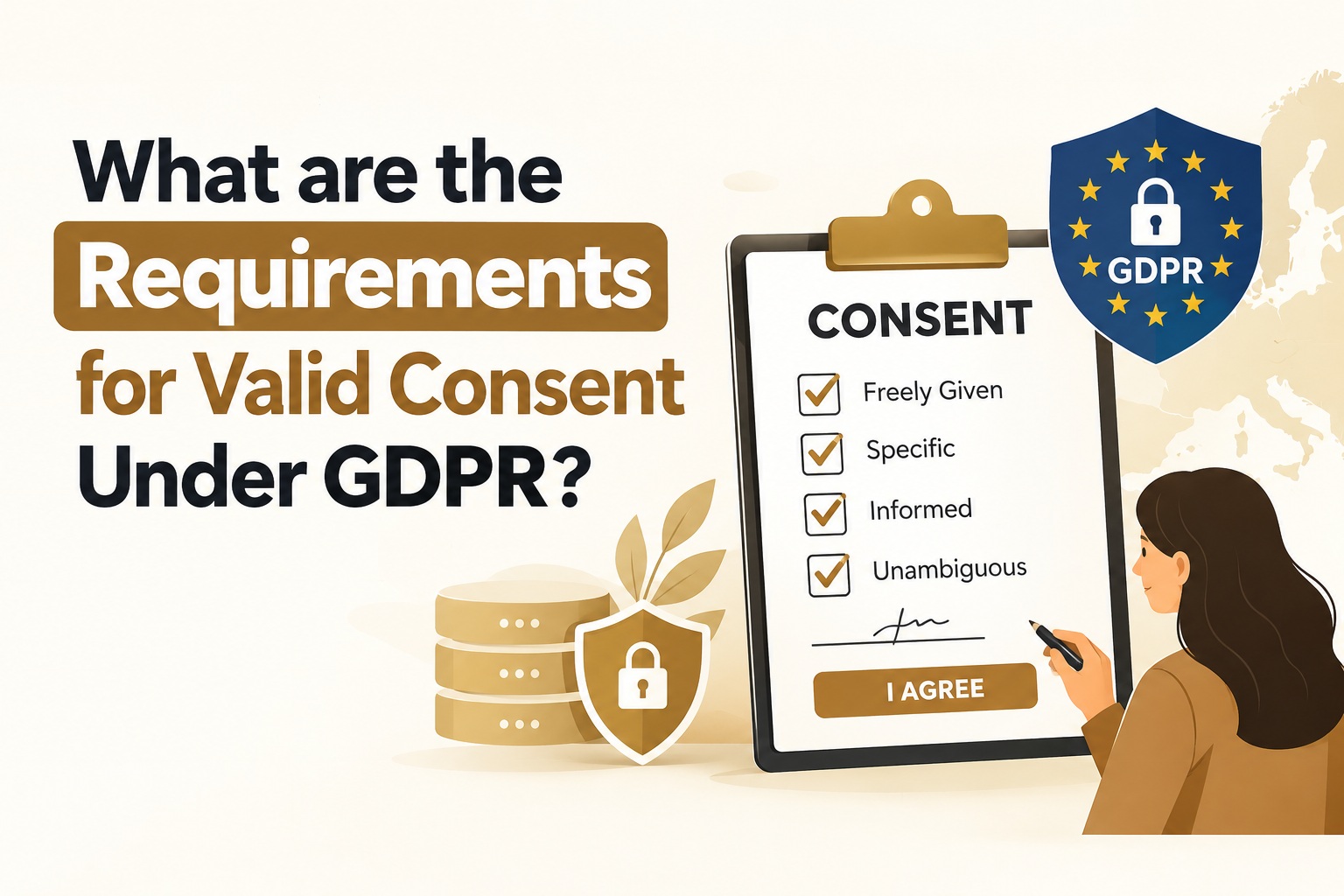
Consent Must Be Freely Given
Individuals must genuinely be able to decide whether or not to give their consent. They ought to be free to refuse without suffering an unjust punishment or needlessly losing access to anything.
An imbalance of power should be taken into account by organisations. For instance, because employees may feel under pressure to comply, employers may find it challenging to rely on employee consent. Professionals can learn when consent is a legitimate basis for processing through GDPR Training.
Consent Must Be Specific
One should be fully aware of what they are consenting to. Organisations should make it clear why they are gathering and using their data.
The necessary degree of choice might not be provided by broad permission for several unconnected reasons. Separate consent alternatives could be required when different processing activities serve distinct purposes. People now have more control over their personal information.
People Must Be Properly Informed
Clear information is necessary for valid consent. Before making a choice, people must be aware of what will happen to their information.
A consent request should specify who is gathering the information, why it is necessary, and how it will be used. The wording should be clear and simple to comprehend. Professionals can gain a deeper comprehension of these data protection regulations by undergoing GDPR Training.
Consent Must Be Unambiguous
There must be no doubt as to whether someone has consented. It must be evident from their behaviour that they approve of the suggested processing.
Organisations shouldn’t assume consent just because someone hasn’t voiced an objection or hasn’t spoken up. A clear indication of agreement must be shown by the person’s choice. This lessens doubt around data use and makes General Data Protection Regulation (GDPR) compliance easier to prove.
Demonstrable and Properly Recorded
Organisations need to be able to demonstrate that legitimate consent was acquired. It is insufficient to just say that someone agreed. Consent should be clearly documented, including who gave it, when it was granted, and what they agreed to.
Maintaining accurate records promotes General Data Protection Regulation (GDPR) accountability. Organisations should record the information provided at the time as well as the consent procedure. These documents might serve as proof that the consent procedure complied with GDPR regulations.
Easy to Withdraw
Consent does not imply a permanent loss of power. People are free to revoke their consent at any moment.
The withdrawal procedure needs to be as simple as the consent procedure. Prior to obtaining consent, organisations must inform individuals about their rights. Processing based on consent shall cease as soon as it is practically possible after consent is withdrawn.
Consent Declarations Must Be Distinguishable
A request for consent should be kept apart from any other statements, terms, or conditions. When people are asked for their consent, they should be aware of it right away.
The request for consent must be easily discernible from the other content if it is included in a document that addresses many topics. Organisations should speak in an understandable and straightforward manner. This promotes GDPR transparency and aids people in making an informed decision.
Conclusion
Valid GDPR consent gives individuals meaningful control over how organisations use their personal information. It must be freely given, specific, informed and supported by a clear positive action. Organisations must also make withdrawal simple and maintain suitable records. Getting these requirements right supports trust while reducing data protection risks.
Professionals can strengthen their data protection and compliance skills through GDPR Training from The Knowledge Academy, a top training provider.
Frequently Asked Questions About Valid Consent Under GDPR
What is valid consent under GDPR?
Valid consent is a freely given, specific, informed and unambiguous indication of a person’s wishes, shown by a statement or a clear positive action. It is defined in Article 4(11) and conditions are set out in Article 7. The controller must also be able to prove it. If any one element is missing, the consent is invalid.
Is a pre-ticked box, silence or inactivity valid consent?
No. Recital 32 says silence, pre-ticked boxes and inactivity do not count as consent. The Court of Justice of the EU confirmed this for pre-ticked checkboxes in the Planet49 ruling (Case C-673/17). The person has to do something deliberate, such as ticking an empty box or clicking an “Accept” button.
What is the difference between consent and explicit consent?
Explicit consent is a stricter form. The person must confirm in an express statement, such as typing “I agree” or ticking a box next to a specific sentence. It is required for special category data (health, biometrics, religion, political opinions) under Article 9(2)(a), for solely automated decisions with legal effects under Article 22, and for some international data transfers under Article 49.
Can an employer use employee consent as a lawful basis?
Rarely. Recital 43 points to a clear imbalance of power between employer and employee, and staff may feel unable to say no. The European Data Protection Board (EDPB) takes the view that consent is problematic in most employment settings. Employers usually do better with contract, legal obligation or legitimate interests, depending on the purpose.
Can I make consent a condition of using my service or website?
Generally not, unless the data is truly needed for the service. Article 7(4) says the controller must consider whether consent is bundled with a contract that doesn’t need that data. A “cookie wall” that blocks access unless the visitor accepts tracking is likely to fail the freely given test, according to EDPB Guidelines 05/2020 on consent.
How do I prove that I have valid consent?
Keep a consent record for each person. It should show who consented, when, how (the form or banner used), what they were told, and which version of the privacy notice applied. Consent management platforms (CMPs) usually log this automatically. Under the accountability principle in Article 5(2), the burden of proof sits with the controller.
How easy does withdrawing consent have to be?
Article 7(3) says withdrawal must be as easy as giving consent. If someone agreed with one click, they should not have to write a letter or call a helpline to undo it. People must be told about this right before they consent. Withdrawal does not make earlier processing unlawful, but the controller should stop processing as soon as practicable.
Does GDPR consent expire?
The regulation sets no fixed expiry date. Consent should still be refreshed when the purpose changes or when enough time has passed that the original choice may no longer reflect the person’s wishes. Some regulators set their own guidance for cookies. France’s CNIL, for example, recommends asking again after six months. Consent collected before May 2018 only stands if it already met GDPR standards (Recital 171).
What is the age of consent for children’s data under GDPR?
Article 8 sets the default at 16 for online services offered directly to a child. Member states can lower it, but not below 13. The UK uses 13, France uses 15, and Germany and Ireland use 16. Below the threshold, a parent or guardian must give or authorise the consent, and the controller must make reasonable efforts to verify this.
When should I use another lawful basis instead of consent?
Consent is one of six lawful bases in Article 6(1). It fits best where the person has a real choice, such as marketing emails or non-essential cookies. For things you must do to deliver a contract, meet a legal duty, or run your business in ways people would reasonably expect, contract, legal obligation or legitimate interests are often safer. You can’t swap to a different basis after someone withdraws consent just to keep the data.
Do cookies need GDPR-standard consent?
Yes, for non-essential cookies. The ePrivacy Directive (Article 5(3)) requires consent before storing or reading information on a user’s device, and it borrows the GDPR definition of consent. That means a clear, granular banner, no pre-ticked boxes, and a “Reject” option that is as easy to use as “Accept”. Strictly necessary cookies are exempt.
What are the fines for invalid consent?
Breaking the basic principles for processing, including the conditions for consent, can lead to administrative fines of up to €20 million or 4% of total worldwide annual turnover, whichever is higher (Article 83(5)). Regulators can also order the deletion of data collected without valid consent and ban further processing.
Is the Digital Omnibus changing GDPR consent rules?
Not yet. The European Commission proposed the Digital Omnibus in November 2025. It would move cookie consent rules into the GDPR and list some low-risk purposes that need no consent. The Council agreed its negotiating position on 21 October 2026, but the European Parliament has not adopted its own, and reports suggest entry into force is unlikely before 2027. The current rules in Articles 4(11) and 7 still apply today.

Senior Content Manager at TrendusAI
Rashida Hanif is a content strategist at Trendusai.com, creating informative articles on artificial intelligence, emerging technologies, and digital solutions. She focuses on delivering valuable insights that help readers understand AI innovations, software development, and technology trends.