There is a robot arm in the corner of a lab I visited last year, draped in a dust sheet, still perfectly functional. It was bought to automate one assay, it did that assay beautifully, and then the assay was retired. Nobody could think of a second job for it, because it had never been connected to anything else.
That dust sheet is a decent summary of the first wave of laboratory automation. Individual tasks got faster while the workflow around them stayed manual, so gains showed up in one step and evaporated in the next.
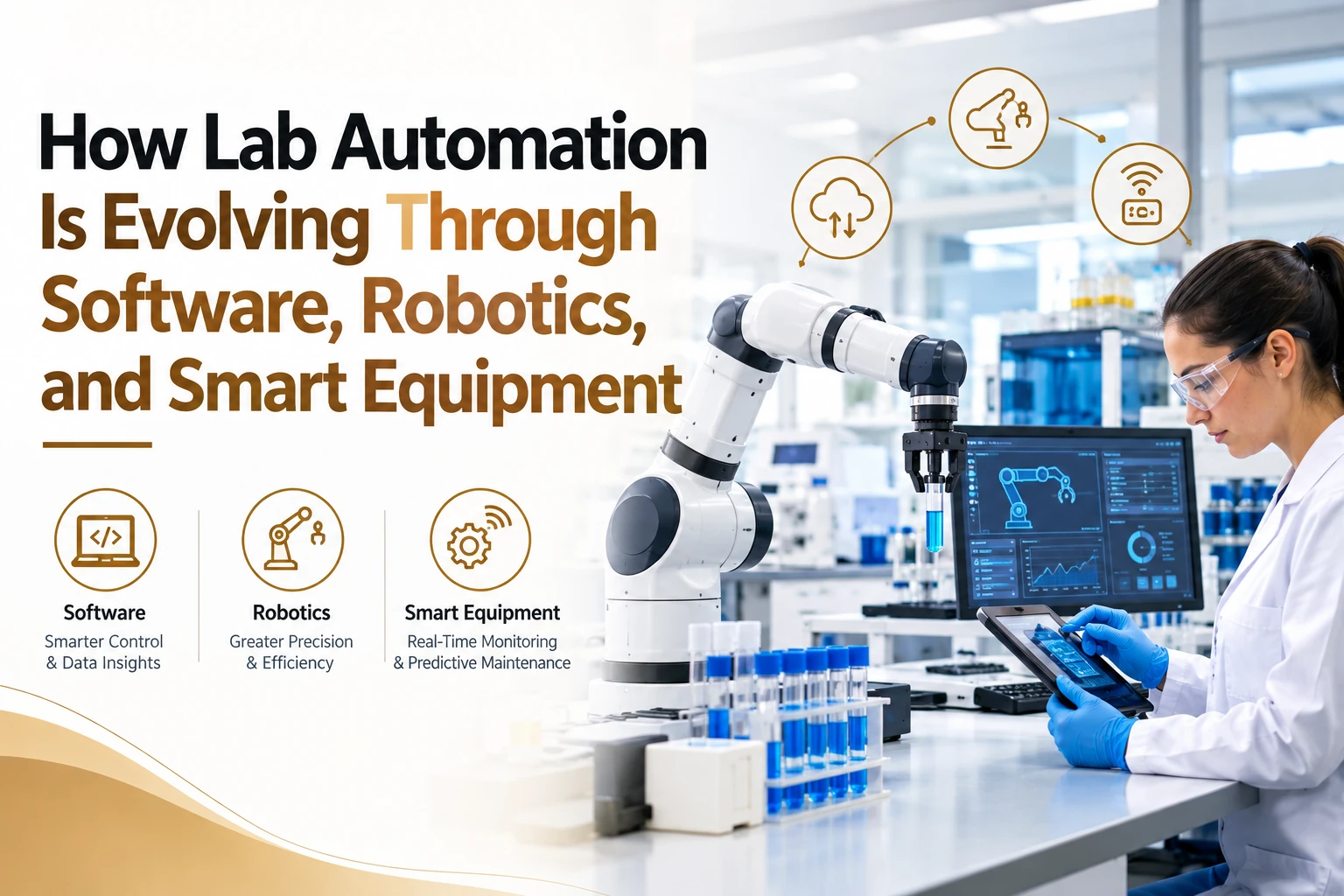
What has changed over the last few years is less about the hardware and more about everything joining up. Robotics, instruments that report their own state, scheduling software and shared data platforms are converging into something closer to a single operating environment, and that convergence is what finally turns clever equipment into dependable throughput.
From Automated Islands to Connected Workflows
Modern instruments arrive expecting to be talked to. They expose run status, error codes, consumable levels and calibration history over a network interface rather than a front panel, which means a scheduler can make decisions about them instead of a person reading a screen. Robotic handling has followed the same path, moving from fixed, single purpose arms toward mobile and modular systems that can be reassigned as priorities change.
The software layer is where this gets interesting. A well specified lab automation setup now plans across the whole sequence, so a plate moves from storage to prep to read without anyone scheduling each hop by hand. Open robotics frameworks have accelerated that shift considerably; the ROS project has built a standard software platform that carries robotics work from research and prototyping through to production deployment, and the same reusable components now underpin instrument handling in science labs as well as warehouses.
Interoperability Decides How Far Automation Goes
Every integration project eventually hits the same wall, and it is rarely mechanical. One instrument writes results as a proprietary binary, another exports a CSV with its own column names, a third offers an API that was clearly an afterthought. Stitching those together is where budgets quietly disappear.
This is why standards work has become a practical concern rather than an academic one. IUPAC has taken a leading role in pushing chemistry toward FAIR data, meaning results that are findable, accessible, interoperable and reusable by both people and machines, and labs that buy with those principles in mind spend far less on translation layers later. The useful question during procurement is no longer whether a machine is fast, but whether its output can be read by everything else without a custom script.
Data is also becoming the real product of an automated lab. A connected workflow generates a continuous record of what ran, when, on which instrument, with which lot, and that trail is worth as much as the results themselves when a client asks why two batches differ. Automation has grown by leaps and bounds in recent years precisely because the data side finally caught up with the mechanical side.
The Cost Conversation Nobody Skips
Integrated automation is not cheap, and pretending otherwise helps nobody. The instrument price is the visible part; integration work, validation, facility changes, service contracts and the training time of the people who will run it all land afterward, and they routinely add up to a meaningful fraction of the hardware cost.
The labs that come out ahead tend to scope narrowly and expand once something works. They pick the workflow that hurts most, automate that end to end rather than automating four steps across four workflows, and insist on open interfaces so the next phase does not require starting over. Modularity is what protects the investment, because the assay that justifies a purchase today may well be retired in three years.
Why Human Oversight Still Matters
Automation shifts where expertise is needed; it does not remove the need for it. Somebody still has to decide that a result looks wrong, notice that a reagent is behaving oddly, and judge when a drifting instrument needs attention rather than another recalibration. Those calls require context that no scheduler holds.
The better implementations treat people as the exception handlers and the designers of the system, not as its spare capacity. Scientists spend their hours on method development, troubleshooting and interpretation, while the software takes the repetitive coordination that it genuinely does better.
The Direction of Travel
Lab automation is heading toward environments where instruments, robots, scheduling and data live in one connected system, and where adding a new capability means plugging it in rather than rebuilding around it. What usually limits progress is planning, not hardware.
So the honest advice is unglamorous. Start with the workflow that is costing you most, buy for openness rather than specification sheets, and keep humans firmly in the loop where judgment is required. Do that and the robot arm in the corner of your lab stays busy for years, rather than ending up under a dust sheet with a story attached.

Senior SEO Content Marketing Manager at Trendusai.com
Rashida Hanif is a Senior SEO Content Marketing Manager, specializing in data-driven content strategy and SEO. She helps brands improve online visibility through keyword research, content planning, and AI-powered marketing insights.