

Latest AI News: Google, Walmart, and OpenAI Developments
AI headlines move fast, and most skip the part you need. Who launched what? Which deal ended? What changes for your store, your team, or your cart? The latest AI news can feel like a pile of press releases with no order. This roundup puts the stories in order. It covers Google, Walmart, and OpenAI as of October 2, 2026, with dates and figures tied to named sources. You’ll see what happened, why it matters, and what to watch next. Think of it as a regular roundup of AI news that checks its facts before repeating them, so you can skim and move on.
Latest AI News This Week: Quick Summary of Top Headlines
Here’s the short version of the latest AI news and updates. The table lists each story, who’s behind it, and why it counts. Longer sections follow. If you only read AI news today, start here.
| Headline | Who | What happened | Why it counts |
| Walmart ends OpenAI Instant Checkout | Walmart, OpenAI | Walmart pulled the feature in mid-March and embedded Sparky in ChatGPT and Gemini | Walmart keeps its own checkout |
| Google’s UCP grows | Cart transfer and a YouTube Business Agent beta, reported Sept 16 | Checkout spreads across Search, Gemini and YouTube | |
| OpenAI launches dots | OpenAI | Personal agents powered by GPT-6 Astra, launched Sept 29 | ChatGPT moves toward ongoing task work |
| Gemini 4 Argon arrives | Google DeepMind | Limited release to cyber partners and Google staff | Output limit reaches one million tokens |
| White House AI accord | Six AI companies | Voluntary pledge with four safety controls, signed Sept 29 | Critics note it isn’t binding |
| Nvidia agent safety platform | Nvidia | Open Agent Safety Platform, introduced Sept 28 | Aims to keep agents inside set limits |
What’s new in AI this week comes down to agents. Agentic AI means software that takes steps for you, like building a cart or booking a table. Walmart, Google, and OpenAI all shipped agent features. Weekly AI news usually lists launches one by one. Here’s a thread on the most recent advancements in artificial intelligence now sitting at the checkout button.
Walmart’s Big AI Shift: From OpenAI to Google Gemini
What Happened in the Latest AI News on Walmart
Walmart announced its OpenAI partnership in October 2025. The plan let shoppers buy through ChatGPT with Instant Checkout. It listed about 200,000 products there starting in November 2025. The aim was an AI-first experience for people who start shopping in a chat box.
Results fell short. The Paypers reported conversion rates roughly three times lower than clicks that landed on Walmart’s own site, and a senior Walmart official called the chat purchase experience unsatisfying. Another report says the tool struggled to match Walmart’s internal systems and to confirm stock and delivery times. In mid March 2026, Walmart pulled the feature.
Walmart then moved its own assistant into the chat. Sparky is Walmart’s homegrown shopping assistant, used on its website and apps since 2025. Retail Dive reported that Walmart debuted a Sparky-powered app inside ChatGPT. Shoppers go from discovery in ChatGPT to a Walmart space with account linking, loyalty, and payment.
Gemini follows the same idea. Walmart and Google announced a partnership on January 11, 2026. Gemini will include Walmart and Sam’s Club products when they fit a question. Purchases are completed at Walmart’s own checkout. The companies said delivery could arrive in under three hours, and as fast as 30 minutes.
Why It Matters
Walmart kept the parts it values most: the checkout, the account, and the loyalty perks. Daniel Danker is Walmart’s executive vice president for AI acceleration, product and design. He said Walmart and OpenAI learned a lot about agentic commerce while working together. Walmart’s shift is a useful case in the latest AI news on AI in retail, because the sale itself moved back to the store.
The numbers need care, since none come from audited filings. A TechBuzz report, cited by TheStreet, says Sparky users in ChatGPT complete purchases at about 70% of the rate of Walmart.com shoppers. Walmart hasn’t published full Instant Checkout figures to compare. Jefferies analysts noted that Sparky users build baskets about 35% higher. A Walmart executive also said units sold through Sparky rose four times year over year, helped by restocking of everyday items.
The pattern is simple. Chat tools find the product. The store closes the sale. OpenAI reached the same view, and the OpenAI section below covers it.
Timeline of Walmart, OpenAI and Google Deals
The timeline below pulls dates from the latest AI news on the three deals.
| Date | Event |
| Sept 2025 | OpenAI launches Instant Checkout, built on the Agentic Commerce Protocol with Stripe |
| Oct 2025 | Walmart announces its OpenAI partnership |
| Nov 2025 | Walmart lists about 200,000 products in Instant Checkout |
| Jan 11, 2026 | Walmart and Google announce a Gemini partnership |
| Mid-March 2026 | Walmart ends the Instant Checkout pilot |
| Mar 24, 2026 | OpenAI refocuses ChatGPT shopping on discovery, and Walmart adds an in-ChatGPT app |
| May 2026 | Google names Walmart among retailers for Universal Cart checkout features |
| Sept 29, 2026 | Walmart’s CEO rules out AI pricing based on who a shopper is |
Google AI News: The Latest AI Moves
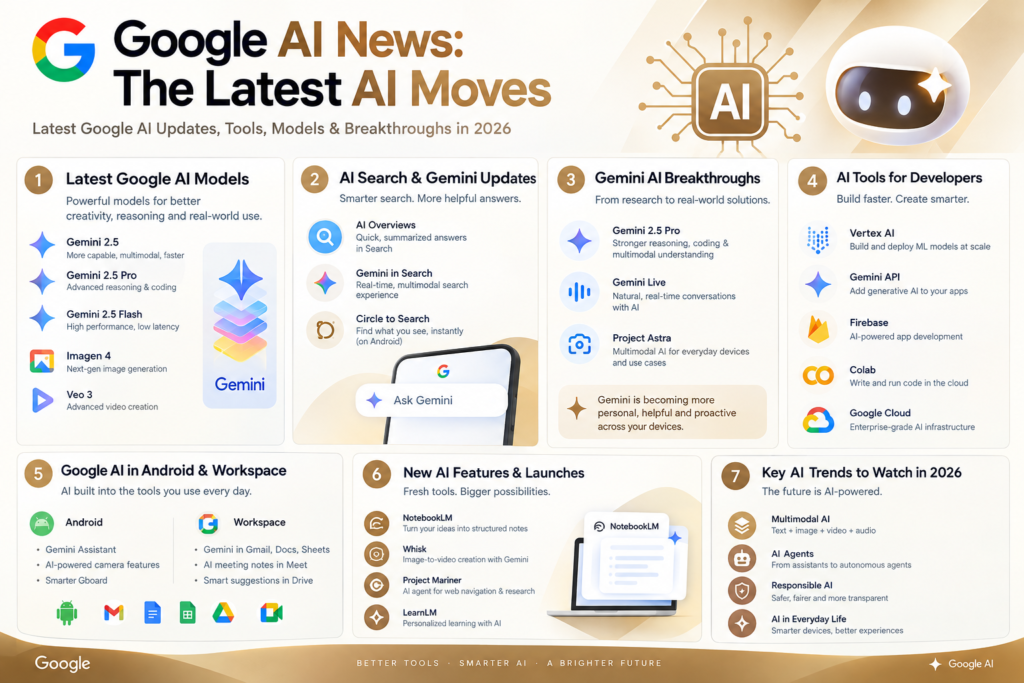
Gemini Product Updates in the Latest AI News
Start with Search. UCP powers checkout on eligible product listings in AI Mode and the Gemini app. AI Mode is Google’s AI-powered search experience, so you can shop without leaving the chat. Universal Cart saves products from Search, Gemini, YouTube, and Gmail in one place, then tracks deals, price drops, and restocks. Conversational AI now reaches the buy button.
Maps and Workspace got Gemini updates too. Google said people will soon order food delivery from a conversation in Google Maps and book hotels from AI Mode. In Workspace, Gemini can now work with Asana, Atlassian Rovo, HubSpot, Mailchimp, QuickBooks, Monday, and Salesforce through Model Context Protocol connections. On September 30, Google added reusable skills to the Gemini app and Workspace. Skills don’t sync between the two yet. Docs can also use Gemini Notebook as a source for drafts. These latest AI updates aim to make AI more helpful and accessible at work.
Google DeepMind, the lab Demis Hassabis helped found, builds Gemini. Gemini 3.8 Flash arrived on September 2. This week brought Gemini 4 Argon. Access is limited to selected cybersecurity partners through the Fairwind Program and to Google staff. Google says output can reach one million tokens, up from 64,000. A token is a small chunk of text. Launch pricing is $2 per million input tokens and $10 per million output tokens.
Paid API users and Google AI Ultra subscribers come next, then consumers, with no date. Bloomberg reported that some Google staff find Argon strong on benchmarks and weaker in daily use, especially front-end design. Google called the coding claim inaccurate. Treat early scores as company claims until outside testers weigh in. Google also introduced Gemini Spark, a personal agent in the Gemini app, at I/O in May. Among this week’s AI advancements, Argon is the main model story.
Universal Commerce Protocol (UCP) Launch
UCP drives much of Google’s latest AI news in commerce. Google revealed it on January 11 at the National Retail Federation show. It’s an open standard that covers discovery, buying, and support after the sale. Think of it as a shared language between AI agents and store systems. UCP works with Agent2Agent, Agent Payments Protocol, and Model Context Protocol.
Shopify, Etsy, Wayfair, Target, and Walmart helped build it. More than 20 companies endorsed it, including Visa, Mastercard, Stripe, Best Buy, and The Home Depot. Checkout started with Google Pay as the first payment option.
Growth has continued since launch. In May, Google added Universal Cart and said shoppers could pay with Google Pay or move the cart to the store’s site. The retailer stays the merchant of record either way. On September 16, reports covered cart transfer in the US, with Australia and Canada early next year, plus a Business Agent beta inside YouTube ads. Google says UCP already enables direct checkout for hundreds of thousands of brands. Treat that as Google’s own count.
What This Means for Businesses and Consumers
For stores, product data decides who shows up. Google added conversational attributes for product descriptions and an AI performance insights tool in Merchant Center. There’s a trade. Analyst Richard Crone warned that merchants lose the last touchpoint when checkout moves to Gemini, where he says 33% to 76% of upsell and cross-sell happens. That’s his estimate, so weigh it that way.
For shoppers, eligible items take fewer taps. You can compare, save to a cart, and pay in one place. Check who the seller is before you pay. Google says the retailer remains the merchant of record.
OpenAI News: The Latest AI Moves
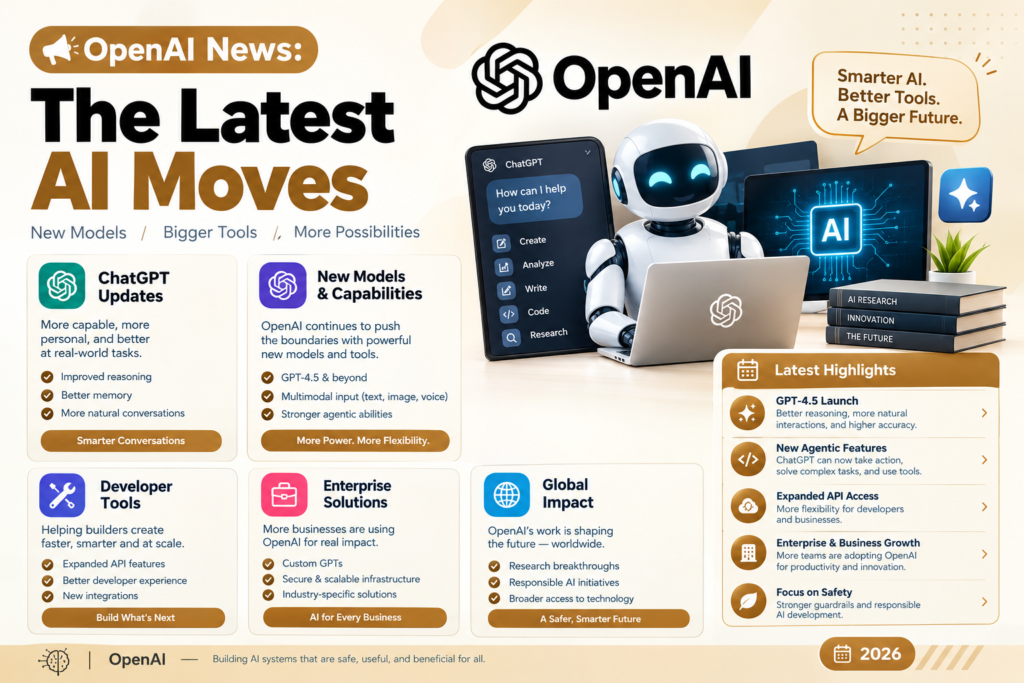
Agentic Commerce Protocol Updates
OpenAI launched Instant Checkout in September 2025, powered by the Agentic Commerce Protocol, or ACP, built with Stripe. Etsy and Shopify were the first partners. OpenAI’s docs say it isn’t the merchant of record in ACP.
On March 24, 2026, OpenAI said the first version of Instant Checkout lacked the flexibility it wanted, and it let merchants use their own checkout while it focused on discovery. ACP now carries product feeds and promotions so catalogs show up fully in ChatGPT. Target, Sephora, Nordstrom, Lowe’s, Best Buy, The Home Depot, and Wayfair have joined ACP, OpenAI said.
One developer write-up says feeds refresh every 15 minutes. Check that detail in OpenAI’s docs before you build.
ChatGPT Shopping Experience Changes
ChatGPT updates from March 24 changed how product search looks. Users get visual browsing, side-by-side comparisons, conversational filters, and image-based lookalike search. The rollout covered Free, Go, Plus, and Pro users.
OpenAI said ACP could later support personalization, local availability, and delivery times. Walmart’s Sparky app is one example of a store running its own checkout inside ChatGPT. Generative AI tools like ChatGPT now sit at the start of the shopping trip.
OpenAI’s Broader Retail Strategy
The latest AI news from OpenAI goes beyond shopping, but retail shows the plan clearly. Checkout.com summed up the shift this way: AI handles discovery and intent, and merchants keep checkout.
On September 29, Sam Altman announced dots at OpenAI’s DevDay. Dots are personal agents powered by GPT-6 Astra, for Pro and Business Premium users in eligible markets. Each dot has its own cloud computer and reaches more than 4,000 apps through OpenAI’s plugin ecosystem. Pro plans cost $100 to $500 a month, and Altman called dots a premium product.
OpenAI is working with Microsoft so specialist dots fit Agent 365 security controls. One day earlier, OpenAI delayed GPT-6.1 Astra over safety concerns. OpenAI puts ChatGPT at 1.2 billion weekly users. GPT-6 follows the GPT-5 generation. The GPT Store, which opened for custom GPTs in 2024, didn’t appear in this week’s coverage.
Google vs Walmart vs OpenAI: Who’s Winning the AI Commerce Race?
Latest AI news pieces like to name a winner. No source ranks the three, and they play different roles. Google runs the surfaces and sets a standard. Walmart sells goods and owns its assistant. OpenAI runs the chat app and a protocol. A winner call would be a guess, so the table sticks to facts.
| Company | Role | Checkout approach | Latest move | Open question |
| Search and Gemini surfaces, plus UCP | Google Pay or cart transfer, with the retailer as merchant of record | Cart transfer and a YouTube Business Agent beta | Merchants lose the last touchpoint, per one analyst | |
| Walmart | Retailer with its own agent, Sparky | Account linking, loyalty and payment in Walmart’s space | Sparky app in ChatGPT, Gemini partnership announced in January | Limits on AI pricing, shares fell about 2.6% on Sept 29 |
| OpenAI | ChatGPT and ACP | Merchants run checkout while OpenAI focuses on discovery | Dots on GPT-6 Astra | GPT-6.1 Astra delayed over safety concerns |
Market and Stock Impact in the Latest AI News
Walmart shares moved on a pricing promise. On September 29, shares fell about 2.6% to $105.86 during the day after CEO John Furner’s letter. It says income, purchase history, and urgency won’t raise an individual’s price, and shopping tools won’t bury cheaper options. Morgan Stanley keeps a Buy rating with a target near $125. Mizuho kept Outperform but cut its target to $125 from $130 on September 29.
Alphabet had a choppy week. Shares rose about 2% in premarket trading on October 1 after the Argon launch. One report says the gain faded, with shares near $340.62 on October 2, down about 2.5% over 24 hours. Jefferies said the stock had fallen 16% from its May 18 peak while investors waited for Gemini 4 Pro. Alphabet also keeps spending on AI infrastructure. Its June filing shows $20.5 billion in net proceeds from a share sale, planned for general uses including AI infrastructure spending.
OpenAI is private, so it has no public share price. A caution from Fortune’s trending list: the SEC alleges that investors who thought they bought pre IPO OpenAI shares were misled about where their money went. Bloomberg also reported that Anthropic is targeting an IPO before Thanksgiving. AI insights and reports from Jefferies, Morgan Stanley,y and Mizuho help, yet they’re opinions. None of this is investment advice.
What This Means for Shoppers, Businesses and Developers
Latest AI news and insights help only when you act on them. Shoppers should start with AI literacy basics: ask who owns the checkout, who holds your payment details, and whether prices change by person. Walmart says it won’t raise an individual’s price based on income or urgency. Linking a store account inside ChatGPT brings loyalty perks, as the Walmart app shows.
Businesses need clean product data. One seller-focused site says complete item details decide whether Sparky connects a product to a conversation. One developer guide suggests a single product data pipeline can serve both ACP and UCP, though update rhythms differ. Machine learning and data teams that already tune feeds for search have a head start. AI adoption across workforce teams matters too. Fortune covered its AIQ summit, where executives discussed hiring people who learn fast and drop old assumptions.
Developers have docs to read. Google asks merchants to finish the technical work in the UCP developer guide before onboarding in Merchant Center, and a sandbox is available. The rollout is gradual in the US, with Australia and Canada to follow. OpenAI’s docs list three flows for Instant Checkout support, starting with a product feed, and say it’s open to approved partners. Pick AI models and tools after you test them on your own data. Plan for AI-powered tools to change fast.
Latest AI News and Breakthroughs: Other Notable Developments This Week
Latest AI announcements didn’t stop at retail. Here are the smaller stories worth a minute.
- White House accord. Google, Anthropic, Meta, OpenAI, xAI, and Nvidia agreed to four voluntary layers of controls and audits. Critics point out it isn’t binding and gives few details. Supporters call it a step toward greater accountability. It’s the main push toward responsible AI development on the table, and AI safety stays a live debate.
- Nvidia. Nvidia introduced the Open Agent Safety Platform, pairing OpenShell with Sentry, a separate monitoring system. More than 100 organizations, including Anthropic, Arm and Microsoft, committed to use it.
- Microsoft. CEO Satya Nadella was among the tech leaders at the White House lunch. Microsoft also appears in the dots story through Agent 365.
- Anthropic. Its CEO Dario Amodei took part in the accord event, and the IPO report above adds a business angle.
- Perplexity. On September 29, it added Automations to Perplexity Computer for scheduled and event-triggered tasks. An appeals court earlier ruled that its Comet agent can shop on Amazon, finding that the user is the one accessing Amazon. On AI research, its blog described Photon, a retrieval and ranking engine built from scratch.
- Meta and OpenAI staff news. Meta released its Muse assistant earlier this month. Fortune’s newsletter also reported that OpenAI fired three employees who allegedly shared information with an AI safety group.
- Adobe. Adobe launched an editing plugin for ChatGPT and widened its integration with Gemini.
These latest developments in AI show where the field is heading. Few are AI breakthroughs in research terms. Most are product, safety, and policy moves, and AI news and trends point the same way: more agents, more guardrails.
Conclusion
Retail is a clear case of reshaping industries with AI, since the checkout step itself is changing. Walmart, Google and OpenAI each chose a different way to serve the same shopper. The common thread is practical AI for everyone: tools that save a trip, a click, or an hour. Furner called agent-led shopping “the next great evolution in retail.”
Keep an eye on a few dates and questions as the latest AI news develops:
- Gemini 4 Argon. Wider access comes after paid API and Google AI Ultra users, with no date.
- Sparky in Gemini. Watch Walmart’s own channels for a launch date.
- UCP growth. Checkout is due in Canada and Australia, and later the UK, along with hotel booking and food delivery.
- Dots. Altman said OpenAI hopes to offer a version to a mass-market audience later.
- The accord. The text itself says it may make sense to turn the steps into laws over time.
Treat this page as your AI weekly rundown. Check the dates, and trust the named sources over loud headlines.
Frequently Asked Questions
Why did Walmart drop OpenAI’s Instant Checkout?
Reports say conversion ran roughly three times lower than clicks to Walmart’s site, and a senior official called the experience unsatisfying. Another report cites trouble matching Walmart’s systems and checking stock and delivery. Walmart ended the feature in mid March 2026.
Is Walmart now working with Google or OpenAI?
Both. Sparky runs as an app inside ChatGPT. Walmart and Google announced a Gemini partnership on January 11, 2026. Walmart also helped build Google’s UCP.
What is Google’s Universal Commerce Protocol?
It’s an open standard for agentic commerce that covers discovery, buying, and post-sale support. It lets AI agents and store systems talk without custom links for each pair. It works with Agent2Agent, Agent Payments Protocol, and Model Context Protocol.
How does ChatGPT shopping work now?
ChatGPT helps you find and compare products. You get visual browsing, side-by-side comparisons, and image-based lookalike search. Merchants can run their own checkout. Instant Checkout is limited to approved partners.
What is Walmart’s Sparky AI assistant?
Sparky is Walmart’s generative AI shopping assistant, built for conversational and personalized help. Walmart has used it on its site and apps since 2025. Jefferies analysts noted that Sparky users build baskets about 35% higher.
Where can I find the latest AI news in a weekly roundup?
Company blogs from Google and OpenAI post launches with dates. Business outlets such as Fortune and CNBC add context and market reaction. A weekly AI news roundup like this one pulls them together. Check dates first, since AI news today can change by tomorrow.

Senior SEO Content Marketing Manager at Trendusai.com
Rashida Hanif is a Senior SEO Content Marketing Manager, specializing in data-driven content strategy and SEO. She helps brands improve online visibility through keyword research, content planning, and AI-powered marketing insights.