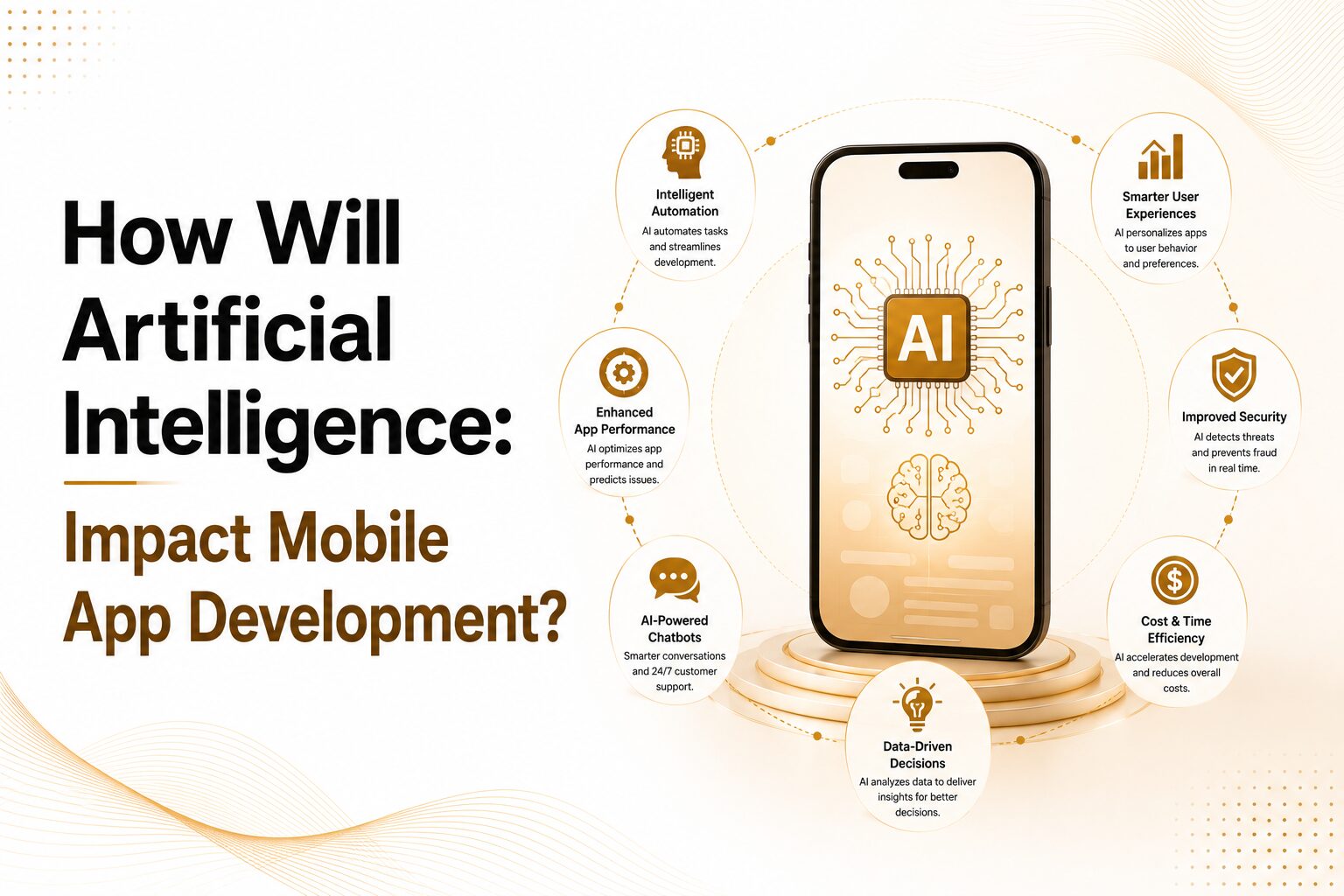
Artificial intelligence in mobile app development has moved from a niche advantage to a foundational expectation. In 2024, the global AI in mobile app market was valued at over $2.1 billion, and analysts project it will surpass $15 billion by 2030. That growth is not driven by hype. It is driven by a measurable shift in what apps can do, how quickly they are built, and how deeply they engage users.
This guide covers every major dimension of that shift, from how AI changes the development process itself to how it shapes user experience and business outcomes. If you are a product owner, developer, or business leader making decisions about mobile apps right now, this is your reference point.
1. What AI Actually Means in the Context of Mobile Apps
The term “artificial intelligence” gets used loosely. Before examining its impact, it helps to define what it means in a mobile context.
Artificial Intelligence in mobile app development covers two distinct areas.
The first is AI-assisted development, where machine learning tools support developers in writing code, detecting bugs, automating tests, and prototyping interfaces. The second is AI-powered app functionality, where end users experience intelligent features such as personalized recommendations, voice assistants, or real-time fraud detection.
Both areas matter. They operate at different layers of the product lifecycle, but both influence the quality of the final application. Understanding this distinction prevents confusion when evaluating tools, timelines, and investment priorities.
The core technologies underpinning these capabilities include machine learning (ML), natural language processing (NLP), computer vision, deep learning, and large language models (LLMs). These are not interchangeable terms. Machine learning refers to systems that learn from data. NLP handles human language understanding. Computer vision processes image and video input. LLMs, such as GPT-4 or Gemini, are advanced language models capable of reasoning and generating text. Each plays a specific role depending on the problem an app is designed to solve.
To understand how these technologies are evolving, explore our in-depth breakdown of AI development trends shaping 2026 — including how agentic AI and on-device models are redefining what’s possible.
2. How AI Is Changing the Way Mobile Apps Are Built
Developers were the first to feel the impact of AI through the tools they used to build the apps. The development lifecycle has shortened significantly, and the quality floor has risen.
AI-Assisted Code Generation
Tools such as GitHub Copilot, Cursor, and Amazon CodeWhisperer generate functional code from natural language prompts. A developer describes a function, and the tool drafts it in real time. Studies from GitHub indicate that developers using Copilot complete tasks up to 55% faster on repetitive coding work. For cross-platform development targeting both iOS and Android, this compounds — writing shared logic once and adapting it for two ecosystems no longer doubles the effort.
Automated Testing and QA
Manual testing is one of the most resource-intensive parts of mobile development. AI-powered testing frameworks, including tools like Applitools, Mabl, and Testim, identify visual regressions, flag edge cases, and simulate thousands of user interactions automatically. These platforms use machine learning to distinguish real bugs from expected changes, dramatically reducing false positives. This is AI-powered automated testing for mobile development at scale, not just in theory.
Bug Detection and Code Review
AI debugging and error detection tools scan code repositories continuously. They surface issues before they reach production, identify performance bottlenecks, and suggest specific remediation steps. DeepCode and SonarQube’s AI layer are examples of platforms doing this at the repository level. For mobile teams working in Kotlin, Swift, Flutter, or React Native, early detection directly reduces post-release patch costs.
AI-Driven UI and UX Prototyping
Design tools such as Figma’s AI features and Uizard allow teams to generate full UI mockups from sketches or text descriptions. An early-stage startup can move from a product brief to a clickable prototype in hours rather than weeks. This compresses discovery phases and enables faster stakeholder alignment. Explore how TrendusAI covers the intersection of AI tools and product development for businesses navigating these decisions.
If your team is evaluating what AI tooling to build into your mobile product stack, our AI development services provide structured support from ideation through deployment — including mobile-first AI integration.
3. What AI Adds to the User-Facing Side of Mobile Apps
The developer experience is only half the story. The more visible transformation is in what users encounter when they open an AI-powered app.
Hyper-Personalization
Personalization is not new. Recommendation engines have existed for years. What AI adds is depth and responsiveness. Modern AI recommendation engines in apps do not just track purchase history; they factor in time of day, device usage patterns, weather data, location, and even scroll speed. Netflix’s recommendation engine reportedly saves the company over $1 billion annually by reducing churn through relevant content suggestions. Spotify’s Discover Weekly uses collaborative filtering and NLP to surface music that users did not know they were looking for.
For a standard business app, this same principle applies to product suggestions, content feeds, notification timing, and dashboard layouts. AI personalization for user engagement works when it is fed quality behavioral data, which is why data collection and consent management are part of the same conversation.
Natural Language Processing and Voice Interfaces
Voice recognition and NLP in mobile apps have matured far beyond simple voice-to-text. Modern implementations understand intent, handle conversational context, and respond appropriately to ambiguous phrasing. Google Assistant, Apple’s Siri, and Amazon’s Alexa are consumer-facing examples, but enterprise apps are integrating NLP directly into customer workflows — enabling users to search, filter, approve, and submit forms through spoken commands.
AI chatbot integration in apps has similarly evolved. Earlier chatbots followed rigid decision trees. Current LLM-based assistants handle open-ended queries, reference previous conversation turns, and escalate to human agents when confidence drops. Customer support costs in apps using AI chatbots have been shown to drop by 30 to 40 percent in documented cases.
Computer Vision
AI-enabled image and speech recognition powers a category of features that would have required substantial custom infrastructure five years ago. Today, mobile developers integrate computer vision through APIs, such as Google ML Kit, Apple’s Vision framework, and Amazon Rekognition, without training custom models from scratch. Retail apps use it for visual product search. Healthcare apps use it for symptom photography. Logistics apps use it for package barcode scanning and damage detection.
Predictive Analytics and Adaptive Interfaces
AI-driven predictive analytics for mobile apps allows an application to anticipate user needs before they are expressed. A banking app might surface a fraud alert before a user notices an unauthorized charge. A fitness app might prompt a rest day based on sleep patterns and training load. An e-commerce app might pre-populate a shopping cart based on seasonal purchase history. These are not gimmicks — they reduce friction at the moments it matters most. Our guide on AI personalization strategies covers how product teams implement these systems effectively.
Adaptive and context-aware interfaces take this further. The app layout itself adjusts based on the user’s context: time of day, network speed, frequently used features, or accessibility needs. This represents a move from static UX design to dynamic, AI-responsive interface logic.
4. AI and Mobile App Security: The Full Picture
Security is where AI’s impact is both most beneficial and most underappreciated.
Threat Detection and Fraud Prevention
AI security apps and fraud detection systems analyze behavioral signals in real time. Rather than matching patterns against a static rules database, ML models identify anomalies. Financial institutions using AI-powered fraud detection report false positive reductions of over 50 percent compared to rule-based systems, while simultaneously catching more fraud events.
Biometric Authentication
Face ID and fingerprint authentication are now baseline expectations in mobile apps. Underlying these features is AI — specifically, computer vision models trained to distinguish between a live face and a photograph, and neural networks mapping unique fingerprint topology. As presentation attacks (spoofing attempts) grow more sophisticated, the AI models defending against them are updated continuously.
The Other Side: AI as an Attack Vector
Honest coverage of AI in security requires acknowledging the risk. AI-generated phishing content is now highly convincing. Deepfake audio is being used in vishing attacks targeting mobile users. Adversarial inputs can fool image recognition models embedded in apps. Development teams must account for this threat landscape when designing their security architecture — not only building AI defenses but stress-testing them against AI-driven attacks.
5. AI Applications Across Industries: Where the Impact Is Most Measurable
AI does not deliver equal returns across all verticals. The table below maps specific AI capabilities to the industries where they have the clearest documented impact.
| Industry | AI Application | Measurable Outcome | Example |
| Healthcare | Symptom analysis, wearable data processing | Earlier diagnosis, reduced hospital readmissions | Ada Health, Apple Health |
| Fintech | Fraud detection, robo-advisory, and credit scoring | 50%+ reduction in false positives on fraud | Chime, Robinhood, Stripe Radar |
| Retail & eCommerce | Visual search, dynamic pricing, and personalization | Up to 30% increase in conversion rates | Amazon, ASOS, Pinterest Lens |
| Logistics | Route optimization, demand forecasting | 15–20% reduction in delivery costs | UPS ORION, FedEx SenseAware |
| EdTech | Adaptive learning paths, automated grading | Improved retention and learning outcomes | Duolingo, Khan Academy |
| Travel & Booking | Price prediction, itinerary personalization | Higher user retention and repeat bookings | Hopper, Google Flights |
| Streaming | Content recommendation, thumbnail optimization | Reduced churn, longer session times | Netflix, Spotify, YouTube |
These outcomes are not theoretical. They are drawn from published case studies and documented performance improvements by the companies listed. AI in mobile apps delivers measurable ROI when applied to the right problem with adequate data.
6. The Real Challenges of Integrating AI in Mobile Apps
Any honest treatment of this topic requires addressing what makes AI in mobile development genuinely difficult. These are not insurmountable obstacles, but they require deliberate planning.
Data Privacy and Regulatory Compliance
AI personalization depends on user data. In the United States, CCPA governs data collection from California residents. GDPR applies to any app serving EU users. India’s Digital Personal Data Protection Act (DPDP) applies to apps operating in that market. Developers must build consent management frameworks, implement data minimization, and ensure that AI models do not inadvertently expose personal data through their outputs. AI compliance and privacy in apps is not a legal checkbox — it shapes the architecture of how data is collected, stored, and processed.
Staying current on regulation is non-negotiable. Our AI news roundup tracks key regulatory developments including EU AI Act deadlines and compliance requirements that directly affect mobile app teams.
On-Device Compute Constraints
On-device AI versus cloud AI for mobile apps is a genuine design decision, not a preference. On-device inference offers speed, privacy, and offline functionality. But mobile hardware has limited RAM, processing power, and battery capacity. A large model that performs well on a server may cause thermal throttling and battery drain on a mid-range Android device. Development teams must benchmark models against real device profiles, not just high-end test hardware.
Model Bias and Fairness
Machine learning models reflect the data they were trained on. If that data is unrepresentative, the model’s outputs will be systematically skewed. A facial recognition model trained predominantly on light-skinned faces performs poorly for darker-skinned users. A credit scoring model trained on historical lending data may perpetuate existing inequalities. Ethical AI practices in app development require audit processes, diverse training datasets, and ongoing monitoring of model outputs across user demographics.
Third-Party API Dependency
Many developers integrate AI through third-party APIs — OpenAI, Google Cloud AI, AWS AI services, and similar providers. These integrations are efficient, but they introduce dependency risk. API pricing can change. Service availability is not guaranteed. Data processed through third-party APIs may be subject to the provider’s data handling policies. Teams building long-term products should evaluate when building or fine-tuning proprietary models becomes strategically worthwhile.
7. How to Decide Whether Your App Is Ready for AI
Not every app needs AI immediately. Adding AI to a product that lacks a clear data strategy or defined use cases creates complexity without corresponding value. Three questions help frame the decision.
- Do you have a specific problem AI can solve? Generic automation is not a sufficient justification. Define the exact user behavior or operational inefficiency you are targeting.
- Do you have the data to support it? AI models require training data. For supervised learning, that means labeled examples. Evaluate data volume, quality, and recency before committing to an AI approach.
- Should you build or integrate? Custom models offer control and competitive differentiation. Pre-built AI tools for cross-platform app development offer speed and lower upfront cost. Most early-stage products benefit from starting with integrations and migrating toward custom models as they scale.
For businesses evaluating AI-powered mobile app development services, TrendusAI’s mobile AI consulting services provide structured assessments of data readiness, use-case fit, and build-versus-buy tradeoffs before any development begins.Not sure how to find the right technical partner? Read our guide on how to hire app developers without getting scammed — including what to look for when vetting AI-capable teams.
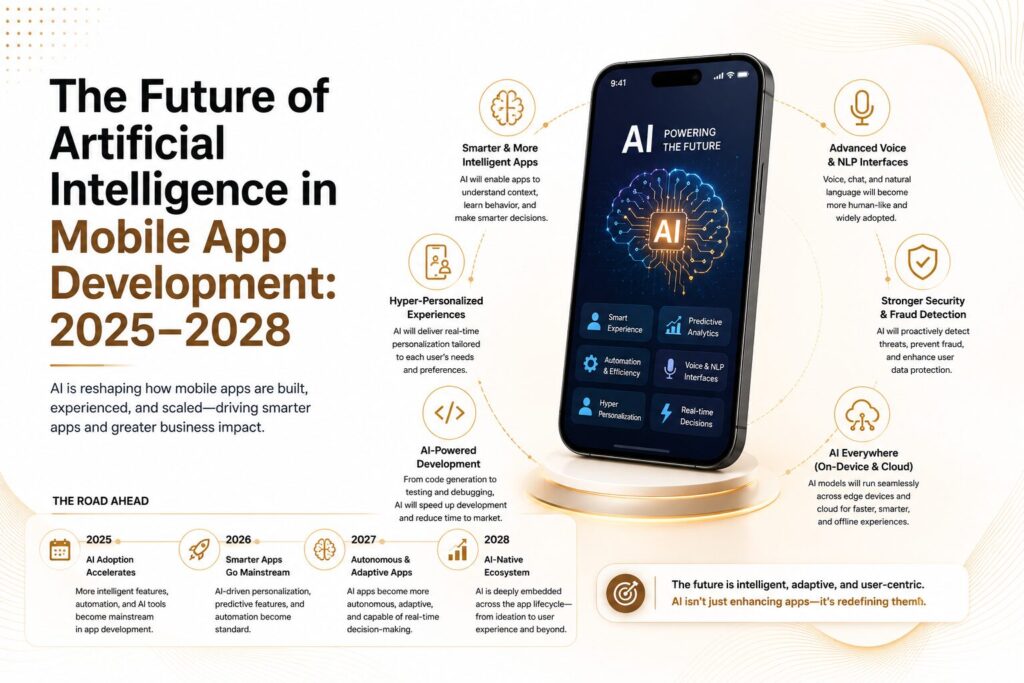
8. The Future of Artificial Intelligence in Mobile App Development: 2025–2028
The trajectory of AI in mobile apps points toward capabilities that are currently emerging, not yet mainstream. Understanding this trajectory helps product teams make architecture decisions today that do not require costly rewrites in two years.
On-Device Large Language Models
Apple Intelligence, Google’s Gemini Nano, and Meta’s LLaMA-based on-device efforts represent the shift toward running sophisticated language models directly on consumer hardware. This means conversational AI features — summarization, drafting, reasoning — without sending user data to a remote server. As chip architectures improve, the performance gap between on-device and cloud inference will narrow. Apps built with on-device AI in mind will have a significant privacy and latency advantage.
Agentic AI in Mobile Applications
Agentic AI in mobile apps refers to systems that can plan, take action, and complete multi-step tasks autonomously on a user’s behalf. Rather than answering a question, an agentic assistant books a flight, updates a calendar, sends a confirmation, and checks back in when conditions change. This is not science fiction — it is the direction that Apple’s App Intents framework, Google’s Project Astra, and early LLM-based automation tools are pointing toward. AI-first app development architecture will account for this by designing apps as composable services that AI agents can coordinate.
Multimodal Interfaces
Current apps handle input in one mode at a time — text, voice, or image. Multimodal AI processes all of them simultaneously. A user might hold up their phone to a product, ask a question about it, and receive a combined visual and spoken response. Apple’s Vision Pro and Google Lens are early expressions of this. As multimodal models become lighter and faster, this interaction pattern will move from specialty devices to mainstream smartphones.
Ethical AI and Explainability
Regulators and users are increasingly demanding transparency from AI systems. The EU AI Act, fully effective in 2025, requires high-risk AI applications — including those in healthcare, finance, and law enforcement — to provide explainable outputs. Explainable AI in mobile applications means that when an algorithm denies a loan, declines an insurance claim, or flags a medical anomaly, the user can understand why. Development teams building in regulated industries must treat explainability as a first-class requirement, not a future retrofit.
For a broader perspective on responsible AI deployment, the MIT Technology Review’s coverage of AI governance provides well-sourced analysis relevant to enterprise and consumer app contexts.
AI vs. Traditional Mobile App Development: A Direct Comparison
| Dimension | Traditional Development | AI-Augmented Development |
| Development speed | Linear; feature-by-feature | Accelerated via code generation and automated testing |
| Personalization | Rule-based or static segments | Dynamic, real-time, per-user |
| Testing | Largely manual; time-intensive | Automated; continuous regression coverage |
| Security | Perimeter-based; signature detection | Behavioral anomaly detection; adaptive |
| UX adaptation | Fixed layouts; manual iteration | Context-aware, self-adjusting interfaces |
| Cost over time | Consistent but scales with team size | Higher upfront; lower marginal cost at scale |
| Data requirements | Minimal for core function | High model quality depends on data quality |
Conclusion
Artificial intelligence in mobile app development is not a single technology or a single decision. It is a set of compounding capabilities — some that help teams build faster, some that make products smarter, and some that will define entirely new interaction models within the next three years.
The apps that will lead their categories in 2027 are being designed now. The teams building them are not waiting for AI to become simpler. They are investing in data infrastructure, selecting the right integrations, and building AI readiness into their product architecture from the start.
For development teams and product leaders ready to move from evaluation to execution, the decisions made in the next six to twelve months will compound. Starting with a clear use case, clean data, and the right partner makes the difference between AI that adds cost and AI that adds value. TrendusAI works with startups and enterprises at every stage of this journey — from initial AI readiness assessment to full-scale deployment.

Senior SEO Content Marketing Manager at Trendusai.com
Rashida Hanif is a Senior SEO Content Marketing Manager, specializing in data-driven content strategy and SEO. She helps brands improve online visibility through keyword research, content planning, and AI-powered marketing insights.