

You have an app idea, and you’re looking for the one who may put your idea into reality. You find someone online, the portfolio looks convincing, the price feels reasonable, and you send the deposit. A few weeks pass. Updates get shorter. Then they stop, and then the profile is gone.
It happens constantly, and most people who go through it never talk about it publicly because it’s embarrassing. The FTC’s 2025 consumer fraud report put losses from tech and developer-related fraud at over $340 million for the year. Remote hiring, especially for app development, is one of the most exploited categories because clients rarely have the technical background to catch problems early.
This guide is about why and how to hire app developers without becoming one of those numbers. You’ll also come to know where to look, but how to screen, what the work costs in 2026, and what separates a legitimate developer from someone who’s very good at appearing like one.
Why Does This Keep Going Wrong for Smart People?
The people who get burned when they hire mobile app developers are not naive. Many of them have run businesses, hired teams, and managed budgets. The problem is that mobile development has a few specific qualities that make standard hiring instincts less reliable.
First, you usually can’t evaluate the work yourself. If you hire a copywriter and the writing is bad, you know immediately. If a developer hands you code that’s poorly structured, has no error handling, and will break under real user load, you may not find out until six months after launch.
Second, the upfront deposit is industry standard. Developers across every platform, every country, and every experience level ask for money before they start. That’s normal and reasonable. It also means scammers fit right into the expected pattern.
Third, a convincing profile is genuinely easy to fake in 2026. AI-generated code samples, purchased App Store reviews, stolen GitHub repositories, and fabricated client testimonials are not uncommon. A polished presentation no longer guarantees anything.
A 2026 Checkr workforce report found that 64% of US hiring managers had caught developer candidates misrepresenting technical skills, up from 60% the previous year. Thirty-five percent said they had verified a fake professional identity during the interview process. For remote hires, which covers most app development work, those numbers are likely understated.
Decide What You’re Actually Hiring Before You Look
Most founders post a job before they’ve thought through what they need. That one step costs them weeks and usually money.
iOS developers work in Swift and build for iPhones and iPads. Android developers use Kotlin and target the far broader but more fragmented Google Play market. If your app needs to run on both, you either hire separately or hire cross-platform.
React Native developers and Flutter developers write code that works on both platforms from one codebase. If you’re weighing that route, it’s worth understanding what cross-platform app development actually involves before you commit to a hiring model — the cost savings are real, but so are the trade-offs on device-level features. Lower cost upfront, faster to ship an MVP, but with limitations on deeper device-level features. Full-stack app developers handle both the visible front-end and the server-side back-end, useful when you’re working with a small team or a tight budget. But the best ones are expensive, and the mediocre ones tend to be thin everywhere.
On the working model
In-house means a salaried employee, full control, continuity, and high fixed costs. Stack Overflow’s 2025 developer survey put median mobile developer salaries at $49,000+ before benefits in the US. For a startup that hasn’t hit revenue yet, this is a heavy commitment.
Freelancers work on defined scopes and are easier to engage quickly. Upwork’s 2026 platform data shows the global median for mobile developer hourly rates at around $32/hour, with US-based professionals running $65–$160. The flexibility is real. So is the risk — a freelancer with four active clients can deprioritize yours without much warning.
Agencies add structure, process accountability, and a team that doesn’t disappear when one person gets sick or takes another job. If you’re evaluating whether to work with a dedicated AI development company versus a general-purpose dev shop, the distinction matters more than most founders realize — especially when AI features are part of the build. US agencies run $80–$220/hour. Eastern European shops charge $35–$90. Latin American teams sit at $28–$65.
Where to Actually Find Good App Developers
Upwork is still the largest marketplace for this kind of work. Rate range is wide — from $12/hour to $175+, and quality varies accordingly. The platform holds payment in escrow and has a functioning dispute process, which matters. The challenge is signal-to-noise. A well-written job post with specific requirements filters out a lot of low-quality bids, but you’ll still need to spend real time reviewing applications.
Toptal runs its own screening process and claims to accept roughly 3% of applicants. In practice, the developers on the platform are noticeably more consistent than what you find on open marketplaces. Rates start around $65–$160/hour. Better suited for complex builds where a bad hire costs more than the rate premium.
Fiverr makes sense for small, isolated tasks — a specific fix, a prototype of one feature, a quick API integration. For a full app build, the project-based pricing creates problems the moment scope shifts, which it always does.
LinkedIn remains underused for developer hiring. You can find professionals with verifiable work history, recommendations from named people, and public GitHub accounts. The process takes longer than a platform, but the hires tend to be more grounded because there’s a real professional identity attached to them.
Clutch.co is the most reliable place to find agencies with verified client reviews. If you’re going the outsourcing route rather than a solo freelancer, Clutch gives you a clearer picture of who actually ships versus who just pitches well.
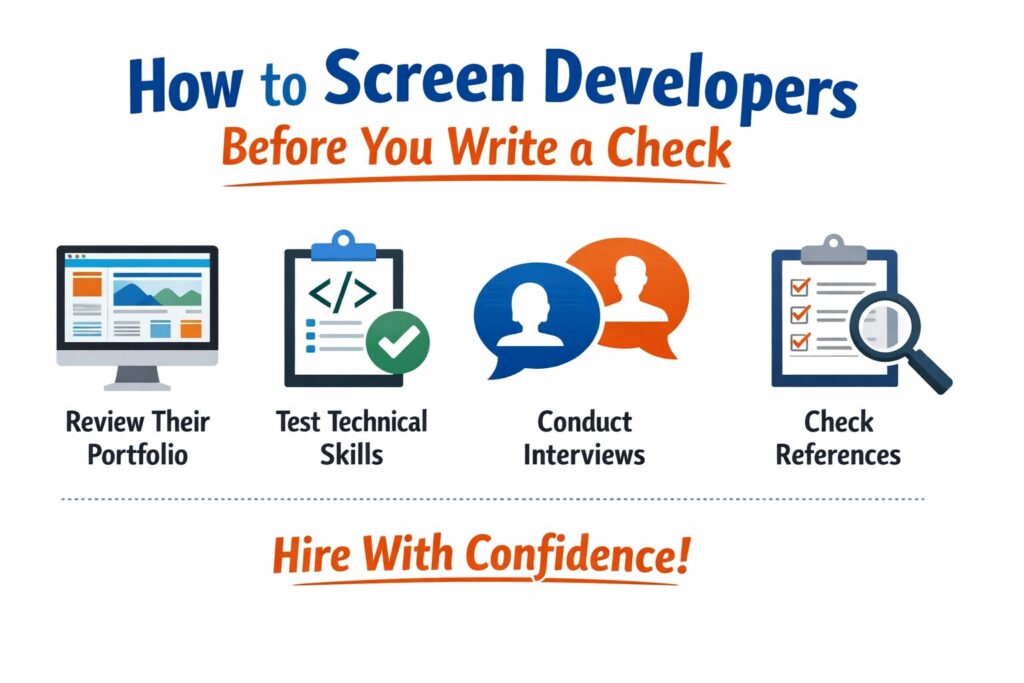
How to Screen Developers Before You Write a Check
This is where most hiring decisions actually get made, and where most mistakes happen. A confident first impression is not a vetting process.
Check Work That’s Actually Live
Ask for App Store or Google Play links. Download the apps. Use them. Read the reviews. Look at the update history. A developer who has shipped real work has something to show you. Screenshots and Figma designs tell you nothing about development capability.
Ask for a GitHub Profile and Actually Look at It
You don’t need to read code to check whether the account has years of consistent commits, readable documentation, and a professional repository structure. An account created three months ago with a handful of commits is suspicious. Flat refusal to share any code at all is worse.
Give a Paid Test Task
This is the most reliable filter in this entire process, and it costs almost nothing relative to the project budget. Assign something small and specific — fix a bug in a test file, build a simple screen from a brief, write a basic data-fetching function. Pay a fair hourly rate for the time. Legitimate developers treat it as a normal part of the process. People who plan to fake their credentials or subcontract your work tend to produce something that doesn’t match what they claimed in the interview.
Run Background Verification for Distributed Teams
When you’re hiring across borders — which is most of this market — a portfolio and a video call only tell you so much. Background verification for global teams has become a standard step for founders who’ve been burned before: confirming identity, past employment, and whether the person on the call is actually who they claim to be. It won’t catch a bad developer, but it will catch a fake one, and the two problems require very different fixes.
Ask Technical Questions You’ve Looked Up Beforehand
You don’t need development experience to run a technical interview. Prepare five or six questions, look up what a good answer actually contains, and then listen carefully to how the developer responds. Someone who knows their work explains things clearly, often with examples. Someone with expertise talks around specifics and changes the subject toward their portfolio or pricing.
Build Milestone Payments Into Every Contract
This is standard practice and protects both parties. Tie each payment to a specific, reviewable deliverable — wireframes approved, back-end built and tested, front-end integrated, QA complete, submission ready. No milestone, no payment.
What App Development Costs in 2026
Hourly rates by region:
- United States freelance: $65–$160/hour
- United States agency: $80–$220/hour
- Eastern Europe: $35–$90/hour
- Latin America: $28–$65/hour
- South/Southeast Asia: $18–$45/hour
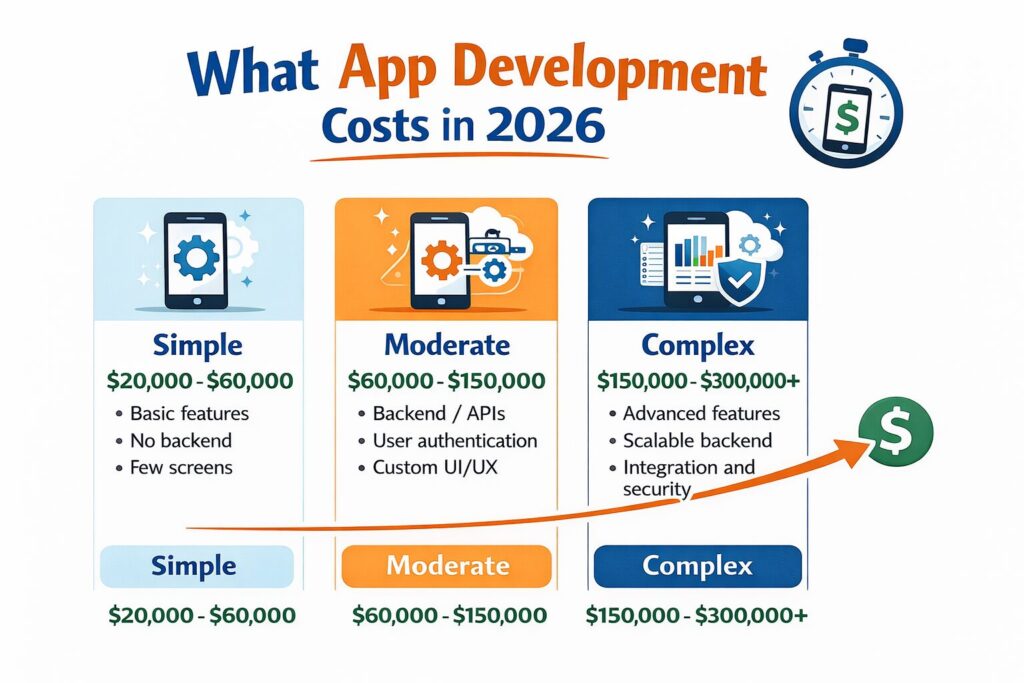
Full project cost ranges:
- Simple app, 3–5 screens, basic functionality: $12,000–$55,000
- Mid-complexity app with auth, APIs, and dashboards: $55,000–$160,000
- Complex multi-platform app with real-time features: $160,000+
Fixed price vs. hourly: Fixed price suits projects where the scope is fully defined and unlikely to shift. Hourly works better for iterative development, where requirements will evolve as you build. Most experienced teams use a middle path — fixed price per milestone, with a specific deliverable attached to each stage. You keep budget control without boxing yourself into a rigid scope that needs to change halfway through.
A quote of $4,000 for a full e-commerce app with a custom backend and user authentication is not a deal. It is a signal.
Three Builds — What Happened and Why
The $40,000 Lesson From a Cold Email
A US founder running a SaaS business decided to hire app developers after an offshore team reached out through LinkedIn. The website was clean, the portfolio listed recognizable brand names, and the sales calls were smooth. He paid 50% upfront, $40,000, before a single line of code was written. Three months later, after a pattern of delayed updates and vague status messages, contact stopped entirely. The website went dark. The code delivered to that point was mostly copied from public repositories, non-functional as delivered, and unusable as a foundation. No milestone structure. No verified references. No contract with enforceable terms.
Fourteen Weeks From Brief to App Store
A product manager at a mid-size SaaS company needed a React Native developer to build a companion mobile app for their web platform. Companies that hire mobile app developers through vetted platforms or from a leading company as Nimble AppGenie, tend to move faster — he used Toptal’s matching service, ran a structured two-week trial, and kept the developer on for the full build.The app launched in fourteen weeks, earned a 4.6 rating on the App Store, and hit 68% user retention at thirty days. The rate was $135/hour. The project finished on scope and on schedule.
A $28,000 Loyalty App With Measurable Results
A regional restaurant chain set out to hire app developers for a loyalty app covering both iOS and Android — push notifications, a points system, and basic account management. They posted a detailed brief on Upwork, shortlisted five candidates, gave paid test tasks to two of them, and hired a React Native developer based in Colombia at $58/hour. The total cost came to $28,000. The app launched in eleven weeks. Customer return visits tracked through app engagement increased 23% in the first quarter after launch.
What People Who Hire Well Actually Do
They Write a Brief Before They Speak to Anyone
Not a paragraph — a real document covering the platform, core features, integrations needed, what the user does in the app, and what success looks like at thirty, sixty, and ninety days post-launch. A detailed brief filters candidates before the first conversation. Serious developers respond to specifics. People who can’t deliver tend to stay vague.
They Find Out Who Will Actually Write the Code
Some freelancers subcontract without disclosing it. The person who impressed you on the call is not necessarily the person building your app. Ask directly. Put the answer in the contract with a clause about unauthorized subcontracting.
They Make the Paid Test Task Non-Negotiable
Not just to assess technical output — to watch how someone handles a real task in normal conditions. Do they ask clarifying questions, or do they assume and deliver something off-brief? Do they explain their decisions? Do they deliver on time? Those same behaviors play out at ten times the scale and ten times the stakes when the real project begins.
They Own the Codebase From Day One
Every professional developer works in version control from the first commit. If someone pushes back on a shared repository early in the conversation, they’re either disorganized or they’re planning to use your code as leverage later. Either version of that is a problem worth walking away from.
They Check References With Better Questions
“Was this person good?” produces a useless answer. “What would you do differently if you worked with them again?” and “Did they ever miss a deadline, and what did they do when it happened?” produce honest, specific ones.
FAQ
How do I find reliable app developers without getting scammed?
Use platforms with escrow protection, like Upwork, or screened networks like Toptal. Run a paid test task before any financial commitment. Verify that apps in the portfolio are live and downloadable. Structure every payment around a specific, verified deliverable — not time or good faith.
What should I ask when hiring app developers?
Ask them to walk through a recent project from the initial brief through to the store submission. Ask how they’ve handled scope changes mid-build. Ask who else will write the code. Ask for references who can speak to a project that actually finished.
What are the best platforms to hire vetted app developers?
Toptal for complex, high-stakes builds. Upwork for mid-range projects where you have time to screen properly. Clutch for agency-level outsourcing with verified client feedback. LinkedIn for direct hires with visible professional histories.
How much does it cost to hire app developers in 2026?
US-based freelancers run $65–$160/hour. Agencies charge $80–$220. Offshore teams in Eastern Europe run $35–$90. Full builds range from $12,000 for a simple MVP to $160,000+ for complex, multi-platform applications with real-time functionality.
How do I hire app developers for a startup on a tight budget?
Narrow the MVP scope to the smallest version that proves the idea. Offshore teams in Eastern Europe and Latin America deliver solid work at $28–$90/hour. Use milestone-based fixed pricing so you know exactly what you’re paying for before each stage begins. A quote dramatically below market is a warning, not a find.
Fixed price or hourly — which should I use?
Fixed price when the scope is stable and documented. Hourly, when requirements will change as the project moves, in practice, a fixed price per milestone gives you the best of both — cost predictability without locking into a scope that needs to breathe.

Senior SEO Content Marketing Manager at Trendusai.com
Rashida Hanif is a Senior SEO Content Marketing Manager, specializing in data-driven content strategy and SEO. She helps brands improve online visibility through keyword research, content planning, and AI-powered marketing insights.