SEO is hard work. One day you’re doing great. The next day? Your website drops in the rankings. Traffic goes down. You have no idea why. Most tools just throw numbers at you. They don’t tell you what went wrong. They don’t help you fix it. ZipTie AI Search Analytics is different. It catches SEO problems before they hurt your site. It shows you how to fix them. The tool uses AI to watch your website all day, every day. It sees problems early. You stay ahead of other websites.
Do you run a website? Are you in charge of SEO? Do you own a business? This guide will tell you everything. You’ll learn what ZipTie AI does and why choose the ZipTie AI search performance tool for your site. Modern AI automation tools like ZipTie AI are changing how people do search work in 2026.
Why Traditional SEO Tools Fall Short
Old SEO tools have big problems. And they keep giving people headaches.
They dump data on you without real help. Google Search Console shows your rankings went down. But it won’t say why. SEMrush shows you keywords and where you rank. But it won’t fix anything. You sit there looking at charts. You try to figure it out yourself. Meanwhile, other websites are beating you.
Checking things by hand takes way too long. You waste days looking for SEO problems. You click on links one by one to see if they work. You read through hundreds of pages. You test how fast pages load on your phone. While you’re doing all this? Your rankings keep falling. Search engines change their rules. Other websites get better. You can’t keep up. And you probably miss half the problems anyway.
You always find out too late. Tools tell you about problems after the damage is done. You find duplicate content after losing traffic for weeks. You see indexing problems after Google already removed your pages. By the time you know what happened, you’ve lost rankings. You’ve lost traffic. You’ve lost money. All of it could have been saved if you knew earlier.
HubSpot did research in 2025. They found the average website only gets a 13% click-through rate from SEO. Most teams don’t have good tools. They use old methods. They can’t compete anymore.
AI search analytics platforms fix this. They watch your site all the time. They tell you what to do. They keep your website healthy.
What Is ZipTie AI Search Analytics?
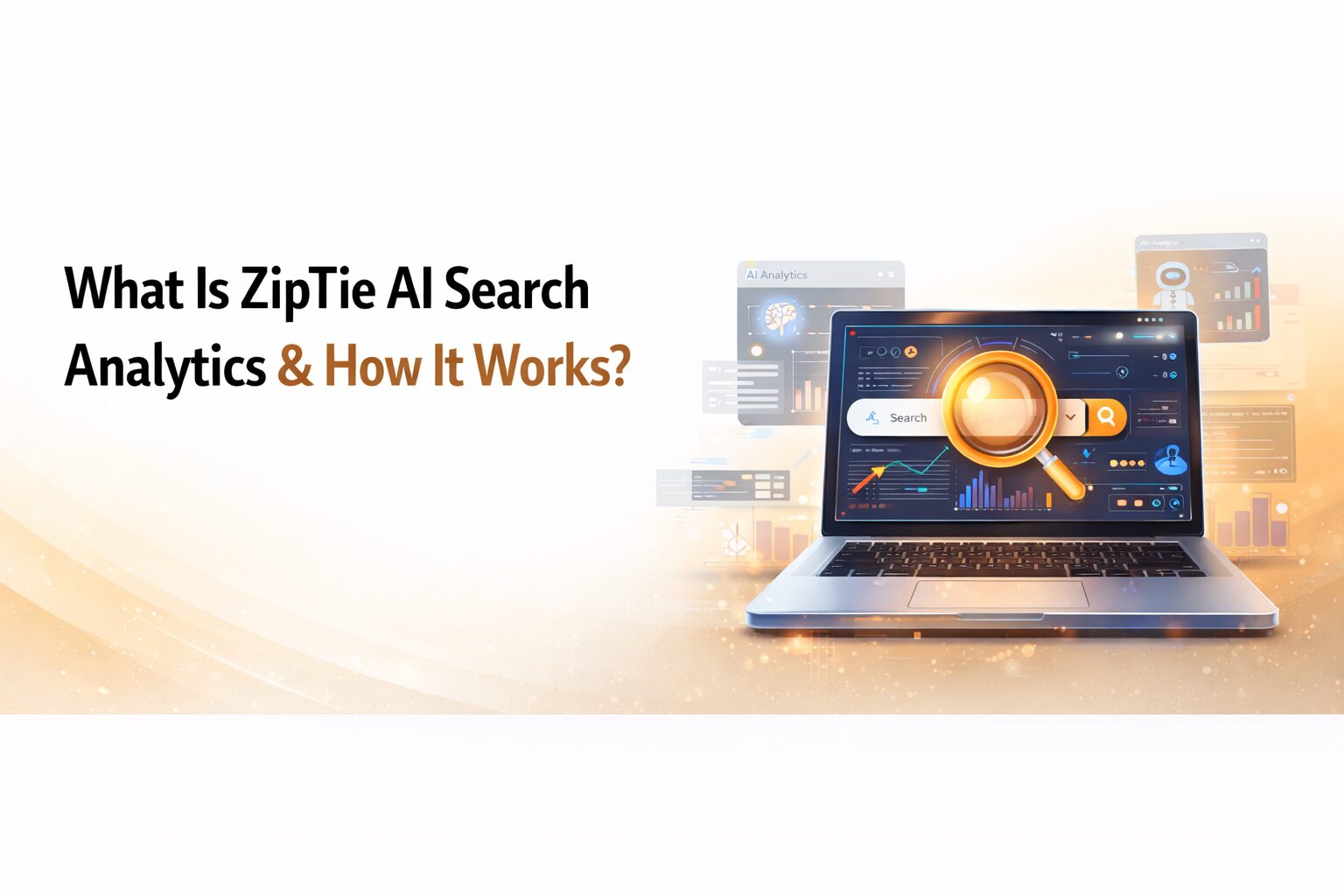
ZipTie AI Search Analytics is a tool that runs on AI. It finds SEO problems and fixes them on its own. Other tools just show you data. ZipTie AI actually works to make your search better. It watches your site nonstop. It gives you smart ideas.
Think of it like a doctor for your website. It checks your health 24/7. Google Analytics shows how many people visit. Google Search Console shows your rankings. ZipTie AI puts it all together with AI. You see things you’d never see otherwise.
What It Does
ZipTie AI finds problems by checking your site all the time. It never sleeps. It spots technical SEO issues that tank rankings. It finds content gaps. These are places where you’re missing out. It catches ranking problems before they get bad. The system works around the clock. It watches hundreds of things that affect your search.
The tool tracks everything. It watches how keywords move up and down in real time. It looks at your traffic from Google Search and Bing Search. It knows how different search engines see your site. It changes what it tells you based on what matters most.
ZipTie AI gives smart info that goes way deeper than basic reports. It uses natural language processing. This means it understands what people really want when they search. The tool can tell you how to improve content so it matches what users need. Not just stuffing in keywords.
Most important? The system shows you how to fix things. It doesn’t just point at problems. It tells you exactly what to do. Step by step. Even people who aren’t tech experts can follow along. SEO doesn’t have to be a mystery anymore.
How ZipTie AI Works
Here’s how ZipTie AI search analytics works. Simple steps anyone can get.
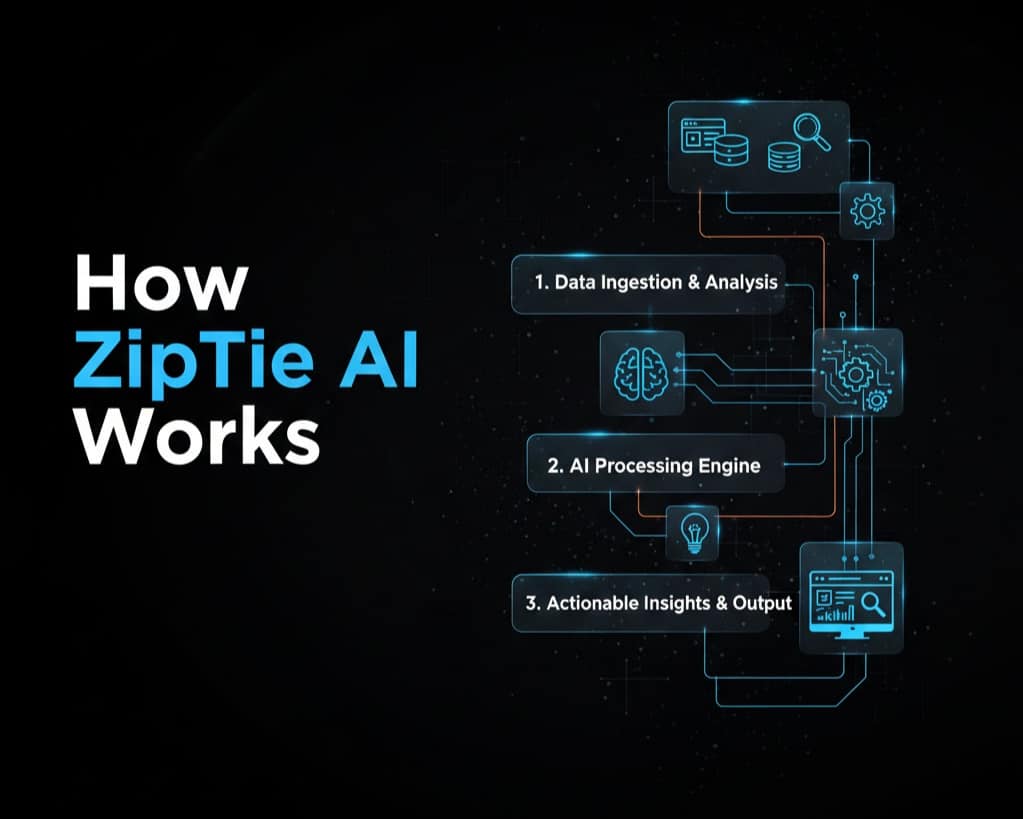
Step 1: Connects to Your Data
ZipTie AI starts by linking to tools you already use. The platform connects to Google Search Console. It pulls in your search data, clicks, and how many times you show up. It hooks into Google Analytics to see how people use your site. It looks at your website directly to check pages and content. And it connects to your rank tracking tools to watch thousands of keywords.
The system grabs data on keywords and how they’re doing. It finds crawl errors that stop Google from reading your site. It sees traffic patterns. It checks Core Web Vitals. These measure if your site is fast and easy to use. All this data feeds the AI.
Step 2: AI Analyzes Everything
Machine learning does the hard work. This would take people weeks. The AI checks if your content matches what people search for. It goes deeper than just keywords. If someone searches for “best running shoes for beginners,” the AI checks if your page really helps beginners pick shoes. Or if you just mention those words without helping.
When rankings drop, the system finds out why. It looks at dozens of reasons all at once. Did you change your site? Did search engines update their rules? Did other websites get better? Is your content worse? The AI figures out what caused the drop.
Even better, the platform sees problems coming. It looks at old patterns and what’s happening now. It warns you before things go bad. If your pages are loading slower and slower, it tells you before Google punishes you. If duplicate content is spreading, it lets you know before penalties hit.
Step 3: Rank Issues
Not every problem is the same. ZipTie AI gets this. It sorts problems by what matters most.
First, it figures out how much traffic you’ll lose if you don’t fix something. A big indexing problem on your top 20 pages? That comes before a small text issue on a blog nobody reads. Second, it checks how hard each fix is. Third, it looks at how urgent things are.
A huge indexing issue blocking hundreds of pages comes first. A tiny text problem comes later. This smart sorting means your team always works on what helps most.
Step 4: Gives Clear Steps
For every problem, you get a full plan. No guessing needed. The platform tells you what’s wrong in plain English. No tech talk. It explains how to fix it with clear steps. Different people have different skills, so the steps work for everyone. It tells you when you’ll see results. Some changes work fast. Others take weeks. And it says what you need. Do you need a developer? A writer? Other tools? You’ll know.
This makes SEO clear. Any organized team can do it.
Step 5: Keep Watching
After you make fixes, ZipTie AI tracks what happens. It checks if your changes worked. Did fixing broken links boost traffic? Did rewriting product pages help sales? The platform measures everything you do.
Over time, the AI learns what works for your site. It figures out what content your visitors like most. It finds which fixes help rankings the most. It shows which keywords are easiest to win. This learning makes the tool better and better.
Key Features
Automatic Technical Checks
People miss things when checking sites by hand. Big sites have too many pages. ZipTie AI crawls your site just like Google does. It checks every page, link, and file. It finds broken links. It spots slow redirects. It catches missing image descriptions. It sees wrong canonical tags. These confuse Google about which pages to show. It finds JavaScript problems that break your site.
One company found 200 hidden pages. These pages had no links to them. Google couldn’t find them. People couldn’t find them. After fixing the links, their traffic jumped 34% in six weeks. Google found and ranked all those hidden pages.
Search Visibility Tracking
ZipTie AI measures real visibility. It’s more than just rankings. The platform tracks SERP features. Do you show up in featured snippets? Answer boxes? Image packs? Video results? These special spots get more clicks than regular links.
The system looks at click rates. Are people clicking when you rank well? A rank 3 spot means nothing if your title and description are boring. ZipTie AI finds these cases. It tells you how to write better titles and descriptions.
It watches competitors. Where do they beat you? The platform shows what they’re doing differently. It tells you how to compete better.
Smart Keyword Analysis
Old tools just show rankings. ZipTie AI explains why keywords matter. It shows which ones you should focus on.
It finds which keywords bring sales, not just visitors. Some keywords get thousands of clicks but nobody buys. Others get fewer clicks but people actually buy things. ZipTie AI tells the difference. You focus on keywords that make money.
It shows where you compete with yourself. This is called keyword cannibalization. When multiple pages target the same keyword, they fight each other. Neither page ranks well. The AI finds these fights. It tells you how to fix them.
It highlights easy wins. These are keywords where you rank on page two. You’re so close to page one. Small changes could get you there. Instead of chasing hard keywords, you can improve these near-misses for quick results.
And ZipTie AI shows how searches change over time. It tracks seasons. It finds new topics people care about. It spots shifting interests. You can make content for what people will search next, not what they searched yesterday.
Content Gap Finding
ZipTie AI compares you to top competitors. It shows exactly where your content falls short. The analysis finds topics they cover but you don’t. These gaps are chances to get traffic you’re missing.
The platform finds questions users ask that you don’t answer. People use voice search more now. They ask full questions. If you’re not answering common questions, you’re missing out big time.
It shows keywords competitors rank for when you don’t. Not random keywords. Ones you should rank for based on your topic. The AI sees if your content is too short. When top results are 2,000 words and yours is 400, ZipTie AI flags it. It tells you to add more.
One agency learned their clients missed 60% of customer questions. They added answers to these questions. Rankings went up 12 spots on average. They moved from page two to page one.
ZipTie AI vs Other Tools
vs Google Search Console
Google Search Console gives raw numbers. No explanation. It shows your clicks dropped from 3.2% to 2.8%. But it won’t say why. It won’t tell you how to fix it. ZipTie AI takes those numbers. It figures out what they mean. It explains the causes. It tells you what to do. Where Search Console stops, ZipTie AI starts.
vs SEMrush
SEMrush is great for research. It has huge keyword databases. Good competitive info. But you do all the work yourself. You spend hours looking at reports. You try to connect the dots. ZipTie AI does it automatically. It processes millions of data points in seconds. It gives you ready plans. SEMrush gives you ingredients. ZipTie AI gives you the finished meal.
vs Ahrefs
Ahrefs is amazing for backlinks. It has the biggest link index anywhere. Super powerful. But also super complex. Hard to learn. Too much data. ZipTie AI makes it simple. Clear next steps. Where Ahrefs drowns you in options, ZipTie AI gives you direction.
The best way? Combine tools. Use ZipTie AI for daily watching and priorities. Add tools like Ahrefs when you need deep research. Each tool has its place.
Real Results
SaaS Company Fixed Indexing
A B2B SaaS company saw traffic drop. They kept publishing new content. They didn’t understand why it wasn’t working. Traffic went down every week. Their marketing team got frustrated.
ZipTie AI found the problem in minutes. Wrong robots.txt settings were blocking Google from their blog. Months of content sat invisible. One tiny error nobody noticed.
The fix was fast. They updated the robots.txt file in one day. Three weeks later, over 80 pages started ranking. Traffic went up 47%. All because they found and fixed one setting.
Store Solved Duplicate Content
An online store sold outdoor gear. They had more than 300 similar product pages. Different colors and sizes made separate pages. The descriptions were almost the same. Google didn’t know which pages to rank. So it ranked none of them well.
ZipTie AI caught the problem right away. Every duplicate page got flagged. The company rewrote descriptions. They made each one unique. They fixed canonical tags to tell Google the right version.
Search visibility went up 28%. Google started ranking their products better. Sales from search went up 15%. The right pages showed up for the right searches.
Agency Kept More Clients
A marketing agency ran 20 client websites. Different industries. Even with experience, they had a problem. They always reacted too late. They found issues only after clients complained.
With ZipTie AI, they could stop problems before they started. The platform watched all 20 sites at once. It warned the team before performance dropped. Audits ran all the time. They could show clients they were being proactive.
Client retention went from 68% to 89%. Clients loved the change from firefighting to prevention. The agency had more time for strategy. They got 5 new clients because of their reputation for using AI tools.
Why Choose ZipTie AI Search Performance Tool?
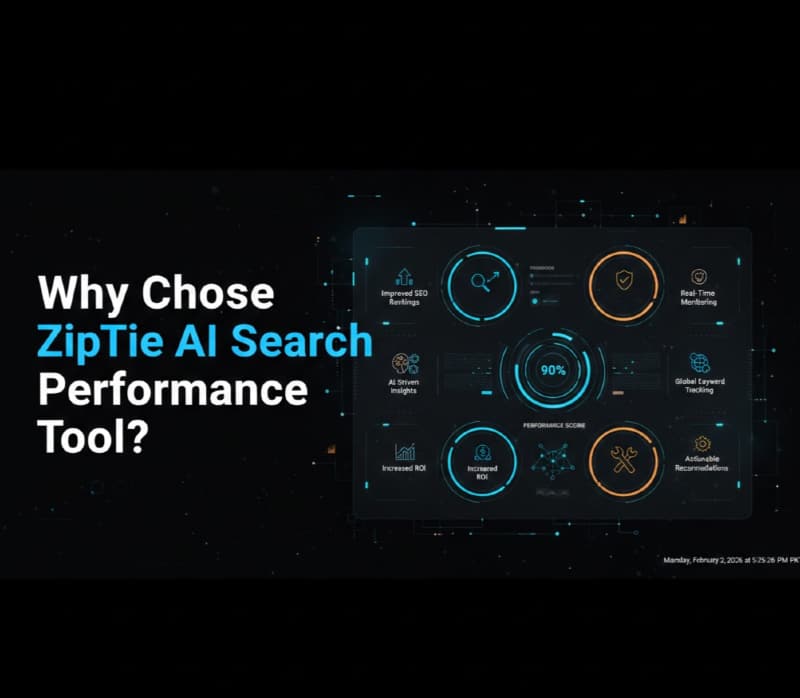
Saves Time
Remember spending entire weekends on SEO audits? Saturday and Sunday gone. You’d work 8 to 12 hours. Looking through spreadsheets. Checking data from five different tools. Clicking every broken link by hand. Trying to make sense of conflicting info. Exhausting. Error-prone. Soul-crushing.
Those days are over. ZipTie AI runs audits automatically. It works while you sleep. It never gets tiring. Your team stops doing work machines do better. They start planning a strategy. They work on creative campaigns. They talk to customers.
One marketing director said it simply: “We got our weekends back.” That says it all.
Catches Problems Early
Most tools tell you about disasters after they happen. The damage is done. Recovery is way harder. Your traffic drops 40% over two weeks. Then you start looking. You find the broken robots.txt file. It’s been blocking Google for days. You’ve lost thousands of dollars. Lost weeks of rankings. Too late to prevent it. Now you’re in damage control.
ZipTie AI works differently. It stays alert all the time. It spots the robots.txt error the same day. Sometimes within hours. It tells you right away. Before Google stops reading your site. Before rankings fall. You fix it in 10 minutes instead of losing weeks.
Think about your car. Would you rather fix a small oil leak today? Costs $50. It takes 20 minutes. Or replace the whole engine next month after it dies? Costs $5,000. You lose your car for a week. Early catches save everything.
Makes Smart Choices
Your boss asks: “Should we fix these 50 broken links or rewrite our product pages?” Without data, you’re guessing. Maybe you pick right. Maybe you pick wrong and waste three weeks on low-value work. High-value chances slip away. The stakes are high. Wrong choices pile up.
ZipTie AI does the math. It calculates traffic impact for each option. It checks old data and what competitors do. It guesses how hard each fix is. It looks at what you need and what you have. It shows fixing links will boost traffic 5%. Rewriting pages will boost it 30%. The choice is obvious.
Now you know where to focus. No more guessing. No more office fights about priorities. Data makes decisions easy.
Grows With You
Small blogs with five pages need SEO help. Big sites with 50,000 pages need it more. The bigger you get, the harder it gets.
Most tools pick a lane. Simple tools for bloggers can’t handle big sites. They can’t deal with multiple sites, languages, and content types. Complex tools for enterprises overwhelm small teams. Too many features. Hard to use. You pick between simple and powerful. You rarely get both.
ZipTie AI scales with you. Got 5 pages when you start? It handles them well. Growing to 500 pages? It keeps up easy. Hit 50,000 pages? Still smooth. It adds what you need when you need it.
A startup founder told us: “We started small. Now we’re huge with sites across different regions. ZipTie grew with us the whole way. We never had to switch tools or learn new systems.” That saves money and time.
Works With Your Tools
You already spent thousands on Google Analytics. You spent years learning it. You built custom reports. You use the Search Console every day. Maybe you pay for Ahrefs or SEMrush. Expensive subscriptions that help.
ZipTie AI doesn’t make you dump these tools. That would waste your money. It would force you to start over. Instead, it makes your tools better. It connects to them. It makes them stronger.
It pulls data from Analytics. It adds AI insights to your traffic reports. It makes Search Console smarter by explaining what numbers mean. It works with your workflow. No disruption. You keep what works. You add what was missing.
Expert Tips
Start with easy wins
When you first hook up ZipTie AI, you’ll see lots of issues. The dashboard might show 50, 100, or 200 problems. Depends how long your site went without good care. Don’t freak out.
Look for green flags in the tool. These mark high-impact fixes that are easy. Maybe it’s adding descriptions to 10 images. It takes 15 minutes. Maybe it’s fixing 5 redirects. Quick work.
Do these first. Get them done today if you can. Why right away? Results come fast with easy fixes. Your boss sees better traffic in two weeks. Your team feels good about progress. You build momentum.
Save hard stuff for later. You’ll have more practice by then. More confidence. Proven track record. Hard fixes are easier to push when you’ve already won some battles.
Set up alerts
Don’t wait until Monday to find out Friday’s server work broke everything. By Monday morning, you lost a whole weekend of traffic. Maybe thousands in money. Competitors had three days to steal your visitors.
Set up instant alerts for big problems. When your site goes down completely, you know in minutes. When indexing breaks, you get a text. When rankings drop 10+ spots for important keywords, you’re told right away.
One e-commerce manager learned this the hard way. Server settings blocked Google for two days during their busy season. No alerts meant nobody noticed for two full days. Lost sales during peak shopping. Lost crawling of new products. The money lost was huge. All preventable.
Now that manager has alerts set up. Every big issue triggers a message. The peace of mind is worth it.
Check weekly
Every Friday at 2 pm, look at your ZipTie AI dashboard. Make it a habit. Like your morning coffee. Block time on your calendar. Protect it from meetings. This matters more than you think.
The AI learns from what you do. When you fix certain issues fast, it notices. It starts putting those types first in the future. When you always ignore certain suggestions, maybe because they don’t fit your business, it adjusts. It stops bugging you about them.
Regular use trains the system to think like you. It gets smarter about your needs. It learns which keywords matter to you. It learns which tech issues hurt your site most. Skip weeks and the AI can’t learn your style. You get generic advice instead of personal help.
Combine AI with human thinking
AI is great at patterns. It processes millions of data points at speeds you can’t match. You can’t compete with that power. Don’t try. The AI can look at hundreds of competitor sites at once. It finds patterns you’d never see.
But AI doesn’t understand your brand voice. It doesn’t know your business goals beyond numbers. It can’t judge if a suggestion fits your overall plan. It doesn’t know about office politics, limited resources, and strategic priorities.
Use both together. Let AI find technical issues across thousands of pages. Let AI crunch numbers. Calculate traffic potential. Find competitive gaps. Then you decide which chances match your vision and values. You apply strategy.
A SaaS founder said: “ZipTie shows me what’s possible. I provide the why behind our picks. Together we win.” That teamwork beats either alone.
Track changes
Before you fix anything ZipTie AI suggests, write down your numbers today. Record traffic from Google Analytics. Write down rankings for your top keywords. Note conversions and where they come from. You need these baseline numbers.
Make the fix like ZipTie AI says. Do it carefully and completely. Then wait four weeks minimum. SEO changes take time. Google needs to recrawl pages. Reindex content. Recalculate rankings. Checking daily is useless. It just makes you anxious.
After four weeks, check numbers again. Compared to your baseline. Did traffic go up like predicted? Did rankings improve? Did sales rise? This comparison proves what works. You know exactly what helped and what didn’t.
You can show your team real results. You prove value with real numbers, not vague claims. You learn which changes work for your site. This knowledge builds up over time. Without tracking, you’re blind. You make dozens of changes without knowing which ones matter.
You might fix 20 things in a month. Overall traffic goes up. Success! But which 3 fixes actually mattered? Which ones drove the most results? You’ll never know without tracking. You waste time repeating low-value work. You ignore high-value tactics.
Fix small problems
One broken link on a sidebar seems harmless, right? Just one link on a page nobody visits much anyway. Missing descriptions on two images feels small when you have 500 images. Why bother with such tiny issues when big projects need attention?
Because small problems grow. One broken link becomes five as you add pages without checking old ones. Five becomes twenty. Twenty becomes a mess taking weeks to clean. What started as a 2-minute fix becomes a 20-hour project.
Fix them while they’re tiny. It takes two minutes now to fix one broken link. Take two weeks later when you have 200 broken links. The math is simple. Prevention beats cleanup every time.
Think about washing dishes after dinner. Clean one plate right after eating? Easy. 30 seconds. Clean a week’s worth of crusty plates sitting in the sink? Nightmare. 30 minutes. Serious scrubbing. Tests your patience. Small messes become big problems when ignored.
Plan content with AI
Most content calendars come from hunches. “I think our audience wants to read about this,” someone said in a meeting. Maybe they’re right. Maybe they’re totally wrong. You spend weeks making content nobody searches for. Wasting time and money on articles that get zero traffic.
ZipTie AI removes guessing. It shows you exactly what questions people ask in search engines. It shows gaps in your content. It finds topics where demand exists but supply is low. This turns content planning from art into science.
Build your calendar from these insights. Write content people actually search for. Match real demand, not imagined interest. Skip topics nobody cares about. Save time and resources for high-potential subjects.
One blog tripled traffic in six months using this. They stopped writing random posts based on gut feelings. They wrote what the data showed. They answered real questions from real searchers. Results spoke for themselves. Traffic climbed month after month.
For businesses looking to boost AI-driven work, ZipTie AI fits smoothly with existing tools and processes. You don’t need to change your whole tech setup.
Mistakes to Avoid
Ignoring AI warnings
The dashboard flashes red. “Critical: 100 pages blocked from indexing.” You see it but think, “I’ll check next week when things calm down. Too busy with this product launch.” You dismiss it. You go back to your presentation.
Next week arrives. You finally look. Your traffic is down 60% from last week. Those 100 blocked pages? They were your top-earning pages. Making most of your money. The robots.txt problem took 5 minutes to fix. But the delay cost thousands in lost sales. Weeks to recover.
When ZipTie AI marks something critical, it means critical now. The program doesn’t cry wolf. It doesn’t flag small stuff as emergencies. It saves critical alerts for threats to traffic or money. Drop what you’re doing when you see these. Fix it today, not next week. Delay costs way more than the inconvenience.
Skipping basics
You can’t polish a broken foundation. Some sites have terrible basic problems.
Some sites load way too slow. Pages take 8 seconds to show up. Forever in internet time. Mobile users can’t use the site. Buttons are too small. Menus don’t work on phones. The whole site crashes on mobile. These problems kill sales before SEO can help.
Then owners wonder why AI suggestions don’t work. Why don’t you buy it? They’ve fixed meta descriptions and canonical tags. But their site is broken for users.
Fix your foundation first. Get site speed under 3 seconds. Use smaller images. Enable compression. Cut unnecessary code. Make mobile work perfectly. Use responsive design. Test on real phones. Make sure forms, checkout, and menus work. Only then does AI help. You’re building on solid ground.
It’s like asking for diet tips while eating fast food three times a day and never exercising. Fix basics first. Then optimize details. Priority matters.
Expecting instant results
You make a fix on Monday morning. Exactly like ZipTie AI said. By Friday afternoon, you’re checking rankings every hour. Nothing changed from Monday. You check again Monday. Still nothing. You call AI useless. You think about canceling.
Here’s reality every SEO expert knows: Google needs time. It must recrawl your pages. This happens on schedules you don’t control. It must reindex your content. Analyze new text and structure. It must recalculate rankings. Compare your pages to competitors. This takes 4 to 6 weeks minimum. Sometimes longer for pages Google doesn’t check often.
Patience wins in SEO every time. Make the fix. Mark your calendar for 6 weeks out. Check then, not before. You’ll see the improvements. Validated by data and patience.
Checking daily just stresses you out. Accomplishes nothing. Doesn’t speed up Google. Doesn’t make changes work faster. Daily checking wastes time. Creates false conclusions.
Only caring about rankings
You hit position 3 for your target keyword after months of work. Congrats! You celebrate with your team. Update the boss on success.
But here’s the problem: nobody clicks your result. Your description is boring. Generic language. Doesn’t stand out from competitors. Your title lacks appeal. State obvious facts. Doesn’t create curiosity. Doesn’t promise value. You get thousands of views but zero traffic.
Meanwhile, your competitor ranks position 5. Two spots below you. Their title is compelling. Uses emotional words. Clear value. Their description promises specific benefits. They get 80% of clicks despite lower ranking. Who really won?
Search visibility means getting clicked, not just appearing. Rankings mean nothing if they don’t drive traffic. Optimize for clicks, not just positions. Write compelling titles and descriptions that stand out.
No human review
ZipTie AI suggested changing all your product titles. Every single one. 500 pages worth. The suggestions showed in your dashboard. A convenient “apply to all” button promised instant changes.
You clicked “apply to all” without reading examples. Efficiency! Changes went live across your entire site.
Turns out, the AI missed your brand voice. The new titles sound robotic. Generic. They strip away the personality that made your brand special. They don’t match your style. Customer expectations. Customers get confused by the sudden change. Some think you got bought out. Conversion rates drop. Titles don’t connect emotionally anymore.
Always review suggestions before site-wide changes. Check a few examples. Make sure they make sense. Match your brand. Verify they align with your voice and goals. Then roll out slowly. Test results before full launch.
AI is super smart. It processes way more data than people can. But it’s not perfect. It lacks full context about your brand and customers. Your judgment matters. Always check AI suggestions before big changes.
The Future
Search looked one way in 2020. Predictable rules. Stable best practices. It looks totally different in 2026. AI-powered results. New ranking factors. And it’ll look different again in 2027. Technology keeps changing faster. Change is the only constant.
How search is changing
Remember when you typed a question into Google? You got 10 blue links to websites. You clicked through several results. Read multiple articles. Put information together yourself. Those days are fading fast. AI is changing search.
Now you type a question. Google’s AI answers it right at the top. The answer shows up immediately. It pulls info from multiple sources. Put it together in one response. It summarizes key points. Cites sources. Users might never click a link if the AI answer fully helps.
This is Google’s Search Generative Experience. People call it SGE. It’s rolling out everywhere. Different countries. Different devices. Bing has similar features with AI search. Other search engines are doing the same. Integrating AI to give direct answers.
What does this mean for your website and traffic? Traditional SEO isn’t dead. But it needs to change a lot to work in this new world.
What ZipTie AI tracks now
Old metrics still matter. Traditional search results haven’t disappeared. But new metrics matter more for understanding visibility in AI search.
Your content showing in AI answers becomes crucial. When Google’s AI answers a user question, does it mention your site? Does it quote your content? Does it cite you as an authority? These mentions drive brand awareness even without immediate clicks.
ZipTie AI tracks this new stuff. It shows which pages get featured in AI summaries. Why some content gets chosen over others. Understanding these patterns helps you make content that AI cites often.
Click-through changes show how SGE impacts traffic. If Google answers questions directly, fewer people visit websites. ZipTie AI measures this exactly. It shows which queries still drive clicks despite AI answers. Which ones result in zero clicks because users get complete answers without leaving Google.
Format performance analysis finds what works in AI search. Some content formats work better with AI search engines. Lists perform great because they’re easy for AI to read and show. Clear definitions get cited a lot. Quotable, accurate info. Step-by-step guides appear often in AI summaries. They match common question structures. ZipTie AI finds which formats work best for your industry and content.
How smart teams are adapting
Smart SEO pros and marketing teams aren’t panicking. They’re not dumping traditional methods that still work. Instead, they’re adding new approaches on top of proven methods.
They optimize for AI citations. They structure content so AI can easily pull answers. They focus on becoming the authority that AI references most. They make content in formats AI prefers. Clear structure. Strong statements. Quotable passages.
They track both traditional rankings and AI visibility at once. Rankings on page one still matter a ton. But showing up in AI summaries matters too. Smart teams measure both. Complete visibility needs success in multiple places.
They measure clicks from both regular results and AI summaries. Some traffic comes from traditional blue links. Other traffic comes from citations in AI answers that drive branded searches later. Both help business goals. Both deserve tracking.
They test different content formats. They learn what works in this new world by trying various approaches. They adapt faster than competitors stuck on old methods. This experimental mindset creates real competitive edges.
Why this matters for you
Tools matter more than ever. Manual work can’t keep up with these fast changes and complex new metrics. You need systems that track both old and new metrics at once. You need insights across traditional and AI search. You need tools that adapt as search changes.
ZipTie AI sits right at this crossroads of traditional and AI search. It measures classic SEO like rankings and backlinks. It tracks new AI search signals like citation frequency and format performance. It helps you win in both worlds. No separate tools or split workflows needed.
The question isn’t whether search will keep changing. It absolutely will. Probably faster. The real question is whether you’ll have the right tools to adapt when changes happen. Keeping visibility and traffic despite shifting landscapes.
FAQs
What makes ZipTie AI different?
It finds problems on autopilot and tells you how to fix them. Most tools just show data.
How fast will I see results?
Technical fixes show results in 4-6 weeks. Content changes take 8-12 weeks.
Is it only for big companies?
No. Small businesses benefit more because they lack SEO resources. Automation helps them compete.
Does it replace SEO experts?
No. It helps experts work faster. Strategy still needs human thinking.
Is my data safe?
Yes. It connects read-only to your tools. It never stores sensitive user data.
Is it hard to learn?
Most people get it within a week. If you know basic SEO, you’ll do fine.
Can it predict problems?
Yes. It uses past data to warn about future issues before they hurt you.
How often should I check it?
Set alerts for urgent issues. Review weekly for new opportunities. Deep dive monthly.
Final Thoughts
AI is changing SEO right now. How we optimize websites. How we compete for visibility. The question isn’t whether this will happen. It’s whether you’ll use AI tools before your competitors do. Get the edge.
ZipTie AI Search Analytics helps you stay ahead. You stop reacting to problems after they hurt your traffic and rankings. You prevent them instead. Continuous watching. Early catches.
For SEO pros tired of manual work eating weekends. For companies needing better results from content investments. For teams wanting a competitive edge. ZipTie AI offers a real solution. Backed by proven results.
It won’t fix years of neglect overnight. Won’t solve basic business problems. But for teams committed to steady improvement and willing to follow data advice, it’s the missing piece.
Search in 2026 needs smarter tools beyond basic reporting. ZipTie AI delivers AI-powered analysis and clear recommendations.
Ready to change your SEO strategy? Explore more insights on AI tools and automation to stay competitive in the changing digital world.

Senior SEO Content Marketing Manager at Trendusai.com
Rashida Hanif is a Senior SEO Content Marketing Manager, specializing in data-driven content strategy and SEO. She helps brands improve online visibility through keyword research, content planning, and AI-powered marketing insights.